
In this guide
A 100Ah battery can run a small router for days, a television for several hours, or a high-power heater for less than an hour. The answers vary because amp-hours describe electrical charge, not runtime by themselves. To estimate operating time, you also need the battery voltage, the average load in watts, the usable depth of discharge and any losses in an inverter or DC converter.
Quick answer: a 12V 100Ah battery stores about 1,200Wh of nominal energy. In practice, a lead-acid battery may provide roughly 500–600Wh through an inverter if you limit discharge to about 50%, while a LiFePO4 battery may provide roughly 900–1,000Wh when used within its recommended limits.
In this guide
What does 100Ah actually mean?
The 100Ah rating means the battery is rated to deliver a certain amount of charge under specified test conditions. In a simplified example, 100Ah could mean 5A for 20 hours or 10A for 10 hours. Real batteries do not always deliver exactly those figures because the result changes with discharge rate, temperature, age and the manufacturer's test method.
To compare batteries or calculate runtime for appliances, convert amp-hours into watt-hours. Watt-hours account for voltage and are much more useful when the load is given in watts.
Nominal energy of a 100Ah battery
| Battery voltage | Calculation | Nominal energy |
|---|---|---|
| 12V | 100Ah × 12V | 1,200Wh |
| 24V | 100Ah × 24V | 2,400Wh |
| 48V | 100Ah × 48V | 4,800Wh |
Do not compare a 12V 100Ah battery with a 24V or 48V 100Ah battery as if they store the same energy. Their amp-hour ratings are equal, but the higher-voltage batteries contain more watt-hours.
The practical battery runtime formula
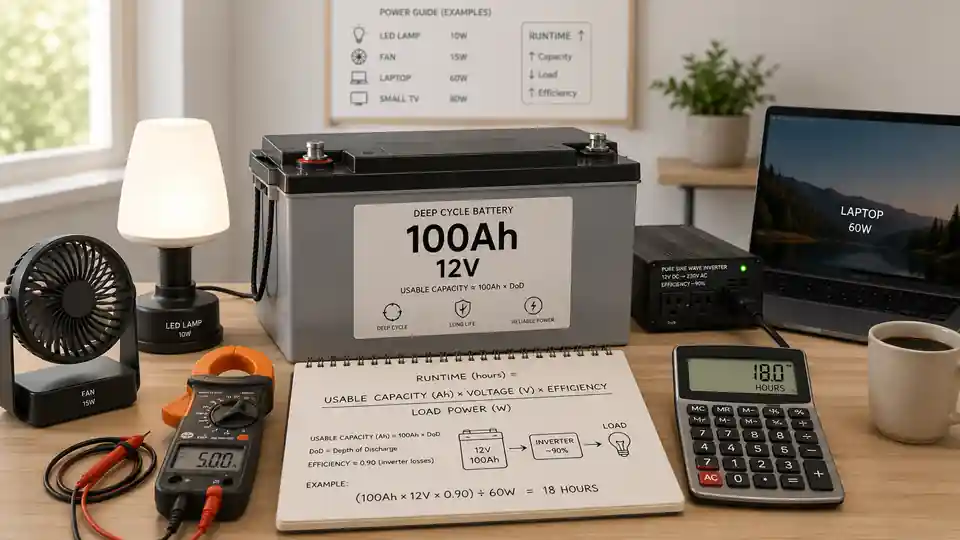
For a practical estimate, start with nominal energy and then reduce it for the portion of capacity you plan to use and for conversion losses.
Runtime in hours = (battery Ah × battery voltage × usable capacity fraction × system efficiency) ÷ average load in watts
- Battery Ah: the rated capacity, such as 100Ah.
- Battery voltage: usually 12V, 24V or 48V.
- Usable capacity fraction: 0.50 means using 50% of the rated capacity; 0.90 means using 90%.
- System efficiency: include inverter or DC-converter losses, for example 0.85 or 0.90.
- Average load: the real average power used by all connected devices, including inverter standby consumption when relevant.
How long will a 12V 100Ah lead-acid battery run a 100W load?
Answer: About 5.1 hours as a planning estimate.
Explanation: Nominal energy: 100Ah × 12V = 1,200Wh. Usable energy at 50% depth of discharge: 1,200Wh × 0.50 = 600Wh. After 85% inverter efficiency: 600Wh × 0.85 = 510Wh. Estimated runtime: 510Wh ÷ 100W = 5.1 hours.
How long will a 12V 100Ah LiFePO4 battery run the same 100W load?
Answer: About 9.7 hours as a planning estimate.
Explanation: Nominal energy: 100Ah × 12V = 1,200Wh. Usable energy at 90% depth of discharge: 1,200Wh × 0.90 = 1,080Wh. After 90% inverter efficiency: 1,080Wh × 0.90 = 972Wh. Estimated runtime: 972Wh ÷ 100W = 9.72 hours.
Quick runtime estimates for a 12V 100Ah battery
The table below compares two common planning assumptions. It is not a promise of actual runtime. High loads, cold conditions, battery wear and voltage cut-off settings can shorten the result.
Estimated runtime by load
| Average load | Lead-acid estimate | LiFePO4 estimate |
|---|---|---|
| 10W | About 51 hours | About 97 hours |
| 50W | About 10.2 hours | About 19.4 hours |
| 100W | About 5.1 hours | About 9.7 hours |
| 300W | About 1.7 hours | About 3.2 hours |
| 500W | About 1.0 hour | About 1.9 hours |
| 1,000W | About 0.5 hour | About 1.0 hour |
Assumptions: 12V nominal voltage; lead-acid at 50% usable capacity and 85% inverter efficiency; LiFePO4 at 90% usable capacity and 90% inverter efficiency. The 1,000W row is especially sensitive to cable size, inverter efficiency, voltage sag, battery discharge limits and battery management system settings.
The same 100Ah battery can give very different runtimes

A small 10–20W load such as a router and network terminal may run for many hours or even several days, while a television or laptop setup usually reduces runtime to several hours.
At 500–1,000W, the same battery may last only around one or two hours—or less—because the load drains stored energy much faster and creates higher current on the battery side.
This is why a useful runtime estimate must include the real average load, battery chemistry, usable depth of discharge and inverter losses rather than relying on the 100Ah label alone.
What can a 100Ah battery run?
A useful estimate starts with the average power of the entire system, not only the label on one appliance. Add every device that will operate at the same time, then include inverter standby draw or conversion losses.
Router and optical network terminal: 20W combined
Answer: A 12V 100Ah LiFePO4 battery could provide roughly 50 hours through an efficient DC setup.
Explanation: Using 90% of a 1,200Wh battery gives 1,080Wh. With about 95% DC conversion efficiency, usable output is around 1,026Wh. Dividing by 20W gives about 51 hours. The actual result depends on the battery's low-voltage cut-off and the converter's own consumption.
Television, streaming device and inverter: 105W total
Answer: A 12V 100Ah LiFePO4 battery could last about 9 hours.
Explanation: Using the 972Wh practical AC-energy estimate, 972Wh ÷ 105W = about 9.3 hours. Screen brightness, television size and inverter standby consumption can noticeably change this result.
Refrigerator averaging 70W over time
Answer: The same LiFePO4 setup could provide roughly 14 hours, provided the inverter can handle compressor startup.
Explanation: 972Wh ÷ 70W = about 13.9 hours. A refrigerator does not draw the same power continuously, so a plug-in energy meter or manufacturer energy-use figure is more useful than the compressor's maximum wattage alone.
Heating appliances, kettles, hair dryers, induction cookers and large power tools can drain a 12V 100Ah battery very quickly. They also create high DC current, so the inverter, battery, protection devices, terminals and cables must all be suitable for the load.
Lead-acid versus LiFePO4 runtime
Why two 100Ah batteries may give very different results
| Factor | Lead-acid battery | LiFePO4 battery |
|---|---|---|
| Common planning depth of discharge | Often around 50% for longer service life | Often around 80–90%, subject to manufacturer limits |
| Voltage under load | Usually drops more as load and discharge increase | Usually remains steadier through much of the discharge |
| High-current performance | Usable capacity may fall more noticeably | Often better, but limited by the BMS and cell rating |
| Weight | Heavier for the same nominal capacity | Usually lighter |
| Cold-weather behaviour | Capacity and voltage can fall in cold conditions | Discharge performance also falls; charging below allowed temperature may be restricted |
The battery label alone is therefore not enough. Check the data sheet for recommended depth of discharge, continuous discharge current, low-voltage cut-off, temperature limits and the conditions used to establish the 100Ah rating.
Seven factors that change the real runtime
- Battery voltage. A 24V 100Ah battery stores twice the nominal energy of a 12V 100Ah battery.
- Usable depth of discharge. Stopping at 50% remaining capacity gives much less runtime than using 80–90% of the rated capacity.
- Inverter efficiency. Efficiency changes with load, and a lightly loaded oversized inverter may waste a noticeable share of the energy.
- Inverter standby draw. A 10–20W idle loss matters greatly when the connected devices use only 20–40W.
- Discharge rate. Lead-acid batteries commonly deliver less usable capacity at high current than their low-rate capacity rating suggests.
- Temperature and battery condition. Cold, age, poor charging history and cell imbalance can all reduce usable energy.
- Load behaviour. Motors, pumps, compressors and power tools may have high startup demand even when their average running power looks modest.
Series and parallel batteries: what changes?
Connecting batteries changes the battery bank rating, but the result depends on the connection method.
Two identical 12V 100Ah batteries
| Connection | Bank rating | Nominal energy | What changes |
|---|---|---|---|
| Series | 24V 100Ah | 2,400Wh | Voltage doubles; amp-hours stay the same |
| Parallel | 12V 200Ah | 2,400Wh | Amp-hours double; voltage stays the same |
Only connect batteries in series or parallel when the battery manufacturer permits it. Batteries should be compatible in chemistry, voltage, capacity, age and state of charge, and the system needs appropriate protection and wiring.
How to make your estimate more realistic
- Measure AC appliances with a plug-in power meter where possible.
- For cycling appliances such as refrigerators, use average energy over several hours rather than a single instant reading.
- Add the inverter's idle consumption to the load.
- Use the efficiency shown for your approximate operating load, not only the inverter's best advertised efficiency.
- Apply the battery manufacturer's recommended usable depth of discharge.
- Check that the battery can supply the required continuous and surge current.
- Keep a reserve instead of planning to reach the cut-off voltage every time.
- Compare the estimate with a real discharge test after the system is installed.
For critical backup power, calculate the expected runtime and then design with additional margin. A system intended to keep communications, medical equipment, heating controls or safety devices running should not depend on a best-case result.
Common calculation mistakes
Mistake, consequence and better approach
| Mistake | Why it causes an error | Better approach |
|---|---|---|
| Dividing 100Ah by appliance watts | Amp-hours and watts are different units | Convert battery capacity to watt-hours first |
| Using all 1,200Wh from a 12V battery | The full nominal capacity is rarely available to the load | Apply depth of discharge and efficiency |
| Ignoring inverter idle draw | Standby consumption can dominate a small load | Add it to the total watts |
| Using only appliance maximum power | Maximum and average power may differ greatly | Measure or estimate average consumption over time |
| Ignoring startup surge | A motor may start at several times its running power | Check inverter surge rating and battery current capability |
| Assuming an old battery still has 100Ah | Capacity falls with age and use | Test the battery or include a capacity-reduction factor |
Use the battery runtime calculator
Enter the battery voltage, rated amp-hours, expected load, usable capacity and conversion efficiency to get an estimated runtime. Try both a normal-load scenario and a worst-case scenario so you can see how sensitive the result is to appliance use and battery limits.
Open the battery runtime calculatorThe calculator gives a planning estimate, not a guaranteed operating time. Always compare the result with the battery, inverter and equipment specifications.
Safety and equipment limits
Battery systems can deliver enough current to overheat cables, damage equipment or start a fire. Use correctly rated fuses or circuit protection, cables, connectors, ventilation and enclosures. Follow the battery and inverter manufacturers' instructions, and use a qualified installer where local rules or the system design require one.
Do not select an inverter only from the average wattage. Confirm continuous power, startup surge, DC input voltage, low-voltage cut-off and the maximum current the battery or its BMS can safely supply. For lead-acid batteries, also consider ventilation and the manufacturer's requirements for charging and placement.
Frequently asked questions
Will a 100Ah battery last 100 hours?
Only under a suitable low-current load and the battery's rated test conditions. For example, a 1A DC load could theoretically approach 100 hours, but conversion losses, cut-off voltage, temperature and battery condition usually reduce the usable time.
How long will a 100Ah battery run a 1,000W inverter load?
A simplified estimate is about 30 minutes for a 12V lead-acid battery used to 50% depth of discharge and about one hour for a 12V LiFePO4 battery used to 90%, after typical inverter losses. Actual runtime may be shorter because a 1,000W load creates very high current on a 12V system.
How long will a 100Ah battery run a refrigerator?
It depends on the refrigerator's average energy use, ambient temperature, door opening, thermostat cycle and compressor startup. A 12V 100Ah LiFePO4 battery may provide roughly 10–15 hours for a refrigerator averaging around 65–95W through an efficient inverter, but measurement is better than relying on a generic appliance rating.
Is a 100Ah battery enough for overnight backup?
It can be enough for light loads such as a router, several LED lamps, phone charging and a laptop. It may not be enough for continuous heating, cooking or other high-power equipment. Add the expected watt-hours for the whole night and compare them with the battery's usable watt-hours.
Does a larger inverter make the battery last longer?
Not by itself. A larger inverter may have higher standby consumption, especially at a very small load. Runtime depends on the actual efficiency curve and idle draw, not only on the inverter's maximum watt rating.
Should I calculate with 12V or the fully charged battery voltage?
For a simple planning calculation, use the battery's nominal system voltage and the rated watt-hours from the manufacturer. Using the fully charged open-circuit voltage can overstate stored energy because voltage changes throughout the discharge.
Final estimate
A 12V 100Ah battery contains about 1,200Wh of nominal energy, but the useful output may be closer to 500–600Wh for a conservatively used lead-acid battery or around 900–1,000Wh for many LiFePO4 setups after typical conversion losses. Divide that usable energy by the real average load to estimate runtime, then reduce the result if the battery is old, cold, heavily loaded or operating near equipment limits.
The most reliable approach is to calculate first, verify every component's limits and then compare the estimate with a measured test under the same load you plan to use.