
In this guide
A battery may run a Wi-Fi router for many hours but struggle to support a kettle, heater or pump for more than a short time. The difference is not only battery size. Runtime also depends on usable capacity, appliance power, inverter losses, startup demand, battery condition and the way the appliance operates.
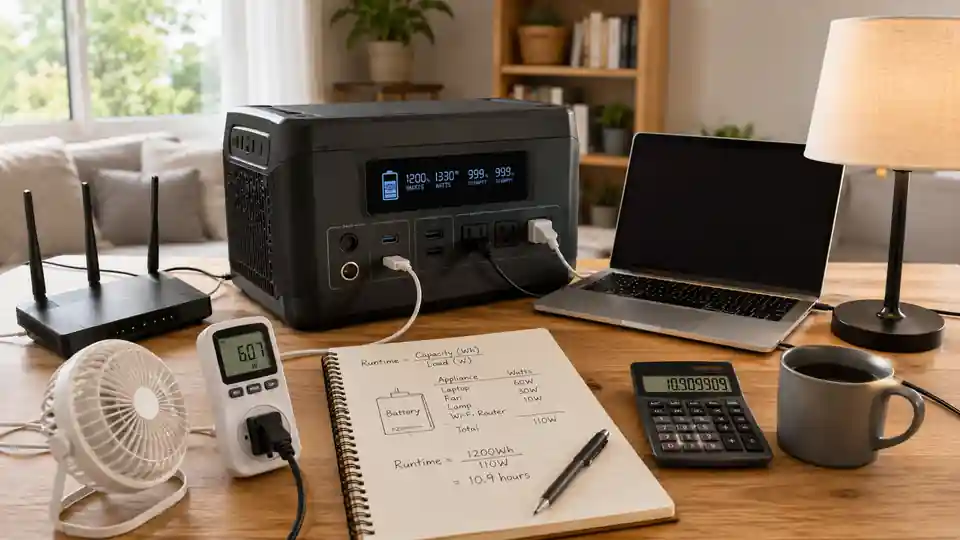
Battery runtime calculations are estimates, not guarantees. Always check the battery, inverter, battery management system and appliance specifications. Electrical, wiring, protection and installation requirements vary by local regulations and applicable codes. Permanent wiring, large battery banks and high-power backup systems should be designed or checked by a qualified specialist.
The short answer: runtime depends on usable energy and total load
Battery runtime is approximately the usable energy available from the battery divided by the total power used by the connected equipment. The result is usually expressed in hours.
Estimated runtime (hours) = usable battery energy (Wh) ÷ total load (W)This simple relationship is the starting point, but usable battery energy is normally lower than the capacity printed on the label. Some energy remains reserved to protect the battery, some is lost in the inverter and cables, and additional power may be consumed by the backup system itself.
Energy capacity and power output are different limits
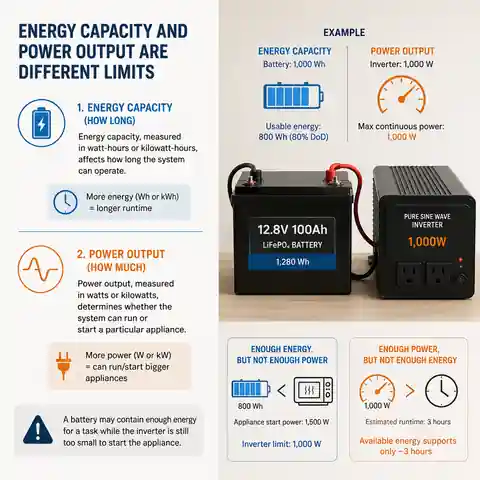
Energy capacity, measured in watt-hours or kilowatt-hours, affects how long the system can operate.
Power output, measured in watts or kilowatts, determines whether the system can run or start a particular appliance.
A battery may contain enough energy for a task while the inverter is still too small to start the appliance.
Five numbers that determine battery runtime
- Battery energy capacity in watt-hours or kilowatt-hours.
- The percentage of that capacity that can be used before the system stops discharging.
- The efficiency of the inverter or power conversion system.
- The combined running power of all connected appliances.
- Any additional system consumption, including inverter idle power, monitoring equipment and control electronics.
What to find before calculating runtime
| Input | Where to find it | Why it matters |
|---|---|---|
| Battery voltage | Battery label or data sheet | Needed when capacity is listed in amp-hours |
| Battery capacity | Label, manual or battery monitor | Shows the nominal amount of stored charge or energy |
| Usable capacity or discharge limit | Battery or BMS documentation | Prevents assuming that all nominal energy is available |
| Appliance running watts | Rating plate, manual or power meter | Sets the main continuous load |
| Startup or surge watts | Manual, manufacturer data or measured result | Helps determine whether the inverter can start the appliance |
| Inverter efficiency and idle consumption | Inverter data sheet | Accounts for energy used before it reaches the appliance |
Step 1: convert battery capacity to watt-hours
If the battery label already gives capacity in Wh or kWh, use that figure as the nominal energy capacity. If it gives voltage and amp-hours, multiply the two values.
Nominal battery energy (Wh) = battery voltage (V) × battery capacity (Ah)

Example:
12 V × 100 Ah = 1,200 Wh
Amp-hours alone do not show the total stored energy. A 100 Ah battery at 12 V contains a different amount of energy from a 100 Ah battery bank at 24 V or 48 V.
Step 2: estimate the usable battery energy
Nominal capacity is the value printed on the battery or power station. Usable capacity is the portion the system allows you to discharge in normal operation. The correct allowance depends on battery chemistry, product design, BMS settings, age, temperature and the manufacturer's recommended discharge limits.
Usable DC energy (Wh) = nominal battery energy (Wh) × usable capacity fraction

Example:
1,024 Wh × 0.85 = 870.4 Wh
Do not automatically apply the same percentage to every battery. A lithium power station with an integrated BMS, a deep-cycle lead-acid battery and a starter battery may have very different recommended operating limits.
Step 3: include inverter and system losses
Most household appliances use AC power, while many batteries store DC energy. The inverter converts DC to AC, and part of the stored energy is lost during that conversion. The inverter may also use power simply by remaining switched on.
Usable AC energy (Wh) = nominal energy × usable capacity fraction × inverter efficiency

More detailed runtime estimate:
Runtime (hours) = usable AC energy ÷ (appliance load + system overhead)
For a direct DC load, such as a compatible router connected through a regulated DC output, the inverter may not be involved. Conversion and cable losses can still occur, so the correct efficiency should come from the actual equipment rather than a universal assumption.
Step 4: calculate the real appliance load
Add the running power of every device that may operate at the same time. Do not add appliances that will never be used together unless you want to calculate the worst-case load.
- Use the input power in watts, not only the useful output of the appliance.
- Include chargers, routers, monitors, pumps, fans and control equipment that remain active.
- Check whether an appliance cycles on and off instead of running continuously.
- Separate normal running power from startup or surge power.
- Use a plug-in power meter when the rating plate does not reflect typical operation.
Measured consumption is more useful than a generic wattage list
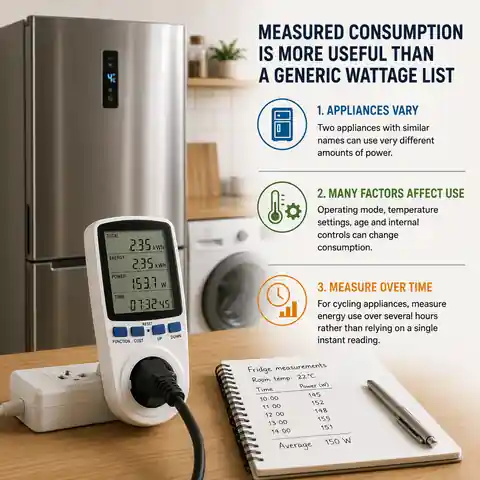
Two appliances with similar names can use very different amounts of power.
Operating mode, temperature settings, age and internal controls can change consumption.
For cycling appliances, measure energy use over several hours rather than relying on a single instant reading.
Worked example: a battery powering several small appliances
How long can a 1,024 Wh battery run appliances drawing 120 W, before inverter and system overhead?
Answer: Assume that 85% of the nominal battery capacity is usable, inverter efficiency is 90%, and the inverter and control system consume another 8 W. Usable AC energy is 1,024 × 0.85 × 0.90 = 783.4 Wh. Total power is 120 + 8 = 128 W. Estimated runtime is 783.4 ÷ 128 = approximately 6.1 hours.
Explanation: The calculation does not divide nominal capacity by appliance watts alone. It first allows for the usable capacity limit, inverter losses and system overhead. The final result is still an estimate because real load and battery performance can change during operation.
How the same usable energy changes with load
| Combined load including system overhead | Estimated runtime from 783 Wh | Practical interpretation |
|---|---|---|
| 40 W | About 19.6 hours | Small continuous electronics |
| 80 W | About 9.8 hours | A moderate essential load |
| 120 W | About 6.5 hours | Several low-power devices |
| 250 W | About 3.1 hours | A larger mixed load |
| 500 W | About 1.6 hours | High continuous demand |
| 800 W | About 1 hour | Very high demand for this battery size |
Reducing a continuous load often extends runtime more effectively than expected. Disconnecting one unnecessary 100 W device can make a major difference when the battery is supporting only a few hundred watts in total.
Why real battery runtime is often shorter than the calculation
Common reasons for a shorter runtime
| Factor | What it changes | What to check |
|---|---|---|
| Battery is not fully charged | Less energy is available at the start | State of charge and charger status |
| Battery ageing | Actual capacity may be lower than the original rating | Battery monitor data, test results or replacement guidance |
| Low temperature | Available capacity and voltage performance may decrease | Permitted operating temperature |
| High discharge rate | Effective capacity may fall, especially with lead-acid batteries | Battery discharge curves and C-rate data |
| Inverter idle consumption | Energy is used even when appliance demand is small | No-load or standby consumption |
| Voltage drop | The inverter or BMS may reach its low-voltage limit earlier | Cable length, cable size and connection quality |
| Cycling or variable loads | A single wattage reading may not represent average demand | Energy use measured over a realistic period |
| Protection limits | The BMS or inverter may stop output before the battery appears empty | Low-voltage, current, temperature and overload settings |
Lead-acid battery capacity is particularly sensitive to discharge rate. When current demand rises, the effective capacity can be lower than the capacity shown at a slower test rate. This behaviour is commonly described using Peukert's law. Lithium batteries are generally less affected, but their permitted current, BMS limits and temperature limits still matter.
Continuous, cycling and startup loads need different treatment
How appliance behaviour changes the estimate
| Load type | Typical behaviour | How to calculate it |
|---|---|---|
| Continuous load | Uses a fairly steady amount of power | Use measured or rated running watts |
| Cycling load | Switches on and off according to temperature or demand | Use average power measured over several cycles |
| Variable load | Changes power with speed, mode or processing demand | Measure typical and worst-case operating modes |
| Startup load | Draws a short power surge when a motor or compressor starts | Use running watts for energy runtime and surge watts for inverter sizing |
A runtime result does not prove that the inverter can start an appliance. Refrigerators, freezers, pumps, compressors and some power tools may require a much higher short-term starting output than their normal running wattage.
How to estimate battery runtime for a refrigerator
A refrigerator does not normally consume its rated running power every minute. The compressor cycles according to room temperature, thermostat settings, door opening, ventilation and the amount of food inside. For a useful estimate, measure energy consumption over several hours and convert it to an average wattage.
A refrigerator averages 65 W over a measured period. How long could 783 Wh of usable AC energy support it?
Answer: Estimated runtime is 783 ÷ 65 = approximately 12 hours.
Explanation: The average already includes periods when the compressor is running and periods when it is off. However, the inverter must still support the compressor's startup surge, and actual cycling may change during a warm day or frequent door opening.
Battery capacity is not the same as inverter capacity
A battery stores energy, while an inverter supplies power at a particular moment. A 2 kWh battery does not automatically mean that any 2 kW appliance can be connected. The inverter, battery, BMS, cables, fuses and connectors must all support the required continuous current and short-term surge.
Energy questions and power questions
| Question | Main value to check |
|---|---|
| How many hours can the appliance run? | Usable energy in Wh or kWh |
| Can the inverter run the appliance continuously? | Continuous inverter output in W |
| Can the appliance start? | Surge output and surge duration |
| Can the battery provide enough current? | Maximum discharge current and BMS limit |
| Can the wiring carry the current? | Cable size, length, protection and connection quality |
What not to do when planning battery backup
- Do not calculate runtime from amp-hours without including battery voltage.
- Do not assume the entire nominal capacity can always be discharged.
- Do not ignore inverter idle power when the appliance load is small.
- Do not use startup watts as the continuous load for the entire runtime calculation.
- Do not use running watts alone to decide whether an inverter can start a motor or compressor.
- Do not bypass the BMS, fuse, breaker, thermal protection or low-voltage protection.
- Do not assume an automotive starter battery is automatically suitable for regular indoor backup use.
- Do not install batteries in an unsuitable enclosure or location without following ventilation, clearance and temperature requirements.
- Do not connect battery banks, inverters or permanent household circuits without the correct protection and professional verification.
When a simple runtime estimate is not enough
A basic calculation is useful for comparing loads and planning essential appliances. More detailed design is needed when the system includes high current, multiple batteries, permanent wiring, automatic changeover equipment, solar charging, heating equipment or appliances with large starting surges.
- The battery bank contains several batteries connected in series or parallel.
- The inverter will be connected to fixed household wiring.
- A pump, compressor, boiler, refrigerator or freezer must start reliably.
- The system will operate unattended.
- Battery charging and discharging may occur at the same time.
- The equipment has medical, safety or critical heating functions.
- The calculated current is close to the battery, BMS, inverter or cable limit.
- The manufacturer's documentation does not provide clear usable-capacity or surge information.
A practical checklist before relying on the result
- Write down every appliance that must operate during an outage.
- Separate essential devices from optional devices.
- Find or measure the running watts of each essential load.
- Identify appliances with motors, compressors or high startup demand.
- Confirm the battery's voltage and nominal capacity.
- Check the permitted usable capacity or discharge limit.
- Check the inverter's continuous output, surge output and idle consumption.
- Include system overhead in the total load.
- Calculate a realistic runtime range rather than one exact promise.
- Test the completed system under controlled conditions before depending on it during an outage.
Frequently asked questions
How long will a 100 Ah battery run a 100 W appliance?
Battery voltage and usable capacity must be known first. A 12 V 100 Ah battery contains 1,200 Wh nominally. With an assumed 80% usable capacity and 90% inverter efficiency, about 864 Wh reaches the AC side. If the appliance uses 100 W and the system uses another 10 W, the estimate is 864 ÷ 110, or about 7.9 hours. With only 50% usable capacity and 85% efficiency, the same nominal battery would provide about 510 Wh, reducing the estimate to approximately 4.6 hours.
Can I calculate battery runtime from amp-hours only?
No. Amp-hours must be combined with battery voltage to estimate watt-hours. You also need an allowance for usable capacity, conversion losses and total appliance power.
Why does the inverter shut down before the battery looks empty?
The inverter or BMS may stop output because of low voltage, excessive current, temperature, overload or another protection limit. Voltage can also fall temporarily under a heavy load, especially with an ageing battery, high resistance connection or undersized cable.
Should I use running watts or starting watts?
Use running or average watts to estimate energy consumption and runtime. Use starting or surge watts to check whether the inverter and battery system can start the appliance without tripping protection.
Does a larger inverter make the battery last longer?
Not by itself. A larger inverter increases available power capacity, but runtime is mainly determined by usable battery energy and load. An oversized inverter may also have higher no-load consumption, although the actual difference depends on the model and operating mode.
How accurate is a battery runtime calculator?
A calculator can provide a useful planning estimate when the inputs are realistic. Accuracy improves when you use measured appliance power, manufacturer-specified usable capacity, inverter efficiency and system overhead. Battery age, temperature, cycling loads, discharge rate and protection settings can still make the real result different.
Plan for a runtime range, not an exact promise
The most useful battery runtime estimate is not a single perfect-looking number. It is a realistic range based on measured load, usable capacity and known system losses. Calculate normal operation, a heavier-load scenario and a reserve margin. This makes it easier to decide which appliances are essential, whether the battery is large enough and where reducing demand can extend backup time.
Calculate how long your battery may run your appliances