
Contents
The right battery backup size is not determined by the size of your home alone. It depends on which appliances must keep running, their combined power demand, the number of backup hours you want, the usable portion of the battery and the output limits of the inverter or UPS. A small system may be enough for internet access, lighting and a laptop, while refrigeration, pumps, heating controls or selected household circuits can require substantially more energy and higher surge capability.
There is no single battery size that is suitable for every home. Start with a defined backup load and outage duration. Then check both energy capacity in watt-hours or kilowatt-hours and output power in watts or kilowatts.
Start with the outage you actually want to cover
Many systems become unnecessarily expensive because the first question is “How large a battery can I buy?” A better first question is “What must continue working when the grid is unavailable?” Separating essential loads from convenient and high-power loads usually gives a more realistic home battery backup plan.
Three common home backup goals
| Backup goal | Typical loads | What usually determines system size |
|---|---|---|
| Basic communication and lighting | Router, fibre terminal or modem, phone charging, several LED lights and a laptop | Low continuous load, required working hours and inverter standby consumption |
| Core household continuity | Basic loads plus refrigeration, heating controls, a circulation pump or selected electronics | Battery energy, compressor or motor starting power and appliance duty cycles |
| Selected circuits or extensive home backup | Several fixed circuits, pumps, cooling, kitchen equipment or most household services | Professional load assessment, inverter output, surge demand, switching, protection and installation design |
A battery intended for a few carefully chosen devices can be sized from a simple appliance list. A system connected to fixed wiring, a distribution board, consumer unit or breaker panel needs a broader electrical review because the backup source must also be integrated and isolated safely.
Build an essential-load list before choosing a battery
Walk through a realistic outage and divide appliances into three groups. This prevents optional equipment from quietly doubling the required battery capacity.
- Must run: communication equipment, essential controls, safety equipment, essential lighting and other genuinely critical loads.
- Useful if capacity allows: laptops, a television, extra lighting, selected kitchen equipment and refrigeration.
- Normally left off a small backup system: electric heaters, kettles, ovens, cooktops, water heaters, clothes dryers, irons, hair dryers and other high-power heating loads.
Create at least two scenarios: a minimum emergency load and a more comfortable load. The difference shows how much extra battery capacity and inverter output are being purchased for convenience rather than necessity.
Battery capacity and inverter power are different
A home backup system must satisfy two separate requirements. The battery must store enough energy for the desired runtime, while the inverter or UPS must deliver enough power at any moment. A system can have plenty of stored energy but still shut down when a motor starts, or it can have a powerful inverter attached to a battery that becomes empty too quickly.
The two ratings you must check
| Rating | Usually shown as | What it answers |
|---|---|---|
| Energy capacity | Wh or kWh | How much electrical energy the battery can store and approximately how long the selected loads may run |
| Continuous output power | W or kW | How much combined running load the system can supply continuously |
| Surge or peak output | W or kW for a stated duration | Whether the system can handle brief starting demand from compressors, pumps and motors |
| Apparent power on some UPS units | VA | A second output rating that must be checked together with the UPS watt rating and power factor |
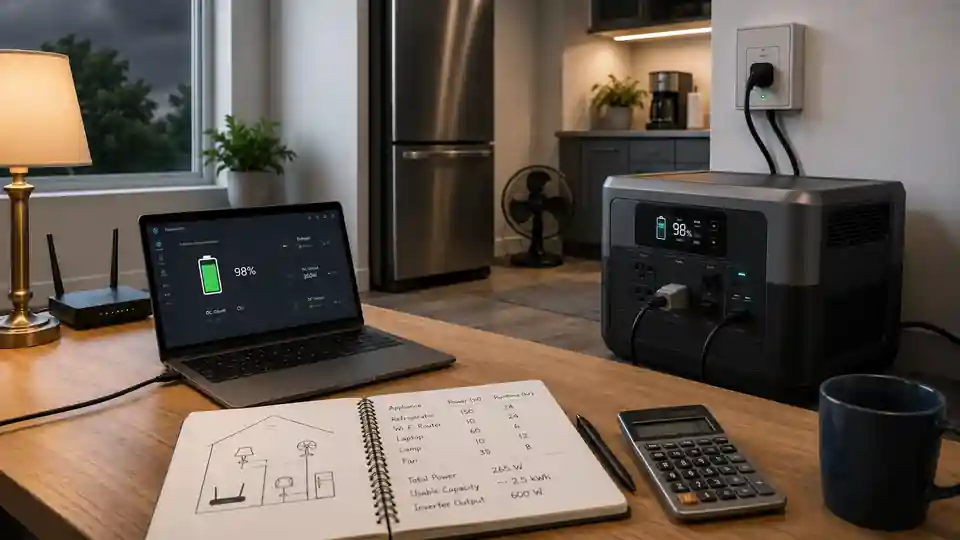
Do not choose a backup system from the battery kilowatt-hour figure alone. Confirm continuous output, surge output, surge duration, battery discharge-current limits and appliance compatibility in the manufacturer specifications.
Step 1: calculate the running load in watts
List every device that may operate at the same time and record its normal running power. Use a reliable power meter where practical. A product label or power adapter can provide a starting value, but it may show maximum input rather than typical consumption.
- Record the running watts for each essential device.
- Include separate network equipment such as a modem, fibre terminal, router and network switch.
- Count only the lights that need to operate during an outage.
- Add the power used by the inverter or UPS itself when that information is available.
- Create a realistic simultaneous-use total rather than adding every appliance in the property.
- Add a planning margin for measurement uncertainty and small future changes.
For a fixed household circuit plan, the total home electrical load and the intended backup load are not the same. The first describes what the installation may demand; the second describes the smaller group of loads you deliberately choose to support during an outage.
Step 2: check starting and surge power
Some appliances briefly draw much more power when a compressor or motor starts than they use while running. This short demand may not add much to the battery energy calculation, but it can determine whether the inverter starts the appliance successfully or trips on overload.
- Refrigerators and freezers
- Water, circulation and drainage pumps
- Air-conditioning equipment
- Power tools
- Some boiler, furnace and heating-system components
- Any appliance with a compressor or electric motor
Do not estimate motor starting power by guessing a universal multiplier. Check the appliance documentation, measure the startup event with suitable equipment or ask a qualified installer to verify compatibility. The inverter must support both the peak level and the required surge duration.
Step 3: choose a realistic backup duration
Battery capacity rises almost in direct proportion to runtime. Supporting a 300 W load for eight hours requires roughly four times the delivered energy needed for the same load for two hours. Decide whether the system must bridge a short interruption, cover an evening, last overnight or support a longer outage with possible recharging.
How runtime goals change the plan
| Runtime goal | Planning question | Useful approach |
|---|---|---|
| Short interruption | Which devices must stay online until power returns or another source starts? | Prioritise communication, controls and a small number of lights |
| Several hours | What will operate continuously and what can be used only occasionally? | Create a schedule so optional loads do not run together |
| Overnight | Will refrigeration, heating controls or pumps cycle while people sleep? | Allow for cycling loads, inverter self-consumption and reduced battery performance |
| A day or longer | How and when can the battery be recharged? | Plan charging from the grid, solar or another approved source instead of relying only on a larger battery |
Step 4: estimate the required battery energy
A useful planning formula is: required nominal battery energy = connected load × backup hours × (1 + planning reserve) ÷ inverter efficiency ÷ usable battery fraction. Enter percentages as decimal values: 15% reserve becomes 0.15, 90% efficiency becomes 0.90 and 80% usable capacity becomes 0.80.
What battery capacity is needed for a 120 W essential load for six hours?
Answer: The devices need 120 × 6 = 720 Wh. Adding a 15% planning reserve gives 828 Wh. With 90% inverter efficiency and 80% usable battery capacity, the required nominal energy is 828 ÷ 0.90 ÷ 0.80 = approximately 1,150 Wh, or 1.15 kWh.
Explanation: The battery must store more energy than the appliances receive because conversion losses and the intentionally unused part of the battery reduce the energy available at the output. The result is a planning estimate and should be rounded up to an available product size after checking its discharge limits.
Illustrative battery sizing scenarios
| Selected continuous load | Target runtime | Assumptions | Approximate nominal battery energy |
|---|---|---|---|
| 130 W | 6 hours | 15% reserve, 90% inverter efficiency, 80% usable capacity | 1.25 kWh |
| 420 W | 8 hours | 15% reserve, 90% inverter efficiency, 80% usable capacity | 5.37 kWh |
| 800 W | 12 hours | 15% reserve, 90% inverter efficiency, 80% usable capacity | 15.33 kWh |
These examples use constant loads to show the sizing method. Real refrigerators, pumps and heating equipment cycle on and off, while inverter efficiency and battery performance change with operating conditions. Use measured consumption or a professionally reviewed load profile for a more reliable design.
Do not confuse nominal capacity with usable energy
Battery labels may show amp-hours, watt-hours or kilowatt-hours. Amp-hours are meaningful only when the battery voltage is also known. Multiplying nominal voltage by amp-hour capacity gives an approximate nominal energy value in watt-hours.
Why voltage matters when comparing amp-hours
| Battery system | Rated capacity | Approximate nominal energy |
|---|---|---|
| 12 V | 100 Ah | 1,200 Wh or 1.2 kWh |
| 24 V | 100 Ah | 2,400 Wh or 2.4 kWh |
| 48 V | 100 Ah | 4,800 Wh or 4.8 kWh |
| 12 V | 200 Ah | 2,400 Wh or 2.4 kWh |
Nominal energy is still not the same as energy delivered to appliances. The usable share may be reduced by the battery management system, the manufacturer's recommended depth of discharge, battery age, temperature, discharge rate, inverter losses, cable losses and low-voltage cut-off settings.
A 100 Ah battery is not a complete description of backup capability. Always pair amp-hours with system voltage and then check usable energy, maximum continuous discharge current and compatibility with the inverter or UPS.
How much inverter or UPS output do you need?
The inverter's continuous watt rating should exceed the highest realistic simultaneous running load, including an appropriate margin. Its surge rating must separately cover brief starting demand. On UPS products, check both watts and volt-amperes because a VA label does not automatically equal the same number of usable watts.
- Continuous output in watts or kilowatts
- Surge or peak output and the time it can be maintained
- Output waveform required by the connected equipment
- Transfer time for devices that must not reboot
- Battery voltage and battery-management compatibility
- Maximum battery discharge current
- Built-in charger output and expected recharge time
- Standby consumption at low load
- Operating temperature, ventilation and installation limits
Sensitive electronics, pumps, compressors and some heating equipment may not operate correctly from every inverter waveform or UPS design. Compatibility should be confirmed from both the appliance and backup-system documentation rather than assumed from wattage alone.
Should you back up a few devices or the whole home?
Backup system scope
| System scope | Main advantage | Main limitation | Typical installation need |
|---|---|---|---|
| Portable backup for individual devices | Simple load control and lower required capacity | Manual connections and limited output | Use according to product instructions without modifying fixed wiring |
| Dedicated backup outlets or selected circuits | Essential loads are easier to manage during an outage | Requires correct switching, circuit selection and protection | Qualified electrical design and installation |
| Extensive or whole-home backup | Greater convenience and automatic operation may be possible | High power, energy and installation requirements | Full load assessment, compliant transfer equipment and professional commissioning |
Trying to run every appliance is often less practical than protecting a defined group of essential circuits. Electric resistance heating and high-power kitchen appliances can consume several times more energy than communication, lighting and small electronics, so even occasional use may change both battery and inverter requirements.
- Electric space heaters
- Electric water heaters
- Kettles, cooktops and ovens
- Washing machines or dishwashers while heating water
- Clothes dryers
- Large air-conditioning systems
- Workshop tools and pumps that have not been checked for surge demand
The most economical sizing improvement is often load reduction. Keeping a 2 kW heating appliance off the backup system can save more battery capacity than removing several lights, a router and a laptop combined.
Does adding solar change the battery size?
Solar generation can extend backup time or recharge a battery during a longer outage, but it does not guarantee that the battery can be smaller. Night-time loads still need stored energy, and daytime charging depends on weather, season, array size, orientation, inverter limits and whether the system is designed to operate when the grid is down.
For a solar-plus-storage plan, calculate the essential overnight requirement first. Then estimate how much energy the solar array may realistically produce and how much charging power the battery can accept. A system that produces enough energy over a full day can still experience a power shortfall if the inverter or battery cannot supply the required peak load.
Estimate home solar generation and battery storage needs with the Home Solar Panel CalculatorBattery chemistry affects usable capacity, charging and service life
Two batteries with the same nominal kilowatt-hour rating may deliver different practical results. Chemistry, battery-management settings, recommended depth of discharge, discharge current, temperature limits and ageing behaviour all affect usable energy and long-term performance. Manufacturer specifications and warranty conditions should take priority over a generic percentage.
Battery specifications to verify
| Specification | Why it matters for sizing |
|---|---|
| Nominal and usable energy | Shows the difference between the label capacity and the energy intended for regular use |
| Continuous and peak discharge power | Determines whether the battery can support the inverter and connected load |
| Recommended depth of discharge | Affects practical runtime, cycle life and warranty conditions |
| Charge power and charging profile | Determines recharge time and charger compatibility |
| Operating temperature range | Capacity and permitted charge or discharge power may change in hot or cold conditions |
| Cycle-life test conditions | Allows a more meaningful comparison between products |
| Battery management system limits | May restrict current, temperature, series or parallel connections and compatible equipment |
Account for recharge time as well as runtime
A battery may be large enough for one outage but still be unsuitable if it cannot recharge before the next one. Approximate recharge time depends on the energy that must be replaced, charger output, charging efficiency, battery-management limits and any household load operating while charging.
Why can a larger battery create a charging problem?
Answer: If several kilowatt-hours must be restored through a relatively small charger, charging can take many hours even before conversion losses and reduced charging power near full state of charge are considered.
Explanation: Runtime and recharge time are linked. Increasing storage without checking charger capacity may leave the system partly charged when another outage begins.
Common home battery sizing mistakes
Mistake, consequence and better approach
| Mistake | What can go wrong | Better approach |
|---|---|---|
| Sizing from home floor area | Two similar homes can have completely different essential loads | Build an appliance and runtime list |
| Using monthly electricity consumption alone | A monthly total does not show simultaneous power or outage priorities | Measure selected backup loads and their operating pattern |
| Comparing amp-hours without voltage | Batteries with the same Ah rating may store very different energy | Convert each option to Wh or kWh |
| Assuming all nominal energy is usable | Runtime is overestimated | Use the product's usable-energy or discharge guidance |
| Ignoring starting power | The inverter may trip when a compressor or pump starts | Verify surge output and appliance starting demand |
| Using average load for inverter sizing | Short periods of high simultaneous demand may exceed output | Size continuous output from the highest realistic simultaneous load |
| Ignoring inverter self-consumption | Small loads may run for less time than expected | Include standby consumption or a conservative margin |
| Assuming solar always recharges the battery | Poor weather or a grid-dependent solar system may provide little or no outage charging | Check off-grid operation, expected generation and charging limits |
| Forgetting recharge time | The system may not recover before the next outage | Compare battery energy with charger power and available charging window |
When a qualified electrician or installer is needed
Portable equipment used exactly as instructed is different from a backup source connected to permanent household wiring. Professional design and installation are important whenever the system supplies fixed sockets, selected circuits or a distribution board.
- The inverter or battery will connect to fixed household wiring.
- Automatic or manual transfer switching is required.
- Several circuits or the main distribution board will be backed up.
- There is any possibility of feeding electricity back toward the utility supply.
- The property has old wiring, uncertain earthing or existing electrical faults.
- Batteries will be connected in series or parallel.
- A high-power inverter or a 24 V or 48 V battery bank is planned.
- The system includes pumps, refrigeration, heating equipment or other significant motor loads.
- Cable size, fusing, isolation, ventilation or enclosure requirements are uncertain.
Never connect an inverter to household wiring with an improvised plug-to-plug cable. An unsafe connection can energise circuits unexpectedly, expose workers or neighbours to backfeed, damage equipment and create a serious shock or fire risk.
Electrical requirements, approved equipment and installation rules vary by location. Use this guide and the HomDera calculators for preliminary planning, then have the final design checked against the battery, inverter and appliance documentation and the electrical rules that apply where the system will be installed.
A practical battery backup sizing worksheet
- Choose the exact devices or circuits that must operate during an outage.
- Record normal running watts and identify cycling loads.
- Find or measure starting power for motors and compressors.
- Decide the minimum and preferred backup duration.
- Add the simultaneous running load and a reasonable planning reserve.
- Calculate required battery energy after usable-capacity and inverter-efficiency allowances.
- Select inverter continuous output above the realistic simultaneous load.
- Confirm surge power, waveform, transfer time and appliance compatibility.
- Check battery discharge-current limits, charger size and recharge time.
- Plan switching, protection, isolation, cables, ventilation and installation with a qualified professional where fixed wiring is involved.
When heating-system controls or a circulation pump are part of the essential load, treat them as a separate operating scenario. Their electrical demand, startup behaviour and required runtime may differ from a general electronics backup plan.
Frequently asked questions
Is a 1 kWh battery enough for a home?
It may be enough for a light emergency load, but it is not normally a whole-home solution. With 80% usable capacity and 90% conversion efficiency, a nominal 1 kWh battery would deliver about 720 Wh to the connected devices before any additional reserve. That is roughly 7.2 hours at 100 W or 2.4 hours at 300 W under simplified constant-load assumptions.
How long will a 5 kWh battery run a house?
There is no single runtime because “a house” is not a fixed load. With 80% usable capacity and 90% conversion efficiency, a nominal 5 kWh battery provides about 3.6 kWh to the loads under simplified assumptions. That could be approximately 12 hours at 300 W, 6 hours at 600 W or 3.6 hours at 1 kW. Surge demand, cycling appliances, temperature, battery condition and inverter consumption can change the result.
What size battery backup is needed for a refrigerator?
Use the refrigerator's measured energy consumption over time rather than relying only on its running watts. The compressor cycles and may require a much higher starting power than its normal operating level. The battery must provide enough energy for the desired hours, while the inverter must separately support compressor startup and the required output waveform.
Should I choose the battery kWh or inverter kW first?
Start by defining the load. The highest simultaneous running and starting demand determines inverter output, while load energy over the chosen number of hours determines battery capacity. The two components must then be checked together for voltage, current and manufacturer compatibility.
Can a portable power station supply a whole home?
Some units can support several portable loads, but supplying permanent household circuits is a separate installation task. Do not improvise a connection to the home's wiring. Whole-home or selected-circuit operation requires suitable transfer equipment, isolation, protective devices and professional verification.
How much spare capacity should I add?
There is no universal percentage. A planning margin can cover measurement uncertainty, inverter consumption, minor load growth and normal performance variation, but it does not replace a surge-power check or the manufacturer's usable-capacity guidance. Larger uncertainty, ageing allowance or critical loads may justify a more conservative design.
Is a larger battery always better?
Not automatically. A larger battery can extend runtime, but it may cost more, take longer to recharge, require higher fault-current protection and exceed the compatibility limits of the charger or inverter. The best size is the one that supports the defined loads and runtime with an appropriate margin and a safe, compatible installation.
The practical answer
To choose a home battery backup, first total the watts of the appliances that must operate together, check any motor or compressor starting demand, and decide how many hours they need to run. Convert that requirement into nominal battery energy after allowing for usable capacity, inverter efficiency and a planning margin. Then select an inverter or UPS that can support both continuous and surge power. Use calculator results as a preliminary comparison, not as a substitute for product specifications or professional electrical design.