
The most expensive home you can qualify to buy is not necessarily the most expensive home you can comfortably afford. A lender looks at whether a mortgage meets its lending rules. Your household has a wider job: paying for the purchase, keeping enough cash after completion, handling the monthly housing costs and still having room for repairs, bills, savings and ordinary life.
Quick answer: a realistic home-buying budget has to pass four tests at the same time — enough cash upfront, a monthly housing cost that fits your real budget, a mortgage amount a lender is willing to approve, and enough financial resilience left after the purchase.

In this guide
This guide is for general planning, not individual mortgage, financial, tax or legal advice. Mortgage products, lender criteria, taxes, insurance requirements and transaction costs differ by location and can change. Check current lender documents and the official rules that apply where you are buying before committing money.
The price you can borrow is not the price you can comfortably afford
It is tempting to begin with a property listing and work backwards: find the price, ask how much a lender might provide and then try to make the rest of the budget fit. A safer approach runs in the opposite direction. Start with the household finances, determine what can be spent upfront and each month, protect the money that must remain untouched, and only then convert those limits into a realistic property price range.
The four affordability ceilings
| Ceiling | What limits it | What goes wrong if you ignore it |
|---|---|---|
| Upfront cash ceiling | Savings available after protecting reserves and paying purchase costs | You can reach completion but have too little cash left for moving, repairs or emergencies |
| Monthly budget ceiling | Mortgage payment plus the real ongoing cost of owning the property | The home fits on paper but crowds out normal bills, savings and other goals |
| Lender ceiling | The mortgage amount and terms a lender is prepared to offer | Your personal budget may support a plan that the lender will not finance |
| Resilience ceiling | How well the budget survives higher costs, repairs or a temporary income shock | One ordinary setback turns the mortgage into a financial emergency |
Your real maximum is the lowest ceiling
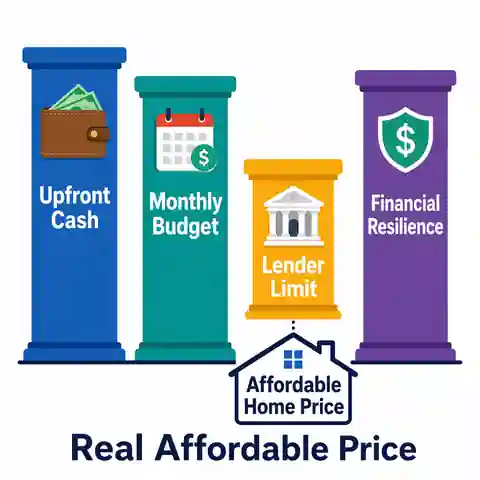
A buyer may have enough income for a large mortgage but not enough cash for the purchase costs and a sensible reserve.
Another buyer may have substantial savings but prefer a lower monthly payment because childcare, travel, debt repayment or irregular income uses part of the household budget.
The useful price range is the one that passes all four tests, not the largest number produced by any single test.
Start with cash, not the listing price
Your savings are not automatically the amount you should apply to the property price. Some of that money may need to pay transaction costs, moving expenses, immediate work and a cash reserve. If every available dollar or pound is committed to the purchase, even a perfectly affordable mortgage can leave the household financially exposed.
- Add the cash and savings that are genuinely available for the purchase.
- Remove money reserved for taxes, legal or settlement costs, surveys or inspections, lender fees and other transaction expenses.
- Remove expected moving costs and the money needed for essential work soon after moving in.
- Protect an emergency reserve instead of assuming that future income will rebuild it immediately.
- The amount left is the maximum cash contribution you can safely consider applying to the purchase price.
- Compare several contribution levels rather than automatically using the maximum.
A larger upfront contribution can reduce the mortgage, but using every last unit of cash to make the loan smaller can be a false economy if you then need expensive borrowing for repairs, furniture or an emergency.
Upfront buying costs: what leaves your savings before you get the keys
The purchase price and the cash applied directly to it are only two parts of the amount needed before moving day. The exact list depends on the country, state or nation, property type, lender and transaction, but the planning categories are surprisingly similar.
Upfront costs to plan before choosing a price range
| Cost group | What it may include | Why it matters |
|---|---|---|
| Cash applied to the purchase price | Your own money reducing the amount financed | Changes the mortgage size and often the loan-to-value position |
| Mortgage and lender costs | Application, arrangement, origination, valuation or other lender-related charges where applicable | Some are paid upfront; others may be added to the loan and cost interest |
| Property checks | Inspection, survey, appraisal, specialist reports or additional investigations | Can reveal risks that affect the purchase decision or future repair budget |
| Legal and ownership transfer | Legal work, conveyancing, title work, registration or settlement services | Required processes differ substantially by jurisdiction |
| Taxes and government charges | Transaction taxes, recording charges and other location-specific costs | Can be material and may depend on buyer status or number of properties owned |
| Insurance and prepaid items | Home insurance and, in some transactions, prepaid taxes, interest or other amounts | May be required before or at completion |
| Moving and immediate setup | Removals, utility setup, locks, basic furniture and essential repairs | These costs arrive immediately after the purchase |
| Protected reserve | Cash deliberately left unspent | Keeps a routine repair from becoming new high-cost debt |
If you are buying in the US
For a US purchase, use US terminology and actual figures from your Loan Estimate, local tax information and insurance quotes. Think of the upfront budget as more than the down payment. Closing costs, inspections, appraisal and title-related items can all draw from the same cash you planned to bring to the purchase.
US home-buying costs to check
| Item | What to look for | Budget question |
|---|---|---|
| Down payment | The cash portion of the purchase price | How much can you put down without draining your reserve? |
| Closing costs | Lender charges, appraisal, title-related costs, government fees, prepaid items and other transaction charges | What does the Loan Estimate show as estimated cash to close? |
| Home inspection | General inspection and any specialist inspections you choose or need | Would a major finding change the price, repair budget or decision to buy? |
| Property taxes | Local tax estimate and whether amounts are collected through escrow | What is the realistic annual and monthly cost for this specific property? |
| Homeowners insurance | Coverage and premium for the property | Does the actual quote fit the monthly budget? |
| Mortgage insurance | May apply to some loans, including many conventional loans with a smaller down payment | Is it included in the payment estimate, and when can it change or end? |
| HOA or condo dues | Regular association charges and possible special assessments | Are dues separate from the mortgage payment, and could they rise? |
| Immediate repairs and moving | Work needed before or soon after occupancy | How much cash must remain available after closing? |
US upfront cash: separate the down payment from the rest

The down payment reduces the amount borrowed, while closing costs and other purchase expenses consume cash without reducing the home price.
Use the Loan Estimate and property-specific quotes as the purchase becomes real.
Keep moving, immediate repairs and the post-closing reserve visible instead of letting them disappear into the down-payment target.
For US planning, the Consumer Financial Protection Bureau currently suggests estimating typical closing costs at roughly 2% to 5% of the purchase price, excluding the down payment. Treat that as an early planning range only: the actual Loan Estimate and property-specific costs are what matter before you commit.
US worked example: how savings become a real down payment
A buyer is considering a $450,000 home and has $120,000 in available savings. How much of that can safely become the down payment?
Answer: In one illustrative plan, protecting $25,000 as an emergency reserve, keeping $7,000 for moving and immediate work, and budgeting $13,500 for closing costs leaves $74,500 for the down payment. That would mean a mortgage of about $375,500 before any financed fees.
Explanation: The calculation is $120,000 - $25,000 - $7,000 - $13,500 = $74,500. The $13,500 closing-cost assumption is 3% of the purchase price and is used only to demonstrate the method. A real buyer should replace it with the current Loan Estimate and local figures.
If you are buying in the UK
For a UK purchase, build the budget using the deposit, mortgage costs, survey, conveyancing, property tax for the nation where you are buying, insurance, moving costs and any property-specific ongoing charges. Do not import US closing-cost assumptions into a UK budget; the process, taxes and fee structure are different.
UK home-buying costs to check
| Item | What to look for | Budget question |
|---|---|---|
| Deposit | The cash portion of the purchase price | How much can you use without exhausting the money needed after completion? |
| Mortgage fees | Product, arrangement, booking, valuation or adviser fees where applicable | Which fees are paid upfront and which are added to the mortgage? |
| Survey | The level of survey appropriate for the property and any specialist checks | Could the building condition create a large early repair bill? |
| Conveyancing and legal costs | Solicitor or licensed conveyancer fees, searches and registration-related costs | Is the quote complete and does it include expected disbursements? |
| Property transaction tax | The tax system that applies where the property is located and your buyer circumstances | What does the current official calculator show for this exact purchase? |
| Buildings insurance | Cover required for the property and lender conditions where applicable | What is the real premium for this home? |
| Council Tax | The council tax band and local charge | What will the ongoing household budget need to absorb? |
| Service or estate charges | Leasehold service charges or other recurring estate charges where applicable | Are there planned major works or charges that could materially change the budget? |
| Moving and immediate repairs | Removal costs, locks, essential furniture and early work | How much cash needs to survive the purchase? |
UK upfront cash: build the deposit around the real purchase costs
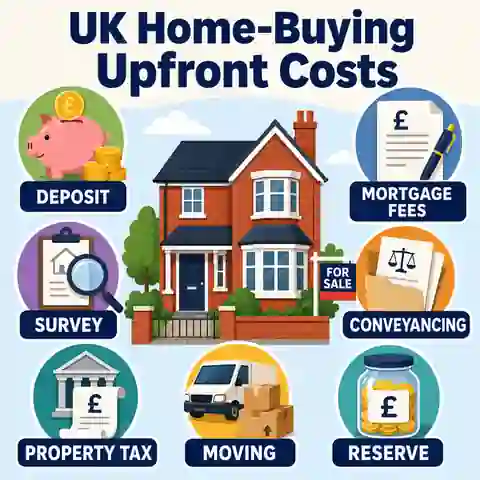
The deposit is only one use of your savings. Mortgage fees, survey, conveyancing, the correct national property tax and moving costs can all compete for the same cash.
Use the official tax calculator for the nation where the property is located rather than copying a figure from another part of the UK.
Keep a separate reserve for the first months of ownership and any work identified by the survey.
UK property transaction tax is not one UK-wide calculation. Stamp Duty Land Tax applies in England and Northern Ireland, Land Transaction Tax applies in Wales, and Land and Buildings Transaction Tax applies in Scotland. Buyer status and the property can change the result, so use the current official calculator for the nation where you are buying.
UK worked example: keep the tax as a real input, not a guess
A buyer is considering a £325,000 home and has £70,000 in savings. How can the maximum deposit be estimated before making an offer?
Answer: Suppose the buyer protects £15,000 as an emergency reserve, keeps £4,000 for moving and essential early work, budgets £3,500 for mortgage, survey and legal costs, and the official tax calculator for the buyer's nation and circumstances returns £3,750. The remaining £43,750 could be considered for the deposit, giving an illustrative mortgage of £281,250.
Explanation: The calculation is £70,000 - £15,000 - £4,000 - £3,500 - £3,750 = £43,750. The £3,750 tax figure is deliberately hypothetical; replace it with the current official result for England, Northern Ireland, Wales or Scotland before relying on the calculation.
Monthly affordability starts with the household budget
The monthly mortgage repayment is the largest housing cost for many buyers, but it is not the whole housing budget. Build the monthly number from the property outward: mortgage first, then the recurring costs that belong to that home, then a realistic maintenance allowance, and finally the amount you still need for the rest of life.
What belongs in the monthly housing budget
| Cost area | US buyer | UK buyer |
|---|---|---|
| Mortgage | Principal and interest, plus any mortgage insurance or escrowed items shown in the loan documents | Mortgage repayment plus any recurring mortgage-related charge that applies to the product |
| Local property charge | Property taxes, whether escrowed or paid separately | Council Tax |
| Insurance | Homeowners insurance and any additional cover required for the property | Buildings insurance and any additional cover chosen or required |
| Shared-property or estate costs | HOA or condo dues where applicable | Service charges, estate charges or similar recurring property costs where applicable |
| Utilities | Electricity, gas, water, sewer, internet and other household services | Electricity, gas, water, broadband and other household services |
| Maintenance and repairs | Routine upkeep plus money for larger repairs over time | Routine upkeep plus money for larger repairs over time |
| Other property-specific costs | Flood, hazard or location-specific costs where relevant | Leasehold, freehold-estate or location-specific costs where relevant |
Turn the mortgage payment into a full housing payment
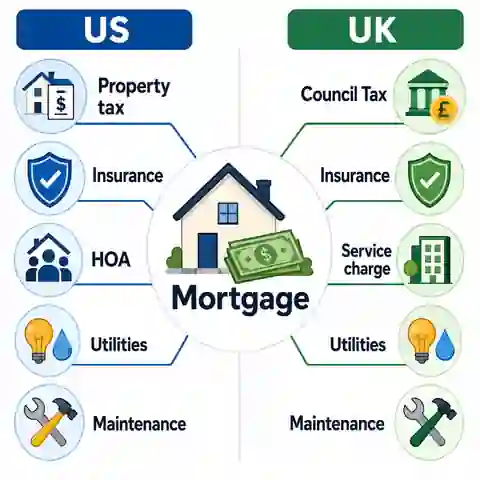
Start with the mortgage repayment, then add every recurring cost tied to the property.
Use actual local figures for taxes or Council Tax, insurance and shared-property charges wherever possible.
The number that matters is what remains for the rest of the household after the complete housing cost is paid.
Do not compare the mortgage repayment with your current rent and call the difference affordable. Ownership can add taxes or council charges, insurance, association or service charges, maintenance and repairs that a rent comparison may not capture.
Interest rate and mortgage term can move the monthly payment dramatically
A property price does not produce one universal mortgage payment. The amount borrowed, interest rate, repayment term and loan structure all matter. Longer terms usually reduce the scheduled monthly repayment but increase the time over which interest can be paid. A lower rate can change affordability substantially, but it should not be treated as permanent unless the product actually guarantees it for the period you are budgeting.
US illustration: what is the principal-and-interest payment on a $375,500 mortgage at 6.0% over 30 years?
Answer: About $2,251 per month for principal and interest.
Explanation: This is a mathematical example, not a current mortgage quote. The real monthly housing cost would also need to include property taxes, homeowners insurance, mortgage insurance if applicable, HOA or condo dues where relevant, utilities and maintenance.
UK illustration: what is the repayment on a £281,250 mortgage at 5.0% over 25 years?
Answer: About £1,644 per month for a standard repayment mortgage in this simplified example.
Explanation: This is an illustrative rate and term, not a recommendation or current market offer. Add Council Tax, buildings insurance, service or estate charges where relevant, utilities and maintenance to build the real monthly housing budget.
Run an affordability stress test before you make the offer
A budget that works only when every assumption stays perfect is not a comfortable budget. Before settling on a property price, deliberately make the scenario worse. The purpose is not to predict disaster; it is to find out whether ordinary financial pressure still leaves the household functioning.
- What if one income is temporarily reduced or irregular work produces a weaker month?
- What if insurance, property tax, Council Tax or service charges rise?
- What if a mortgage rate can change later, or a future refinance or remortgage is available only at a higher rate?
- What if the first year includes an urgent repair that costs several thousand dollars or pounds?
- What if childcare, commuting, healthcare, vehicle or family costs increase?
- Can you still save for emergencies, retirement, pensions or other long-term goals?
- After all housing costs, is there still unallocated monthly room rather than a budget that reaches exactly zero?
A simple affordability traffic-light test
| Position | What the budget looks like | What to do |
|---|---|---|
| Comfortable | Regular housing costs fit with visible room for saving, repairs and normal changes | Keep checking the property-specific costs and lender terms |
| Stretched | The budget works, but a repair or moderate cost increase would require cutting important spending | Reduce the price, increase the cash buffer or reconsider the mortgage structure |
| Fragile | The plan needs overtime, bonuses, perfect spending discipline or use of the emergency fund for routine ownership | Treat the property as above the comfortable budget until the assumptions improve |
Test the budget before the house tests it
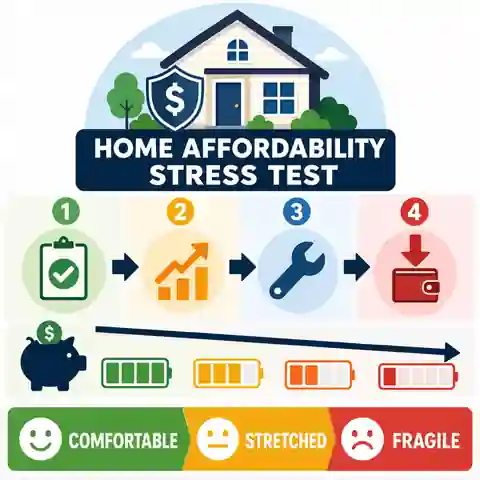
Change one assumption at a time: income, rate, insurance, property charges or repair spending.
Watch the remaining monthly buffer, not only whether the mortgage payment can technically still be made.
A home that stays manageable in a slightly worse scenario is usually a healthier target than one that requires every month to go exactly to plan.
Your lender has a ceiling. Your household needs its own.
In the US, prequalification or preapproval can be useful for understanding what a lender may be willing to finance, but it is not a personal spending target. Lenders assess the information and rules relevant to the loan; they do not decide how much you want to preserve for travel, education, retirement, future children, career changes or a larger emergency fund.
In the UK, an agreement or decision in principle and a lender's affordability assessment serve a similar planning purpose: they help establish what may be borrowable under that lender's criteria. The lender may consider income, outgoings, credit commitments and its own stress tests, but the household still needs to decide what payment level feels sustainable alongside its wider plans.
Treat lender approval as one boundary, not as permission to spend to the boundary. A comfortable purchase price can be lower than the maximum amount available.
Do not spend every dollar or pound on completion day
Cash left after the purchase has a different job from the cash used to buy the property. It pays for the things the mortgage cannot solve quickly: a failed appliance, an insurance excess or deductible, an urgent plumbing repair, a move that costs more than planned, or a period when income is temporarily lower.
- Keep a general emergency reserve that is not already promised to furniture or decoration.
- Create a separate line for known work required soon after moving in.
- Do not count available credit-card limits as the emergency reserve.
- If the property is older or has known defects, increase the repair planning rather than assuming the inspection or survey found everything.
- If income is variable, consider holding a larger cash buffer than a household with very stable income.
- If the purchase leaves almost no cash after completion, reduce the property price or the amount committed upfront before assuming the budget is safe.
A home can be affordable on day one and expensive by year two
Affordability should include the property itself, not only the financing. Two homes with the same purchase price can create very different long-term budgets because of age, energy use, insurance, local taxes or charges, shared-property fees and upcoming maintenance.
Costs that can separate two equally priced homes
| Property feature | Possible budget effect | What to investigate before buying |
|---|---|---|
| Older roof, heating or cooling system | Higher probability of a large repair or replacement | Age, condition, service history and replacement estimate |
| Poor energy performance | Higher electricity or heating bills | Recent utility information and property efficiency |
| High local property tax or Council Tax | Higher fixed household cost | Actual local charge for the property |
| HOA, condo, service or estate charges | Recurring cost that sits outside the basic mortgage repayment | Current fee, reserve position, planned works and recent changes where information is available |
| Insurance-sensitive location | Higher premium or additional cover | Real insurance quote before committing |
| Large garden, pool or complex exterior | More routine maintenance and equipment | Annual upkeep, contractor cost and your own time |
| Immediate renovation need | Cash spending soon after purchase | Prioritised repair and renovation budget |
| Long commute | Higher transport cost and time | Real weekly commuting cost, parking and travel pattern |
Compare the total monthly life of two homes, not just their prices
Suppose two properties are listed at the same price. One has lower taxes or Council Tax, modest energy use and no major work expected. The other has a lower quoted insurance premium but a large shared-property charge and an ageing heating system. The purchase prices are equal, but the financial experience of owning them is not.
Property comparison worksheet
| Cost | Home A | Home B |
|---|---|---|
| Purchase price | Enter actual price | Enter actual price |
| Cash needed upfront | Enter full completion amount | Enter full completion amount |
| Mortgage repayment | Enter lender scenario | Enter lender scenario |
| Property tax or Council Tax | Enter actual local figure | Enter actual local figure |
| Insurance | Enter real quote | Enter real quote |
| HOA / condo / service / estate charges | Enter if applicable | Enter if applicable |
| Utilities | Estimate from property and local information | Estimate from property and local information |
| Maintenance reserve | Estimate by condition and systems | Estimate by condition and systems |
| Known first-year work | Enter priority amount | Enter priority amount |
| Monthly buffer after all household spending | Calculate | Calculate |
What to change when the home you want is above budget
If the preferred property fails one of the four affordability ceilings, do not force the numbers by deleting realistic costs. Change the plan instead. The best lever depends on whether the problem is upfront cash, monthly payment, lender approval or resilience.
- Lower the target purchase price.
- Delay the purchase while building more savings and a separate reserve.
- Compare mortgage offers and structures using the same loan amount and realistic term.
- Use a larger upfront contribution only if sufficient cash remains after all purchase costs and reserves.
- Choose a property with lower recurring charges or less immediate repair work.
- Reduce optional post-purchase renovation rather than pretending essential repairs will not happen.
- Revisit other large household commitments only if doing so genuinely improves the long-term budget.
- Walk away when the price works only under optimistic assumptions.
Do not make an unaffordable home look affordable by excluding real costs, using a best-case future rate, assuming bonuses are guaranteed or spending the emergency reserve twice — once on paper and once again when something breaks.
Build your home-affordability worksheet in this order
- Write down reliable monthly household take-home income and note any variable or uncertain portion separately.
- Record all non-housing spending, debt payments and regular savings goals using real recent figures.
- Set the monthly buffer you want to keep after ordinary spending.
- Estimate the full recurring cost of the target property, not only the mortgage repayment.
- Determine the mortgage payment that fits inside the remaining monthly housing budget.
- List all cash available for the purchase.
- Subtract purchase costs, moving costs, immediate essential work and the reserve that must remain untouched.
- Use the remaining cash and affordable mortgage amount to build a property price range.
- Check that the range also fits lender criteria.
- Stress-test the range with higher costs or lower income.
- Repeat the calculation for the actual property before making the final commitment.
Minimum numbers to collect before making an offer
| Number | Where to get it | Do not substitute |
|---|---|---|
| Reliable household income | Recent income records and realistic expected earnings | Best-ever month or hoped-for overtime |
| Regular spending | Bank and card history plus known upcoming commitments | A rounded guess that excludes irregular bills |
| Mortgage scenario | Lender quote or calculator using the planned loan, rate and term | The lowest advertised payment with different assumptions |
| Purchase costs | Lender documents, legal or settlement quotes and official tax tools | One generic percentage for every location |
| Property charges | Local authority, tax records, association or property documents | What a similar home costs elsewhere |
| Insurance | Property-specific quote | A national average |
| Immediate work | Inspection, survey, contractor estimate or priority allowance | Zero because the work is not decorative |
| Emergency reserve | A deliberate household decision | Whatever happens to be left |
Frequently asked questions
How much house can I afford?
The useful answer is the lowest price limit produced by four tests: the cash you can safely spend upfront, the monthly housing cost your budget can carry, the mortgage amount a lender will actually offer, and the amount that still leaves enough resilience for repairs, emergencies and other goals. A lender's maximum alone is not a complete affordability calculation.
Should I buy at the maximum amount a lender approves?
Not automatically. Approval shows what may fit the lender's criteria, not what best fits your household priorities. Compare the full monthly housing cost with your real spending, savings targets and expected future commitments before choosing the property price.
How much cash do I need upfront in the US?
Plan for the down payment plus closing costs and other cash needs such as inspections, moving and immediate work. The CFPB currently gives 2% to 5% of purchase price as a typical early estimate for closing costs excluding the down payment, but your Loan Estimate, location, loan type and property determine the real figure.
How much cash do I need upfront in the UK?
Plan for the deposit, mortgage-related fees, survey, conveyancing, the property transaction tax that applies in the nation where you are buying, insurance, moving costs and cash for immediate work. The exact total depends on the property, lender, buyer status and whether the purchase is in England, Northern Ireland, Wales or Scotland.
Is a bigger down payment or deposit always better?
A larger cash contribution reduces the mortgage and may improve available loan pricing or terms, but it is not automatically better if it empties the household reserve. Compare the mortgage benefit with the value of keeping accessible cash for completion costs, repairs and emergencies.
Should I include maintenance when calculating affordability?
Yes. Maintenance is irregular rather than optional. The amount should reflect the age, condition and complexity of the property instead of relying on one universal percentage. Known defects should have their own estimate rather than being hidden inside a generic maintenance allowance.
What if the mortgage payment is affordable but the upfront cash is not?
Then the property is not yet affordable under the current purchase plan. Reducing or borrowing transaction-cost money can create additional debt or leave too little reserve. Rework the price, timing, savings target or mortgage structure before treating the monthly payment as proof that the purchase fits.
How often should I recalculate my home-buying budget?
Recalculate when the target property changes, the mortgage rate or term changes, you receive a real insurance quote, transaction costs become clearer, income or debt changes, or an inspection or survey identifies work. The budget should become more property-specific as you move from browsing to making an offer and then to completion.
The practical answer
A realistic home price is not discovered by applying one income multiple or accepting the largest mortgage number offered. Start with the household budget, protect the cash that must remain after the purchase, include every recurring ownership cost and determine the mortgage payment that still leaves room for normal life.
For a US purchase, replace generic estimates with the Loan Estimate, property-tax information, insurance quote and property-specific association costs. For a UK purchase, replace them with the actual mortgage fees, survey and conveyancing costs, the correct national property-tax calculation, Council Tax and any service or estate charges. The method is shared; the local inputs stay local.
The best affordability result is not the largest home the spreadsheet can force into the numbers. It is the price range that still looks reasonable after the excitement of the viewing has worn off, the first full month of bills has arrived and the house has begun behaving like a real house.
Explore HomDera finance guides for home buying, renovation and construction budgets