
In this guide
Buying too little paint can interrupt the job and make it harder to achieve an even finish. Buying far too much wastes money and leaves you with containers that may never be used. A useful estimate starts with the actual wall area, the number of coats and the coverage stated for the specific paint.
This guide explains how to calculate the amount of wall paint needed for a rectangular room, how to account for doors and windows, and why the final quantity may differ from a simple mathematical result.
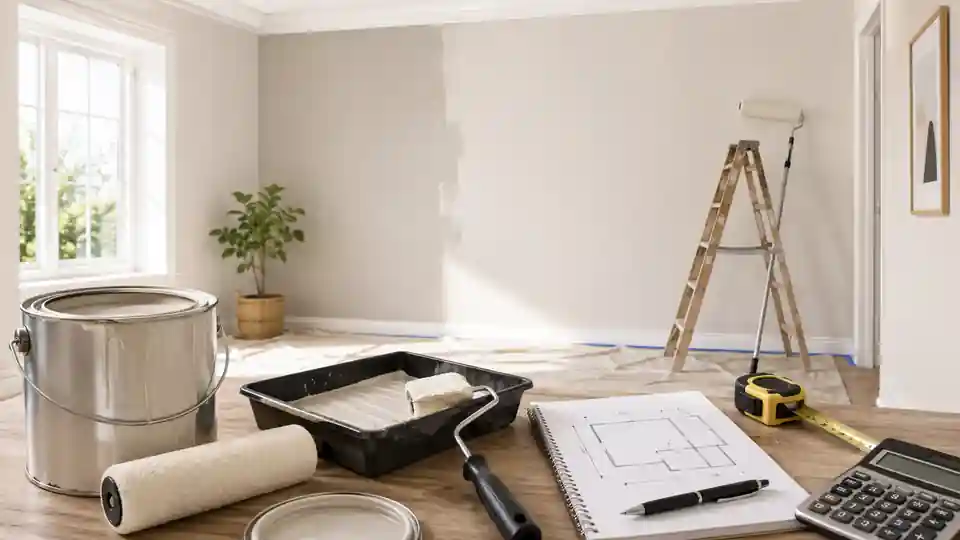
The basic calculation is: paintable area × number of coats ÷ coverage per litre or gallon. Always use the coverage figure printed on the product label rather than relying only on a general average.
What you need to know before calculating paint
You do not need a detailed building plan, but you do need consistent measurements. For a normal rectangular room, measure the room length, width and wall height. Then note any large areas that will not be painted.
Measurements used in a room paint estimate
| Input | What to measure | Why it matters |
|---|---|---|
| Room length | The length of the longer walls | Used to calculate the room perimeter |
| Room width | The length of the shorter walls | Used to calculate the room perimeter |
| Wall height | From the finished floor to the ceiling | Converts the perimeter into total wall area |
| Doors and windows | Width multiplied by height | Can be deducted from the wall area |
| Number of coats | Usually based on the product and surface condition | Two coats require roughly twice the calculated coverage area |
| Paint coverage | The value printed on the paint container or technical sheet | Shows how much surface one litre or gallon is expected to cover |
Keep all measurements in one system. Use metres with square metres and litres, or feet with square feet and gallons. Mixing units is one of the easiest ways to produce a wrong result.
The basic formula for calculating room paint
For the most useful estimate, first calculate the total wall area. Subtract the area of large doors and windows, multiply the remaining area by the planned number of coats, and divide the result by the coverage of the chosen paint.
Paintable wall area = total wall area − doors and windows

Total coating area = paintable wall area × number of coats

Paint required = total coating area ÷ paint coverage
Coverage may be shown as square metres per litre (m²/L), square feet per US gallon (ft²/US gal), or another unit specified by the manufacturer. A US gallon and an Imperial gallon are different volumes, so always use the exact unit printed on the product label and keep the surface area and coverage units consistent.
Shortcut for a rectangular room
Instead of measuring all four walls separately, you can calculate the room perimeter and multiply it by the wall height. This works when opposite walls have the same length and the ceiling height is reasonably consistent.
Room perimeter = 2 × (length + width)

Total wall area = room perimeter × wall height
Example: paint needed for a 4 m by 3.5 m room
A room is 4 m long, 3.5 m wide and 2.5 m high. It has one door measuring 0.9 m × 2 m and one window measuring 1.6 m × 1.5 m. The walls need two coats, and the selected paint covers 12 m² per litre. How much paint is required?
Answer: Room perimeter: 2 × (4 + 3.5) = 15 m. Total wall area: 15 × 2.5 = 37.5 m². Door area: 0.9 × 2 = 1.8 m². Window area: 1.6 × 1.5 = 2.4 m². Paintable wall area: 37.5 − 1.8 − 2.4 = 33.3 m². Area for two coats: 33.3 × 2 = 66.6 m². Paint required: 66.6 ÷ 12 = 5.55 L, which is approximately 1.47 US gal or 1.22 Imperial gal.
Explanation: The mathematical result is 5.55 L, but paint is sold in fixed container sizes. In practice, the buyer should round up to a suitable available combination, such as 6 L or the closest larger pack size, while also considering the surface condition.
The example uses a coverage rate of 12 m²/L only to demonstrate the calculation. Your product may have a different stated rate, so the number on the container should take priority.
Three ways to estimate paint, from quick to detailed
Not every project needs the same level of precision. A quick estimate may be enough during early budgeting, while a detailed estimate is more useful immediately before buying paint.
Choosing the right level of calculation
| Method | How it works | Best used for | Main limitation |
|---|---|---|---|
| Quick estimate | Calculate all wall area and do not subtract openings | Early budgeting or a room with few openings | May slightly overestimate the quantity |
| Standard estimate | Subtract major doors and windows, then apply coats and coverage | Most bedrooms, living rooms and offices | Does not fully reflect texture or surface absorbency |
| Detailed estimate | Calculate each surface separately and use product-specific coverage | Rooms with several colours, feature walls or different surfaces | Takes more measurements and planning |
Should you subtract doors and windows?
Subtracting large unpainted openings gives a more accurate result, but it is not always necessary to deduct every small area. Leaving a small opening in the calculation can create a modest allowance for roller loading, minor spills and later touch-ups.
- Subtract large windows, wide door openings, built-in wardrobes and full-height wall panels that will not be painted.
- Do not subtract an opening if its frame, reveal or surrounding trim will use the same paint.
- For a quick estimate, you may leave one standard door or a small window in the calculation rather than creating a separate allowance.
- If several openings occupy a large part of the room, measure them individually instead of using a rough deduction.
How many coats of paint should you include?
The number of coats can change the result more than any other input. One coat may refresh a clean wall in a similar shade, but two finish coats are commonly planned when the colour changes, the existing finish is uneven or a more consistent appearance is required.
Situations that affect the number of coats
| Surface or project | What may be needed | What to check |
|---|---|---|
| Previously painted wall in a similar shade | One or two finish coats | Existing colour, marks and the paint manufacturer's instructions |
| Dark wall changing to a light shade | Primer or undercoat plus finish coats | Whether the existing colour still shows through |
| New plaster, drywall or another porous surface | A suitable primer or sealer before the finish paint | Surface preparation requirements for the specific material |
| Patched or repaired wall | Primer on repaired areas and enough finish coats for an even result | Differences in absorbency and texture |
| Feature wall in a strong colour | Potentially more than one coat | Product opacity and the colour underneath |
Primer and finish paint are separate quantities. Do not count a primer coat as one of the finish coats unless the product instructions specifically describe a different system.
Why actual paint coverage can differ from the label
A coverage rate is a planning figure, not a guarantee for every wall. Two rooms with the same dimensions may use different amounts of paint because the surfaces and application methods are different.
- Rough, textured or heavily repaired walls usually hold more paint than smooth sealed surfaces.
- Fresh plaster, unprimed drywall and other porous materials can absorb part of the first coat.
- A large change from a dark colour to a light one may require additional preparation or coating.
- Some paints have higher opacity than others even when their stated coverage is similar.
- Roller pile, brush technique and spray overspray can affect material use.
- Uneven wall height, recesses, columns and alcoves add area that a simple room formula may miss.
- Painting several small sections can create more tool and container losses than painting one uninterrupted wall.
Before buying, inspect the walls in daylight. Texture, repairs, stains and bare patches often reveal that the job needs primer or additional paint even when the room dimensions have not changed.
Calculate walls, ceilings and trim separately
A room may use several different products. Wall paint should not automatically include the ceiling, doors, skirting boards, baseboards or window trim because these surfaces may need different finishes, colours and coverage rates.
- For the ceiling, multiply room length by room width and calculate its paint separately.
- For one feature wall, calculate only that wall's width multiplied by its height.
- For doors, measure the painted faces and check whether both sides are included.
- For trim, use total linear length and the average painted width, or follow the product's own estimator.
- If different wall colours are planned, divide the room into separate paint areas before calculating.
How much extra paint should you buy?
There is no single waste percentage that suits every project. For a smooth, prepared room with accurate measurements, rounding up to the next practical container size may be enough. A rough or highly absorbent wall needs a more cautious allowance, while a very large automatic percentage can leave unnecessary surplus.
When choosing between pack sizes, compare the calculated requirement with the available containers. A result of 5.55 L cannot be purchased exactly, so the practical question is whether to buy a combination close to 6 L or a larger container that also leaves enough paint for later repairs.
A small amount of correctly stored leftover paint can be useful for touch-ups. Record the brand, product, finish, colour name or code and batch information before putting the container away.
Common mistakes when estimating room paint
- Using floor area as if it were wall area.
- Forgetting to multiply the surface area by the number of coats.
- Using a general coverage average instead of the figure for the selected product.
- Subtracting doors and windows before checking whether their frames or reveals will also be painted.
- Including the ceiling in the wall paint quantity without calculating it separately.
- Ignoring alcoves, columns, chimney breasts or sloped wall sections.
- Assuming new plaster or repaired drywall will use the same amount as a sealed painted wall.
- Rounding the calculation down because the difference appears small.
- Mixing metres with feet or litres with gallons.
- Buying paint before confirming the final colour plan and the surfaces assigned to each product.
A practical checklist before buying paint
- Measure the room length, width and wall height.
- Calculate the total wall area or measure each wall separately.
- Subtract major surfaces that will not be painted.
- Decide whether the ceiling, trim and doors need separate products.
- Confirm the planned number of primer and finish coats.
- Read the coverage rate for the exact paint product.
- Adjust the estimate for rough, porous or heavily repaired surfaces.
- Round up to a sensible available container size.
- Keep the calculation and paint details for future touch-ups.
Paint is only one part of a room project. If you are also planning preparation, flooring, electrical work or other renovation tasks, estimate those costs separately rather than treating the paint quantity as the full room budget.
Estimate the wider project budget with the HomDera Room Renovation Estimate CalculatorFrequently asked questions
Can I calculate wall paint from the floor area?
Answer: Not accurately. Floor area shows the size of the room footprint, while wall area depends on the room perimeter and wall height.
Explanation: Two rooms can have the same floor area but different shapes. A long narrow room normally has more wall area than a square room with the same floor area.
Does one container of paint cover one room?
Answer: There is no reliable one-container-per-room rule. The result depends on room dimensions, wall height, openings, coats, container volume and product coverage.
Explanation: A small room with rough walls and two coats may use more paint than a larger room with smooth walls and one coat.
Should I subtract every door and window?
Answer: Subtract large unpainted areas when you want a more precise estimate. For a quick calculation, leaving a small opening in the total can act as a modest allowance.
Explanation: The best approach depends on how much of the room is occupied by openings and how accurately you need to match the available container sizes.
Can I use the same formula for a ceiling?
Answer: Yes, but calculate the ceiling separately. For a rectangular ceiling, multiply the room length by the room width, then apply the number of coats and the ceiling paint coverage.
Explanation: Ceiling paint may have a different coverage rate and finish from the product used on the walls.
What should I do if the calculated amount falls between container sizes?
Answer: Round up to the most practical available size or combination of sizes. Do not round down if it creates a realistic risk of running out during the final coat.
Explanation: Stopping partway through a wall can make it harder to maintain a consistent finish, especially when the replacement paint comes from a different batch.
The final answer is an estimate, not just a formula
To estimate how much paint you need for a room, calculate the paintable wall area, multiply it by the number of coats and divide by the coverage of the chosen product. Then adjust the result for the real condition of the walls and the container sizes available to buy.
Accurate measurements reduce waste, but the most reliable plan also considers preparation, absorbency, colour changes and application method. Use the calculated amount as a purchasing guide and check the product instructions before starting the work.
HomDera calculations provide a planning estimate. Actual paint use may vary because of product formulation, wall condition, preparation quality, application method and the number of coats required for an even finish.