
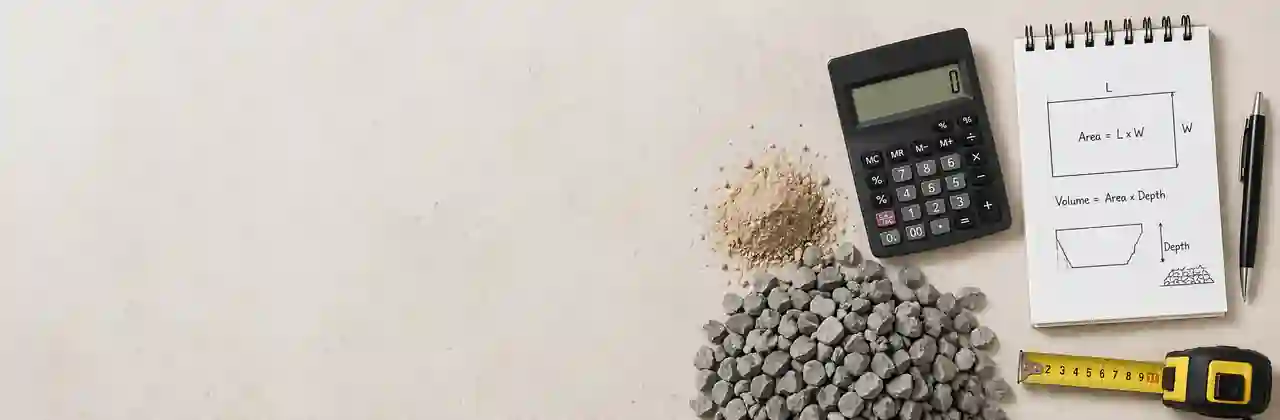
Start with the finished layer, not the delivery unit
Suppliers may sell aggregate by cubic metre, cubic yard, metric tonne, US short ton, bag or truck load. The calculator avoids choosing one too early: it first finds the finished layer volume, then applies compaction and handling allowances before converting the order into each practical purchasing quantity.
“Gravel”, “road base”, “crusher run”, “Type 1”, “crushed rock” and “blue metal” are not interchangeable specifications. Regional names can describe products with different grading, fines and bulk density.
The three decisions that control the result
Before entering a price
| Decision | What the calculator needs | Why it matters |
|---|---|---|
| Area | Length and width, diameter, or a known area | This defines the horizontal coverage. |
| Finished depth | The layer remaining after spreading | Depth changes volume directly and should not include several different layers together. |
| Material category | The closest aggregate preset or a supplier density | Density converts bulk volume into delivery weight. |
Compaction, waste, bag size, load capacity and price stay inside Advanced settings so a normal estimate does not require a long form.
Regional names: match the product, not only the label
Common market language
| Region or market | Names you may see | What to confirm |
|---|---|---|
| United States and Canada | crusher run, quarry process, road base, pea gravel, river rock, clean stone | Whether the quoted ton is a US short ton or a metric tonne, plus the stated density or coverage. |
| United Kingdom and Ireland | Type 1 sub-base, scalpings, gravel, shingle, chippings, clean stone | Whether the product is sold by bulk bag, loose tonne or cubic quantity. |
| Australia and New Zealand | road base, crushed rock, blue metal, screenings, drainage aggregate | Compacted density, particle size and whether the rate is per tonne or cubic metre. |
| International product data | crushed stone, graded aggregate, drainage gravel, decorative stone | The exact grading, moisture condition and loose bulk density. |
A familiar product name is useful for searching, but the supplier specification is the better input for ordering.
How area and depth become an order quantity
- Calculate the project area from the selected shape.
- Multiply area by finished depth to obtain the geometric placed volume.
- Add the selected percentage for compaction or settlement.
- Add a separate allowance for base unevenness, handling and measurement uncertainty.
- Multiply order volume by bulk density to estimate weight.
- Round bags and delivery loads up to complete purchasable quantities.
Compacted gravel is not the same as loose-delivered gravel
A compactable base contains a range of particle sizes that can rearrange under moisture and mechanical force. Clean drainage stone behaves differently because it contains fewer fines and normally retains more open voids. The calculator therefore treats compaction as an editable extra-order percentage rather than pretending that one universal factor fits every aggregate.
Planning allowance examples
| Project condition | Possible starting allowance | Do not assume |
|---|---|---|
| Decorative cover with little mechanical compaction | 0–5% | That a thin layer will fully hide an uneven substrate. |
| Path, patio base or ordinary landscape preparation | 5–10% | That the supplier’s loose volume equals the final compacted volume. |
| Driveway or base course compacted in lifts | 10–20% | That percentage alone verifies structural performance. |
Density is the bridge between yards and tons
Bulk density is the mass of a loose bulk material per unit volume, including the voids between particles. It changes with rock type, grading, fines, moisture and handling. Presets are useful for an initial estimate; a supplier’s value for the exact stock item should replace them before a large order.
The calculator keeps metric tonnes and US short tons distinct. One metric tonne is 1,000 kg; one US short ton is 2,000 lb.
Choose the result that matches the quote
Buying route
| Supplier quote | Use this calculator result | Extra questions |
|---|---|---|
| Per cubic metre | Bulk volume to order in m³ | Minimum volume, delivery rounding and whether the measure is loose or compacted. |
| Per cubic yard | Bulk volume to order in yd³ | Whether the yardage is loaded by bucket, bin or stated conversion. |
| Per metric tonne | Estimated order weight in tonnes | Scale-ticket minimums and delivery payload. |
| Per US short ton | Estimated order weight in short tons | Whether local “tons” are definitely 2,000 lb. |
| Per bag | Full bags to buy | Exact bag weight and pallet quantities. |
| Per load | Estimated delivery loads | Payload, body volume, access and partial-load charges. |
Worked example: a compacted crushed-stone layer
A 12 m by 3 m area at a finished depth of 50 mm has a geometric volume of 1.8 m³. Adding 10% for compaction and 5% for unevenness and handling produces an order of about 2.08 m³. At 1,600 kg/m³, that is approximately 3.33 metric tonnes or 3.67 US short tons. With 20 kg bags, the rounded quantity is 167 bags.
This example explains the calculation sequence. It is not a fixed coverage rule for every crushed-stone product.
When one project needs more than one calculation
- The sub-base and surface layer use different products.
- Part of the site has a different finished depth.
- A drainage trench and a flat surface are being filled.
- Some material is delivered loose and some is purchased in bags.
- You want to compare a per-tonne quote with a per-yard quote without mixing the units.
Small-order checks that prevent expensive delivery errors
- Confirm the product grading and whether fines are included.
- Ask which ton or tonne the quote uses.
- Check minimum order, part-load and delivery charges.
- Confirm the vehicle payload and whether site access limits the load.
- Allow a safe, suitable unloading location.
- For compacted work, confirm the maximum recommended lift thickness.
Questions people ask before ordering
Is this a gravel tonnage calculator or a cubic-yard calculator?
It is both. Geometry produces the bulk volume, and density converts that volume into weight. Switch units to view cubic metres and tonnes or cubic yards and US short tons.
Can I use it as a crushed-stone bag calculator?
Yes. Enter the package weight in Advanced settings. The calculator divides the estimated order weight by the bag weight and rounds up to complete bags.
Does it calculate driveway design depth?
No. It calculates material from the depth you enter. Subgrade condition, drainage, traffic, frost, local practice and structural design determine the required layer build-up.
How should I measure an irregular garden or path?
Split the site into simple shapes and add the areas, or obtain the total area from a plan. Then choose the known-area input. Calculate zones separately when their depth differs.
What the estimate does not replace
This is a purchasing estimate, not a road, drainage or foundation design. It does not verify bearing capacity, local codes, frost protection, slope, geotextile requirements or the supplier’s actual loaded density.