

What the apartment electrical load calculator estimates
This apartment electrical load calculator provides an initial estimate of how much power your household appliances may require when several of them are operating at the same time. It adds the connected wattage, applies an estimated simultaneous-use percentage, includes an optional planning margin and converts the resulting load into approximate current in amps.
The result is particularly useful when planning a kitchen renovation, installing an electric water heater, adding air conditioning, replacing gas appliances with electric alternatives or reviewing whether the existing electrical supply has enough capacity for new equipment.
- Estimate the total connected wattage of household appliances
- Model a more realistic simultaneous-use scenario
- Convert the estimated load into approximate current in amps
- Compare the result with the main breaker rating
- See whether there appears to be capacity for additional appliances
- Identify situations that should be reviewed by a qualified electrician
This calculator does not select a breaker, determine a safe cable size or verify the condition of an electrical installation. Wiring, protective devices, earthing or grounding, supply capacity and circuit design must be assessed by a qualified electrician in accordance with local requirements.
Why electrical load should be reviewed before renovation
Renovation often increases electrical demand without making the change immediately obvious. An older kitchen may have used only a refrigerator, kettle and small oven. A renovated kitchen may add an induction hob, full-size oven, dishwasher, microwave, coffee machine and several countertop appliances.
Bathrooms and living areas can also gain new loads such as an electric water heater, tumble dryer, heated floor, air conditioner, portable heater or home office equipment. Each device may be acceptable on its own, while several operating together can approach or exceed the available supply capacity.
Appliances that can significantly increase household electrical demand
| Appliance or area | Why it matters | What should be checked |
|---|---|---|
| Electric oven or hob | Heating elements can require several kilowatts | The appliance may require a dedicated circuit and suitable connection |
| Electric water heater | It can operate for long periods at a steady load | Cable capacity, breaker protection and earthing or grounding |
| Washing machine or dryer | Water and air heating can create a much higher load than standby operation | Whether other high-power appliances share the same circuit |
| Air conditioner | Compressors may have operating and starting characteristics not shown by a simple wattage total | Manufacturer data, circuit design and possible starting current |
| Portable electric heater | It can place a continuous high load on an outlet circuit | Outlet condition, extension lead use and circuit capacity |
| Kitchen outlets | Several heating appliances are often used within a short period | How the sockets are divided between circuits |
Information required for the calculation
For an initial estimate, enter the supply voltage, the current rating of the main breaker and the approximate wattage of the appliance groups in the home. Appliance power can usually be found on a rating plate, product label, instruction manual or manufacturer specification page.
Use the rated input power rather than guessing from the physical size of an appliance. Where a product lists several operating modes, use the value that best represents the highest realistic household use.
What estimated simultaneous use means
Adding the rated power of every appliance produces the connected load, but most homes do not operate every device at maximum power at exactly the same moment. The simultaneous-use percentage provides a simple way to model a more realistic household scenario.
For example, a setting of 70% means that the calculator uses 70% of the total connected wattage when estimating the simultaneous load. This percentage is a planning assumption, not an engineering diversity calculation and not a replacement for circuit-by-circuit design.
Example simultaneous-use settings
| Setting | Possible use | Important limitation |
|---|---|---|
| 50–60% | A home where high-power appliances are rarely used together | May underestimate demand if household routines change |
| 70% | A general starting point for an initial comparison | Should not be treated as a universal standard |
| 80–90% | A home with several electric cooking, heating or hot-water appliances | Still depends on which appliances can actually operate together |
| 100% | A full connected-load stress check | Assumes every entered load operates at the same time |
How the electrical load estimate is calculated
The calculator first adds the wattage entered for lighting and each appliance group. It then applies the simultaneous-use percentage and the selected planning margin. For the final current estimate, the calculated power is divided by the entered supply voltage.
- Add the wattage of all entered appliance groups
- Convert the total from watts to kilowatts
- Apply the estimated simultaneous-use percentage
- Add the selected planning margin
- Divide the resulting wattage by the supply voltage
- Display the approximate current in amps
- Compare the current and power estimate with the main breaker rating
The current calculation is a simplified single-phase estimate. Motors, compressors, electronic power supplies, reactive loads, starting current, three-phase systems and equipment-specific characteristics may require a different engineering assessment.
How to understand the results
The results should be reviewed together rather than as one isolated number. Connected load describes all appliances entered in the form. Estimated simultaneous load applies the usage assumption. Load including the planning margin shows a more cautious scenario, while estimated current allows a basic comparison with the main breaker rating.
Meaning of each calculator result
| Result | What it represents | How to use it |
|---|---|---|
| Connected load | The combined rated power of all entered appliances | Shows the overall scale of the equipment included |
| Estimated simultaneous load | Connected load after applying the simultaneous-use percentage | Provides a practical planning scenario |
| Load including planning margin | Estimated simultaneous load with the selected extra percentage | Allows for uncertainty and possible future additions |
| Estimated current | Approximate current based on power and voltage | Can be compared with the main breaker rating as an initial check |
| Approximate main breaker capacity | Voltage multiplied by the breaker current rating | Shows a simplified theoretical power comparison |
| Breaker capacity used | The calculated load expressed as a percentage of the approximate breaker capacity | Helps identify whether the estimate is comfortably below or close to the limit |
| Estimated remaining capacity | The difference between approximate breaker capacity and calculated load | A small or negative result indicates that professional review is advisable |
Worked example: oven, water heater and everyday appliances
What happens if the entered appliances total 11 kW, simultaneous use is set to 70%, the planning margin is 15%, and the main breaker is rated at 25 A?
Answer: The connected load is 11,000 W, or 11 kW. Applying 70% gives an estimated simultaneous load of 7.7 kW. Adding a 15% margin increases the estimate to approximately 8.86 kW. At 230 V, the simplified current estimate is about 38.5 A. A 25 A breaker at 230 V represents an approximate theoretical capacity of 5.75 kW.
Explanation: The result does not mean that every appliance must be removed. It shows that the selected simultaneous-use scenario is above the simplified breaker comparison. Appliance schedules, dedicated circuits, supply capacity and the existing installation should therefore be reviewed by an electrician.
Why kitchens commonly create high electrical demand
Why can a kitchen circuit trip even when appliances elsewhere in the home appear to work normally?
Answer: A kettle, toaster, microwave, coffee machine, dishwasher and electric oven may operate at overlapping times. Several of these appliances use electric heating elements, so their combined demand can rise quickly even though each product appears ordinary when considered alone.
Explanation: The total household load and the load on an individual branch circuit are different questions. The main breaker may appear adequate while one kitchen circuit is overloaded. This calculator compares the overall supply and cannot diagnose individual circuits.
Review the load before finishes are installed
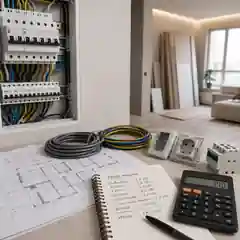
Renovation frequently adds appliances that were not part of the original electrical plan, including electric ovens, water heaters, air conditioners and heated floors.
Checking likely demand before decorating can reveal whether additional circuits, panel work or a supply review may be needed.
Changes to concealed wiring are generally easier to plan before walls, tiles, flooring and fitted furniture are completed.
Why a larger breaker is not an automatic solution
A breaker is intended to protect wiring and connected equipment under defined conditions. Replacing it with a higher rating without checking the cable, terminals, installation method and permitted supply can remove an important layer of protection.
An electrical problem may also be caused by a damaged outlet, loose connection, overloaded branch circuit, poor termination or ageing wiring rather than the main breaker itself. A simple total-load estimate cannot identify these conditions.
- Breaker ratings must be coordinated with cable capacity and installation conditions
- A cable or connection can overheat even when the main breaker does not trip
- High-power appliances may require dedicated circuits
- Wet areas usually require appropriate additional protection
- Old wiring should be inspected before major loads are added
- Increasing the available supply may require approval from a utility, building manager or other local authority
Common household electrical planning mistakes
- Planning only the number of outlets without listing the appliances they will supply
- Placing most kitchen appliances on one existing circuit
- Forgetting electric water heating, space heating or heated floors
- Using extension leads as a permanent solution for high-power equipment
- Assuming the main breaker rating confirms that all internal wiring is suitable
- Ordering appliances before checking their electrical requirements
- Ignoring motor starting current or manufacturer connection instructions
- Leaving no practical capacity for future equipment
When an electrician should inspect the installation
Professional inspection is appropriate whenever the calculation is close to the apparent supply limit, major appliances are being added or the condition of the existing installation is uncertain. An electrician can assess the wiring, distribution panel, protective devices, earthing or grounding, circuit arrangement and actual supply conditions.
- The home is being rewired or circuits are being altered
- An electric hob, oven, water heater, air conditioner or heated floor is being installed
- Breakers trip repeatedly
- Outlets or plugs become warm, spark or smell burnt
- The wiring is old or its material and condition are unknown
- New circuits or distribution-panel work are required
- The household wants to increase the available electrical supply
- The calculated load is close to or above the simplified breaker capacity
The most practical time to review wiring and circuit requirements is before final wall finishes, fitted cabinets, tiles and flooring make changes more disruptive.
How to use the estimate in a renovation plan
After calculating the load, identify which appliance groups contribute the most wattage. A kitchen, electric water heater or space-heating system may account for much of the estimate. These areas deserve separate discussion when circuits and protective devices are being planned.
- Check that all important fixed and portable appliances have been included
- Review the connected and simultaneous load values
- Compare the estimated current with the main breaker rating
- Test more than one simultaneous-use scenario
- Consider likely future appliances
- Prepare a list of the largest loads for the electrician
- Do not change wiring or protective devices based only on the calculator result
Frequently asked questions
Does a 25 A breaker always provide 5.75 kW?
Multiplying 25 A by 230 V gives 5.75 kW as a simplified single-phase comparison. Real installations are affected by supply voltage, load characteristics, circuit design, local rules and the condition of the equipment. The figure should not be treated as a guaranteed continuous usable capacity.
Does this calculator check individual outlet circuits?
No. It estimates the combined household load and compares it with the main breaker. One branch circuit can still be overloaded even when the total household estimate remains below the main-breaker comparison.
Should appliance standby power be included?
For supply-capacity planning, the appliance's operating input is usually more relevant than standby consumption. Devices with heating elements, compressors or motors should be entered using an appropriate operating or maximum rated value from the manufacturer.
Summary
The apartment electrical load calculator provides a practical first look at household wattage, simultaneous demand, current in amps and approximate main-breaker capacity. It can improve renovation planning and help identify questions that should be resolved before new appliances are installed. The calculation remains an estimate: safe electrical design also depends on cables, circuits, connections, protective devices, supply arrangements and local electrical requirements.