

What the floor screed calculator estimates
This floor screed calculator estimates how much material may be required to create a level base before installing tile, laminate, engineered flooring or another finish. Enter the floor area, average screed thickness, product consumption rate, bag weight and an allowance for unevenness or material loss.
The result includes the theoretical screed volume, an adjusted volume with the selected allowance, the estimated total weight of dry mix and the number of full bags to purchase. This makes the tool useful for early material planning, delivery estimates and comparisons between different screed products.
- Calculate the floor area covered by screed
- Estimate screed volume from the average layer thickness
- Add an allowance for unevenness, handling loss and measurement uncertainty
- Estimate the total weight of factory-produced dry mix
- Convert the required weight into full bags
- Compare how a thicker or thinner layer changes the material quantity
The calculator provides a material estimate rather than an installation specification. The correct screed type, minimum thickness, reinforcement, substrate preparation and drying conditions depend on the product and the floor construction.
Measurements and product information you need
For a useful estimate, you need the total floor area and the average thickness of the planned screed. You should also check the manufacturer's stated consumption rate and the weight of one bag. Product data is important because different cement-based, rapid-setting and self-levelling mixes can require different quantities for the same area and depth.
Main floor screed calculator fields
| Field | What it means | What to check |
|---|---|---|
| Floor area | The total surface that will receive the screed | Divide irregular rooms into simple shapes and add their areas together |
| Average screed thickness | The estimated average depth across the floor | The highest and lowest points may require different local depths |
| Material allowance | Extra material for unevenness, loss and measuring uncertainty | A visibly uneven substrate may require a larger allowance than a flat prepared base |
| Dry mix consumption rate | The quantity of dry product required for a stated area and reference thickness | Use the value printed on the technical sheet or product packaging |
| Bag weight | The net weight of one bag of dry mix | Common bag sizes vary by manufacturer and market |
Use the consumption figure for the exact product you plan to buy. Two screed mixes can have similar descriptions but different densities, aggregate sizes and stated coverage rates.
Why average screed thickness matters
Material quantity changes directly with screed thickness. A 50 mm layer requires roughly twice the volume of a 25 mm layer across the same floor area. Even a small thickness change can therefore add several bags when the room is large.
Do not use an average thickness that falls outside the manufacturer's permitted range. Applying a product too thinly or too deeply can affect strength, drying, cracking and adhesion.
How the screed calculation works
The calculator converts the selected layer thickness into the required base unit and multiplies it by the floor area. This produces the theoretical volume of a uniform screed layer. The selected allowance is then added to account for unevenness, loss and minor measurement differences.
Dry mix weight is calculated separately from the product consumption rate. The calculator adjusts the reference consumption to the selected thickness and floor area, applies the allowance and divides the final weight by the bag size. The number of bags is rounded up because partial bags cannot normally be ordered.
- Multiply floor area by average screed thickness to estimate volume.
- Apply the selected allowance to the theoretical volume.
- Scale the manufacturer's consumption rate to the chosen layer thickness.
- Multiply the adjusted rate by the total floor area.
- Apply the same material allowance to the dry mix quantity.
- Divide the required dry mix weight by the weight of one bag.
- Round the result up to the next full bag.
Worked floor screed example
How much dry mix is required for a 20 m² floor with an average screed thickness of 50 mm?
Answer: A 20 m² floor at an average thickness of 50 mm has a theoretical screed volume of 1.0 m³. With a 10% allowance, the adjusted volume is approximately 1.1 m³. If the selected dry mix uses 18 kg per m² for every 10 mm of thickness, the calculated requirement is about 1,980 kg including the allowance. With 25 kg bags, this rounds up to 80 full bags.
Explanation: The example shows why thickness must be included in the estimate. At 50 mm, the product consumption is five times the stated consumption for a 10 mm reference layer.
The volume result and the dry mix weight describe the same project in different ways. Volume is useful for understanding the size of the pour, while dry mix weight and bag count are more useful when ordering packaged material.
A small thickness change can add many bags
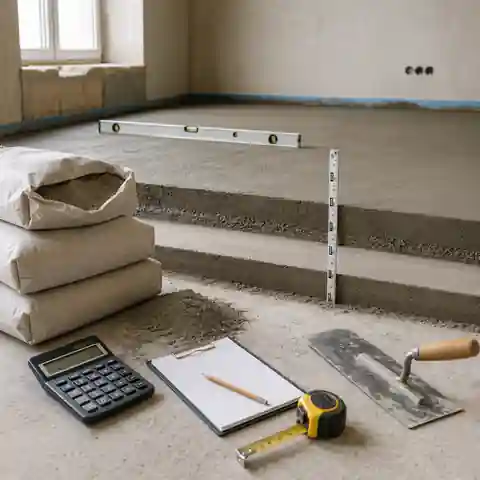
The same floor area can require very different material quantities depending on the average depth of the screed.
A thin levelling layer uses much less material than a deep layer designed to correct large changes in floor level.
Measure the substrate carefully before ordering, because an underestimated average thickness can create a substantial material shortage.
Choosing a suitable material allowance
The allowance is not intended to replace accurate measuring. It provides a margin for small floor irregularities, material left in containers, minor spillage and differences between the assumed and actual average thickness.
Factors that may affect the required allowance
| Floor condition | Effect on the estimate | Planning consideration |
|---|---|---|
| Flat and accurately measured substrate | The theoretical quantity may be close to actual use | A modest allowance may be sufficient |
| Minor depressions and surface variation | Some areas require more material than the average suggests | Allow extra material and measure several points |
| Large changes in level | A single average value may hide substantial local depth | Create a level survey or divide the floor into separate zones |
| Complex room shape | Measurements and area calculations become less certain | Calculate each section separately |
| First-time DIY installation | Handling and mixing losses may be higher | Avoid using the smallest possible allowance |
Dry screed mix, site-mixed screed and levelling compounds
The bag calculation is intended for products sold with a stated dry mix consumption rate. This may include packaged cement-based screed or certain floor-levelling compounds. It should not automatically be treated as a mix-design calculator for separate quantities of cement, sand, aggregate or water.
Traditional site-mixed screed, flowing screed and self-levelling products may use different methods, minimum depths and installation procedures. Always check whether the product is designed for bonded, unbonded or floating construction and whether it is compatible with insulation or underfloor heating.
Do not use the calculated bag quantity as a substitute for a structural specification or a manufacturer's installation instructions. Floors over insulation, membranes, heating systems or unstable substrates may require a specific build-up and professional assessment.
What to check before laying the final floor finish
A screed is normally a base for another floor finish rather than the completed surface. Before installing tile, laminate, wood, vinyl or another material, check that the screed has reached the required strength, dryness and surface condition.
- Follow the product's mixing and curing instructions
- Protect fresh screed from rapid drying or unsuitable temperatures
- Check flatness before installing rigid or floating floor finishes
- Measure moisture when required by the flooring manufacturer
- Repair cracks, weak areas or poor adhesion before covering the surface
- Confirm primer, adhesive and underlay compatibility
Drying time is not determined by thickness alone. Product type, temperature, humidity, ventilation and floor construction can all affect when the screed is ready to receive the final finish.
Screed over underfloor heating
Underfloor heating can change the required screed depth, construction method and drying procedure. Pipes or cables must have the correct coverage, and the heating system should normally be tested before it becomes inaccessible.
The heating system should not be used to force rapid drying unless the screed and heating manufacturers provide a specific commissioning process. Heating too early or increasing the temperature too quickly can contribute to cracking or other defects.
For heated floors, use the thickness and commissioning requirements specified for the complete system. The calculator estimates material quantity only and does not design the floor build-up.
Common floor screed estimating mistakes
- Calculating from floor area without including layer thickness
- Using the lowest measured depth instead of a realistic average
- Entering a generic consumption rate instead of the selected product's value
- Forgetting that irregular floors require more material
- Rounding the bag quantity down
- Ignoring the permitted minimum or maximum product thickness
- Confusing packaged dry mix consumption with a site-mixed sand and cement ratio
- Ordering material before checking access, storage and total delivery weight
Planning delivery, storage and mixing
A large screed project can involve a substantial total weight of dry material. Before ordering, consider delivery access, safe storage, lifting requirements, mixing capacity and whether the material can be placed within its specified working time.
Keep bags dry and protected from the ground. Check product shelf life and batch information, and avoid ordering more material than can be stored safely. For large or time-sensitive pours, a contractor or ready-mixed solution may be more practical than mixing individual bags.
Frequently asked questions
Does the calculator show the exact amount of screed required?
No. It provides an estimate based on the floor area, average thickness, product consumption rate and allowance you enter. Actual use can change because of substrate irregularities, mixing loss, installation method and the product's real yield.
How do I find the average screed thickness?
Measure the difference between the planned finished level and the existing substrate at several points across the room. Use those measurements to estimate a representative average rather than relying on a single location. Large variations may be easier to calculate as separate floor zones.
Where can I find the dry mix consumption rate?
Look on the product bag, manufacturer's technical data sheet or official product page. Use the stated quantity for a defined area and layer thickness, then make sure it matches the unit system selected in the calculator.
Why is the bag result rounded up?
Dry screed products are normally purchased as complete bags. Rounding down would leave less material than the calculated requirement and could interrupt the work before the floor is complete.
Can I use the calculator for self-levelling compound?
It can provide a preliminary estimate when the product uses the same type of area-and-thickness consumption data supported by the calculator. Check the product's permitted depth carefully, because many self-levelling compounds are intended for thinner applications than traditional screed.
Can I calculate using metric or US customary units?
Yes. The calculator supports metric and US customary measurements. Keep the floor area, layer thickness, consumption rate and bag weight within the selected unit system so that the inputs remain consistent.
How to use the final result
Use the calculated volume to understand the overall size of the screed layer and the dry mix result to prepare a packaged-material order. Review the bag count together with the total weight, as this can affect transport, storage and handling.
Before purchasing, confirm the product coverage, bag size, recommended thickness and substrate requirements. Where the floor has major level changes, underfloor heating, insulation, movement or structural concerns, ask an experienced installer or relevant professional to verify the proposed floor build-up.
How HomDera prepares calculator estimates and practical guidance