
In this guide
A home electrical load calculation estimates how much power your appliances and equipment may require at the same time. It can help you compare everyday usage scenarios, prepare for a renovation, discuss a possible service upgrade with an electrician, or decide which appliances should be included in a backup power plan.
This guide is for preliminary planning only. It does not confirm that a circuit, cable, socket, breaker, panel or electrical service is safe or correctly sized. Final decisions about wiring, protective devices and fixed electrical equipment should be checked against local rules by a qualified electrician.
What home electrical load actually means
Electrical load is the power being demanded by connected equipment at a particular moment. It is usually expressed in watts (W) or kilowatts (kW). Current is expressed in amperes (A), while voltage is expressed in volts (V). These values are related, but they are not interchangeable.
Load is also different from energy consumption. A 2,000 W kettle may create a high load for a few minutes, while a 100 W device left on for many hours may use more energy over the day. Load helps with capacity planning; kilowatt-hours help with energy use and cost.
The main electrical values used in a home load calculation
| Value | Unit | What it tells you |
|---|---|---|
| Power | W or kW | How much electrical power equipment demands while operating |
| Current | A | How much current flows at a given voltage |
| Voltage | V | The supply voltage used in the calculation |
| Energy | kWh | How much electricity is used over time |
For a basic home load estimate, focus on the appliances likely to operate at the same time. Adding every device in the property as though all of them run at full power together usually gives an unrealistic planning figure.
Define what you are trying to calculate
The phrase "home electrical load" can refer to several different questions. Decide which one you need before collecting numbers, because the same appliance list can produce different results depending on the purpose.
Information to collect before you start
- The appliance or device name.
- The input power shown in watts or kilowatts.
- The rated current in amperes when wattage is not provided.
- The supply voltage used by the appliance.
- The number of identical devices.
- Whether the device runs continuously, cycles on and off, or is used only briefly.
- Which other appliances are likely to run at the same time.
- Whether the appliance contains a motor, compressor, pump or transformer that may have a higher starting demand.
Use the input rating from the appliance label, manual or manufacturer documentation where possible. Do not substitute heating output, cooling capacity, sound power, battery capacity or another figure that is not the electrical input.
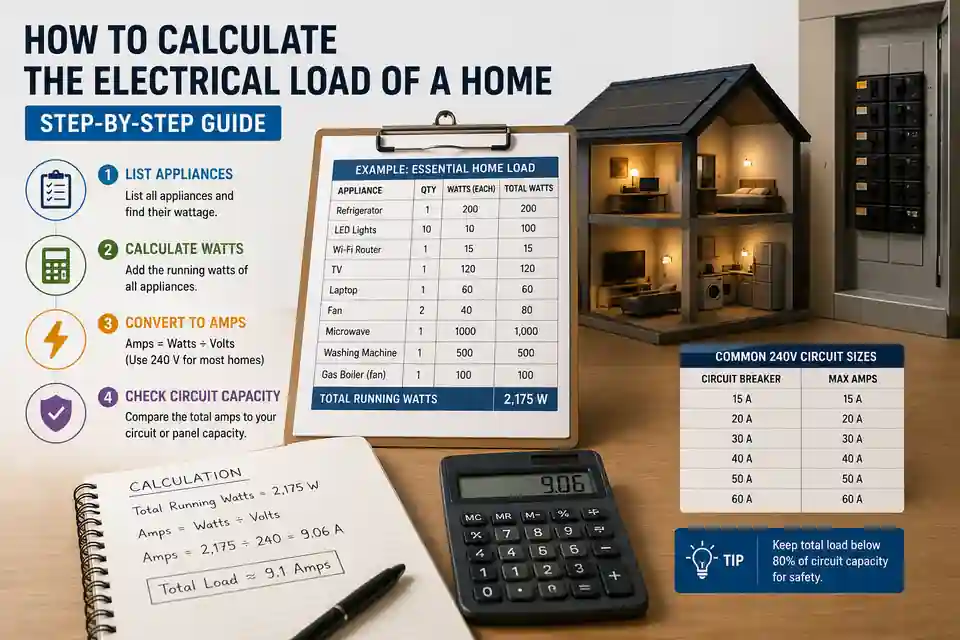
How to calculate home electrical load step by step
Make a room-by-room appliance list
Walk through the home and record fixed equipment, portable appliances and important electronics. A room-by-room list is less likely to miss devices than trying to remember everything at once. Include quantities: six 10 W lamps create a 60 W load, not 10 W.
Record the electrical input rating
Look for a rating label on the back, underside or inside edge of the appliance. If the label provides watts, use that value. If it provides voltage and current, you can make a simple estimate using the formulas below. For equipment with different modes or settings, use a figure that matches the scenario you are assessing.
Power in watts = Voltage in volts × Current in amperes

Current in amperes = Power in watts ÷ Voltage in volts

1 kilowatt = 1,000 watts
The simple formula P = V × I is suitable for a preliminary estimate when the relevant rating values are known. Some AC equipment also involves power factor, efficiency and waveform considerations, so the nameplate data or manufacturer documentation is usually more reliable than reconstructing the rating from incomplete information.
Choose a realistic simultaneous-use scenario
The useful question is not simply "What appliances do I own?" but "Which of them may operate together?" Build one or more realistic scenarios instead of relying on a single total.
Examples of simultaneous-use scenarios
| Scenario | Equipment that may be running |
|---|---|
| Normal background load | Refrigerator, router, standby devices, lighting and computers |
| Busy cooking period | Background load plus kettle, microwave, oven or other cooking appliances |
| Laundry period | Background load plus washing machine, dryer or water-heating equipment |
| Hot or cold weather | Background load plus air conditioning, electric heating, fans, pumps or a boiler system |
| Essential backup mode | Only selected lighting, communications, refrigeration, heating controls and other priority loads |
Add the running wattage
For each scenario, multiply the wattage of every device by its quantity and add the results. Keep short-duration high-power appliances in the scenario when they may genuinely overlap with other loads. A kettle may run for only a few minutes, but it still matters during those minutes.
Convert the total from watts to amps when needed
To estimate current, divide the total power by the actual supply voltage used for the calculation. The same wattage produces a different current at a different voltage, which is why voltage must never be guessed.
A simultaneous load totals 5,520 W. What current does that represent?
Answer: At 230 V: 5,520 ÷ 230 = approximately 24 A. At 120 V: 5,520 ÷ 120 = approximately 46 A.
Explanation: This comparison shows why a wattage total cannot be converted to amperes without knowing the voltage. It is still only a planning estimate and does not determine the required circuit, cable or protective device.
Consider starting and surge demand
Motors, compressors, pumps and some power supplies can demand more current when starting than during normal operation. Refrigerators, freezers, air conditioners, pumps and workshop tools are common examples. The size and duration of the starting demand vary by product, so use manufacturer data rather than applying one universal multiplier.
A running-watt calculation may look acceptable while a motor or compressor still causes a breaker, inverter or backup system to trip during startup. Where starting performance matters, check both continuous and surge ratings.
Worked example: a busy evening at home
Consider a simple evening scenario in which lighting, internet equipment, two laptops, a refrigerator, a kettle and a microwave may operate together. The figures below are examples only; actual appliance labels should be used for a real calculation.
Example simultaneous electrical load
| Appliance | Quantity | Example input | Combined load |
|---|---|---|---|
| LED lighting | 6 | 10 W | 60 W |
| Wi-Fi router | 1 | 15 W | 15 W |
| Laptops | 2 | 90 W | 180 W |
| Refrigerator | 1 | 180 W running | 180 W |
| Electric kettle | 1 | 2,000 W | 2,000 W |
| Microwave | 1 | 1,300 W input | 1,300 W |
60 W + 15 W + 180 W + 180 W + 2,000 W + 1,300 W = 3,735 W

At 230 V:
3,735 W ÷ 230 V = approximately 16.2 A

At 120 V:
3,735 W ÷ 120 V = approximately 31.1 A
This does not mean all six loads should be placed on one circuit. It is only a simultaneous whole-scenario estimate. In a real home, cooking appliances, sockets, lighting and fixed equipment may be distributed across different circuits, and the permitted arrangement depends on the installation and local requirements.
Whole-home load, circuit load and backup load are not the same
Choose the calculation that matches the decision
| Calculation | What it includes | What it can help you do |
|---|---|---|
| Appliance load | One appliance or device | Check its approximate running demand |
| Socket or extension load | All devices connected through that point | Compare the combined rating with the stated limit |
| Circuit load | Equipment supplied by one branch circuit | Prepare information for an electrician or investigate repeated tripping |
| Whole-home load | Loads across the property that may overlap | Explore service capacity, renovation or electrification scenarios |
| Backup load | Only selected essential equipment | Estimate the continuous and surge demand of a backup system |
Do not assume that a breaker number alone tells you how much more equipment can be added. Cable size, installation method, conductor material, ambient conditions, circuit length, voltage drop, connections, protective devices and local rules can all affect the final decision.
Common mistakes in home electrical load calculations
Mistake, consequence and better approach
| Mistake | Why it causes problems | Better approach |
|---|---|---|
| Using kWh instead of W or kW | Energy over time is not the same as instantaneous load | Use input power for load calculations and kWh for consumption |
| Adding every appliance at full power | The result may be unrealistically high | Create realistic simultaneous-use scenarios |
| Ignoring quantities | Repeated lamps, heaters or chargers are undercounted | Multiply each rating by the number of devices |
| Using output capacity instead of electrical input | Heating, cooling or cooking output may not equal input power | Use the electrical input rating |
| Guessing the voltage | The calculated current can be wrong | Use the actual supply or appliance voltage |
| Ignoring startup demand | Motors and compressors may trip equipment at startup | Check manufacturer surge or starting data |
| Treating an extension lead as extra capacity | It adds connection points, not supply capacity | Keep the combined load within the stated rating and avoid daisy chaining |
| Assuming the calculation proves the wiring is safe | A wattage total cannot reveal damaged, loose or incorrectly installed wiring | Arrange inspection where condition or suitability is uncertain |
Stop using an outlet, plug, extension lead or appliance if you notice overheating, a burning smell, scorch marks, buzzing, crackling, repeated sparking or repeated protective-device operation. Disconnect safely if possible and have the cause checked rather than repeatedly resetting the breaker.
Use the HomDera electrical load calculator
A calculator can make scenario testing faster. Enter the appliances you expect to use, their wattage, quantity and usage assumptions, then compare normal, peak and essential-load combinations. The result is most useful when the input values come from actual labels rather than generic averages.
Calculate an apartment or home electrical loadThe calculator provides an estimate, not approval for a new circuit, cable, breaker, panel, service connection or fixed appliance. Treat the result as organised information for planning and professional review.
If your next question is about conductor sizing, total load is only one input. Cable length, voltage drop, conductor material, installation conditions and protection also matter.
Estimate cable size and voltage drop for preliminary planningFor a battery or UPS plan, make a separate essential-load scenario instead of trying to support every appliance in the home. High-power heating and cooking loads can change the required inverter and battery size dramatically.
Build an essential apartment backup power estimateWhen a calculation is useful and when you need an electrician
A home load estimate is useful for organising information. It can show which appliances dominate a scenario, which combinations create peaks and whether a planned backup system is being asked to support too much. It cannot inspect the condition or compliance of an installation.
A preliminary calculation can help with
- Comparing normal and peak household demand.
- Preparing an appliance schedule before renovation.
- Identifying high-power loads that may need special attention.
- Separating essential from non-essential backup loads.
- Giving an electrician a clearer description of current and planned equipment.
Professional assessment is especially important when
- You plan to add a new fixed high-power appliance.
- You are changing the panel, service connection, circuits or protective devices.
- Breakers or fuses operate repeatedly.
- Sockets, plugs or cables become warm, discoloured or damaged.
- There are burning smells, buzzing, crackling or unexplained flickering.
- The wiring is old, undocumented, modified or of unknown condition.
- The calculation will be used to select cables, breakers, generators, inverters or other safety-critical equipment.
Quick self-check before trusting your result
- Did you use electrical input power rather than output capacity?
- Did you include the correct quantity of each device?
- Did you use the actual voltage for any watts-to-amps conversion?
- Did you model appliances that may genuinely operate together?
- Did you create a separate peak-load scenario?
- Did you check for motors, compressors, pumps or other startup loads?
- Did you keep whole-home, circuit and backup calculations separate?
- Did you avoid treating the result as proof that the wiring is safe?
Frequently asked questions
Should I add the wattage of every appliance in the home?
Not for a realistic running-load estimate. Add the appliances likely to operate together in the scenario you are studying. A separate theoretical maximum can still be useful, but it should be labelled clearly so it is not confused with normal or peak demand.
Can I calculate electrical load from my electricity bill?
A bill normally shows energy consumption in kilowatt-hours over a period, not the exact power being demanded at one moment. It can help you understand overall consumption, but appliance ratings or measured demand are more useful for a load calculation.
Why does a breaker trip when my total looks acceptable?
Possible reasons include a high load on one circuit, startup current, a fault, a loose connection, unsuitable equipment or a problem with the protective device. A whole-home wattage total cannot identify the cause, so repeated tripping should be investigated rather than treated as a calculation problem alone.
Should I calculate in watts or amps?
Watts are convenient for adding appliance loads. Amps are useful when comparing current at a known voltage. Record the original rating where possible and convert only when the purpose of the calculation requires it.
Does a battery or solar system reduce the home's electrical load?
The appliances still demand power. A battery or solar system may change where that power comes from, but it does not remove the load itself. The inverter, battery, solar production, grid connection and transfer arrangement must each be considered separately.
Use the result as a planning tool
A reliable home electrical load estimate starts with real appliance ratings, realistic simultaneous-use scenarios and a clear distinction between whole-home, circuit and backup loads. It can reveal demand peaks and help you prepare better questions. It should not be used as a shortcut around inspection, local requirements or professional design where safety-critical decisions are involved.