
In this guide
A circuit breaker usually keeps tripping because it is detecting a condition that could overheat wiring, damage equipment or expose people to electric shock. The most common causes are an overloaded circuit, a faulty appliance, a short circuit, earth or ground leakage, damaged wiring, a loose connection or a breaker that needs professional testing. The timing of the trip and the appliances that were running can provide useful clues, but they do not replace an electrical inspection.
Treat repeated tripping as a safety signal, not as an inconvenience. If you notice smoke, a burning smell, sparks, buzzing or crackling, scorch marks, unusual heat, an electric shock, water near electrical equipment or visible damage to the panel, stop using the affected equipment. Do not keep resetting the device. Contact a qualified electrician, and use local emergency services if there is smoke or fire.
Quick answer: why a breaker trips
A circuit breaker is a protective switch. It disconnects a circuit when the current or fault conditions move outside the range the electrical installation was designed to handle. A trip may be caused by too many loads operating together, one defective appliance, damaged insulation, moisture, a wiring fault or a problem with the protective device itself.
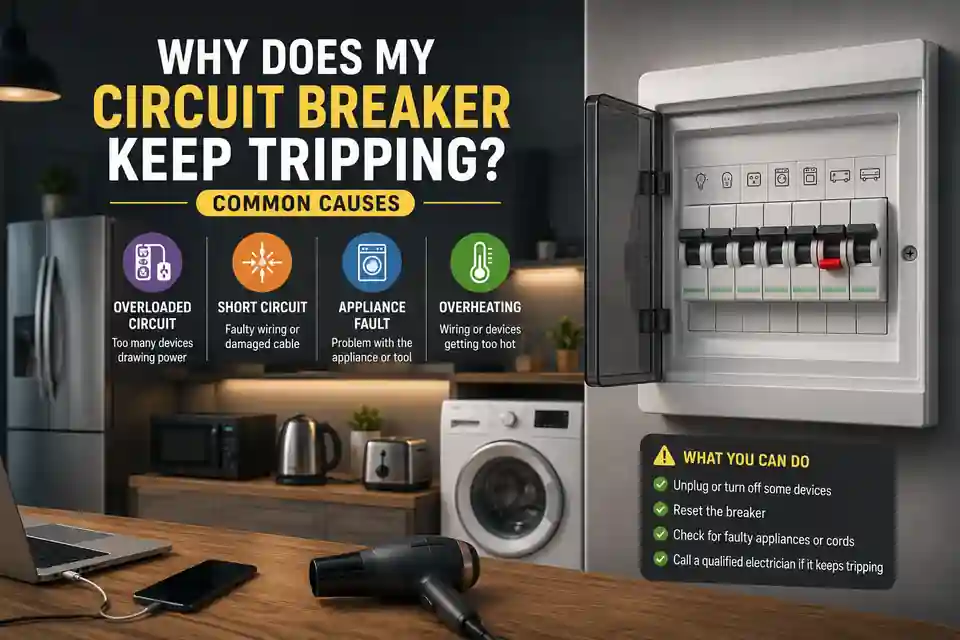
What the tripping pattern may suggest
| What happens | Possible explanation | Safer next step |
|---|---|---|
| The breaker trips immediately when reset | A short circuit, severe appliance fault, damaged cable or another active fault may still be present | Disconnect portable loads if this can be done safely. Do not keep resetting it if it trips again |
| It trips only when one appliance is switched on | The appliance, plug, flex, socket or the circuit supplying it may be faulty | Stop using that appliance and arrange testing or repair |
| It trips when several appliances run together | The combined electrical load may be exceeding the circuit capacity | Reduce the simultaneous load and record which appliances were operating |
| It trips after several minutes | A sustained overload, heat-related fault or deteriorating connection may be developing | Switch off the load and have recurring trips investigated |
| It trips during rain, after a leak or in a damp area | Moisture may be creating earth or ground leakage | Keep away from wet equipment and arrange an urgent professional check |
| An RCD or GFCI-type device trips across several circuits | One appliance or circuit may be leaking current to earth or ground | Unplug portable appliances where safe and have persistent tripping tested |
| The main breaker or main protective device trips | The total load may be high, or a fault may affect a larger part of the installation | Reduce load only if there are no danger signs and arrange a professional assessment |
The table is a pattern guide, not a diagnosis. Different breaker types respond to different fault conditions, and electrical terminology, circuit ratings and protection requirements vary by country and installation.
First identify what actually tripped
People often use the words breaker, fuse box, consumer unit and electrical panel for the whole assembly, but the switch that moved may not be a standard circuit breaker. Identifying the label on the device helps explain what kind of problem it may have detected.
- Circuit breaker or MCB: usually protects wiring against overload and short-circuit current.
- RCD or GFCI-type protection: reacts to current leaking away from the intended path and is intended to reduce electric-shock risk.
- RCBO or combined device: provides both overcurrent protection and residual-current protection for a circuit.
- Main breaker or main switch with protection: may disconnect power to several circuits or the whole property.
- Arc-fault protection, where installed: may respond to certain dangerous arcing conditions as well as other faults, depending on the device.
Do not remove the panel cover to identify a device. Use only visible labels and the normal front controls. If labels are missing, contradictory or unclear, that is useful information for an electrician.
The six most common reasons a circuit breaker keeps tripping
Cause, typical clue and why it matters
| Possible cause | Typical clue | Why the breaker may trip |
|---|---|---|
| Circuit overload | The trip happens when several high-power appliances operate together | The current remains above the level the circuit is designed to carry |
| Faulty appliance | The same appliance repeatedly triggers the trip | An internal fault, damaged flex, plug problem or leakage may be present |
| Short circuit | The breaker trips immediately, sometimes with a pop, spark or smell | Current rises sharply through an unintended low-resistance path |
| Earth or ground leakage | An RCD, GFCI or combined device trips, often around damp equipment | Some current is flowing outside the intended live and neutral path |
| Loose or damaged connection | Tripping is intermittent, load-dependent or accompanied by heat or crackling | A poor connection can heat, arc or create unstable fault conditions |
| Breaker or installation problem | Trips continue after obvious loads are removed, or began after electrical work | The protective device, wiring arrangement or circuit design may need testing |
1. The circuit is overloaded
An overload occurs when the appliances on one circuit draw more current than the circuit can carry for the required time. Portable heaters, kettles, toasters, hair dryers, cooking appliances, air conditioners and other heating or motor loads can quickly increase the total. The circuit may work with each appliance separately but trip when several operate together.
For a rough load estimate, current is approximately total power divided by supply voltage: amps ≈ watts ÷ volts. This is only a preliminary calculation. Starting current, power factor, circuit design, breaker characteristics, cable installation and local requirements can all affect the real result.
A 2,000 W heater, a 1,500 W kettle and a 1,000 W toaster are running on the same circuit. What is the approximate combined load?
Answer: The appliances total 4,500 W. At 230 V, the approximate current is 4,500 ÷ 230 ≈ 19.6 A. At 120 V, it is 4,500 ÷ 120 = 37.5 A.
Explanation: This does not prove that a particular circuit is overloaded because circuit ratings and installation rules differ. It does show why several high-power appliances can trip a breaker even when each appliance works normally on its own.
A load calculator can help you organise appliance wattages and identify combinations that may be demanding. It cannot confirm the condition of cables, sockets, connections or protective devices, and it must not be used to justify fitting a larger breaker.
2. One appliance is faulty
If the breaker trips whenever the same appliance starts, the appliance may have an internal short circuit, insulation failure, moisture problem, damaged power cord, defective plug or excessive leakage. Refrigerators, washing machines, dishwashers, pumps, boilers, air conditioners and power tools may also trip only during a particular part of their operating cycle.
- Note which appliance was starting or running when the trip occurred.
- Switch it off using its normal control and unplug it if the plug is accessible and there are no signs of heat, damage or moisture.
- Inspect only visible parts such as the plug and flexible cord. Do not open the appliance.
- Do not move a suspect appliance to another circuit simply to see whether it will trip there as well.
- Keep the appliance out of use until it has been checked, repaired or replaced.
3. There is a short circuit
A short circuit is an unintended connection that allows a very high current to flow. It may occur inside an appliance, plug, socket, junction, light fitting or damaged cable. An immediate trip, a sharp sound, visible spark, burning smell or scorch mark can be a warning sign. Do not reset the breaker repeatedly or continue testing appliances when these signs are present.
4. Current is leaking to earth or ground
Residual-current protection may trip when current leaves the intended circuit path. Common triggers include damaged appliance insulation, water ingress, outdoor equipment, heating elements, pumps, extension leads used in damp conditions and cumulative leakage from several electronic devices. The appliance may appear to work normally while still presenting a fault.
If tripping began after flooding, a roof leak, plumbing work, condensation, outdoor rain exposure or water entering an appliance, do not touch wet electrical equipment. Isolate the area only from a safe, dry location if you know how to do so, and arrange an urgent inspection.
5. A connection or cable is damaged
Loose terminals, damaged insulation, crushed extension leads, deteriorated sockets, rodent damage, screws or drill bits entering a cable route and heat-damaged connections can all cause intermittent trips. Because these faults may be hidden inside walls, fittings or the panel, the absence of visible damage does not rule them out.
6. The breaker or circuit arrangement needs testing
A protective device can deteriorate, be incorrectly selected, have a poor connection or be unsuitable for the way a particular load starts. Tripping may also begin after circuits are altered, loads are moved, a new appliance is installed or previous work changes how circuits share neutral or protective conductors. These possibilities require testing rather than guesswork.
The timing of the trip is often the best clue
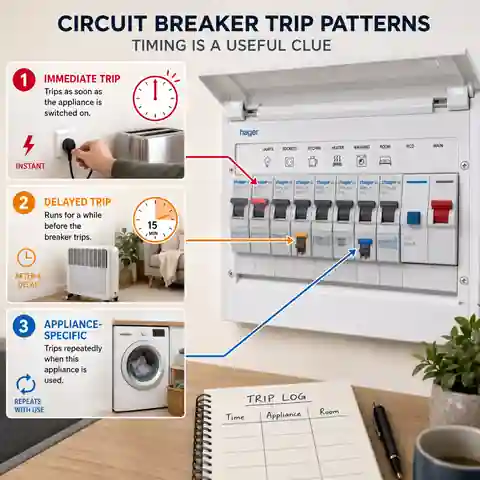
An immediate trip points to a different group of possible faults than a trip that occurs after ten or twenty minutes.
A trip linked to one appliance is useful evidence, but the socket or circuit supplying that appliance may still be part of the problem.
A written note of the time, active appliances and affected rooms can shorten the electrician's diagnostic process.
Do not deliberately recreate a trip when there are warning signs such as heat, smell, sparks, moisture or damaged equipment.
What you can check without opening the electrical panel
The aim of a homeowner check is to collect information and remove obvious portable loads, not to repair the circuit. Only continue when the panel, room and equipment are dry, there is no burning smell or visible damage, and you can use the normal controls safely.
- Record which rooms, sockets, lights or appliances lost power.
- Write down everything that was operating immediately before the trip, including heaters, chargers and appliances that cycle automatically.
- Switch off and unplug accessible portable appliances on the affected circuit.
- Look for visible damage, discolouration, loose plugs, crushed cords or overloaded adapters without touching anything hot or damaged.
- If there are no danger signs and the manufacturer's and local safety guidance allow it, reset the protective device once after removing the likely load.
- Reconnect portable appliances one at a time, allowing enough time to observe whether a particular item is associated with the trip.
- Stop immediately if the device trips again, if the cause is unclear or if any warning sign appears.
Some appliances start automatically. A refrigerator compressor, water heater, pump, dehumidifier, heating control or charger may be the hidden load that explains why the breaker appears to trip at random.
What not to do when a breaker keeps tripping
- Do not reset the breaker again and again without finding the cause.
- Do not replace it with a higher-rated breaker or fuse unless a qualified professional has verified the entire circuit design.
- Do not hold, tape or mechanically force a protective switch into the on position.
- Do not bypass an RCD, GFCI, RCBO, arc-fault device or other protective function.
- Do not remove the panel cover, tighten internal terminals or test exposed wiring yourself.
- Do not continue using an appliance that causes repeated trips, gives a shock, smells burnt or has a damaged cord.
- Do not treat extension leads and multi-way adapters as a permanent way to redistribute high-power loads.
- Do not assume a trip is harmless simply because power returns after a reset.
A larger breaker does not create a stronger circuit. If the wiring, socket, connections or cable route are not designed for the higher current, increasing the protective rating can remove an important layer of protection and allow dangerous overheating.
When to call a qualified electrician
Professional testing is appropriate whenever the cause is not obvious, the trip repeats or fixed wiring may be involved. The urgency increases when there are signs of heat, arcing, moisture, physical damage or electric shock.
- The breaker trips again after portable loads have been disconnected.
- It will not reset, or it trips immediately with no obvious appliance connected.
- The panel, breaker, socket, plug or wall area feels unusually warm.
- There is a burning smell, buzzing, crackling, sparking, smoke or discolouration.
- Anyone receives a shock or tingling sensation from an appliance, tap, pipe or metal surface.
- The trip began after drilling, renovation, new electrical work or installing a high-power appliance.
- An RCD, GFCI or combined protective device trips repeatedly and the source cannot be isolated.
- The main breaker trips or several circuits lose power together.
- The property has old, damaged, poorly labelled or previously modified wiring.
- Water, flooding, condensation or outdoor moisture may have reached electrical equipment.
What an electrician may test
A proper diagnosis is more than replacing the breaker. Depending on the symptoms, an electrician may compare the actual load with the circuit design, inspect connections, test insulation, measure leakage current, check earthing or grounding, test appliances, verify protective-device operation and look for heat or damage along the circuit.
- Actual current while the relevant appliances are operating
- Condition and rating of the breaker, cable, sockets and connected equipment
- Insulation resistance and earth or ground leakage
- Loose, overheated or damaged terminations
- Appliance faults and startup current
- Moisture entry, damaged cable routes or accidental drilling damage
- Whether high-power equipment needs a correctly designed dedicated circuit
- Whether previous alterations comply with the rules that apply locally
Cable sizing is not determined by appliance power alone. Installation method, cable length, conductor material, ambient temperature, grouping, voltage drop, protective device and local rules all matter. Never use a calculator result to change an existing breaker or cable without professional verification.
Did the tripping start after a change?
The first trip often follows a change that seems unrelated. A new appliance may increase demand, furniture may crush a cable, renovation work may disturb wiring, or moisture may enter a fitting. Review what changed in the hours, days or weeks before the problem began.
- A portable heater, oven, hob, air conditioner, dryer, boiler, pump or workshop tool was added
- Several appliances were moved onto the same socket group or extension lead
- A new light, socket, charger, inverter, UPS or fixed appliance was installed
- Walls, floors or ceilings were drilled, screwed, cut or opened
- There was a roof leak, plumbing leak, flood or heavy condensation
- Outdoor equipment or an extension lead was exposed to rain
- The property experienced a power outage and many appliances restarted together
- The trip began after maintenance, decorating or moving heavy furniture
A practical decision path
- Check for smoke, smell, heat, sparks, water, damage or electric shock. If any are present, do not reset the device and seek urgent help.
- Identify which protective device moved and which parts of the property lost power.
- Record the appliances that were running and disconnect accessible portable loads where safe.
- If one appliance is clearly associated with the trip, keep it unplugged and arrange appliance testing.
- If several high-power appliances were running, reduce the simultaneous demand and use the load calculator to organise the figures.
- If the trip repeats, happens with loads disconnected, affects the main protection or has no clear pattern, arrange an electrical inspection.
- Keep notes of the time, weather, appliance cycle and recent changes so the fault can be reproduced professionally without unnecessary guesswork.
Frequently asked questions
Can I reset a tripped circuit breaker?
A single reset may be reasonable only after the likely load has been switched off or unplugged, there are no signs of heat, damage, smell, moisture or shock, and the normal operating instructions allow it. If it trips again, stop resetting it and have the cause investigated.
Why does the breaker trip only when two appliances run together?
Their combined current may exceed the capacity of the circuit even though each appliance works normally by itself. This is common with heating and cooking appliances. It may also reveal a weak connection or a load that draws extra current during startup.
Why does the breaker trip after a few minutes instead of immediately?
A delayed trip often fits a sustained overload or a heat-related problem. Some breakers use thermal protection that responds over time, and some faults appear only after an appliance warms up or enters a later operating stage. Recurring delayed trips still need investigation.
Can a faulty breaker cause nuisance tripping?
Yes, a breaker or its connection can deteriorate, but it should not be assumed to be the problem simply because it trips. Overloads, appliance faults, leakage and wiring defects should be assessed, and the protective device should be tested by a qualified electrician.
Why does an RCD or GFCI trip while individual breakers stay on?
The residual-current device may be detecting leakage to earth or ground rather than an overload. One appliance, outdoor circuit or damp fitting can affect a device that protects several circuits. Persistent trips require fault isolation and testing.
Is it safe to replace the breaker with a higher amp rating?
Not without a complete design check. The breaker rating must coordinate with the cable, installation method, sockets, connected equipment and applicable rules. Increasing the rating may allow the wiring to overheat before protection operates.
Why does the breaker trip after a power outage?
Several appliances may restart at the same time, creating a brief high demand, or a power event may expose an existing appliance or wiring fault. Switch off non-essential loads before restoring them one at a time. Repeated tripping after outages should be checked professionally.
Can rain or humidity make a breaker trip?
Yes. Water can enter outdoor sockets, lights, pumps, cables or appliances and create leakage or insulation faults. Keep away from wet electrical equipment and arrange an urgent inspection rather than waiting for it to dry and trying again.
The useful question is not only 'How do I turn the power back on?' but 'What condition caused the protection to operate?' A breaker that trips once may have responded to a temporary overload. A breaker that keeps tripping is asking for the load, appliance or circuit to be checked before normal use continues.