
In this guide
A battery can run a refrigerator for anywhere from a few hours to more than a full day. The actual runtime depends on the refrigerator’s average energy use, the battery voltage and capacity, the usable depth of discharge, inverter losses, compressor cycling and startup surge. A 12 V 100 Ah battery, for example, may run an efficient refrigerator for roughly 5–10 hours when it is a lead-acid battery, or around 10–20 hours when it is a LiFePO4 battery. These are planning estimates, not guaranteed operating times.
The number printed on the refrigerator label is not always its average power consumption. A compressor may draw considerable power while running, switch off for part of each hour and briefly require much more power when starting.
What This Guide Covers
Quick Refrigerator Runtime Estimate
The table compares a 12 V 100 Ah lead-acid battery with a 12.8 V 100 Ah LiFePO4 battery under several average refrigerator loads. The lead-acid estimate assumes 50% usable depth of discharge and 85% inverter efficiency; the LiFePO4 estimate assumes 90% usable depth of discharge and 90% inverter efficiency. These simplified estimates exclude separate inverter idle draw.
Estimated Runtime: 12 V Lead-Acid vs 12.8 V LiFePO4, Both 100 Ah
| Average refrigerator load | 12 V lead-acid, 100 Ah | 12.8 V LiFePO4, 100 Ah |
|---|---|---|
| 50 W | About 10.2 hours | About 20.7 hours |
| 75 W | About 6.8 hours | About 13.8 hours |
| 100 W | About 5.1 hours | About 10.4 hours |
| 150 W | About 3.4 hours | About 6.9 hours |
These figures use average load rather than compressor running wattage. If a refrigerator draws 150 W while the compressor is operating but runs only 40% of the time, its simplified average load is approximately 60 W. Real cycling changes with room temperature, thermostat setting, insulation, door opening and how much food is inside.
What Determines How Long a Battery Can Run a Refrigerator?
- Battery voltage, amp-hour capacity and condition
- Battery chemistry and recommended depth of discharge
- Refrigerator energy consumption over a full day
- Compressor duty cycle and startup surge
- Inverter efficiency and standby consumption
- Ambient temperature and ventilation around the refrigerator
- Thermostat setting and frequency of door opening
- Cable losses, connection quality and low-voltage cutoff settings
Convert Battery Capacity from Ah to Wh
Amp-hours alone do not show how much energy a battery stores because the voltage also matters. The basic conversion is: battery energy in watt-hours = battery voltage × battery capacity in amp-hours. A 12 V 100 Ah battery therefore stores about 1,200 Wh in theory. A 12.8 V 100 Ah LiFePO4 battery stores about 1,280 Wh.
How much usable AC energy can a 12 V 100 Ah lead-acid battery provide?
Answer: Approximately 510 Wh under conservative assumptions.
Explanation: The nominal energy is 12 V × 100 Ah = 1,200 Wh. At 50% usable depth of discharge: 1,200 Wh × 0.50 = 600 Wh. After 85% inverter efficiency: 600 Wh × 0.85 = 510 Wh available to the refrigerator.
How much usable AC energy can a 12.8 V 100 Ah LiFePO4 battery provide?
Answer: Approximately 1,037 Wh under typical planning assumptions.
Explanation: The nominal energy is 12.8 V × 100 Ah = 1,280 Wh. At 90% usable depth of discharge: 1,280 Wh × 0.90 = 1,152 Wh. After 90% inverter efficiency: 1,152 Wh × 0.90 = about 1,037 Wh available to the refrigerator.
A Refrigerator Does Not Use the Same Power All the Time
A refrigerator is a cycling appliance. The compressor starts, cools the cabinet and then switches off until the temperature rises again. Fans, controls, displays, heaters and ice makers may also add smaller or intermittent loads. For runtime planning, daily energy consumption or measured average power is usually more useful than the highest running-watt figure.
Power Figures You May See
| Power figure | What it means | How to use it |
|---|---|---|
| Running watts | Power used while the compressor is operating | Useful for checking continuous inverter capacity |
| Startup or surge watts | Brief power demand when the compressor starts | Useful for checking peak inverter capacity |
| Average watts | Average demand after compressor cycling is included | Best for estimating battery runtime |
| kWh per day or year | Energy consumed over a stated period | Often the most practical basis for runtime calculations |
A battery may contain enough energy for several hours of operation while the inverter still fails to start the refrigerator. Battery capacity and inverter surge capability must be checked separately.
Battery Runtime Formula for a Refrigerator
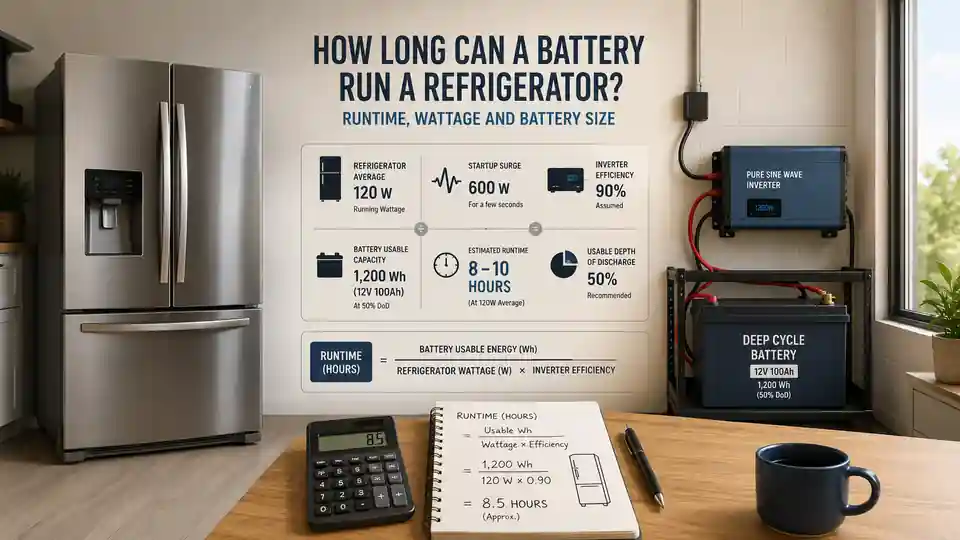
A practical planning formula is: runtime in hours = battery voltage × battery capacity in Ah × usable depth of discharge × inverter efficiency ÷ average refrigerator power in watts. Use decimal values for the percentages. For example, 50% becomes 0.50 and 90% becomes 0.90.
How long will a 12 V 100 Ah lead-acid battery run a refrigerator averaging 60 W?
Answer: Approximately 8.5 hours.
Explanation: Runtime = 12 V × 100 Ah × 0.50 × 0.85 ÷ 60 W. Runtime = 510 Wh ÷ 60 W. Estimated runtime = 8.5 hours. The result will be shorter if the battery is aged, cold, partially charged or affected by high-current discharge.
How to Find the Refrigerator’s Average Load
- Check the energy label or manual for kWh per day or kWh per year.
- Use a plug-in energy meter and measure consumption for at least 24 hours under normal use.
- If only running watts are known, multiply them by an estimated compressor duty cycle.
- Include any separate loads powered by the same inverter, such as a freezer, router, lights or charger.
- Add a modest planning margin instead of treating the calculated runtime as exact.
What is the average power of a refrigerator using 1.2 kWh per day?
Answer: Approximately 50 W.
Explanation: 1.2 kWh is 1,200 Wh. Average power = 1,200 Wh ÷ 24 hours. Average power = 50 W. The instantaneous compressor load may still be much higher than 50 W.
What Battery Size Is Needed for a Refrigerator?
To size a battery for a target runtime, reverse the calculation. First multiply the refrigerator’s average power by the required operating time. Then divide by the intended usable depth of discharge and inverter efficiency. Finally, divide the required nominal watt-hours by battery voltage to estimate the amp-hour capacity.
Approximate Battery Size for a Refrigerator Averaging 60 W
| Target runtime | 12 V lead-acid estimate | 12.8 V LiFePO4 estimate |
|---|---|---|
| 8 hours | About 94 Ah | About 46 Ah |
| 12 hours | About 141 Ah | About 69 Ah |
| 24 hours | About 282 Ah | About 139 Ah |
The table assumes 50% usable discharge and 85% inverter efficiency for lead-acid, and 90% usable discharge with 90% inverter efficiency for LiFePO4. Battery sizes are theoretical minimums based on a steady 60 W average load. A real system normally needs additional margin for ageing, temperature, inverter standby use and uncertain compressor cycling.
Lead-Acid vs LiFePO4 for Refrigerator Backup
Battery Chemistry Comparison
| Factor | Lead-acid | LiFePO4 |
|---|---|---|
| Typical usable capacity | Often planned around 50% | Often planned around 80–90% |
| Voltage under load | Drops more noticeably | Usually remains more stable |
| Cycle life | Generally lower | Generally higher |
| Weight | Heavier for the same usable energy | Lighter for the same usable energy |
| High-current performance | Can lose effective capacity at heavier loads | Usually handles sustained loads more efficiently |
| Cold-weather charging | Still requires suitable charging control | Charging below the manufacturer’s permitted temperature may be restricted |
A 100 Ah rating does not mean both battery types provide the same practical runtime. LiFePO4 commonly provides more usable energy because it can normally be discharged further while maintaining a steadier voltage. However, the battery management system, discharge-current limit, charger and inverter must all be compatible.
Choosing an Inverter That Can Start the Refrigerator
- Check that the inverter’s continuous rating exceeds the refrigerator’s running load plus any other connected appliances.
- Check the inverter’s surge rating and how long it can sustain that surge.
- Use a pure sine wave inverter unless the refrigerator manufacturer explicitly permits another waveform.
- Confirm that the inverter input voltage matches the battery bank voltage.
- Account for the inverter’s no-load or standby consumption.
- Follow the inverter and battery manufacturers’ requirements for fusing, cable size, cable length and ventilation.
Do not connect a household refrigerator directly to a battery unless it is specifically designed for that DC voltage. Do not use improvised wiring or feed an inverter into household circuits through an ordinary wall socket. A fixed backup installation should be designed and checked by a qualified professional.
Why Real Runtime May Be Shorter Than the Calculation
- The battery is not fully charged before the outage.
- An older battery no longer delivers its original rated capacity.
- Lead-acid capacity falls more noticeably under heavier discharge.
- The refrigerator runs longer in a warm room or poorly ventilated enclosure.
- The door is opened frequently during the outage.
- Warm food is placed inside and must be cooled.
- An automatic defrost heater, fan or ice maker adds consumption.
- The inverter uses energy even when the compressor is off.
- Undersized or loose DC connections create voltage drop.
- The inverter shuts down before the battery reaches the assumed discharge level.
- Other appliances are connected without being included in the calculation.
A Safer Refrigerator Backup Setup
- Measure or estimate the refrigerator’s average daily energy consumption.
- Check running power and compressor startup surge separately.
- Choose a deep-cycle battery with enough usable energy for the desired runtime.
- Choose a compatible pure sine wave inverter with sufficient continuous and surge capacity.
- Use the cable size, fuse or circuit protection and connection method specified by the equipment manufacturers.
- Keep DC cables as short as practical and protect terminals from accidental contact.
- Place equipment in a dry location with the ventilation required for the battery and inverter type.
- Test the complete system while mains power is available before relying on it during an outage.
- Monitor battery state of charge and stop operation before the battery reaches a damaging discharge level.
Lead-acid batteries may release gas while charging and should not be placed in an unventilated living space. Lithium batteries require a suitable battery management system and compatible charger. Damaged, swollen, leaking, overheated or unusually hot batteries should not be used.
Common Refrigerator Battery Runtime Mistakes
Mistake, Consequence and Better Approach
| Mistake | What goes wrong | Better approach |
|---|---|---|
| Using Ah without battery voltage | Stored energy is calculated incorrectly | Convert Ah to Wh before calculating runtime |
| Dividing nominal Wh directly by fridge watts | Runtime is overstated | Include usable depth of discharge and inverter efficiency |
| Using running watts as average watts | Runtime may be understated | Use daily kWh or a measured 24-hour average |
| Ignoring startup surge | The inverter trips when the compressor starts | Check continuous and surge ratings separately |
| Assuming all 100 Ah batteries are equal | Usable capacity and voltage behaviour are overlooked | Account for chemistry, age and discharge limits |
| Ignoring other connected loads | The battery empties sooner than expected | Add every device powered by the inverter |
| Planning to reach 0% charge | Battery life may be shortened or the system may shut down early | Use a conservative discharge limit and keep a reserve |
Worked Refrigerator Runtime Examples
How long can a 100 Ah LiFePO4 battery run an efficient refrigerator averaging 45 W?
Answer: Approximately 23 hours.
Explanation: Usable AC energy = 12.8 V × 100 Ah × 0.90 × 0.90 = about 1,037 Wh. Runtime = 1,037 Wh ÷ 45 W = about 23 hours. A practical result may be lower after allowing for inverter standby consumption, temperature and battery reserve.
How long can a 100 Ah lead-acid battery run an older refrigerator averaging 90 W?
Answer: Approximately 5.7 hours.
Explanation: Usable AC energy = 12 V × 100 Ah × 0.50 × 0.85 = 510 Wh. Runtime = 510 Wh ÷ 90 W = about 5.7 hours. An aged battery or long DC cables may reduce this further.
What LiFePO4 battery capacity is needed for a refrigerator using 1.2 kWh per day?
Answer: Approximately 116 Ah at 12.8 V before adding a planning margin.
Explanation: The refrigerator requires 1,200 Wh for 24 hours. Required nominal battery energy = 1,200 Wh ÷ 0.90 ÷ 0.90 = about 1,481 Wh. Battery capacity = 1,481 Wh ÷ 12.8 V = about 116 Ah. A larger standard size may be sensible where long outages, cold conditions or battery ageing are expected.
How to Extend Refrigerator Runtime During an Outage
- Cool the refrigerator fully before a planned outage.
- Keep the door closed and decide what you need before opening it.
- Avoid adding large amounts of warm food during battery operation.
- Leave the ventilation openings around the refrigerator unobstructed.
- Use an efficient inverter with low standby consumption.
- Disconnect unnecessary devices from the same battery system.
- Check door seals and replace damaged seals.
- Use an appropriate thermostat setting rather than the coldest possible setting.
- Maintain a safe battery reserve instead of running the system until it shuts down.
What the Battery Runtime Calculator Result Means
The calculator provides an estimate based on battery capacity, voltage, load, inverter efficiency and usable depth of discharge. For a refrigerator, enter measured average watts when available. If you enter compressor running watts instead, the calculated runtime may be much shorter than the refrigerator’s real cycling runtime. The result should still be reduced by a planning margin when refrigeration is critical.
Estimate Your Refrigerator RuntimeWhen a Professional Check Is Needed
- The refrigerator repeatedly trips or overloads the inverter.
- You do not know the compressor startup requirement.
- The battery bank is permanently connected to household wiring.
- The system uses multiple batteries in series or parallel.
- DC cables or terminals become warm during operation.
- The inverter, charger and battery management system have uncertain compatibility.
- The backup system must support medicines, commercial food storage or another critical load.
- You plan to install an automatic transfer switch or fixed changeover system.
- Local electrical, fire or building requirements apply to the installation.
Frequently Asked Questions
Can a 100 Ah Battery Run a Refrigerator?
Yes, provided the inverter can handle both the running load and compressor startup surge. A 100 Ah lead-acid battery may provide roughly 5–10 hours for many efficient household refrigerators, while a 100 Ah LiFePO4 battery may provide around 10–20 hours. The actual result depends mainly on the refrigerator’s average energy use.
Will a 1,000 W Inverter Run a Refrigerator?
It may, but the wattage printed on the inverter is not enough information by itself. Check whether 1,000 W is the continuous or peak rating, how much startup surge the refrigerator requires and how long the inverter can provide its surge output. A pure sine wave model is generally the safer choice for compressor appliances.
Can a Refrigerator Run Overnight from a Battery?
Often yes, but the battery must provide enough usable watt-hours for the entire period. Estimate the refrigerator’s average watts, multiply by the number of overnight hours and include inverter losses and a battery reserve. A small lead-acid battery may not provide a full night, while a properly sized LiFePO4 system may do so comfortably.
Does a Refrigerator Use More Battery Power in a Hot Room?
Usually yes. Higher ambient temperature increases the heat entering the refrigerator, so the compressor may run more often or for longer periods. Poor ventilation around the condenser can have a similar effect. Runtime estimates based on cool conditions may therefore be optimistic during hot weather.
Can a Car Starter Battery Run a Refrigerator?
It may run one temporarily through a suitable inverter, but starter batteries are designed for short, high-current engine starts rather than repeated deep discharge. Regularly discharging one to power a refrigerator can shorten its life and may leave the vehicle unable to start. A deep-cycle battery is generally more appropriate for backup power.
So, How Long Can a Battery Run a Refrigerator?
A useful estimate begins with usable battery watt-hours and the refrigerator’s average power consumption. A 12 V 100 Ah lead-acid battery may provide about 510 Wh of usable AC energy under conservative assumptions, while a 12.8 V 100 Ah LiFePO4 battery may provide about 1,037 Wh. Divide that usable energy by the refrigerator’s measured or calculated average watts, then allow additional margin for startup behaviour, temperature, battery condition and inverter consumption. The calculation helps with planning, but the complete battery, inverter, protection and wiring setup must also be suitable for the appliance.
Read more guides about backup power, batteries and energy independenceExplore All Battery and Backup Power Calculators