
In this guide
The number of solar panels a home needs cannot be determined from floor area or the number of bedrooms alone. A small home with electric heating, cooling, water heating or an electric vehicle may use more electricity than a much larger energy-efficient property.
A useful estimate starts with your actual electricity consumption, then considers local sunlight, panel wattage, roof conditions, system losses and the percentage of your demand you want solar to cover. This guide shows how those factors fit together and how to make a preliminary calculation before requesting a professional system design.
This article provides a planning estimate, not an electrical or structural design. Final panel quantity, inverter size, mounting layout, protection equipment and grid connection requirements should be checked by qualified professionals familiar with local rules and the property.
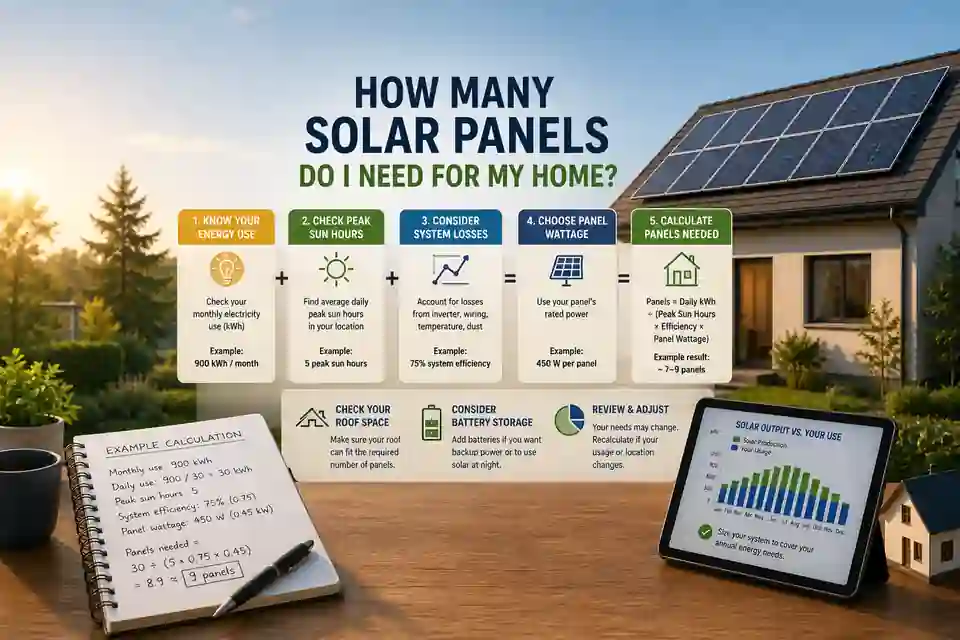
Quick answer: how many solar panels might a home need?
The basic answer is: divide the amount of electricity you want the solar system to produce by the expected output of one panel in your location. The result is then adjusted for roof space, shading, orientation, system losses and practical equipment limits.
The main factors that determine panel quantity
| Factor | Why it matters | What to check |
|---|---|---|
| Household electricity use | Higher annual consumption generally requires more generating capacity | Use at least 12 months of electricity bills where possible |
| Solar resource | The same panel can produce different amounts of energy in different locations | Use a location-based annual solar yield estimate |
| Panel wattage | Higher-wattage panels provide more nameplate capacity per module | Check the exact model and rated power |
| Roof orientation and angle | They affect how much sunlight reaches the array during the year | Assess each usable roof section separately |
| Shading | Trees, chimneys and nearby buildings can reduce production | Check seasonal shading, not only the roof at midday |
| System losses | Inverters, wiring, temperature, dirt and mismatch reduce usable output | Include a realistic loss allowance in the estimate |
| Your solar goal | A system for daytime savings is sized differently from an off-grid system | Define whether the goal is bill reduction, annual offset or backup power |
Start with electricity use, not the size of the house
Your electricity bills are the most useful starting point because they show how much energy the household actually uses. Look for consumption in kilowatt-hours, written as kWh. Do not use only the amount of money paid: tariffs, fixed charges, taxes and time-of-use pricing can change the bill without changing energy consumption.
- Add the kWh figures from the most recent 12 months.
- Check whether any months are estimated rather than based on meter readings.
- Note major seasonal loads such as heating, cooling or water heating.
- Include planned loads such as an electric vehicle, heat pump, workshop or additional air conditioning.
- Separate ordinary household demand from loads that will not continue after the system is installed.
When only monthly data is available, divide annual consumption by 12 to find an average month or by 365 to find an average day. Keep the seasonal figures as well: an annual average can hide very high winter or summer demand.
Should you use one month or a full year?
A single month is rarely enough. Solar production and household demand both change through the year. Sizing from a low-consumption month may produce an undersized system, while sizing from the highest month alone may create more surplus generation than the home can use or export during the rest of the year.
A full year gives a stronger starting point for a grid-connected system. For backup or off-grid planning, monthly and daily peaks also matter because the system must cope with periods when demand is high and sunlight is limited.
Choose what you want the solar system to achieve
Before calculating the number of panels, decide what the target means. Producing an amount equal to annual consumption is not the same as powering the home directly at every moment, and neither automatically provides electricity during a grid outage.
Different goals require different sizing decisions
| Goal | Main sizing focus | Important limitation |
|---|---|---|
| Reduce daytime grid use | Match solar production to loads used while the sun is available | A very large array may produce surplus energy that the home cannot use immediately |
| Offset part of annual consumption | Select a target percentage of annual kWh | Production and consumption will not match hour by hour |
| Offset most annual consumption | Compare expected annual solar generation with annual demand | Roof space, export rules and seasonal mismatch may limit the practical size |
| Provide outage backup | Identify essential loads, inverter output and battery capacity | Ordinary grid-connected solar may shut down during an outage unless backup equipment is installed |
| Operate off-grid | Design for difficult seasons, consecutive low-sun days and peak loads | Annual averages alone are not sufficient for reliable sizing |
A system described as covering 100% of annual consumption may still import electricity at night and during low-production periods. It may export surplus electricity at other times. Annual energy balance and real-time self-sufficiency are different measurements.
Method 1: calculate panel quantity from annual solar yield
For a grid-connected home, the annual-yield method is usually the clearest preliminary approach. It uses an estimate of how many kilowatt-hours a 1 kW solar array can produce in your location during a year.
- Find the home's annual electricity use in kWh.
- Choose the percentage of that use you want solar to cover.
- Find an estimated annual yield in kWh per installed kW for the location and roof conditions.
- Divide the target annual solar production by the estimated annual yield.
- Convert the required system capacity into a panel count using the wattage of the selected panel.
- Round up to a whole panel, then check roof space, inverter limits and local requirements.
Annual solar yield should come from a location-based model, installer assessment or reliable solar map. Do not assume that a value from another country, city or roof will apply to your home.
Example: estimating a system from annual consumption
A home uses 5,400 kWh per year and the owner wants solar to produce an estimated 90% of that amount. The location-based expected yield is 1,100 kWh per installed kW per year. The selected panels are rated at 450 W each. How many panels are required for the preliminary estimate?
Answer: Target solar production: 5,400 × 0.90 = 4,860 kWh per year. Required array capacity: 4,860 ÷ 1,100 = 4.42 kW. Panel quantity: 4.42 × 1,000 ÷ 450 = 9.82. The preliminary result is 10 panels, giving a nameplate array size of 4.5 kW.
Explanation: The calculation converts the desired annual energy production into system capacity and then into whole panels. It is still necessary to confirm shading, roof layout, inverter compatibility, local export limits and the assumptions used in the annual-yield estimate.
Rounding up from 9.82 to 10 panels is reasonable because a fraction of a panel cannot be installed. However, automatically adding several more panels as a vague safety margin can distort the design. First check whether the solar-yield estimate already includes expected system losses.
Estimate panel quantity and system capacity with the HomDera Home Solar Panel CalculatorMethod 2: estimate production from peak sun hours
A second method estimates the daily output of one panel. It can help with a quick check, but it needs a reliable local peak-sun-hours value and a reasonable performance factor for real-world losses.
Estimated daily output per panel = panel power in kW × peak sun hours × performance factor.
What might one 450 W panel produce if the location receives an average of 4 peak sun hours per day and a planning performance factor of 0.80 is used?
Answer: Convert 450 W to 0.45 kW. Then calculate 0.45 × 4 × 0.80 = 1.44 kWh per day.
Explanation: The 0.80 factor represents a simplified allowance for combined real-world losses. It is not a universal value and should not replace a detailed location- and equipment-specific production estimate.
If the target is 15 kWh per day, dividing 15 by 1.44 gives 10.42 panels, so the preliminary result would be 11 panels. This simple average does not show seasonal variation. A system producing enough energy on an average summer day may produce much less during a cloudy winter period.
Do not use the panel's rated wattage as if it were constant output throughout the day. A 450 W rating is measured under defined test conditions. Actual output changes with sunlight, temperature, shading, panel angle, equipment and other conditions.
Why panel wattage alone does not answer the question
Panel wattage describes nameplate power, not annual energy production. Two arrays with the same rated capacity may produce different annual results because one has better sunlight, less shading or a more suitable orientation.
Common causes of lower real-world production
| Cause | Possible effect | Planning response |
|---|---|---|
| High panel temperature | Output can fall when modules operate above their rated test temperature | Use a model that includes temperature effects |
| Partial shading | A chimney, tree or nearby building can reduce production at certain times | Assess shading throughout the year and review string or microinverter options |
| Inverter conversion | Some energy is lost when DC electricity is converted to AC | Use realistic inverter efficiency and sizing assumptions |
| Wiring and connections | Electrical resistance creates losses | Have cable routes and conductor sizes designed correctly |
| Dirt, snow or debris | Obstructed modules receive less sunlight | Consider local conditions and safe maintenance access |
| Panel mismatch and ageing | Modules do not always perform identically over time | Use credible equipment specifications and production assumptions |
| Orientation and tilt | The production profile and annual yield can change | Model each roof section rather than treating the whole roof as identical |
Check whether the panels will actually fit on the roof
A calculation may suggest a 12-panel array while the roof has safe, unshaded space for only eight. Roof dimensions must therefore be checked before treating the calculated quantity as a final answer.
- Measure each usable roof section separately.
- Use the exact length and width from the selected panel's technical sheet.
- Allow for the mounting system and required spacing.
- Exclude skylights, vents, chimneys, antennas and other obstructions.
- Allow safe access and any clearances required by local rules.
- Check whether shadows move across the proposed array during different seasons.
- Confirm that the roof structure and covering are suitable for the installation.
A rough area calculation can be made by dividing usable roof area by the area of one panel, but this is only an upper limit. Rectangular panels may not fit efficiently around roof edges and obstructions, so a scaled layout is more reliable than area alone.
Do not fill every available roof gap without checking mounting zones, wind and snow loads, maintenance access, fire-safety clearances and structural capacity. These requirements vary by location and building.
How orientation, angle and shading affect panel count
The best orientation depends on location, roof geometry and the household's consumption pattern. An array positioned for the highest possible annual output is not always the only sensible design. East- and west-facing sections may spread production across more of the day, which can improve direct use in some homes.
Shading should not be judged from a single visit at one time of day. A tree that causes little shade in summer may cast a longer shadow in winter. Nearby construction, roof equipment and future tree growth may also affect production.
When panels must be divided between roof sections with different orientations, estimate the output of each section separately. Adding all panel wattages together without modelling their different solar exposure can overstate expected production.
Do batteries change how many solar panels you need?
A battery stores electricity; it does not generate it. Adding a battery does not automatically reduce the amount of solar energy required to meet an annual target. It changes when generated energy can be used and may increase self-consumption by storing daytime surplus for later.
How system type changes the planning process
| System type | Role of the panels | Role of the battery |
|---|---|---|
| Grid-connected without battery | Supply household loads and export or limit surplus production | No stored solar energy for later use |
| Hybrid solar with battery | Supply loads and charge the battery when surplus power is available | Moves some solar energy to evening, night or outage periods |
| Backup-focused system | Recharge the battery while also supporting selected loads | Must be sized around essential loads, required runtime and permitted depth of discharge |
| Off-grid system | Must meet demand and restore battery charge without relying on the grid | Provides energy when solar production is unavailable, but requires careful seasonal design |
For backup planning, first decide which appliances are essential and how long they must operate. A system designed to run lighting, communications and refrigeration is very different from one expected to support electric cooking, space heating, water heating or large motors.
Estimate how long a battery may run selected appliances with the HomDera Battery Runtime CalculatorBuild a preliminary appliance load list with the HomDera Electrical Load CalculatorA solar-and-battery system intended for outages requires suitable isolation, inverter functions, protective equipment and connection design. Do not assume that ordinary rooftop solar will continue powering the home when the public grid fails.
Should you add extra panels for future electricity use?
Future loads can justify additional capacity, but they should be estimated rather than guessed. Consider when the new load will operate, how much energy it will use and whether it can be shifted into solar-production hours.
- An electric vehicle may add substantial annual consumption, but charging time affects direct solar use.
- A heat pump can increase electricity demand while reducing another fuel use.
- Electric water heating may be scheduled to use daytime solar production.
- Additional cooling can raise demand during sunny periods when solar output is also high.
- A workshop or home office may create predictable daytime loads.
- Energy-efficiency improvements may reduce the array size required for the same level of comfort.
It may be cheaper and more practical to reduce avoidable consumption before purchasing extra generating capacity. Compare insulation, efficient appliances, controls and load scheduling with the cost of a larger solar array.
Common mistakes when estimating solar panel quantity
- Using the monetary value of an electricity bill instead of consumption in kWh.
- Sizing from the home's floor area or number of occupants without checking meter data.
- Using only one unusually low or high month.
- Treating panel nameplate wattage as continuous real-world output.
- Ignoring shading, roof orientation and different roof sections.
- Adding a loss percentage twice when the solar-yield model already includes it.
- Assuming annual energy offset means the home will be self-sufficient every day.
- Assuming a battery creates additional energy rather than storing generated energy.
- Ignoring inverter input limits, string design and local export restrictions.
- Buying panels before confirming roof condition, mounting layout and structural suitability.
- Designing an off-grid system from annual averages instead of difficult seasonal conditions.
- Forgetting future loads or adding a large future-use allowance with no realistic calculation.
A practical pre-installation checklist
- Collect at least 12 months of electricity use in kWh.
- Identify unusual past consumption and likely future loads.
- Choose a clear goal: daytime savings, partial offset, annual offset, backup or off-grid operation.
- Obtain a location- and roof-specific solar production estimate.
- Select a provisional panel wattage and calculate the quantity.
- Draw a realistic panel layout using exact module dimensions.
- Check shading, orientation, tilt and seasonal production.
- Confirm roof condition and structural suitability.
- Review inverter capacity, operating voltage, string limits and backup functions.
- Check local permits, grid connection rules and export limits.
- Compare expected monthly production with monthly consumption, not only annual totals.
- Have the final electrical, structural and mounting design reviewed by qualified specialists.
Ask an installer to show the assumptions behind the proposal: annual production, monthly production, system losses, shading, panel model, inverter model, usable roof area and expected self-consumption. Two quotes with the same number of panels are not necessarily equivalent if their assumptions and equipment differ.
Frequently asked questions
Can I calculate solar panels from my monthly electricity bill?
Yes, when the bill shows electricity consumption in kWh. Add a full year where possible. Do not calculate from the amount paid because electricity prices and fixed charges do not indicate how much energy the home used.
How many solar panels are needed for 1,000 kWh per month?
There is no universal panel count. Convert 1,000 kWh per month to approximately 12,000 kWh per year, choose the target percentage, obtain the expected annual yield for the location and divide the required system capacity by the wattage of one panel. Roof and grid constraints must then be checked.
Do higher-wattage panels always produce more electricity?
A higher-rated panel has greater nameplate capacity, but annual output also depends on module efficiency, size, temperature behaviour, orientation, shading and equipment. Compare expected energy production and usable roof capacity rather than wattage alone.
Should I cover 100% of my annual electricity use?
Not necessarily. The practical target depends on roof space, daytime consumption, export arrangements, budget, future loads and local connection rules. A smaller system with high direct self-consumption may suit one home better, while another may have a valid reason to maximise annual production.
Will solar panels power my home during a blackout?
Not automatically. Many grid-connected systems are designed to shut down when the grid fails. Backup operation normally requires compatible inverter functions, isolation equipment, protective devices and, in many designs, battery storage.
Can I install fewer panels and add more later?
Expansion may be possible, but it should be considered during the original design. Future modules must be compatible with the inverter, string arrangement, mounting system, roof layout and local connection approval. Mixing equipment can create technical limitations.
How accurate is an online solar panel calculator?
A calculator can provide a useful preliminary estimate when the inputs are realistic. Accuracy depends on the electricity-use data, solar resource, panel rating, loss assumptions and roof information entered. It cannot replace a site survey, shading assessment or final electrical and structural design.
Is more solar always better?
No. Extra panels may be useful when future demand, battery charging or permitted energy export justifies them. They may offer less value when surplus production cannot be used, stored or exported economically. The best size is the one that fits the household's goal and real operating conditions.
Final answer
To estimate how many solar panels your home needs, begin with annual electricity use in kWh, decide what percentage you want solar to cover, and convert that target into system capacity using a location-specific annual solar yield. Divide the required capacity by the wattage of one panel, round to a whole module and then test the result against real roof space, shading, inverter limits, seasonal production and local rules.
For backup or off-grid use, continue beyond the annual calculation. Identify essential appliances, peak power, required runtime, battery capacity and low-sun conditions. These systems need a more detailed design because keeping equipment operating at the required time is different from producing an equivalent amount of energy over an entire year.
Use the HomDera calculator to create a preliminary estimate, then take the result, your electricity records and a roof layout to a qualified installer. A transparent proposal should explain not only how many panels are recommended, but why that quantity suits the home.