
In this guide
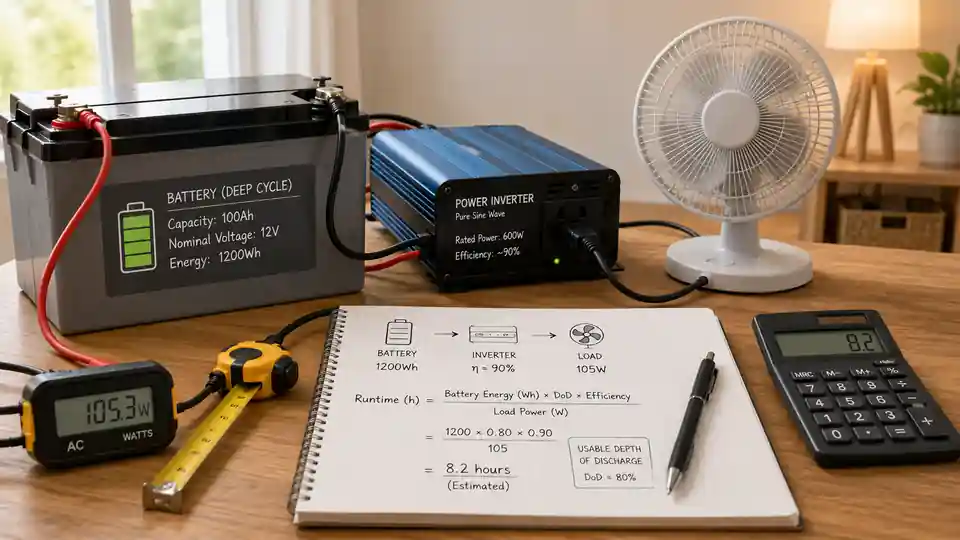
To calculate how long a battery can run an appliance through an inverter, you need more than the battery’s amp-hour rating. The estimate must also account for battery voltage, usable depth of discharge, inverter efficiency, inverter self-consumption and the actual average load.
A basic calculation can be completed in a few minutes. However, the result should be treated as a planning estimate rather than a guaranteed operating time, because batteries and appliances rarely behave exactly like their label values under real conditions.
This guide is intended for preliminary planning. Follow the battery and inverter manufacturers’ instructions, use correctly rated cables and protection devices, and have high-current or permanently installed systems checked by a qualified specialist.
The Basic Battery Runtime Formula
For a quick estimate, use the following formula:
Runtime in hours ≈ Battery voltage × Battery capacity in Ah × Usable depth of discharge × Inverter efficiency ÷ Appliance load in watts
Written more compactly:
Runtime (h) ≈ V × Ah × DoD × η ÷ W
In this formula, V is battery voltage, Ah is battery capacity, DoD is the usable depth of discharge written as a decimal, η is inverter efficiency written as a decimal, and W is the average AC load.
What is the estimated runtime of a 12 V 100 Ah battery with 80% usable capacity, a 90% efficient inverter and a constant 120 W load?
Answer: 12 × 100 × 0.80 × 0.90 ÷ 120 = 7.2 hours.
Explanation: The battery stores 1,200 Wh nominally. After applying 80% usable capacity and 90% inverter efficiency, approximately 864 Wh remains available to the AC appliance. Dividing 864 Wh by 120 W gives an estimated runtime of 7.2 hours.
What You Need Before Starting the Calculation
The calculation is only as useful as the values entered. Before using the formula, identify the following figures.
Values used in a battery runtime calculation
| Value | What it means | Where to find it |
|---|---|---|
| Battery voltage | The nominal voltage of the battery or battery bank, such as 12 V, 24 V or 48 V | Battery label, battery data sheet or system documentation |
| Battery capacity | The rated capacity in amp-hours, usually shown as Ah | Battery label or manufacturer’s specification |
| Usable depth of discharge | The part of the rated capacity that you intend to use before recharging | Battery manufacturer’s recommendations or BMS settings |
| Inverter efficiency | The percentage of battery energy delivered to the AC load after conversion losses | Inverter data sheet or efficiency curve |
| Average appliance load | The real average power consumed while the appliance operates | Plug-in power meter, appliance documentation or measured data |
| Inverter idle consumption | Power used by the inverter even when the connected load is small or switched off | Inverter data sheet or direct measurement |
Step 1: Convert Amp-Hours Into Watt-Hours
Amp-hours alone do not show how much energy a battery stores because the same Ah rating can represent very different amounts of energy at different voltages. Convert the capacity to watt-hours first.
Nominal battery energy (Wh) = Battery voltage (V) × Battery capacity (Ah)
Examples of nominal battery energy
| Battery arrangement | Calculation | Nominal energy |
|---|---|---|
| One 12 V 100 Ah battery | 12 × 100 | 1,200 Wh |
| One 24 V 100 Ah battery | 24 × 100 | 2,400 Wh |
| Two 12 V 100 Ah batteries in parallel | 12 × 200 | 2,400 Wh |
| Two 12 V 100 Ah batteries in series | 24 × 100 | 2,400 Wh |
Two identical batteries can provide the same total watt-hours whether they are connected in series or parallel, but the system voltage and amp-hour value will differ. The inverter must always match the voltage of the completed battery bank.
Do not connect batteries in series or parallel unless they are suitable for that configuration. Batteries should normally match in chemistry, voltage, capacity, condition and state of charge. Incorrect connections can cause excessive current, battery damage, overheating or fire.
Step 2: Apply the Usable Depth of Discharge
The rated watt-hour capacity is not always the amount you should plan to use. A battery may reach its low-voltage cutoff before every rated watt-hour is delivered, and repeatedly discharging some battery types too deeply can shorten their service life.
Usable battery energy (Wh) = Nominal battery energy × Usable depth of discharge
For example, a 1,200 Wh battery used to 80% of its rated capacity provides approximately 960 Wh of usable DC energy. The correct percentage should come from the battery manufacturer, the battery management system settings and the way the system is intended to be operated.
Illustrative planning values
| Battery type | Example usable percentage | Important limitation |
|---|---|---|
| LiFePO4 | Often estimated at 80–90% | The permitted value depends on the BMS, cell manufacturer and desired cycle life |
| Lead-acid AGM or gel | Often estimated at around 50% for routine planning | Actual usable capacity changes with discharge rate, temperature, age and battery condition |
| Starter battery | Not recommended as a regular deep-cycle energy source | Repeated deep discharge can cause rapid capacity loss and starting failure |
These percentages are examples, not universal limits. Some systems may permit a deeper discharge, while others should use a more conservative setting.
Step 3: Account for Inverter Efficiency
An inverter converts DC battery power into AC power, but the conversion is not lossless. Part of the energy becomes heat inside the inverter and cables.
Usable AC energy (Wh) ≈ Usable DC energy × Inverter efficiency
An inverter listed as 90% efficient would deliver approximately 900 Wh of AC energy from 1,000 Wh of usable DC energy under the relevant operating conditions. Efficiency is not fixed at every load. Many inverters perform differently at very low loads, near maximum output or during high-temperature operation.
When the exact efficiency is unknown, a cautious planning estimate is more useful than assuming 100%. For a more accurate result, use the manufacturer’s efficiency curve at approximately the load level you expect to run.
Step 4: Use the Real Average Load
The load figure should represent the average power drawn during the period you want to estimate. The maximum power printed on an appliance label is not always the same as its long-term average consumption.
- A light or resistive heater may draw close to its stated wattage continuously.
- A refrigerator or freezer cycles on and off, so its long-term average load may be lower than its running wattage.
- A water pump, compressor or power tool may have a short startup surge much higher than its normal running load.
- A laptop charger may draw less than its rated maximum once the battery is nearly full.
- Several devices connected at once must be added together.
A plug-in energy meter usually gives a better estimate than relying only on the appliance label. For cycling appliances, measure consumption over several hours rather than reading only the instantaneous wattage.
A More Accurate Formula Including Inverter Idle Draw
The basic formula is convenient, but it does not separately show the power consumed by the inverter itself. This can matter when the connected appliance is small or the inverter remains switched on for many hours.
Runtime (h) ≈ V × Ah × DoD ÷ ((AC load ÷ inverter efficiency) + inverter idle draw)
In this version, the appliance load is converted back to the approximate DC input required from the battery. The inverter’s own consumption is then added before dividing the usable battery energy by the total DC demand.
How long will a 12 V 100 Ah battery last with a 120 W appliance, 80% usable capacity, 90% inverter efficiency and 10 W of inverter self-consumption?
Answer: Usable battery energy: 12 × 100 × 0.80 = 960 Wh. Battery demand: 120 ÷ 0.90 + 10 = approximately 143.3 W. Runtime: 960 ÷ 143.3 = approximately 6.7 hours.
Explanation: The simpler formula produced 7.2 hours because it included conversion efficiency but did not separately account for the inverter’s 10 W idle consumption. The more detailed estimate is about 30 minutes shorter.
Worked Example: 24 V Battery Bank Running Several Devices
Consider a 24 V 100 Ah LiFePO4 battery bank used to 85% of its rated capacity. It powers a 70 W television, a 15 W router and 25 W of lighting through an inverter operating at approximately 92% efficiency.
- Add the loads: 70 W + 15 W + 25 W = 110 W.
- Calculate nominal battery energy: 24 V × 100 Ah = 2,400 Wh.
- Apply usable depth of discharge: 2,400 Wh × 0.85 = 2,040 Wh.
- Apply inverter efficiency: 2,040 Wh × 0.92 = 1,876.8 Wh.
- Divide by the load: 1,876.8 Wh ÷ 110 W = approximately 17.1 hours.
The calculated 17.1 hours is an idealised planning result. Real runtime may be shorter because of inverter idle draw, cable losses, battery temperature, battery ageing, voltage cutoff settings and changes in appliance consumption.
Battery Runtime and Inverter Size Are Different Calculations
Battery Capacity and Inverter Size Solve Different Problems
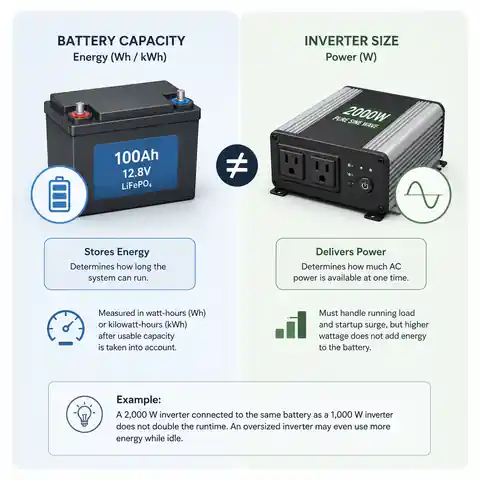
Battery capacity determines how much energy the system stores and therefore has the greatest influence on runtime. It is normally compared in watt-hours or kilowatt-hours after usable capacity is taken into account.
Inverter size determines how much AC power can be supplied at one time. It must handle both the normal running load and any short startup surge, but a higher inverter wattage does not add energy to the battery.
For example, connecting a 2,000 W inverter instead of a 1,000 W inverter to the same battery does not double the runtime. An oversized inverter may even use more energy while idle.
What each calculation answers
| Calculation | Main question | Key inputs |
|---|---|---|
| Battery runtime | How many hours can the system operate? | Battery energy, usable capacity, efficiency and average load |
| Inverter size | Can the inverter start and run the connected equipment? | Continuous load, startup surge, load type and safety margin |
Why the Real Runtime May Be Shorter
Factors that change the result
| Factor | How it affects runtime | What to do |
|---|---|---|
| Battery age | Older batteries may store less energy than their original rating | Use a tested capacity value when available |
| Low temperature | Some battery chemistries deliver less usable capacity in cold conditions | Check the manufacturer’s temperature specifications |
| High discharge rate | Lead-acid capacity may fall when power is drawn quickly | Use discharge-rate data rather than only the headline Ah rating |
| Cable losses | Undersized or long cables waste energy and create voltage drop | Use correctly sized, short cables and secure connections |
| Inverter cutoff | The inverter may switch off before the battery reaches the planned depth of discharge | Compare the inverter cutoff with the battery’s discharge curve and BMS settings |
| Cycling appliances | Refrigerators, pumps and compressors do not draw a constant load | Measure average consumption over a realistic operating period |
| Inverter standby use | The inverter consumes energy even when appliance demand is low | Include idle draw or use an appropriate power-saving mode |
| Battery rating method | The labelled Ah capacity may be measured at a slower discharge rate than your system uses | Check the battery data sheet for discharge curves and test conditions |
Common Calculation Mistakes
- Using amp-hours as though they were watt-hours.
- Ignoring the voltage of the battery bank.
- Assuming the full labelled battery capacity is always usable.
- Entering 90 instead of 0.90 for 90% efficiency in a manual formula.
- Using the inverter’s rated wattage as the appliance load.
- Ignoring the inverter’s idle consumption.
- Using an appliance’s startup surge as though it were a continuous load.
- Ignoring startup surge completely when choosing the inverter.
- Adding amp-hours incorrectly when batteries are connected in series.
- Assuming a battery still has its original capacity after years of use.
- Calculating runtime for only one appliance while several devices remain connected.
Never select cables, fuses, circuit breakers or battery protection only from the runtime result. Runtime and electrical protection are separate calculations. High battery currents can overheat cables or connections even when the AC appliance load appears modest.
How Much Safety Margin Should You Add?
For non-critical planning, it is sensible to avoid designing a system that only just meets the required operating time on paper. A margin helps account for battery ageing, colder conditions, unexpected appliance use and measurement uncertainty.
One practical approach is to calculate the expected runtime and then plan to use only about 80–90% of that result. For example, if the calculation shows 10 hours, treating 8–9 hours as the dependable planning range may be more realistic. The suitable margin depends on the equipment and consequences of an early shutdown.
Do not rely on a simple online estimate as the only power source assessment for medical devices, safety systems, essential pumps, heating protection, communications equipment or any application where an unexpected shutdown could cause injury or serious damage.
Quick Runtime Reference
The table below shows simplified examples for a 12 V 100 Ah battery. The figures already assume a stated usable depth of discharge and inverter efficiency, but they do not separately include inverter idle consumption.
Estimated runtime from a 12 V 100 Ah battery
| Load | 80% usable capacity and 90% efficiency | 50% usable capacity and 85% efficiency |
|---|---|---|
| 50 W | About 17.3 hours | About 10.2 hours |
| 100 W | About 8.6 hours | About 5.1 hours |
| 200 W | About 4.3 hours | About 2.6 hours |
| 500 W | About 1.7 hours | About 1.0 hour |
| 1,000 W | About 0.9 hour | About 0.5 hour |
At higher loads, these simplified figures can become increasingly optimistic, especially for lead-acid batteries. High current, voltage sag, the Peukert effect, inverter limits and battery protection cutoffs may reduce the actual runtime.
Frequently Asked Questions
How do I calculate battery runtime from Ah and watts?
Multiply battery voltage by amp-hours to obtain watt-hours. Multiply the result by the usable depth of discharge and inverter efficiency, then divide by the average appliance load in watts.
How long will a 100 Ah battery last with an inverter?
There is no single runtime for every 100 Ah battery. A 12 V 100 Ah battery stores approximately 1,200 Wh nominally, while a 24 V 100 Ah battery stores approximately 2,400 Wh. Runtime also depends on usable capacity, battery chemistry, inverter losses and load wattage.
Does a larger inverter make the battery last longer?
No. A larger inverter increases the available power capacity, not the amount of energy stored in the battery. An unnecessarily large inverter may have greater idle consumption and slightly reduce runtime at small loads.
Should I use appliance running watts or startup watts?
Use average running watts for the runtime calculation. Use startup or surge watts separately when checking whether the inverter can start motors, pumps, compressors, refrigerators or other inductive loads.
Why did my inverter switch off before the calculated time?
Possible causes include low battery capacity, voltage sag under load, high cable resistance, an inverter low-voltage cutoff, a BMS cutoff, cold temperature, an underestimated load or higher-than-expected inverter losses.
Can I calculate runtime using the battery’s kWh rating?
Yes. Multiply the battery’s kWh rating by 1,000 to convert it to Wh, apply the usable depth of discharge and inverter efficiency, then divide by the load in watts.
Is the battery label capacity always accurate?
The label is a rated value measured under specified test conditions. Real available capacity may differ because of battery age, temperature, discharge rate, state of charge, cell balance and manufacturing tolerance.
A Practical Way to Estimate Your System
- List every appliance that may operate at the same time.
- Measure or estimate the average running wattage of each appliance.
- Add the loads together.
- Confirm the voltage and Ah rating of the complete battery bank.
- Choose a usable depth of discharge supported by the battery manufacturer.
- Use a realistic inverter efficiency rather than assuming 100%.
- Include inverter idle draw when it is significant.
- Calculate the estimated runtime.
- Apply a planning margin for ageing, temperature and load variation.
- Check inverter continuous power and startup surge separately.
Final Check Before Relying on the Result
A useful battery runtime estimate combines five main values: total battery watt-hours, usable depth of discharge, inverter efficiency, inverter self-consumption and the real average appliance load. Leaving out any of these can make the expected runtime look better than it will be in practice.
Use the formula to compare battery sizes, loads and operating scenarios before buying equipment. For the final system, confirm battery limits, inverter compatibility, startup surge, cable size, overcurrent protection, ventilation and installation requirements with the relevant manufacturers or a qualified specialist.