
In this guide
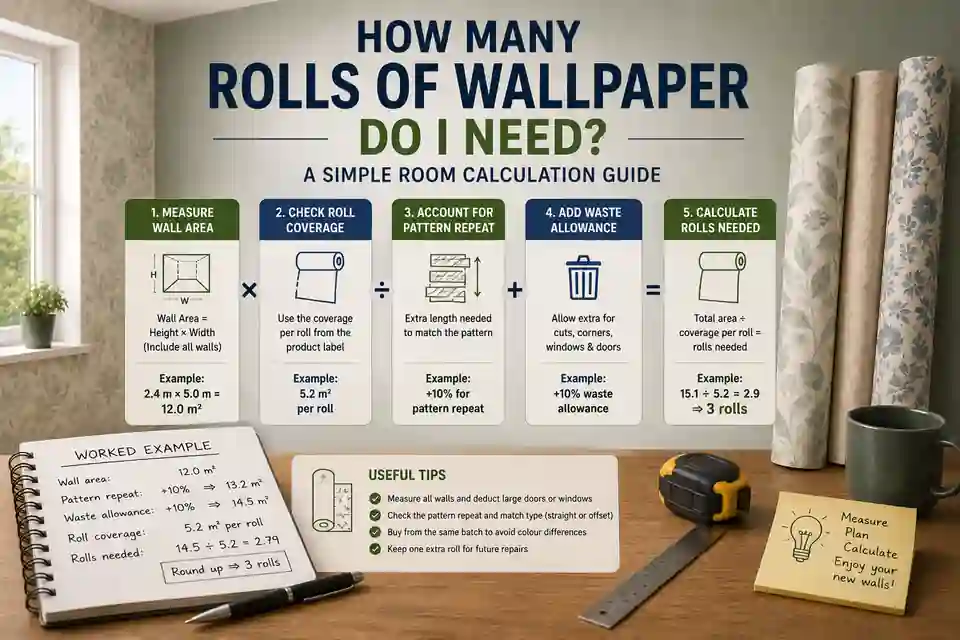
To work out how many rolls of wallpaper you need, you must know the room perimeter, wall height, wallpaper roll dimensions and pattern repeat. A simple wall-area calculation can give a rough estimate, but counting full wallpaper drops usually produces a more reliable result.
Quick answer: measure the total width of the walls, divide it by the wallpaper width to find the number of drops, calculate how many full drops can be cut from one roll, and then divide the required drops by the drops per roll. Always round the final number up.
Why wallpaper should be calculated by drops
Wallpaper is installed in full vertical strips, often called drops. This means that the advertised area of a roll does not always equal the usable wall coverage. Offcuts, trimming, pattern alignment and room height can reduce the number of complete strips available from each roll.
For example, a roll may contain enough material to cover 5.3 m² or about 57 sq ft in theory. In practice, the last section of the roll may be too short for another full-height drop, so part of that theoretical coverage cannot be used.
Information to check before calculating
| Measurement | Why it matters | Where to find it |
|---|---|---|
| Total wall width or room perimeter | Determines how many wallpaper drops are required | Measure every wall that will be wallpapered |
| Wall height | Determines the minimum length of each drop | Measure from floor to ceiling in several places |
| Roll width | Determines how much wall width one drop covers | Wallpaper label or product specification |
| Roll length | Determines how many full drops can be cut | Wallpaper label or product specification |
| Pattern repeat | May increase the cutting length of every drop | Wallpaper label or manufacturer information |
| Pattern match type | Changes how neighbouring strips must be aligned | Wallpaper label or installation instructions |
Do not rely only on labels such as single roll, double roll or large roll. Package names vary between manufacturers and markets. Use the actual width and length printed on the product.
Step 1: Measure the walls
Measure the width of every wall that will receive wallpaper and add the measurements together. For a simple rectangular room, you can calculate the perimeter by adding the room length and width, then multiplying the result by two.
A room is 4 m long and 3 m wide. What is the total wall width?
Answer: The perimeter is (4 m + 3 m) × 2 = 14 m. In imperial units, a room measuring approximately 13.1 ft by 9.8 ft has a perimeter of about 45.9 ft.
Explanation: The full perimeter is used to determine how many vertical wallpaper strips are needed around the room.
- Measure walls at the height where the wallpaper will be installed.
- Include short wall sections beside doors, windows and built-in furniture.
- Measure each wall separately if the room is irregular.
- Use the greatest wall height if the floor or ceiling is slightly uneven.
- Record all dimensions in the same unit before calculating.
Step 2: Calculate how many wallpaper drops you need
Divide the total wall width by the width of one wallpaper roll. Because a partial strip still requires a full drop, round the result up to the next whole number.
Required drops = total wall width ÷ wallpaper width. Always round up.
How many drops are needed for 14 m of wall when the wallpaper is 0.53 m wide?
Answer: 14 ÷ 0.53 = 26.42, so the room requires 27 full drops.
Explanation: Rounding down would leave part of the final wall uncovered. The same method works with imperial units, provided all measurements use the same unit.
Step 3: Add trimming allowance to the wall height
Each strip should be slightly longer than the measured wall height. This gives enough material for alignment and clean trimming at the ceiling and skirting board or baseboard.
A common planning allowance is approximately 5–10 cm, or 2–4 in, per drop. Uneven ceilings, sloping floors or difficult pattern placement may require more.
Do not cut every strip before checking the first installed drop. Walls and ceilings may not be perfectly level, and an allowance that works on one side of the room may be too small elsewhere.
Step 4: Account for the wallpaper pattern repeat
Pattern repeat is the vertical distance before the design begins again. When the pattern must align between neighbouring strips, each drop may need to be cut longer than the wall height. A large repeat can noticeably increase the number of rolls required.
How wallpaper match types affect the calculation
| Match type | What it means | Effect on roll quantity |
|---|---|---|
| Free match or no match | The design does not need to align between strips | Usually produces the least cutting waste |
| Straight match | The same part of the design aligns at the same height | Each drop may need to be rounded up to the next full repeat |
| Half-drop or offset match | The design on the next strip is shifted vertically | Can create more waste and requires careful cutting order |
| Large-scale or mural-style pattern | The design may span several strips | May require layout planning rather than a simple area estimate |
For a straight-match pattern, add the trimming allowance to the wall height and then round that length up to the next complete pattern repeat.
The wall height plus trimming allowance is 2.60 m, and the pattern repeat is 0.64 m. What cutting length should be used?
Answer: 2.60 ÷ 0.64 = 4.06 repeats. Round this up to 5 repeats: 5 × 0.64 m = 3.20 m per drop.
Explanation: Although the wall itself is only 2.60 m high after adding the trimming allowance, each strip must follow the pattern cycle. The extra 0.60 m becomes alignment waste.
Pattern repeat can make every wallpaper drop longer
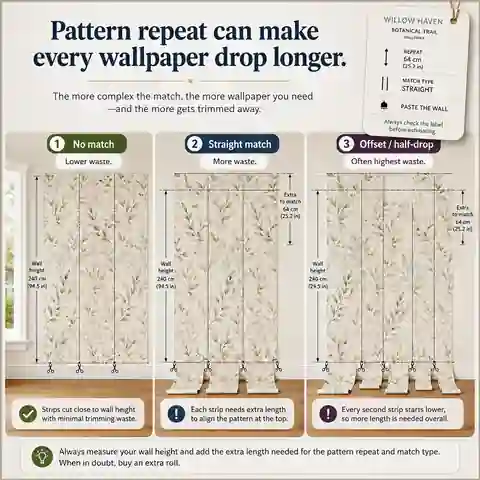
Wallpaper without a required pattern match can usually be cut close to the wall height, with only a small allowance for trimming.
A straight-match design may require each strip to be extended to the next complete pattern repeat so neighbouring strips align correctly.
An offset or half-drop match can create additional waste because every second strip begins at a different point in the design.
Check both the repeat size and the match symbol on the wallpaper label before estimating how many complete drops fit into one roll.
Step 5: Calculate how many drops come from one roll
Divide the roll length by the adjusted drop length. This time, round down because only complete wall-height strips can be used.
Drops per roll = roll length ÷ adjusted drop length. Always round down.
A roll is 10 m long and each prepared drop must be 2.60 m long. How many complete drops can be cut?
Answer: 10 ÷ 2.60 = 3.84, so the roll provides 3 complete drops.
Explanation: The remaining 2.20 m is not long enough for another full-height strip, although it may be useful above a door, below a window or for future repairs.
Step 6: Calculate the number of wallpaper rolls
Divide the total number of required drops by the number of complete drops available from one roll. Round the result up to a whole roll.
Wallpaper rolls needed = required drops ÷ drops per roll. Always round up.
A room requires 27 drops, and one roll provides 3 complete drops. How many rolls are needed?
Answer: 27 ÷ 3 = 9 rolls. For a simple room, it may be sensible to purchase 10 rolls so one matching roll remains available for cutting errors or later repairs.
Explanation: The calculation covers the planned drops. A separate reserve helps with damaged strips, difficult corners and future patching.
Should you subtract doors and windows?
It is usually safer not to subtract every opening from the wall area. Wallpaper is cut in full vertical drops, and the material removed around a window or door cannot always replace another complete strip.
- Do not subtract small windows, standard doors, sockets or narrow openings.
- A large floor-to-ceiling opening may reduce the required number of drops.
- Material above doors and below windows can sometimes be cut from usable offcuts.
- Patterned wallpaper limits how freely offcuts can be reused.
- When uncertain, calculate the complete wall and treat reusable offcuts as a reserve.
Doors and windows do not always reduce the roll count
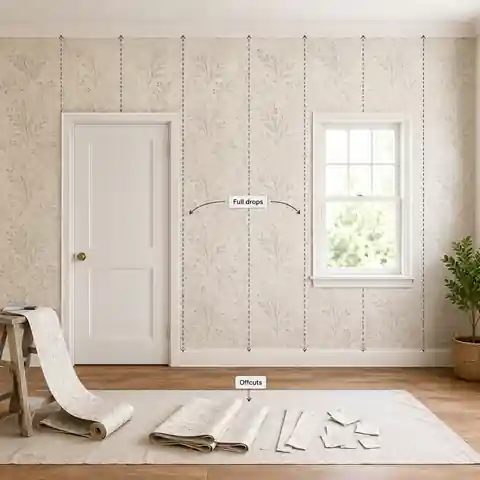
Wallpaper is normally planned as full vertical drops, so a window or door does not automatically remove an entire strip from the calculation.
The section cut from the middle of a drop may be too small or have the wrong part of the pattern for another full-height area.
Useful offcuts can sometimes cover the space above a door or below a window, especially when the wallpaper has no fixed pattern match.
For a safer estimate, calculate the main drops first and treat reusable offcuts as a reserve rather than guaranteed coverage.
For a feature wall, measure that wall separately instead of using the complete room perimeter. The same drop-based method still applies.
How much extra wallpaper should you buy?
The drop calculation already includes much of the unavoidable cutting waste, especially when pattern repeat is included. The additional allowance is mainly for installation errors, damaged sections, awkward corners and future repairs.
Practical wallpaper reserve guidelines
| Project condition | Suggested reserve | Reason |
|---|---|---|
| Small feature wall with no pattern match | At least one extra usable drop or one spare roll | Provides cover for trimming or installation errors |
| Simple room with straight walls | About 5–10% or one additional roll | Covers minor damage and difficult corners |
| Straight-match patterned wallpaper | About 10–15%, depending on repeat size | Pattern alignment creates longer offcuts |
| Half-drop match or large repeat | About 15–20% or a carefully calculated spare roll | Cutting order and pattern position create more waste |
| Irregular room or first-time installation | One additional roll beyond the calculated requirement | Allows for uneven walls and learning errors |
Buy the required rolls from the same production batch whenever possible. Colour and texture can vary slightly between batches, even when the product name and design number are identical.
Common wallpaper calculation mistakes
- Using only the total wall area and ignoring full-height drops.
- Assuming every wallpaper roll has the same width and length.
- Forgetting to include the pattern repeat.
- Rounding the number of drops or rolls down.
- Subtracting every door and window from the estimate.
- Measuring only one wall height in an uneven room.
- Ignoring trimming allowance at the top and bottom.
- Buying the minimum quantity with no matching roll for repairs.
- Mixing rolls from different batch or dye-lot numbers.
- Confusing package labels with the actual number of rolls supplied.
Wallpaper measurement checklist
- Measure the width of every wall to be covered.
- Add the wall widths to find the total wallpapering perimeter.
- Measure the greatest floor-to-ceiling height.
- Check the exact wallpaper roll width and length.
- Find the pattern repeat and match type on the label.
- Add a trimming allowance to the wall height.
- Calculate the adjusted drop length.
- Calculate the number of required drops.
- Calculate how many complete drops fit into one roll.
- Round the final roll quantity up and add a sensible reserve.
- Confirm that all rolls have the same batch or dye-lot number.
Frequently asked questions
How much wall does one roll of wallpaper cover?
The theoretical coverage equals the roll width multiplied by the roll length. However, usable coverage depends on wall height, trimming allowance and pattern repeat. Checking how many full drops can be cut from the roll gives a more realistic result.
How many rolls do I need for one wall?
Divide the wall width by the wallpaper width to find the required drops. Then divide the roll length by the adjusted drop length to find the drops per roll. Divide the required drops by the drops per roll and round up.
Can I calculate wallpaper using square metres or square feet?
Wall area can provide a rough early estimate, but it may underestimate the order because wallpaper is installed in complete vertical strips. The drop method is more reliable for final purchasing.
Does wallpaper pattern repeat increase the number of rolls?
Yes. Matching the design may require every strip to be cut longer than the wall height. A large or offset repeat can reduce the number of complete drops available from each roll.
Should I buy one extra roll of wallpaper?
For most rooms, one matching spare roll is a practical reserve. It can cover cutting mistakes, damaged strips and later repairs. This is especially useful for discontinued designs or wallpapers with visible batch differences.
What if the wallpaper is sold as a double roll?
Use the actual dimensions of the supplied package rather than the marketing name. A double roll may mean one longer physical roll or a package quantity defined by the manufacturer. Confirm the width, total length and number of physical rolls before ordering.
Can leftover wallpaper be used for repairs?
Yes. Store leftover wallpaper in a dry place away from direct sunlight and keep the product label. A full-width offcut longer than the damaged section is usually more useful than several narrow scraps.
Final calculation advice
The most reliable wallpaper estimate is based on full drops rather than wall area alone. Measure the room carefully, use the exact roll dimensions, include trimming and pattern alignment, and round every partial roll up. The result is still an estimate, so checking the manufacturer instructions and keeping one matching spare roll can prevent an unfinished wall or a difficult colour match later.
Use the Wallpaper Calculator to turn your measurements into an estimated roll quantity before placing an order.