

Choosing a range hood looks simple until the product page starts throwing CFM, BTU, duct sizes, sones and mounting heights at you. A 30-inch cooktop may be paired with a 300 CFM hood in one kitchen and a 600 CFM model in another, and both recommendations can make sense because they are solving different cooking and installation problems.
The practical way to size a hood is to begin with the cooking surface and its location, then check gas output when relevant, and finally make sure the hood can actually capture and move that air through the planned duct. This guide walks through that sequence for gas, conventional electric and induction cooktops without treating one rule of thumb as a universal law.
Quick answer: for a wall-mounted hood, a useful HVI planning rate is about 100 CFM per linear foot of cooktop width. For an island hood, use about 150 CFM per linear foot. A 30 in wall cooktop therefore starts around 250 CFM; a 36 in wall cooktop around 300 CFM; and a 36 in island cooktop around 450 CFM. High-output gas cooking may require more.
CFM means cubic feet per minute. For readers using metric airflow, 1 CFM is about 1.70 m³/h, so 300 CFM is roughly 510 m³/h and 600 CFM is roughly 1,020 m³/h.
A sizing guide does not replace the hood, range or cooktop manufacturer's installation instructions or local ventilation rules. The permitted mounting height, duct size, discharge method and make-up-air requirements can change the correct choice.
Size the hood from the cooking source, then make the ductwork support it
Range Hood CFM by Cooktop Size: A Fast Starting Table
HVI-style planning airflow by cooktop width
| Cooktop width | Wall hood: about 100 CFM/ft | Island hood: about 150 CFM/ft | Metric equivalent, wall / island |
|---|---|---|---|
| 24 in / 2 ft | 200 CFM | 300 CFM | about 340 / 510 m³/h |
| 30 in / 2.5 ft | 250 CFM | 375 CFM | about 425 / 640 m³/h |
| 36 in / 3 ft | 300 CFM | 450 CFM | about 510 / 765 m³/h |
| 42 in / 3.5 ft | 350 CFM | 525 CFM | about 595 / 890 m³/h |
| 48 in / 4 ft | 400 CFM | 600 CFM | about 680 / 1,020 m³/h |
These figures are planning baselines, not shopping instructions. A 36 in electric cooktop against a wall may be well served by a properly designed 300 CFM hood, while a 36 in professional-style gas range with 60,000 BTU/h of total burner input can push the airflow check much higher. An island installation also needs more help because there is no wall behind the plume to contain it.
What CFM Actually Tells You — and What It Does Not
Airflow only helps after the hood captures the plume
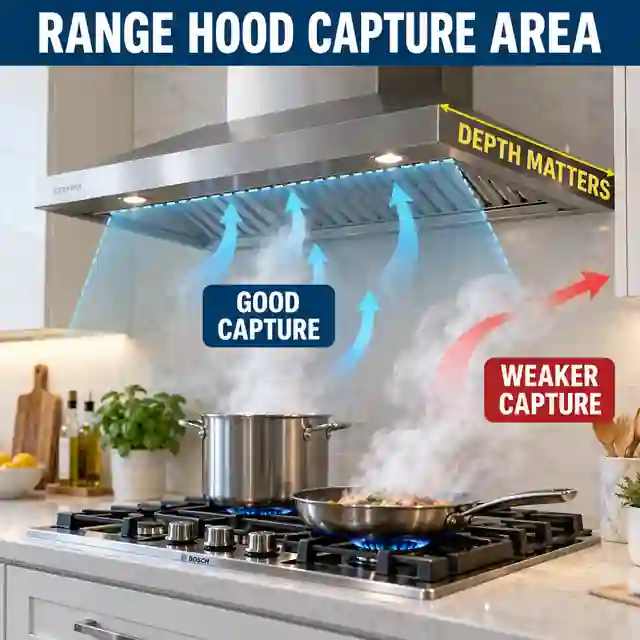
The hot cooking plume naturally rises, but front burners and tall pans can push it beyond a shallow hood.
A deeper or slightly wider hood can improve capture without relying only on a larger blower.
Island hoods work in open air and are more exposed to cross-drafts, so they usually need more capture area and airflow.
Installing a hood higher than its approved range can reduce capture even when the blower rating stays the same.
1. Start With Cooktop Width and Hood Location
For a straightforward residential starting point, the Home Ventilating Institute recommends about 100 CFM per linear foot of cooking surface for a hood against a wall and about 150 CFM per linear foot for an island hood. Convert the cooktop width to feet, multiply by the appropriate rate and then compare the result with the actual hood models available.
Wall hood planning airflow:
CFM ≈ cooktop width in feet × 100

Island hood planning airflow:
CFM ≈ cooktop width in feet × 150

Metric conversion:
m³/h ≈ CFM × 1.699
Why wall and island hoods use different starting rates
| Installation | Planning rate | Why the difference | What to watch |
|---|---|---|---|
| Against a wall | about 100 CFM per ft | The rear wall helps contain the rising plume | Front-burner capture, hood depth and mounting height |
| Island or peninsula | about 150 CFM per ft | The plume is exposed to room air and cross-drafts on more sides | Larger capture area, ceiling height, nearby supply air and open-plan airflow |
What CFM is a reasonable starting point for a 30 in electric or induction range against a wall?
Answer: Thirty inches is 2.5 ft. Using 100 CFM per linear foot gives about 250 CFM. In the real market you would normally compare the nearest suitable model size at or above that target, while checking hood dimensions, duct size and the manufacturer's installation instructions.
Explanation: The width method gives a source-capture starting point. It is more useful than sizing only from the kitchen floor area because the hood is intended to catch contaminants where they are produced.
What about a 36 in cooktop in an island?
Answer: Thirty-six inches is 3 ft. Using 150 CFM per linear foot gives about 450 CFM, or roughly 765 m³/h. A hood around that airflow range is a more sensible starting point than using the 300 CFM wall-hood value.
Explanation: Island cooking is exposed to cross-currents and lacks the rear wall that helps a wall hood contain the plume.
2. For Gas, Check the Total Burner BTU as Well
Gas cooking adds another useful sizing check because high-output burners can create a stronger thermal plume and combustion products as well as the smoke, grease and water vapour produced by cooking itself. A widely used manufacturer guideline for high-output gas equipment is approximately 1 CFM of exhaust for every 100 BTU/h of total burner input.
Gas-output planning check:
CFM ≈ total burner BTU/h ÷ 100

Example:
60,000 BTU/h ÷ 100 = 600 CFM
Gas cooktop output and the 1 CFM per 100 BTU planning check
| Total burner input | BTU-based airflow check | Approx. metric airflow |
|---|---|---|
| 30,000 BTU/h | 300 CFM | 510 m³/h |
| 40,000 BTU/h | 400 CFM | 680 m³/h |
| 50,000 BTU/h | 500 CFM | 850 m³/h |
| 60,000 BTU/h | 600 CFM | 1,020 m³/h |
| 80,000 BTU/h | 800 CFM | 1,360 m³/h |
A 36 in wall-mounted gas range has 60,000 BTU/h of total burner input. Which number should you use: 300 CFM by width or 600 CFM by BTU?
Answer: The width check gives 300 CFM, while the gas-output check gives 600 CFM. For preliminary selection, 600 CFM is the stronger signal. Then verify the exact range manufacturer's ventilation requirement, the hood capture area, duct size and any make-up-air implications before buying.
Explanation: The BTU check catches a high-output appliance that could look ordinary if you sized the hood only by its 36 in width.
Do not assume every gas cooktop needs 1 CFM per 100 BTU regardless of model. Treat it as a planning check for higher-output cooking equipment and follow the appliance and hood manufacturers when they provide a specific ventilation requirement.
3. Electric and Induction Still Need Real Ventilation
Electric resistance and induction cooktops do not create the same combustion products as a gas flame, so their ventilation problem is generally simpler. They still produce cooking-generated particles, grease aerosols, odours, moisture and smoke. Frying bacon on induction does not become an indoor-air-quality hobby just because there is no flame under the pan.
How cooktop type changes the sizing conversation
| Cooktop type | Useful first sizing check | What can push the hood larger |
|---|---|---|
| Induction | Cooktop width and hood location | Frequent frying, searing, wok cooking, large front burners, island installation or high mounting |
| Conventional electric | Cooktop width and hood location | Heavy steam, high-heat cooking, open-plan cross-drafts or weak capture geometry |
| Standard gas | Width plus appliance/manufacturer guidance | Higher total BTU, front burner use, grill or griddle, island installation |
| Professional-style gas | Manufacturer ventilation requirement plus output and capture area | High burner output, integrated grill/griddle, large cooking surface and make-up-air needs |
For induction, do not buy a tiny hood simply because the cooktop is efficient. The heat source changed; the frying pan did not. Size for capture, cooking style and installation, not only for fuel type.
4. Hood Width Can Matter as Much as Fan Power
A hood should generally be at least as wide as the cooking surface unless the specific product instructions say otherwise. More capture area can be especially useful over islands, front-heavy cooking layouts and high-heat appliances. A wider hood gives the rising plume more room to enter the hood before room air carries it away.
Practical hood-width choices
| Cooktop | Wall installation | Island installation | Planning note |
|---|---|---|---|
| 30 in | 30 in hood is the basic match; 36 in can improve capture where space allows | 36 in is often worth considering | Check cabinet and ceiling clearances before upsizing |
| 36 in | 36 in minimum match; 42 in can improve capture for demanding cooking | 42 in can provide useful side overhang | Follow the hood and appliance instructions |
| 48 in | 48 in basic match; wider professional hood may be specified | Wider capture area is commonly desirable | Large systems also drive duct and make-up-air decisions |
A wider capture area catches what extra CFM cannot chase later
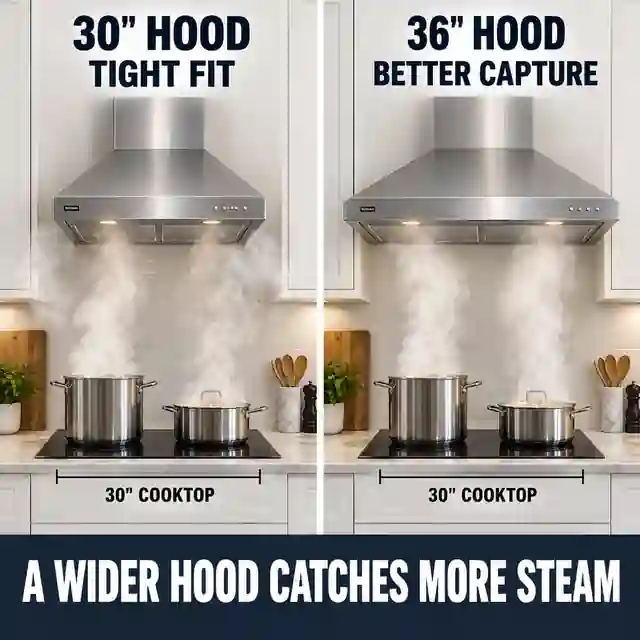
At minimum, match the hood to the cooking surface unless the product instructions specify another arrangement.
A few extra inches of overhang can help catch a plume that spreads beyond the pan, particularly in an island layout.
Width does not excuse poor depth: front burners can still sit outside a shallow capture zone.
Confirm adjacent cabinet clearances and the approved hood size before finalising the kitchen design.
5. Mounting Height Changes Capture
Every hood has an approved or recommended mounting-height range. Install it too low and you can create clearance, heat or usability problems. Install it too high and the cooking plume has more time to spread before it reaches the hood. A larger blower does not automatically repair a hood that is positioned outside the manufacturer's intended geometry.
Do not copy a generic 24, 30 or 36 inch mounting height from another kitchen. Gas and electric appliances can have different minimum clearances, and decorative or professional hoods can use different ranges. The exact hood and cooking appliance instructions must agree.
6. The Duct Can Turn a Strong Hood Into a Weak One
A range hood does not deliver its showroom airflow through any duct you happen to have. Long runs, undersized ducts, sharp elbows, restrictive transitions and poor terminations increase resistance. Manufacturers repeatedly recommend short, straight duct runs and the specified duct size because the fan has to work against the entire path to outdoors.
- Use the duct size specified for the exact hood or blower; do not reduce it simply to fit an old opening.
- Prefer smooth metal ductwork where required or recommended for the range hood system.
- Keep the route short and direct, with as few turns and transitions as practical.
- Use a proper exterior wall or roof cap and keep its damper free to operate.
- Seal joints as instructed so greasy exhaust does not leak into cabinets, ceilings or wall cavities.
- Check the manufacturer's equivalent-length or maximum-duct guidance instead of inventing a fixed CFM penalty for every elbow.
Two 600 CFM hoods can perform very differently after the duct is connected
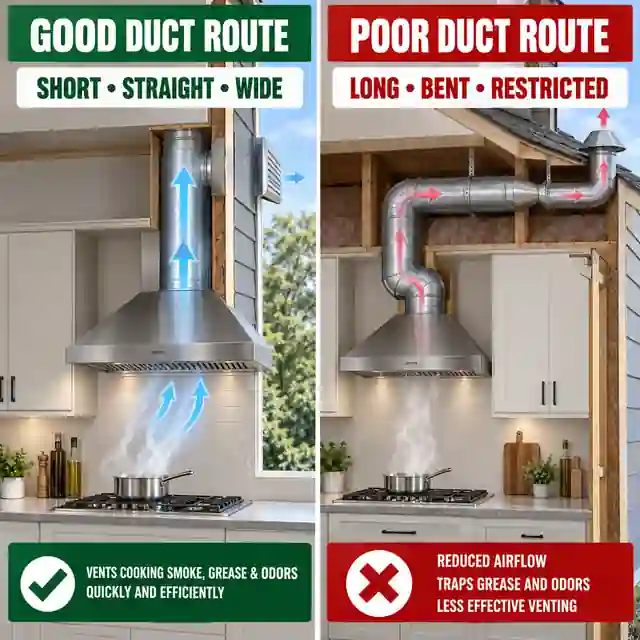
A short, correctly sized route lets the blower operate closer to its intended performance.
Each elbow and transition adds resistance, especially when the duct is already too small.
Do not reduce an 8 in outlet to a convenient old 6 in duct unless the manufacturer explicitly permits that configuration.
Plan the duct before ordering cabinets; the shortest path to outdoors is easier to draw before the kitchen is built.
If the only possible duct route needs several turns and a long horizontal run, choose the route and duct size first, then shortlist hoods that are actually approved to work with it. Do not buy the fan first and ask the ceiling to negotiate later.
Rated CFM Is Not Always Delivered CFM
The number printed on a product page may describe a maximum blower rating, a certified airflow at a test condition or another manufacturer figure. Installed airflow can be lower once the real duct system adds static pressure. When comparing serious candidates, look beyond the largest number in the marketing headline.
Airflow numbers you may encounter
| Term | What it generally means | How to use it |
|---|---|---|
| Maximum / nominal CFM | Headline blower or product airflow figure | Useful for broad comparison, but not proof of installed performance |
| Certified airflow | Performance tested to a recognised procedure where applicable | Better basis for comparing like-for-like products |
| Delivered / operating airflow | Air actually moved through the installed system | Depends on duct resistance, fittings and system setup |
| Capture efficiency | How much of the cooking plume enters and is removed by the hood | Strongly affected by hood geometry and installation, not only CFM |
Ducted vs Recirculating: They Solve Different Problems
A ducted hood sends captured air outdoors. A recirculating or ductless hood passes air through grease and usually odour filters before returning it to the kitchen. Recirculation can be useful where exterior ducting is impossible, but it is not equivalent to exhausting moisture, heat and combustion products outdoors.
Ducted and recirculating range hoods
| Feature | Ducted hood | Recirculating / ductless hood |
|---|---|---|
| Where the air goes | Outdoors through a duct | Back into the kitchen after filtration |
| Grease capture | Filter plus exhaust path | Grease filter; maintenance is critical |
| Odours | Removed outdoors when captured | Reduced by charcoal or other odour filter, with limits |
| Moisture | Exhausted outdoors | Remains in the home |
| Gas combustion products | Can be exhausted when captured | Not removed outdoors |
| Planning priority | Capture plus duct design | Capture plus filter performance and replacement schedule |
Make-Up Air: Why Very Large Exhaust Fans Need More Planning
A powerful hood removes a large amount of indoor air. That air has to be replaced from somewhere. In a leaky older house it may arrive unintentionally through cracks; in a tighter home the pressure difference can become much more significant. The concern is not only comfort. Depressurisation can interact with fireplaces and naturally drafted fuel-burning appliances, so make-up air belongs in the design conversation before a high-CFM hood is purchased.
The often-repeated “over 400 CFM needs make-up air” rule is not universal everywhere. For example, the 2024 International Residential Code ties its domestic kitchen make-up-air requirement above 400 CFM to specific conditions involving fuel-burning appliances inside the dwelling air barrier. Your adopted local code, appliance setup and jurisdiction may use different triggers or exceptions.
When to investigate make-up air early
| Situation | Why it deserves attention |
|---|---|
| Hood above 400 CFM | A common point where North American code discussions and local requirements may change |
| Very tight or recently air-sealed home | Natural replacement air is limited |
| Atmospherically vented fireplace, water heater, boiler or furnace | Depressurisation can affect draft under some conditions |
| Large professional range and 600–1,200+ CFM hood | The exhaust rate is large enough to influence whole-house pressure |
| Cold or hot climate | Unconditioned replacement air can create comfort and energy penalties |
| Open-plan house with other exhaust fans | Multiple exhaust devices can operate at the same time |
Every cubic foot exhausted has to be replaced somehow
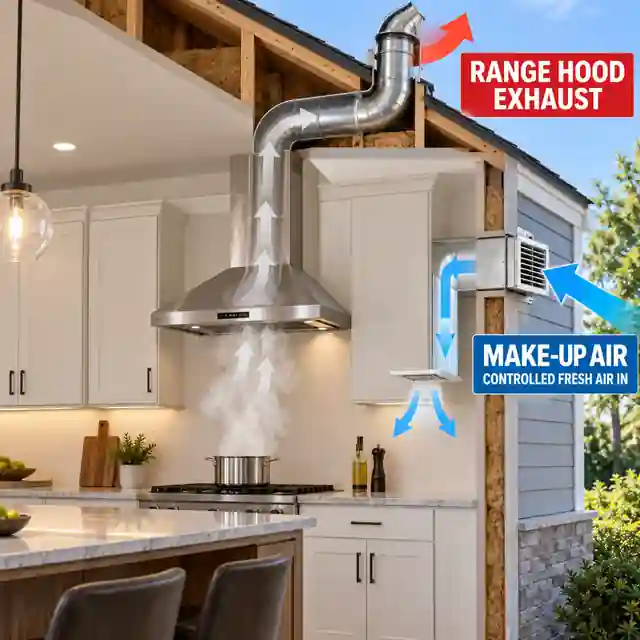
The hood pushes indoor air outdoors and lowers pressure unless replacement air can enter.
A planned make-up-air path is different from hoping air leaks through random gaps.
Fuel-burning appliances and fireplaces can make pressure balance a safety issue, not only an energy issue.
The correct make-up-air strategy depends on the adopted code, climate, appliance venting and total exhaust system.
Cooking Style Can Matter More Than the Fuel Label
Someone simmering soup twice a week and someone searing steaks on cast iron every evening do not create the same plume. If you regularly fry, wok-cook, griddle, blacken, boil large pots or use multiple burners at high output, give more weight to capture area, higher usable fan speeds and a duct system that can support them.
Cooking habits and ventilation demand
| Cooking pattern | Typical demand | What helps |
|---|---|---|
| Light simmering, reheating, gentle induction cooking | Lower | Good source capture at a moderate quiet speed |
| Daily mixed family cooking | Moderate | Multiple fan speeds and a hood at least as wide as the cooktop |
| Frequent frying or searing | Higher grease, smoke and particles | More capture depth/width and higher usable airflow |
| Large pots and heavy steam | High moisture plume | Strong capture and outdoor exhaust where possible |
| Wok, grill or griddle | High heat and spreading plume | Manufacturer-specific hood sizing; often larger capture and airflow |
| Professional-style gas cooking | High heat plus combustion products | Appliance-specific ventilation design, duct and make-up-air review |
Does Kitchen Volume Matter? Use It as a Cross-Check, Not the Main Hood Rule
You will sometimes see range hoods sized from kitchen volume and air changes per hour. Room-volume ventilation can be useful as a secondary check, especially when comparing general kitchen exhaust. But an overhead range hood is a source-capture device: catching the plume above the cooktop is usually more important than exchanging the entire room volume a chosen number of times.
Room-volume cross-check:
CFM = kitchen volume in ft³ × desired air changes per hour ÷ 60

Example only:
12 ft × 15 ft × 9 ft = 1,620 ft³
1,620 × 10 ACH ÷ 60 = 270 CFM
Do not use a room-volume result to override a stronger source-capture, gas-output or manufacturer requirement. A large kitchen does not automatically need a hurricane over the stove, and a small kitchen can still contain a very powerful gas range.
Worked Examples: Gas, Electric and Induction
Four practical sizing examples
| Kitchen setup | First calculation | What I would check next | Practical starting target |
|---|---|---|---|
| 30 in induction, wall hood | 2.5 ft × 100 = 250 CFM | Hood depth, cooking style, duct route | Around 250 CFM or next suitable model size |
| 36 in electric, island hood | 3 ft × 150 = 450 CFM | Island capture width, cross-drafts, ceiling route | Around 450 CFM or suitable nearby rating |
| 36 in gas, wall hood, 60,000 BTU/h | 300 CFM by width; 600 CFM by BTU | Range instructions, duct size, make-up-air implications | Use 600 CFM as the stronger preliminary check |
| 48 in high-output gas island | 4 ft × 150 = 600 CFM before BTU check | Total BTU, grill/griddle, larger hood, duct and make-up air | Manufacturer-specific design likely controls |
Do Not Forget Noise, Filters and the Speeds You Will Actually Use
The most powerful speed is useful only if you are willing to turn it on. A hood that is painfully loud at the airflow you need may spend its life on low speed while smoke escapes around it. In North America, hood noise is often listed in sones; elsewhere you may see dB(A). Compare sound at realistic operating speeds when the manufacturer publishes it.
- Choose multiple useful speed steps rather than focusing only on the maximum setting.
- Check whether airflow and sound ratings are certified or independently tested where applicable.
- Make sure grease filters are easy to remove and clean; a neglected filter adds resistance and becomes a maintenance problem.
- For recirculating models, price and availability of charcoal or odour filters matter over the life of the hood.
- Check lighting quality, controls and filter indicators because the hood is used every time you cook, not only during dramatic frying.
- Compare the hood's required electrical supply and installation instructions before cabinets and finishes are complete.
Common Range Hood Sizing Mistakes
Mistake, why it causes trouble and a better approach
| Mistake | What goes wrong | Better approach |
|---|---|---|
| Buying by CFM alone | A shallow or narrow hood may still miss the plume | Check capture width, depth and mounting height |
| Using only kitchen floor area | The source above the cooktop is ignored | Start with cooktop width and hood location |
| Ignoring gas BTU | A high-output range can be undersized | Check total burner input and appliance guidance |
| Assuming induction needs almost no ventilation | Cooking particles, grease and moisture still exist | Size for cooking and capture, not combustion alone |
| Reducing the duct to fit an old opening | Static pressure rises and airflow can fall | Use the specified duct size |
| Adding a fake fixed CFM penalty per elbow | Different systems have different pressure losses | Use manufacturer duct limits or performance data |
| Installing the hood too high | The plume spreads before entering the hood | Stay within the approved mounting range |
| Treating ductless as outdoor exhaust | Moisture and combustion products remain indoors | Understand what the filters actually remove |
| Buying 900 CFM before checking make-up air | Pressure, duct and code problems appear after purchase | Plan the whole air path first |
| Ignoring noise | The hood is left on a lower speed than intended | Compare sound at the airflow you will use |
Range Hood Size and CFM FAQ
Quick answers to common range hood questions
| Question | Short answer |
|---|---|
| How many CFM do I need for a 30 in range? | A 30 in wall installation starts around 250 CFM using 100 CFM per linear foot. An island starts around 375 CFM. High-output gas can require more. |
| Is 400 CFM enough for a gas range? | It can be for some ranges. A 40,000 BTU/h high-output planning check gives about 400 CFM, while 60,000 BTU/h gives about 600 CFM. Always check the appliance guidance. |
| Do induction cooktops need a range hood? | Yes, ventilation is still valuable because cooking produces grease, particles, odours and moisture even without gas combustion. |
| How many CFM for a 36 in island cooktop? | About 450 CFM is the HVI-style width starting point: 3 ft × 150 CFM per ft. |
| Should the hood be wider than the range? | At least matching the cooktop is a sensible baseline. A wider hood can improve capture, especially on islands and for heavy cooking, if the product and kitchen layout allow it. |
| Is a recirculating hood the same as a ducted hood? | No. Recirculation filters and returns air indoors; a ducted hood exhausts captured air outdoors. |
| What duct size should a 600 CFM hood use? | Use the duct size specified for the exact hood or blower. Do not infer it from CFM alone or reduce the outlet to fit an old duct. |
| Is more CFM always better? | No. Extra airflow can add noise, larger duct requirements, pressure imbalance and make-up-air complications without fixing poor capture geometry. |
Final Range Hood Buying Checklist
- Cooktop or range width is confirmed from the actual appliance.
- Wall, peninsula or island location is known.
- The hood is at least as wide as the cooking surface unless the approved design says otherwise.
- The width-based CFM starting point has been calculated.
- For gas, total burner BTU and the appliance manufacturer's ventilation guidance have been checked.
- Heavy frying, searing, wok, grill or griddle use has been considered.
- The selected hood can be installed within its approved height range.
- The duct diameter or rectangular size matches the manufacturer's requirement.
- The route to outdoors is short enough and uses as few restrictions as practical.
- The wall or roof termination is compatible with the system.
- Rated airflow, sound and fan-speed data have been compared rather than only maximum CFM.
- Make-up-air and pressure-balance requirements have been checked before selecting a high-CFM hood.
- Fuel-burning appliances and fireplaces have been considered as part of the pressure-safety review.
- Recirculating filtration has not been mistaken for outdoor exhaust.
- Filter cleaning and replacement are practical for everyday use.
Technical References Worth Checking
Home Ventilating Institute: range hood airflow recommendations and certified-performance guidanceBroan-NuTone: range hood CFM, ductwork and installed-performance guidance2024 International Residential Code Chapter 15: domestic cooking exhaust and make-up-air provisionsThe right range hood is the one that captures your cooking plume at a usable noise level and can move the required air through the duct system your house can actually support. Start with width and location, add the gas-output check when relevant, then verify hood geometry, mounting height, ducting and replacement air before paying for a larger blower.
Open the HomDera Range Hood CFM Calculator