
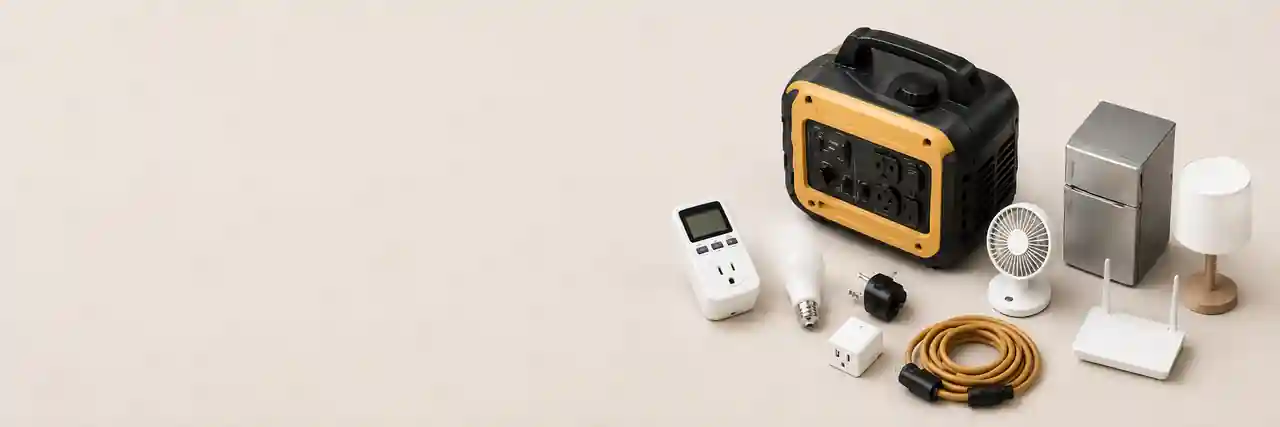
A generator has two limits, and both must pass
The two checks made by the calculator
| Check | What the calculator adds | What the product specification must provide |
|---|---|---|
| Continuous operation | The running watts of every appliance expected to operate at the same time, plus the selected allowance. | A rated, running, continuous or nominal output at least as high as the result. |
| Startup event | The highest selected startup scenario, plus the same allowance. | A starting, surge, peak or maximum output that can support the result for the required duration. |
A product described as a 5,000-watt generator may mean 5,000 starting watts rather than 5,000 watts available continuously. Compare the calculator results with both ratings, not with the largest number printed on the housing.
Build the load plan in four short passes
- Add only the appliances that genuinely need generator power during the same operating period.
- Choose a preset for speed, then replace its figures with the exact nameplate, manual or measured values available for your appliance.
- Set the quantity to the number of identical units that may run at once.
- Decide whether one motor starts at a time or whether a simultaneous-start scenario is genuinely possible.
The easiest way to reduce generator size is often load management rather than deleting essential equipment. Avoid operating a kettle, portable heater or microwave during the startup of a pump, refrigerator or air conditioner.
Preset watts are placeholders, not regional specifications
The appliance menu provides editable planning values so the first estimate takes only a few clicks. Actual demand can differ because of appliance size, age, motor design, climate rating, voltage, frequency and regional product versions. Ordering decisions should use the exact equipment data available in your market.
How to treat different loads
| Load type | Typical characteristic | Best source for the input |
|---|---|---|
| Resistive heating | Kettles, toasters and portable heaters usually draw close to their full stated power while operating, without a large motor-start surge. | Nameplate input watts or the manufacturer’s rated consumption. |
| Electronic equipment | Routers, televisions and computers are generally steady loads, although power supplies may have brief inrush current. | Documented input power, a reliable power meter or manufacturer guidance. |
| Motors and compressors | Pumps, refrigerators, blowers and air conditioners may need a substantially higher starting output for a short period. | Documented starting watts, locked-rotor data interpreted by a qualified person, or a suitable measured startup value. |
Choose the startup assumption deliberately
Available calculation scenarios
| Scenario | How the peak is calculated | When it is useful |
|---|---|---|
| One motor starts at a time | One appliance changes from running watts to starting watts while all other selected loads remain at their running level. | Most managed home-backup plans where large loads are started in sequence. |
| All selected loads start together | The starting watts of every selected unit are added at the same time. | A deliberately conservative check or an installation where controls may restore several loads simultaneously. |
The simultaneous-start option can produce a much larger result and should not be selected automatically. It represents a different operating plan, not an extra safety percentage.
The same wattage does not guarantee global compatibility
Checks that sit outside the watt calculation
| Item | Why it matters across the UK, US, Canada and Australia |
|---|---|
| Voltage and frequency | The generator output must match the appliance and the local installation. A watt result does not resolve 120 V, 120/240 V, 230 V, 50 Hz or 60 Hz compatibility. |
| Outlet rating and connector | A generator may have enough total output while one individual receptacle, lead or connector cannot supply the required current. |
| Building connection | Transfer equipment, neutral treatment, earthing or grounding and inspection requirements vary by installation and jurisdiction. |
| Output quality | Sensitive electronics, controls, pumps and heating equipment may impose waveform, voltage-regulation or manufacturer-specific requirements. |
Available generator output may be reduced by altitude, ambient temperature or other operating conditions. Apply the derating instructions supplied for the exact generator rather than adding a universal correction in this calculator.
Before relying on the result
- confirm which loads really operate at the same time;
- verify every motor or compressor startup figure;
- compare rated output and starting output separately;
- check the duration for which the generator can provide its stated surge output;
- confirm the rating of each outlet, extension lead and distribution device;
- follow the appliance and generator manufacturers’ installation instructions.
Portable-generator safety is not part of the sizing formula
Never operate a fuel-powered portable generator inside a home, garage, basement, shed or other enclosed or partly enclosed space. Place it outdoors well away from doors, windows and vents, direct the exhaust away from buildings and use working carbon-monoxide alarms.
Never backfeed a building through a wall outlet. A generator supplying fixed household circuits requires suitable transfer equipment that isolates the utility supply and installation by a qualified electrician under the rules that apply locally.
What this calculator does not size
The result covers appliance running watts and a selected startup scenario. It does not select fuel capacity, runtime, conductor size, protective devices, transfer equipment, grounding or earthing arrangements, neutral configuration, weather protection, emissions controls or a generator suitable for medical and other life-safety equipment.
Read how HomDera handles assumptions, editable defaults, rounding and the limits of planning calculators.