
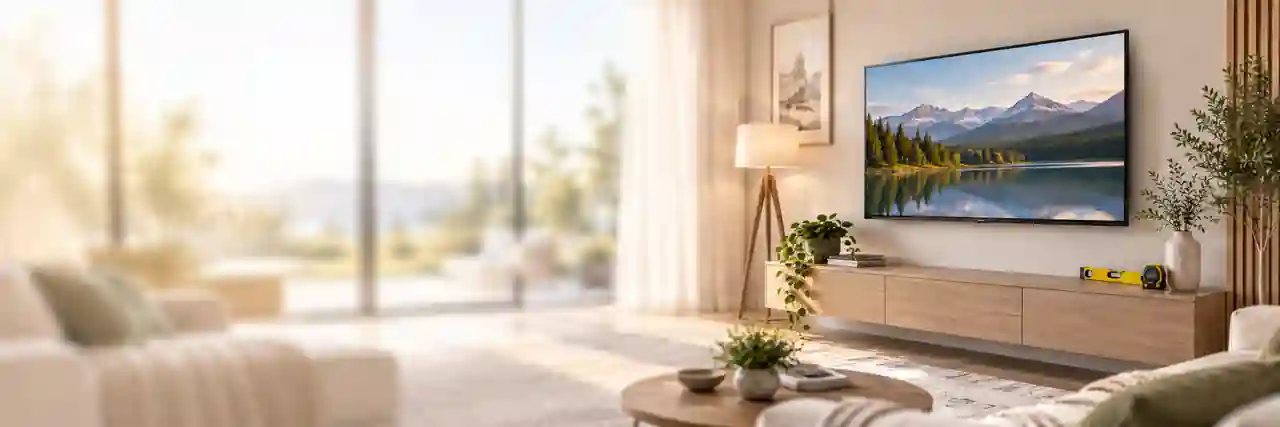
Find the TV center, bottom and top before you drill
A useful TV mounting height calculator should answer the marks you actually need on the wall. Enter the screen diagonal and your measured seated eye height, and HomDera returns the recommended screen center plus the estimated bottom and top edge heights. Those two required inputs are enough for a normal open-wall installation.
The baseline is intentionally simple: place the screen center at the eye level of the person in the main viewing position. Screen size then determines how far the panel extends above and below that center. A 75-inch TV is not automatically mounted with a higher center than a 55-inch TV just because the screen is larger.
- floor-to-center TV mounting height
- bottom edge height for a wall mark
- top edge height
- estimated 16:9 screen height from the advertised diagonal
- optional adjustment when furniture or a mantel forces the TV upward
- optional top-edge viewing-angle check using the real seating distance
Only TV diagonal and seated eye height are required. Viewing distance, a minimum bottom edge and the actual TV cabinet height are optional Advanced settings so a quick answer does not turn into a long setup form.
Measure seated eye height instead of copying a universal number
A frequently quoted starting point is around 42 inches from the floor to the screen center for sofa viewing. That can be useful as a sense check, but your own measurement is better. Seat height, cushions, posture and body height can move the eye line enough to make a copied number feel wrong in the finished room.
The two required inputs
| Input | How to get it | What it controls |
|---|---|---|
| TV diagonal | Use the advertised screen size, such as 55, 65, 75 or 85 inches | Estimates the height of a standard 16:9 picture area |
| Seated eye height | Sit in the main viewing position and measure vertically from the finished floor to your eyes | Sets the baseline screen-center height |
Measure with the sofa, chair or bed set up as it will actually be used. A tape measurement from the real seat is more valuable than another chart of generic TV heights.
TV size changes the edge heights, not necessarily the center height
On an unobstructed wall, two different TV sizes can share the same center line because the viewing eye level has not changed. The larger set simply reaches farther down and farther up. This matters with media consoles: an 85-inch panel centered at the same eye height can run into furniture that a 55-inch screen clears easily.
Approximate 16:9 picture height by common TV size
| TV diagonal | Approximate screen height | Half-height above and below center |
|---|---|---|
| 55 in | 27.0 in | 13.5 in |
| 65 in | 31.9 in | 16.0 in |
| 75 in | 36.8 in | 18.4 in |
| 85 in | 41.7 in | 20.8 in |
| 98 in | 48.0 in | 24.0 in |
These are picture-area estimates derived from a 16:9 diagonal, not guaranteed outside cabinet dimensions. Once you have selected a model, use the optional actual TV height field for a more accurate top and bottom edge.
Use a minimum bottom edge when a console or mantel controls the layout
If the ideal eye-level position would overlap a console, soundbar, shelf or mantel, open Advanced settings and enter the lowest acceptable TV bottom edge measured from the floor. Include whatever visual or manufacturer-required gap you have already decided on in that number.
The calculator compares the eye-level center with the center required to clear that bottom edge. It uses the higher position and reports how far the screen center has been raised above your eye line, making the trade-off visible instead of silently calling every result “ideal.”
Do not use this field to invent fireplace clearance. Heat exposure and clearances depend on the fireplace, mantel, TV and installation instructions. The calculator only solves the geometry you enter; it does not certify a fireplace installation.
Why viewing distance is optional — and when it becomes useful
Worked example: mounting a 65-inch TV at a 42-inch eye line
How high should a 65-inch TV be mounted when seated eye height is 42 inches?
Answer: A 65-inch 16:9 picture is about 31.9 inches high. With the screen center at 42 inches, the estimated bottom edge is about 26.0 inches from the floor and the top edge is about 58.0 inches.
Explanation: The center is controlled by the viewing eye line. The screen diagonal is used to place the physical edges around that center.
Worked example: furniture forces the same TV higher
What if the bottom of that 65-inch TV must be at least 34 inches from the floor?
Answer: Half the estimated panel height is about 16 inches. A 34-inch minimum bottom therefore requires a center near 50 inches. The calculator raises the center from the 42-inch eye line to about 50 inches and, if viewing distance is entered, shows the resulting sightline angle.
Explanation: The furniture constraint is now stronger than the eye-level target, so it becomes the controlling dimension.
Actual TV height is better than diagonal geometry for final marks
The diagonal describes the screen, while the product specification lists the real cabinet dimensions. Bezels are thin on modern TVs, but a lower electronics housing or unusual design can still change the outer height. Enter actual cabinet height in Advanced settings when you know the exact model; the calculator will keep the same center logic but use the real physical height for the top and bottom marks.
Why there is no universal drill-hole height
The screen center and the wall-plate center are not interchangeable. VESA mounting holes can sit above or below the TV center, and each bracket has its own rails, plate and adjustment slots. A calculator that guesses one universal drill height can put the TV in the wrong place. Use HomDera to mark the desired TV rectangle first, then transfer the specific bracket geometry using its template and the TV manual.
TV over a fireplace: calculate the compromise, not a fake universal height
A mantel often pushes the screen well above seated eye level. Instead of giving every fireplace the same answer, enter the minimum TV bottom height required by your actual installation and add viewing distance. You will see the resulting center height and top-edge angle immediately. Then separately verify fireplace and TV manufacturer clearances, heat limits and mounting requirements.
A geometrically possible TV position is not automatically thermally safe. Fireplace installations need manufacturer-specific clearance and temperature checks that this calculator cannot replace.
Common TV mounting height mistakes
- choosing the height while standing even though the TV is watched seated
- using 42 inches as a mandatory rule instead of measuring the real eye line
- mounting a larger TV higher only because the diagonal is larger
- checking the screen center but forgetting where the bottom edge lands above furniture
- treating the advertised diagonal as the physical cabinet height
- assuming the VESA holes are centered on the TV
- drilling the bracket before mocking up the TV outline
- using a generic fireplace gap without the appliance instructions
- ignoring a reclined or lying viewing posture in bedrooms
TV mounting height FAQ
Is 42 inches the correct TV center height?
It is a common sofa-viewing starting point and SANUS uses about 42 inches as an average seated eye-level reference. It is not a substitute for measuring your own eye height, especially with low lounge seating, tall chairs or a bedroom setup.
How high should I mount a 65-inch TV?
Start with your seated eye height for the center. A 65-inch 16:9 screen is about 31.9 inches high, so its bottom sits about 16 inches below that center and its top about 16 inches above it. Furniture underneath may force the whole screen higher.
Can I use this calculator for a bedroom TV?
Yes, but measure eye height in the posture you actually use. A person watching semi-reclined in bed does not share the same eye line and neck posture as someone sitting upright on a sofa. Enter viewing distance as well when the screen is mounted above the normal seated eye line.
Does the calculator tell me where to drill the wall mount?
No — deliberately. It tells you where the TV itself should sit. Exact holes depend on the mount, VESA pattern, TV back panel and adjustment slots. Once the desired TV position is marked, use the specific wall-mount instructions to transfer the drilling points.
A seven-step check before mounting the TV
- Sit in the primary viewing position and measure your eye height from the finished floor.
- Run the calculator with the actual TV diagonal.
- Tape the calculated top, bottom and side outline on the wall before drilling.
- Check the console, soundbar, mantel, sockets, cable route and window reflections.
- If the TV must sit higher, add the minimum bottom edge and real viewing distance.
- Replace the estimated 16:9 height with the selected model's actual cabinet height for final marks.
- Confirm wall construction, fixings, TV weight, bracket capacity and the manufacturer's drilling template before installation.
The goal is not to produce one “perfect height” for every room. It is to give you a center, bottom and top that belong to your screen and your seat, then make any furniture-driven compromise visible before holes are in the wall.