
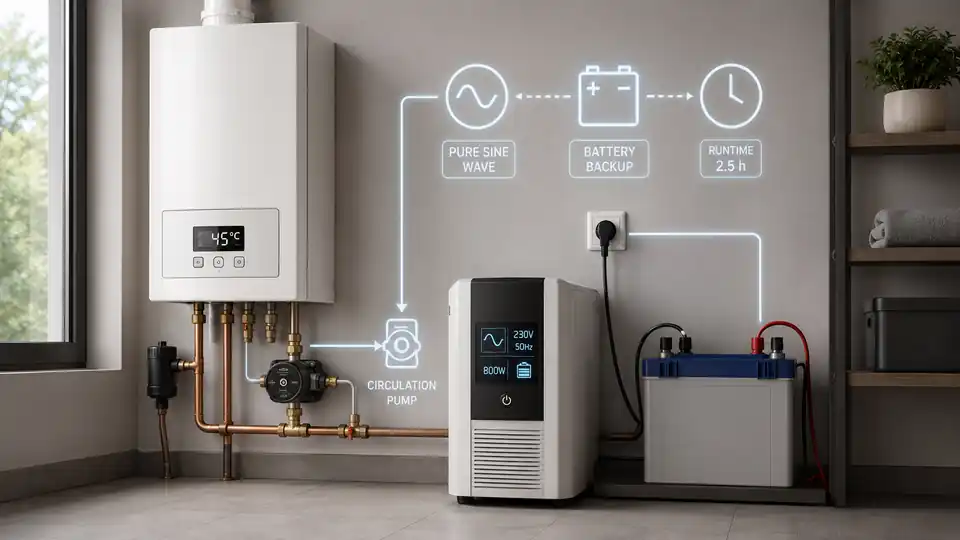
A gas boiler usually needs far less electrical power than its heating rating suggests, but choosing backup power is not as simple as buying the smallest UPS with a larger number on the box. The boiler may contain electronic controls, an ignition system, a fan and an internal circulation pump, while the heating installation may also have external pumps, zone valves, thermostats and controllers. The UPS or inverter must power the complete operating group, change over without upsetting the boiler and provide an electrical supply that the appliance accepts.
This guide is for preliminary equipment selection, not for altering a boiler or designing fixed electrical wiring. Boiler requirements, earthing or grounding arrangements, neutral treatment, transfer equipment and local rules differ. Confirm the manuals for the actual boiler, pumps, UPS or inverter and battery, and use qualified heating and electrical professionals where the system connects to fixed wiring.
What this guide will help you decide
The practical answer before the calculations
For many modern domestic gas boilers, the first sensible shortlist is a pure sine wave UPS or inverter system with a genuine continuous output in the few-hundred-watt range and enough short-duration capacity for any pumps. That is only a starting point. A boiler with one integrated high-efficiency pump can be a light load, while a system with several older pumps, mixing controls and zone equipment may need a substantially larger unit.
Choose the system from the job it must perform
| Your situation | A likely starting option | The deciding checks |
|---|---|---|
| Short outages and one simple boiler | A compatible pure sine wave line-interactive or online UPS | W and VA limits, transfer time, waveform and realistic battery runtime |
| Several hours of heating from an external battery | A UPS designed for external batteries or an inverter/charger | Approved battery voltage, charge current, battery chemistry and safe installation |
| A portable, plug-in backup arrangement | A power station with a suitable AC inverter and documented backup or pass-through function | Continuous watts, surge behaviour, transfer interruption, earthing or grounding and recharge rules |
| A fixed essential-load circuit or whole-home system | A professionally designed inverter/charger and transfer system | Isolation, protection, neutral and earth arrangement, backfeed prevention and local compliance |
Do not connect an inverter to household wiring through a wall socket or outlet. Backfeeding can expose people and equipment to dangerous voltage. A fixed backup circuit needs purpose-designed transfer equipment, protective devices and an installation that follows local requirements.
A 24 kW boiler does not need a 24 kW inverter
The large number in a boiler name usually describes heat delivered to the heating water or domestic hot water. It is not the electrical power drawn from the socket or supply connection. A boiler rated at 24 kW of heat may use roughly one hundred watts of electricity in a particular operating mode, although the real figure is model-specific.
This distinction prevents one of the most expensive sizing mistakes. Entering 24,000 W instead of the boiler's actual electrical input would produce an inverter and battery estimate intended for electric heating rather than for controls, a fan and a pump.
Numbers on a boiler that answer different questions
| Specification | What it describes | Use in backup sizing |
|---|---|---|
| Heating output, for example 24 kW | Heat transferred to the heating system or hot water | Do not use it as the inverter load |
| Maximum electrical power, for example 100–150 W | The highest stated electrical input for the boiler model | Useful for a cautious running-load estimate |
| Standby power | Consumption while the boiler is waiting | Useful for energy estimates, but not enough for sizing the operating load |
| Supply voltage and frequency | The AC supply the appliance is designed to receive | Must match the UPS or inverter output |
| Fuse or circuit information | Protection and connection requirements | Not the same as normal electrical consumption |
Look for “electrical power consumption”, “maximum electrical input”, “power supply” or similar wording in the installation manual. When the label and the manual show different operating figures, ask the boiler manufacturer or installer which value should be used for backup-power planning.
Build a load list for the whole heating system
The boiler is only one possible load. The safest way to avoid omissions is to follow the heating circuit physically and identify every powered component that must remain available during an outage. Some components are inside the boiler casing; others may be beside a cylinder, manifold, mixing station or distribution panel.
What may need power when the gas is still available
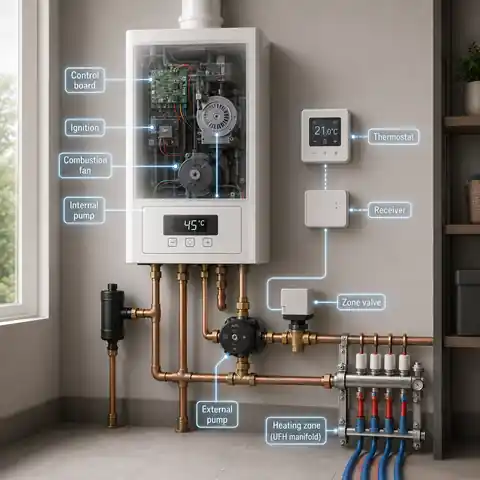
The boiler can include a control board, ignition electronics, combustion fan and an internal pump.
A separate hot-water cylinder, underfloor-heating manifold or additional zone may have its own circulation pump.
Thermostats, receivers, motorised valves and system controllers usually draw less power, but the heating sequence may fail without them.
Only include devices that genuinely need to operate from the backup supply, but do not omit a component that the boiler depends on.
Find values on the actual installed equipment
| Component | Where to find the electrical value | Common counting mistake |
|---|---|---|
| Boiler | Data plate, installation manual or manufacturer technical sheet | Using thermal output instead of electrical input |
| Integrated boiler pump | Usually included in the boiler's stated maximum electrical input | Adding it again as a separate pump |
| External circulation pump | Pump label or pump manual | Using hydraulic output or a model-family maximum without checking the installed unit |
| Zone valve or actuator | Actuator label and controller documentation | Forgetting that several zones may energise together |
| Thermostat receiver or control hub | Power adapter, receiver label or manual | Assuming a wireless thermostat means every part is battery powered |
| Condensate pump or auxiliary equipment | Equipment label and manual | Discovering only during an outage that the boiler locks out when it cannot drain |
Not every heating system has every item in the table. Do not add generic loads simply to make the calculation look safer. Use the actual installed equipment and then apply a transparent reserve for uncertainty.
UPS, inverter/charger or portable power station?
These products overlap, but they are not interchangeable labels. The best choice depends on how quickly power must transfer, how long the heating must run, whether the battery is built in or external, and whether the installation is temporary or fixed.
How the main backup options differ
| Option | Strength | Limitation to investigate |
|---|---|---|
| Small computer-style UPS | Automatic changeover and a compact package | Internal batteries may provide only minutes; waveform, W rating and external-battery support vary |
| Long-runtime UPS with an approved external battery | Automatic operation with battery capacity selected for the required hours | Charging current, battery voltage, chemistry and maximum supported capacity must be compatible |
| Inverter/charger | Flexible battery-bank sizing, charging and transfer functions | Usually needs more design work, protection, configuration and professional installation |
| Portable power station | Simple integrated battery, inverter, display and charger | Some units interrupt the output during transfer, limit pass-through operation or use power-saving modes that may not suit a boiler |
| Stand-alone inverter without charger or transfer | Can power a load from a battery | Does not automatically recharge or change over unless the rest of the system is added correctly |
The word “UPS” does not guarantee pure sine wave output, long runtime or boiler compatibility. Likewise, an inverter/charger may have a UPS mode, but the transfer behaviour and electrical configuration still have to be checked in its manual. Compare functions and measured specifications rather than product-category names.
Six compatibility checks matter before battery size
1. Output voltage and frequency
The backup unit must match the boiler version. A 230 V, 50 Hz appliance should receive a compatible 230 V, 50 Hz supply; a 120 V, 60 Hz appliance needs the corresponding output. Do not assume that a product sold under the same boiler name in another country uses identical electrical specifications.
2. Pure sine wave output
Pure sine wave is the safest general choice for electronic boiler controls, combustion fans and circulation pumps. A modified or stepped waveform may work with some equipment, but it can also lead to noise, additional heating, failed starts or control faults. Use another waveform only when the equipment manufacturer confirms compatibility.
3. Continuous watts and volt-amperes
UPS products commonly show both VA and W. These are not automatically the same usable number. The connected equipment must fit within the continuous watt limit and the VA limit at the same time. For an approximate check, apparent power in VA can be estimated as watts divided by power factor, but measured or manufacturer data are preferable for pumps and complete boiler systems.
A heating system is expected to use 240 W at a power factor of 0.80. What minimum VA value does that imply?
Answer: Approximate apparent power = 240 W ÷ 0.80 = 300 VA.
Explanation: A unit marked 300 VA is not automatically suitable, because its separate watt rating may be below 240 W and no reserve has been included. Check both manufacturer limits and leave justified headroom.
4. Pump starting and inrush behaviour
A circulation pump may briefly demand more current when energised, but one universal multiplier cannot describe every pump. Older induction motors, modern electronically controlled circulators and pumps with inrush-limiting electronics behave differently. Use the pump manual, a suitable measurement or model-specific advice rather than assuming that every pump starts at three times its running watts.
A UPS can pass the normal running-load test and still shut down when a pump starts. Check its overload amount and duration, not only a marketing phrase such as “high surge capacity”.
5. Transfer time and restart behaviour
A line-interactive UPS normally has a brief interruption while it changes to battery power; an online double-conversion UPS normally supplies the load continuously through its inverter. Inverter/chargers and power stations have their own behaviour. The boiler may ignore a short interruption, reboot cleanly or show a fault, so the product specification and a controlled test with the actual boiler are more useful than a generic promise of “uninterrupted” power.
6. Neutral, earth and polarity behaviour
Some boilers operate normally from utility power but refuse to ignite from an inverter even though the voltage and watts look correct. One possible cause is the way the backup source treats live, neutral and protective earth, or whether its output is floating. Flame-detection circuits and protective devices can depend on an appropriate electrical reference. This is an installation issue, not a reason to improvise a neutral-to-earth link.
Do not swap conductors, remove protective earth or add a neutral-earth bond as a trial fix. The correct arrangement depends on the inverter design, transfer method and local electrical system. Have it checked by a qualified professional using the boiler and inverter documentation.
How to size the UPS or inverter in a sensible order
- Record the boiler's maximum electrical input, supply voltage and frequency from model-specific documentation.
- Add each external pump, controller, valve, receiver and auxiliary device that must operate during the outage.
- Determine the highest credible normal combination rather than adding equipment that cannot operate together.
- Apply a reasonable planning reserve to the continuous load. Around 20–25% can be useful for an early estimate, but it is not a universal rule.
- Check pump or fan startup separately using documented or measured inrush data where available.
- Convert the load to approximate VA when power-factor information is available, then compare both the W and VA ratings.
- Confirm pure sine wave output, voltage, frequency, transfer behaviour and any manufacturer compatibility requirements.
- Only after the power checks are complete, calculate battery energy for the required number of hours.
A boiler has a maximum electrical input of 110 W. One external pump uses 60 W and the controls use 20 W. The pump may briefly require 180 W. What preliminary UPS or inverter output should be checked with a 20% reserve?
Answer: Normal load = 110 + 60 + 20 = 190 W. With 20% reserve, the continuous guide is 228 W. The pump-start scenario = 110 + 180 + 20 = 310 W. With 20% reserve, the startup guide is 372 W.
Explanation: The selected product should provide at least 228 W continuously and at least 372 W for long enough to start the pump. Its VA limit, waveform and transfer behaviour must also suit the complete system. A practical product may be larger than these calculated minimums because standard ratings, temperature derating and battery conditions have to be considered.
Do not convert the 372 W startup result into a claim that any 400 W inverter will work. The battery may sag, the UPS may allow its overload for too short a time, or the output reference may be unsuitable for the boiler. Sizing is a sequence of checks, not one final number.
Battery capacity answers a different question
Inverter power determines whether the system can operate at a particular moment. Battery capacity determines how long it can continue. A large inverter connected to a small battery may start the boiler successfully and then stop after a short time. A large battery connected to an undersized inverter may never start the pump.
A useful planning method is to calculate the energy required by the adjusted running load, then allow for inverter losses and the usable part of the battery. Nominal battery energy in watt-hours is approximately voltage multiplied by amp-hours. The complete estimate can be expressed as: required nominal energy = adjusted load × hours ÷ inverter efficiency ÷ usable battery fraction.
Using the 228 W planning load from the previous example, what nominal battery capacity is needed for six hours at 90% inverter efficiency and 80% usable battery capacity?
Answer: Energy delivered to the load = 228 × 6 = 1,368 Wh. Required nominal battery energy = 1,368 ÷ 0.90 ÷ 0.80 = 1,900 Wh. That is about 158 Ah at 12 V, 79 Ah at 24 V or 40 Ah at 48 V.
Explanation: The values describe equivalent nominal energy, not interchangeable battery products. The battery must also support the required current, its BMS or discharge limits, the charger's profile and the installation conditions. A lead-acid design using a smaller usable fraction would require more nominal capacity.
What changes real boiler runtime
| Factor | Why it matters | Planning response |
|---|---|---|
| Boiler and pump cycling | The average load may be lower than the maximum electrical input | Measure energy over a representative cold-weather period when possible |
| Outdoor temperature and heat demand | Colder conditions can increase burner, fan and pump operating time | Do not base winter backup solely on a mild-day test |
| Battery age and state of charge | Available capacity falls when the battery is worn or not fully charged | Include condition and recharge time in the maintenance plan |
| Battery temperature | Cold conditions can reduce available energy and voltage under load | Install and rate the battery within its permitted temperature range |
| UPS or inverter self-consumption | The electronics consume energy even when the boiler is waiting | Add documented idle consumption where it is significant |
| Lead-acid discharge rate | Usable capacity can fall as current increases | Use manufacturer discharge tables rather than relying only on the Ah label |
| LiFePO4 BMS limits | The BMS may disconnect for low temperature, low voltage or excessive current | Check continuous current, peak current and low-temperature charging rules |
Battery voltage, current and charger compatibility
The same AC power requires roughly twice as much battery current from a 12 V bank as from a 24 V bank. For example, supplying 300 W at 90% inverter efficiency draws approximately 28 A from 12 V or 14 A from 24 V before allowing for voltage sag and short peaks. This is why cables, fuses, connectors, battery terminals and BMS limits remain important even when the boiler itself is a modest load.
The charger also has to match the battery. A UPS designed around a small sealed lead-acid battery should not be connected to an arbitrary large battery bank simply because the nominal voltage is the same. Charging voltage, current, temperature compensation, balancing, BMS communication and maximum supported capacity can all matter.
Questions to ask about the battery side
| Question | Why it matters |
|---|---|
| Is this battery chemistry approved by the UPS or inverter manufacturer? | An unsuitable charging profile can damage the battery or prevent a full charge |
| What continuous and peak current can the battery or BMS supply? | The inverter may shut down during pump start even when enough watt-hours are stored |
| How long will recharge take after the design outage? | A battery that runs for eight hours but needs a full day to recharge may be unprepared for the next outage |
| Can the system charge and power the boiler at the same time? | Pass-through and inverter/charger behaviour differs between products |
| What ventilation and placement does the battery require? | Chemistry, enclosure, temperature and local rules affect safe installation |
| What happens when the battery reaches its low-voltage limit? | A controlled shutdown is better than repeated unstable boiler restarts |
For repeated outages, compare systems by usable watt-hours, expected cycle life, recharge time and replacement cost—not only by amp-hours. Amp-hours cannot be compared fairly without battery voltage.
Why a boiler may run on mains power but fail on backup
Symptom, possible explanation and safer next check
| What happens | Possible explanation | What to check next |
|---|---|---|
| The UPS immediately reports overload | Combined load or startup demand exceeds its W, VA or overload limit | Measure the actual group of loads and compare the time-based overload specification |
| The pump hums or repeatedly tries to start | Insufficient startup capability, unsuitable waveform or a pump fault | Stop repeated attempts and check the pump and UPS documentation |
| The boiler display works but the burner does not ignite | Supply polarity, floating output, neutral-earth reference or another control requirement may be involved | Have a qualified professional test the output and installation arrangement |
| The boiler restarts every time utility power fails | Transfer interruption may be longer than the controls tolerate | Check the specified transfer time and test a compatible UPS topology |
| It works from a full battery but fails later | Battery voltage sag, BMS current limit, ageing or cable loss | Measure voltage at the inverter input during pump or fan start |
| Runtime is much shorter than calculated | Actual load, inverter idle power, battery condition or usable capacity differs from the entries | Measure watt-hours over time and review the battery under load |
| The system switches off after the outage but does not restart automatically | Low-voltage shutdown, latching fault or disabled auto-restart | Review restart settings without bypassing boiler or battery protections |
| The boiler works but an external zone stays cold | A valve, receiver or separate pump was left outside the backup circuit | Trace the control sequence and identify every required auxiliary load |
Do not keep resetting a boiler, pump or inverter that repeatedly fails to start. Stop the test, identify the alarm or fault code and follow the relevant manufacturer instructions. Repeated unstable starts can damage equipment and conceal a wiring or combustion-system problem.
A better purchase checklist than “How many watts?”
- Model-specific boiler electrical input, voltage and frequency are known.
- Internal and external pumps have not been counted twice.
- All required controls, valves and auxiliaries are included.
- Continuous output is stated in watts as well as VA.
- Pump or fan startup fits the documented overload amount and duration.
- The battery-mode waveform is pure sine wave unless the appliance manufacturer approves another type.
- Transfer time and automatic restart behaviour suit the boiler.
- Neutral, earth or ground and polarity requirements can be implemented correctly.
- Battery chemistry, nominal voltage, current limits and charging profile are compatible.
- The calculated runtime includes conversion loss, usable capacity and inverter self-consumption.
- Recharge time is acceptable for repeated outages.
- The product can operate in its intended ambient temperature with adequate ventilation.
- Fixed wiring, transfer equipment, protection and isolation will be installed correctly.
- The supplier provides technical documentation and a clear compatibility or return process.
- The complete system will be tested under realistic heating demand before it is relied upon.
A modest boiler system does not necessarily need an oversized inverter. Excessive oversizing can raise purchase cost, idle consumption and battery current capability requirements. The aim is verified compatibility with reasonable headroom, not the largest product available.
What not to do during a power outage
- Do not backfeed a socket, outlet, electrical panel, breaker box or consumer unit from a portable inverter.
- Do not bypass boiler safety controls, fault lockouts, pumps, fans or flue-related protections.
- Do not remove protective earth or grounding to make an ignition fault disappear.
- Do not create an improvised neutral-earth link without a design that accounts for the transfer arrangement.
- Do not place batteries or power electronics where the boiler manual prohibits heat, moisture, gas or restricted ventilation.
- Do not attach an unapproved external battery bank to a small UPS.
- Do not use damaged extension leads, undersized DC cables or loose temporary connections.
- Do not treat an automotive starter battery as a maintenance-free permanent indoor backup solution.
- Do not assume the heating will continue safely just because the boiler display remains on.
Keep carbon-monoxide and smoke alarms operational according to their manufacturer instructions and local requirements. Backup electricity does not replace boiler servicing, safe combustion, a sound flue or working household alarms.
When professional design is the sensible option
A plug-in system may be straightforward when the boiler manufacturer permits that connection and all equipment is compatible. The project becomes a professional design task when it involves fixed wiring, an automatic transfer switch, several circuits, a large battery bank, unusual boiler faults or uncertainty about neutral and earth behaviour.
- The boiler is permanently wired rather than connected through an approved plug and socket.
- The backup will supply a heating circuit through a distribution board.
- Utility power, generator and inverter sources will be combined.
- The boiler runs on mains power but will not ignite from a pure sine wave inverter.
- Several pumps may start together or serve critical frost-protection duties.
- Battery current, cable size, protection or ventilation is uncertain.
- The system must operate unattended for long periods.
- The property has a special earthing, grounding, split-phase or three-phase arrangement.
- Any part of the installation would require opening the boiler or changing its electrical connection.
Technical references used for this guide
The references below illustrate why model-specific data matter. Boiler manuals show that heating output and electrical consumption are different specifications; pump documentation shows that inrush behaviour varies by design; UPS product pages separate VA, watts, waveform and transfer time; and inverter manuals treat neutral, earth and transfer functions as part of the installation rather than as optional details.
Vaillant ecoTEC sustain manual: electrical supply, maximum consumption and permissible voltageBaxi 600 Heat specifications: model-dependent electrical power consumptionGrundfos ALPHA2 GO documentation: circulator electrical and inrush dataAPC line-interactive UPS example: separate VA, watt, sine-wave and transfer-time specificationsVictron Energy Wiring Unlimited: ground, earth, neutral and protective-device principlesVictron MultiPlus-II manual: inverter/charger transfer, battery, grounding and configuration requirementsFrequently asked questions
Does a 24 kW gas boiler need a 24 kW inverter?
No. The 24 kW figure normally describes heat output, not electrical consumption. Use the boiler's model-specific maximum electrical input and add the pumps, controls and other equipment that must remain powered.
Is a 1,000 VA UPS enough for a gas boiler?
It may be, but the VA number alone cannot answer the question. Check the separate watt rating, the complete running load, pump or fan startup, waveform, transfer time and battery runtime. A 1,000 VA product can have a significantly lower maximum watt output.
Does a gas boiler need a pure sine wave UPS?
Pure sine wave is the safest general recommendation for electronic controls, fans and pumps. A different waveform should be used only when the boiler and pump manufacturers confirm that it is acceptable.
Can I use a normal computer UPS for a boiler?
Sometimes, provided that its output waveform, watts, VA, transfer time and electrical arrangement are compatible. The main limitation is often runtime: small internal batteries designed for computer shutdown may not support heating for several hours.
How long will a 100 Ah battery run a gas boiler?
It depends on battery voltage, chemistry, usable depth of discharge, real boiler-and-pump load, inverter efficiency, temperature and battery condition. A 12 V 100 Ah battery contains about 1,200 Wh nominally, but the usable energy delivered to the boiler will be lower.
Why does the boiler display turn on but the burner not ignite from the inverter?
Possible causes include an unsuitable neutral or earth reference, reversed polarity, waveform problems, voltage outside the accepted range or a boiler fault unrelated to the inverter. Do not improvise conductor changes; have the supply and installation checked professionally.
Can a portable power station run a gas boiler?
It can when the AC output matches the boiler, provides enough continuous and startup power, uses a compatible waveform and has an acceptable transfer or restart method. Fixed wiring, floating outputs and earthing or grounding still require careful attention.
Should battery size be calculated from the boiler's maximum watts?
Maximum electrical input is a cautious starting point, but runtime may be better estimated from measured energy over a representative heating period because the burner, fan and pump can cycle. Keep enough margin for colder conditions and auxiliary loads.
Choose compatibility first, then calculate the hours
A dependable gas-boiler backup system begins with the actual appliance and heating layout. Separate heat output from electrical input, include every required pump and control, and verify watts, VA, startup behaviour, waveform, voltage, frequency and transfer performance. Then calculate battery capacity from the required runtime, realistic efficiency and usable battery energy. The final check is not a larger number on the product label—it is whether the complete system starts, runs, changes over and shuts down safely under the conditions in which it will be used.
Calculate backup power for your own boiler and heating system