
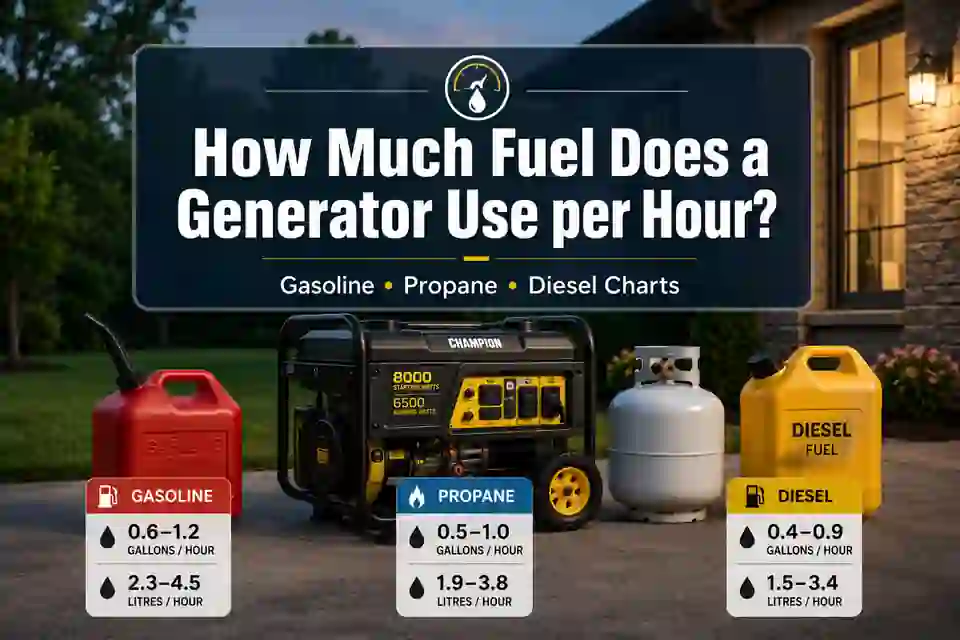
A generator may use less than one litre of fuel per hour or several gallons per hour. The difference is not explained by the fuel alone. A small inverter generator powering a refrigerator and lights operates very differently from a large conventional generator supplying pumps, heating equipment or a whole-house transfer panel.
The most useful answer therefore begins with two numbers: the generator's rated running output and the average load it is actually carrying. Fuel consumption rises as load increases, but it does not rise in a perfectly straight line because the engine still burns fuel to keep itself turning, cooled and ready even when the electrical demand is small.
Quick answer: there is no universal fuel rate for every generator of the same wattage. As a HomDera planning midpoint at about 50% load, a 5 kW rated generator gives approximately 0.45 US gal/h (1.70 L/h) of gasoline, 0.53 US gal/h (1.99 L/h) of liquid-equivalent propane or 0.19 US gal/h (0.73 L/h) of diesel. Published model data can differ materially from these midpoints, so use them to compare scenarios rather than to make a final fuel purchase or size a gas supply.
Never choose a fuel reserve, cylinder, gas line or refuelling schedule from a generic table alone. Use the fuel-consumption data for the exact generator at the nearest published load point whenever it is available.
Portable fuel-powered generators must operate outdoors, away from doors, windows and vents, with the exhaust directed away from buildings. Never run one in a home, garage, basement, shed, enclosed porch or partly enclosed space, even when doors are open. Install and maintain carbon-monoxide alarms.
Generator fuel use, step by step
The Honest Answer: There Is No Universal Gallons-per-Hour Number
Two generators with the same advertised wattage can have different engines, alternators, control systems, operating speeds and efficiency curves. One product may quote maximum or starting watts prominently while another is described by continuous output. Fuel figures are meaningful only when the electrical rating and test load are understood.
The values that control hourly generator fuel use
| Input | Why it matters | Best source |
|---|---|---|
| Rated running output | Sets the continuous electrical capacity used to describe load percentage | Generator data plate or specification sheet |
| Average electrical load | A generator at 25% load normally burns less fuel per hour than at 75% load | Load meter, transfer switch monitor or a realistic appliance schedule |
| Fuel type | Gasoline, propane and diesel use different engines, mixtures and volume units | Exact model and approved fuel configuration |
| Generator design | Inverter control, engine speed, displacement and alternator efficiency affect the curve | Manufacturer fuel or runtime table |
| Site conditions | Altitude, temperature, ventilation and fuel quality can reduce available output or change consumption | Owner's manual and site data |
| Condition and maintenance | Dirty filters, old fuel, incorrect oil, worn ignition parts and poor adjustment can increase consumption | Service history and inspection |
| Operating pattern | Motor starts, cycling loads and long light-load periods change the average | Measured operation over a representative period |
Do not divide the largest wattage printed on the generator by the appliance watts and call that the load percentage. Use the rated or running output, not the short-duration starting or surge rating.
How to Calculate Generator Fuel Use per Hour
The most dependable calculation is direct: use the manufacturer's fuel rate at the load closest to your operating condition. If the manual gives tank capacity and runtime instead of an hourly figure, divide usable tank volume by the stated runtime.
Hourly fuel use = usable fuel consumed ÷ operating hours
A gasoline generator has a 7.9 US gal tank and a stated runtime of 10 hours at 50% load. What is the average fuel rate?
Answer: Approximately 0.79 US gal/h, or about 2.99 L/h, if the test used the complete stated tank volume.
Explanation: 7.9 ÷ 10 = 0.79 US gal/h. Multiply by 3.785 to convert to litres. In practice, check whether the manufacturer treats the entire tank as usable and whether the runtime is rounded.
When no exact table is available, a generalized estimate can be created from rated output, load percentage and a fuel-specific curve. That is the method used in the HomDera calculator's automatic mode. The calculator also has a manual mode for entering a published or measured hourly rate.
Published examples show why the exact model matters
| Published generator example | Rated output and test condition | Rate calculated from published data | Practical takeaway |
|---|---|---|---|
| Honda EM5000SX gasoline | 4.5 kW rated output; 6.2 US gal tank; 10.5 h at 50% load | About 0.59 US gal/h | A similarly sized real generator can use more fuel than the generalized chart midpoint |
| Generac GP7500E DF gasoline | 7.5 kW rated output; 7.9 US gal tank; 10 h at 50% load | 0.79 US gal/h | For this model, use the published 0.79 US gal/h instead of the generalized 7.5 kW value |
| Generac GP7500E DF propane | 6.8 kW rated output on propane; 20 lb cylinder; 5 h at 50% load | About 4.0 lb/h | The generator rating and fuel rate can both change when switching from gasoline to propane |
| Cat D200 GC diesel | 200 kW standby rating; 50% load | 32.6 L/h | Industrial diesel generators should be planned from the manufacturer's complete load table |
Why Fuel Use Does Not Fall in Direct Proportion to Load
A generator at 25% electrical load normally consumes more than 25% of its full-load fuel rate. The engine must overcome friction, drive cooling systems, maintain speed and cover electrical and mechanical losses before useful power reaches the appliances. As a result, a lightly loaded oversized generator often uses more fuel per delivered kilowatt-hour than a well-matched unit.
The engine still has an appetite when the sockets do not
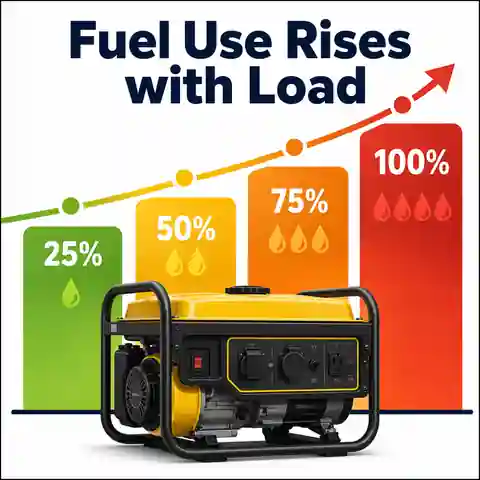
At low load, the generator burns fuel simply to remain running and ready.
As load increases, hourly fuel use rises, but useful electricity usually rises faster than fuel use over part of the operating range.
Near full output, there is little reserve for motor starting, temperature derating or sudden changes in demand.
The shape of the curve varies by model, so use this relationship for planning rather than as a universal engine law.
Planning implications at different average loads
| Average load | What the fuel figure usually means | Planning check |
|---|---|---|
| Below 25% | Low hourly use but often poor fuel efficiency per delivered kWh | Compare a smaller or inverter generator and schedule loads |
| Around 50% | A common point for portable-generator runtime claims | Confirm that the claim uses the correct fuel and rated output |
| Around 75% | Higher hourly use with better use of the generator's capacity | Keep enough headroom for starting loads and changing conditions |
| Above 85% | Operation close to the continuous limit | Check cooling, derating, duty rating and motor-start reserve |
| 100% | Maximum continuous test point, not automatically the best everyday target | Confirm that the rating is continuous rather than surge or standby-only |
Gasoline Generator Fuel Consumption Chart
Gasoline is the standard North American term; petrol is the usual term in the United Kingdom and Australia. The table below uses the same generalized model as the HomDera automatic calculator and assumes an average load of 50%. It is intended for early planning only.
Estimated gasoline or petrol use at 50% load
| Rated running output | Average electrical load | US gallons per hour | Litres per hour | Fuel for 8 hours |
|---|---|---|---|---|
| 2 kW | 1 kW | 0.18 US gal/h | 0.68 L/h | 5.4 L (1.44 US gal) |
| 3.5 kW | 1.75 kW | 0.31 US gal/h | 1.19 L/h | 9.5 L (2.52 US gal) |
| 5 kW | 2.5 kW | 0.45 US gal/h | 1.70 L/h | 13.6 L (3.60 US gal) |
| 7.5 kW | 3.75 kW | 0.67 US gal/h | 2.55 L/h | 20.4 L (5.39 US gal) |
| 10 kW | 5 kW | 0.90 US gal/h | 3.40 L/h | 27.2 L (7.19 US gal) |
| 20 kW | 10 kW | 1.80 US gal/h | 6.81 L/h | 54.5 L (14.38 US gal) |
Treat every gasoline value in this chart as a planning midpoint, not as a universal accuracy range. Published generators with similar rated output can differ by more than 20% because of engine size, alternator design, operating speed, eco-mode behaviour and test conditions. Replace the chart value with the exact model's published or measured rate before buying fuel.
How much gasoline might a 7.5 kW generator use during an 8-hour outage at 50% average load?
Answer: The generalized estimate is about 5.39 US gal, or 20.4 L, for eight hours.
Explanation: The estimated hourly rate is about 0.67 US gal/h or 2.55 L/h. Multiplying by eight gives the fuel quantity. The exact model's published 50% runtime or measured rate should replace this estimate before purchasing fuel.
Propane Generator Fuel Consumption Chart
Propane may also be labelled LP gas or LPG. Most portable generators receive propane vapour from the cylinder, while fuel quantity may be reported as weight, vapour flow or liquid-equivalent volume. The table below converts the HomDera estimate to liquid-equivalent US gallons and litres and to approximate fuel weight using about 0.51 kg/L, or 4.2 lb per US gallon, near 60°F / 15.6°C. This conversion estimates stored quantity only: the cylinder, regulator and hose must still vaporize and deliver the generator's required full-load flow.
Estimated liquid propane use at 50% load
| Rated running output | US gallons per hour | Litres per hour | Approximate propane weight per hour | 20 lb cylinder: arithmetic runtime |
|---|---|---|---|---|
| 2 kW | 0.21 US gal/h | 0.80 L/h | 0.41 kg/h (0.90 lb/h) | About 22 hours |
| 3.5 kW | 0.37 US gal/h | 1.40 L/h | 0.71 kg/h (1.57 lb/h) | About 12.7 hours |
| 5 kW | 0.53 US gal/h | 1.99 L/h | 1.02 kg/h (2.24 lb/h) | About 8.9 hours |
| 7.5 kW | 0.79 US gal/h | 2.99 L/h | 1.53 kg/h (3.36 lb/h) | About 6.0 hours |
| 10 kW | 1.05 US gal/h | 3.99 L/h | 2.03 kg/h (4.48 lb/h) | About 4.5 hours |
| 20 kW | 2.11 US gal/h | 7.98 L/h | 4.07 kg/h (8.97 lb/h) | About 2.2 hours |
The cylinder runtimes are arithmetic fuel-content estimates, not guarantees. Cold weather and high withdrawal rates can reduce propane vaporization, so a cylinder may be unable to supply the engine even while liquid propane remains inside.
What number should be entered for a US cylinder labelled 20 lb?
Answer: Enter 20 lb when that is the propane content rating, not the complete weight of the filled steel cylinder.
Explanation: The cylinder's tare weight is not fuel. Adding it to the calculation would overstate available propane and runtime.
Diesel Generator Fuel Consumption Chart
Diesel generators range from small portable units to large stationary sets, so a single chart must be treated cautiously. The table below uses the generalized HomDera model at 50% load. Industrial manufacturers often publish separate values at 25%, 50%, 75% and 100% load, which should be used for the final plan.
Estimated diesel use at 50% load
| Rated running output | Average electrical load | US gallons per hour | Litres per hour | Fuel for 24 hours |
|---|---|---|---|---|
| 2 kW | 1 kW | 0.08 US gal/h | 0.29 L/h | 7.0 L (1.85 US gal) |
| 3.5 kW | 1.75 kW | 0.13 US gal/h | 0.51 L/h | 12.2 L (3.23 US gal) |
| 5 kW | 2.5 kW | 0.19 US gal/h | 0.73 L/h | 17.5 L (4.61 US gal) |
| 7.5 kW | 3.75 kW | 0.29 US gal/h | 1.09 L/h | 26.2 L (6.92 US gal) |
| 10 kW | 5 kW | 0.38 US gal/h | 1.46 L/h | 35.0 L (9.23 US gal) |
| 20 kW | 10 kW | 0.77 US gal/h | 2.91 L/h | 69.9 L (18.46 US gal) |
| 50 kW | 25 kW | 1.92 US gal/h | 7.28 L/h | 174.7 L (46.15 US gal) |
The diesel chart provides consistent planning midpoints for comparing generator sizes and loads. It is not a guaranteed accuracy envelope for every engine or genset. Injection system, engine displacement, operating speed, emissions equipment, cooling load and standby or prime-duty configuration can all change the real fuel rate. Use the manufacturer's load table for the selected model whenever it is available.
One 7.5 kW Generator Size at Four Load Levels
The next table keeps rated output constant at 7.5 kW and changes only the average electrical load. This makes the non-linear relationship easier to see. Every value is a generalized estimate before model-specific correction.
Estimated hourly fuel use for a 7.5 kW generator
| Average load | Average output | Gasoline / petrol | Liquid propane | Diesel |
|---|---|---|---|---|
| 25% | 1.88 kW | 0.44 US gal/h (1.65 L/h) | 0.43 US gal/h (1.64 L/h) | 0.17 US gal/h (0.66 L/h) |
| 50% | 3.75 kW | 0.67 US gal/h (2.55 L/h) | 0.79 US gal/h (2.99 L/h) | 0.29 US gal/h (1.09 L/h) |
| 75% | 5.63 kW | 0.89 US gal/h (3.38 L/h) | 1.05 US gal/h (3.96 L/h) | 0.41 US gal/h (1.55 L/h) |
| 100% | 7.50 kW | 1.09 US gal/h (4.12 L/h) | 1.27 US gal/h (4.83 L/h) | 0.54 US gal/h (2.04 L/h) |
Liquid volume is not an energy comparison by itself
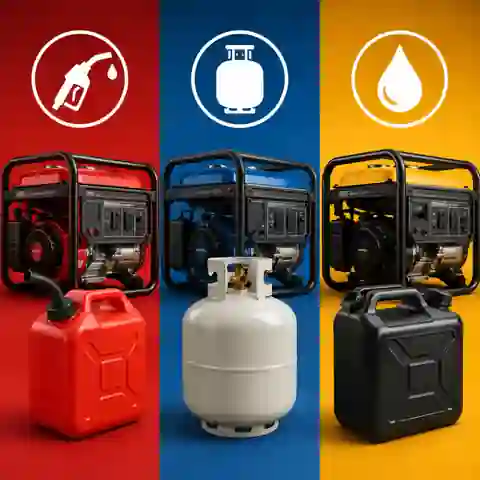
One gallon of gasoline, one gallon of liquid propane and one gallon of diesel do not contain the same energy.
Propane may be purchased by cylinder weight, liquid volume or tank fill, while natural gas is normally metered as gas volume or energy.
A dual-fuel generator may also have different rated electrical output on gasoline and propane.
Compare fuel cost for the same generator, the same useful electrical load and the same operating period.
Gasoline, Propane and Diesel: What the Charts Do Not Decide
Practical differences beyond hourly consumption
| Fuel | Possible advantages | Checks and limitations |
|---|---|---|
| Gasoline / petrol | Common for portable generators; easy cold starting on many models; fuel widely available in some markets | Storage life, vapour and fire risk, regional supply during outages, carburettor maintenance |
| Propane / LPG | Clean storage in approved cylinders or tanks; no stale liquid fuel in a carburettor when operated correctly | Cylinder vaporization, regulator capacity, lower generator output on some dual-fuel models, cylinder exchange cost |
| Diesel | Often selected for long-duration or larger stationary duty; manufacturer load tables are common | Higher purchase cost, cold-weather fuel behaviour, maintenance requirements, noise and emissions rules |
| Natural gas | Continuous utility supply may remove on-site liquid refuelling | Supply can be interrupted; pipe, meter and regulator must support full-load demand; billing units vary |
The lowest number in litres per hour is not automatically the cheapest or best system. Compare local fuel price, generator purchase cost, maintenance, storage, expected outage duration, starting reliability, permissible installation and whether the chosen fuel will actually be available during the event being planned for.
In this article, gasoline means petrol. Natural gas is a separate fuel and cannot be converted directly into gasoline gallons or propane liquid volume. For a natural-gas generator, use the exact model's demand in scfh, ft³/h or m³/h. Gas-meter capacity, inlet pressure, regulators and pipework must be checked for full-load flow rather than average fuel quantity alone.
How Much Fuel Is Needed for 8, 12 or 24 Hours?
Once the hourly rate is known, total fuel is calculated by multiplying by operating time. Use average load over the period, not the highest appliance combination that occurs for only a few minutes.
Fuel required = hourly fuel rate × operating hours
Example for a 7.5 kW generator at 50% average load
| Fuel | Per hour | 8 hours | 12 hours | 24 hours |
|---|---|---|---|---|
| Gasoline / petrol | 0.67 US gal (2.55 L) | 5.39 US gal (20.4 L) | 8.09 US gal (30.6 L) | 16.18 US gal (61.2 L) |
| Liquid propane | 0.79 US gal (2.99 L) | 6.32 US gal (23.9 L) | 9.49 US gal (35.9 L) | 18.97 US gal (71.8 L) |
| Diesel | 0.29 US gal (1.09 L) | 2.31 US gal (8.7 L) | 3.46 US gal (13.1 L) | 6.92 US gal (26.2 L) |
A 24-hour fuel total does not mean a portable generator should run continuously for 24 hours without inspection, oil checks, maintenance or cooling. Follow the exact duty, service and shutdown instructions in the owner’s manual.
How to Estimate Average Generator Load
Fuel consumption depends on average electrical load, while generator sizing must also account for brief starting loads. These are related but different calculations. A refrigerator compressor may need high starting power for a moment while using much less energy over an hour.
- List the appliances that genuinely operate during the same backup period.
- Record running watts for steady loads and separate starting watts for motors and compressors.
- Estimate the duty cycle of equipment that turns on and off.
- Add the average running demand in kilowatts.
- Divide the average demand by the generator's rated running output.
- Use the resulting percentage with the nearest manufacturer fuel-table point.
- Check the starting-watt requirement separately so the generator can still start the loads.
A 7.5 kW generator supplies a 400 W average refrigerator load, 250 W of lighting, a 150 W router and electronics load, and a 1,500 W pump that runs 20 minutes per hour. What is the approximate average load?
Answer: About 1.3 kW, or roughly 17% of the generator's rated output.
Explanation: The pump averages about 500 W over the hour: 1,500 W × 20/60. Add 400 + 250 + 150 + 500 = 1,300 W. The pump's starting demand still needs a separate surge check.
Why an Inverter Generator May Use Less Fuel at Light Load
Many inverter generators can reduce engine speed when electrical demand is low, while conventional fixed-speed generators may remain near their governed operating speed. This can improve light-load fuel use and noise, but the size of the benefit depends on the model, eco-mode limits and the connected equipment.
Compare published runtime at quarter load and rated load rather than assuming that every product labelled “inverter” provides the same saving.
What Can Make Real Fuel Use Higher or Lower?
Common causes of a difference from the chart
| Factor | Possible effect | What to check |
|---|---|---|
| Altitude | Available engine power may fall, changing throttle position and usable output | Manufacturer derating instructions |
| High ambient temperature | Cooling and power capability may be reduced | Ventilation, clearance and temperature limits |
| Cold weather | Starting, warm-up and propane vaporization may become more difficult | Approved oil, battery condition, fuel system and cylinder sizing |
| Eco mode | May reduce fuel at light steady load but may respond differently to sudden starts | Manual and appliance starting behaviour |
| Dirty air filter | Can restrict airflow and worsen combustion | Maintenance schedule and filter condition |
| Old or unsuitable fuel | Can cause poor running, deposits or unreliable starting | Fuel storage guidance and manufacturer requirements |
| Unbalanced or distorted loads | May limit useful generator capacity even when total kW looks acceptable | Outlet, phase and power-quality measurements |
| Frequent motor starts | Creates repeated high-demand events and changing throttle | Load sequencing and starting watts |
| Long extension leads or undersized cable | Voltage drop can make equipment operate poorly without reducing engine effort | Cable size, length, connectors and measured voltage |
| Generator wear or poor adjustment | Can increase fuel use and reduce output | Service inspection and measured fuel rate |
How to Measure the Fuel Rate of Your Own Generator
A controlled measurement can be more useful than a generic chart when the generator, load and operating conditions are stable. The method must not involve unsafe improvised fuel containers, opening a hot fuel system or bypassing the manufacturer's tank, regulator or safety devices.
- Service the generator and begin with the approved fuel and operating setup.
- Measure or document the starting fuel quantity using a safe method permitted by the manufacturer.
- Connect a representative, measured electrical load.
- Allow the generator to warm up as specified.
- Run it for a long enough period to reduce the effect of starting and measurement error.
- Stop the generator and allow it to cool before handling or checking liquid fuel.
- Determine the amount consumed and divide by the measured operating time.
- Repeat the test at another load point when a broader planning curve is required.
- Record temperature, load, eco-mode setting and other conditions with the result.
Do not refuel a running or hot generator. Do not measure consumption by attaching an unapproved temporary bottle, hose or open container. Fuel vapour and spills can ignite.
Tank Runtime Is Not the Same as Safe Continuous Runtime
Tank runtime is a simple fuel-quantity result: usable fuel divided by hourly consumption. It does not override oil-check intervals, duty ratings, maintenance schedules, noise restrictions, refuelling rules or the need to inspect the installation.
A tank contains 7.9 US gal, but only 95% is treated as usable. The generator uses 0.67 US gal/h. What is the planning runtime?
Answer: About 11.2 hours.
Explanation: Usable fuel is 7.9 × 0.95 = 7.505 US gal. Divide by 0.67 US gal/h to obtain approximately 11.2 hours. Use the unrounded hourly rate for the final calculation.
For liquid fuel, a small usable-fuel reduction can cover inaccessible residual fuel and measurement uncertainty. It is not permission to ignore the manufacturer's shutdown, refuelling or reserve instructions.
Generator Fuel Cost per Hour
Fuel cost is found by multiplying the hourly quantity by the local price in the same unit. Use US gallons with a price per US gallon, litres with a price per litre, and the correct propane purchase unit. Do not compare a cylinder exchange price directly with a bulk-propane price without converting both to the amount of fuel received.
Fuel cost per hour = fuel used per hour × price per matching fuel unit
Using an illustrative gasoline price of $3.60 per US gallon, what would a generator using 0.67 US gal/h cost to run?
Answer: Approximately $2.41 per operating hour, or about $19.30 for eight hours.
Explanation: 0.67 × $3.60 = $2.412 per hour. The fuel price is an example only, not a current market quote. For a real estimate, enter the current local price and use the generator's unrounded fuel rate.
Fuel cost is not the complete cost of generator power. Oil, filters, spark plugs, service, cylinder exchange fees, delivery, depreciation, transfer equipment and repairs may be significant, especially when the generator runs for many hours.
US, Canadian, UK and Australian Fuel Terms
Words and units that can cause calculation mistakes
| Term or unit | Common use | Planning note |
|---|---|---|
| Gas / gasoline | In the US and Canada, “gas” usually means gasoline | In other contexts, “gas generator” may mean natural gas or LPG |
| Petrol | United Kingdom, Australia and many other markets | Equivalent fuel category to gasoline in this article |
| US gallon | United States fuel volume | 1 US gal = about 3.785 L |
| Imperial gallon | Older UK or Commonwealth references | 1 imp gal = about 4.546 L; do not treat it as a US gallon |
| LPG / LP gas / propane | Cylinder or bulk gas terminology varies | Check whether the quantity is liquid volume, fuel weight or vapour flow |
| Diesel L/h or gal/h | Common manufacturer table units | Confirm whether “gal” means US or imperial gallons |
| kW | Generator running output and electrical load | Do not confuse kW with kWh, which is energy over time |
A US gallon and an imperial gallon are different. Copy the unit exactly from the specification sheet before converting a runtime claim into fuel use per hour.
Portable Generator Safety Belongs in the Fuel Plan
Outdoor means genuinely outdoors
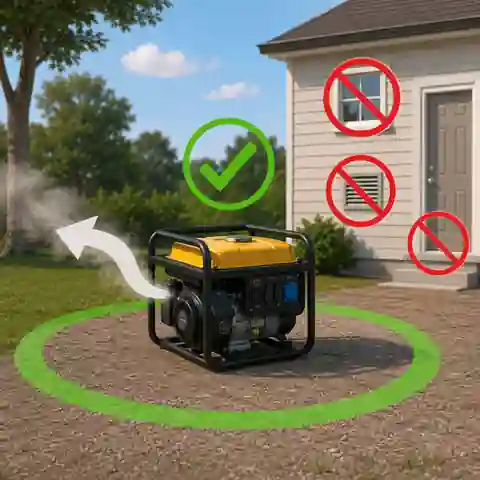
Use the generator outdoors in the location and at the clearance required by its manufacturer. Exhaust must not be able to enter any building.
US CPSC and Health Canada guidance advises placing a portable generator at least 20 ft or 6 m from a home or other building, directing the exhaust away and keeping nearby or downwind doors and windows closed.
UK and Australian guidance also requires outdoor, well-ventilated operation away from doors, windows and other openings. A garage, shed, enclosed porch or partly enclosed carport is not a safe substitute for open outdoor space.
Install and test carbon-monoxide alarms as recommended for the property. Do not rely on smell: carbon monoxide cannot be seen or smelled.
- Stop the generator and let it cool before refuelling.
- Store fuel in approved, labelled containers outside living areas and away from ignition sources.
- Keep the generator protected from rain and standing water in the manner approved by its manufacturer.
- Do not backfeed a home through a wall outlet.
- Use suitable transfer equipment for fixed household circuits and have it installed under the local electrical rules.
- Keep cords, plugs and distribution equipment within their ratings.
- Do not exceed the generator's running output or individual outlet rating.
- Keep children, pets and bystanders away from the hot engine, exhaust and fuel.
If a carbon-monoxide alarm sounds or anyone develops possible CO symptoms, move everyone to fresh air immediately and contact local emergency services. Do not re-enter until the hazard has been assessed and made safe.
Common Generator Fuel-Planning Mistakes
Mistake, consequence and better approach
| Mistake | What goes wrong | Better approach |
|---|---|---|
| Using starting watts as rated output | Load percentage and fuel estimate are distorted | Use continuous or running watts |
| Assuming 50% load means half the full-load fuel | Fuel use is understated | Use the model's load curve or fuel table |
| Using one generic rate for every generator size | Small and large units are treated as identical | Include rated output and design |
| Reading a runtime claim without tank capacity | No hourly rate can be calculated | Use tank volume ÷ runtime |
| Mixing US and imperial gallons | The result differs by about 20% | Convert from the exact stated gallon |
| Counting the steel cylinder as propane | Propane supply and runtime are overstated | Use fuel-content weight |
| Ignoring propane vaporization | The generator may starve for fuel before the cylinder is empty | Check temperature, cylinder and regulator capacity |
| Planning from maximum load only | Fuel may be overestimated for a cycling load plan | Estimate average load and check surge separately |
| Planning from average load only | The generator may fail to start motors | Perform a separate starting-watt check |
| Refuelling while hot or running | Fuel can ignite | Stop, cool and follow the manual |
| Operating in a garage or shed | Lethal carbon monoxide can accumulate | Operate outdoors at safe clearance |
A Better Generator Fuel-Planning Method
- Confirm the exact fuel configuration and rated running output.
- Build a realistic appliance schedule and estimate average load.
- Check starting watts separately.
- Find the manufacturer's fuel rate at the nearest load point.
- Use the HomDera generalized estimate only when exact data is unavailable.
- Multiply the hourly rate by the required operating time.
- Apply a controlled reserve for changing load and measurement uncertainty.
- Check tank, cylinder, regulator or fuel-delivery limits.
- Plan safe shutdown, inspection and refuelling intervals.
- Calculate cost using current local prices in matching units.
- Confirm outdoor placement, CO alarms and safe electrical connection.
- After real operation, record actual fuel use and update the plan.
Technical References Used for This Guide
The charts in this guide are outputs from HomDera's generalized planning model, not market-wide averages collected from every generator sold in the four target countries. The curves were cross-checked against selected manufacturer examples so that generator sizes, fuels and load scenarios can be compared consistently. They are designed for preliminary planning and education, not for predicting the exact consumption of a particular model.
Honda generator comparison: tank capacity and runtime at rated, half or quarter loadGenerac GP7500E DF specification: gasoline tank capacity and gasoline and propane runtime at 50% loadCaterpillar diesel generator specification: fuel use at 25%, 50%, 75% and 100% loadUS Consumer Product Safety Commission: portable-generator carbon-monoxide safetyHealth Canada: generator placement and carbon-monoxide preventionUK Health and Safety Executive: carbon monoxide from petrol-powered equipmentUK Health and Safety Executive for Northern Ireland: portable-generator carbon-monoxide, fire and electrical safetyEnergy Safe Victoria: current household portable-generator placement, refuelling and electrical safety guidanceFrequently Asked Questions
How much gas does a 5,000-watt generator use per hour?
Using the generalized HomDera gasoline curve, a 5 kW rated generator at 50% average load is approximately 0.45 US gal/h or 1.70 L/h. At full load, the same planning model gives about 0.73 US gal/h or 2.74 L/h. The exact model may differ, so check its tank-runtime or fuel-consumption table.
How much fuel does a 7.5 kW generator use per hour?
At 50% average load, the generalized estimates are about 0.67 US gal/h (2.55 L/h) gasoline, 0.79 US gal/h (2.99 L/h) liquid propane or 0.29 US gal/h (1.09 L/h) diesel. Confirm the generator's rated output on the selected fuel because dual-fuel models may have a lower propane rating.
Does a generator use less fuel with fewer appliances?
Usually yes, but not in direct proportion. Removing half the electrical load does not normally cut hourly fuel use in half because the engine still consumes fuel to remain running. An inverter generator may reduce speed and gain more at light load than a conventional fixed-speed design.
Is propane cheaper to run than gasoline?
Not automatically. Compare the exact generator's fuel use, local gasoline price, propane purchase method, generator output on each fuel and total operating period. Cylinder exchange propane can have a very different unit cost from bulk delivery.
Why does a propane generator use more gallons than gasoline?
Liquid propane and gasoline do not contain the same energy per gallon, and the engine may also have a different rated output and efficiency on each fuel. Compare cost and electrical work delivered, not liquid volume alone.
How long will a 20 lb propane tank run a generator?
Runtime depends strongly on generator size and load. In the generalized 50%-load table, arithmetic runtime ranges from about 22 hours for a 2 kW generator to about 6 hours for a 7.5 kW generator and about 4.5 hours for a 10 kW generator. Real runtime can be shorter if the cylinder cannot vaporize propane fast enough in the current temperature.
How do I calculate fuel use from a generator runtime claim?
Divide the stated usable tank capacity by the stated runtime, making sure both refer to the same fuel and load. For example, 7.9 US gal divided by 10 hours equals 0.79 US gal/h. Check whether the runtime is at 25%, 50% or rated load.
Should I size the fuel supply from average or full load?
Use average electrical load to estimate fuel quantity and operating cost over time. When sizing natural-gas piping, regulators or an LP-vapour supply, use the exact generator manufacturer's full-load fuel demand. The design must also account for available inlet pressure, pipe length, fittings, elevation where relevant and other gas appliances that may operate at the same time. Liquid tanks and cylinders must support the required withdrawal and vaporization rate, not merely contain enough total fuel.
Can a generator run all night?
Some generators can operate for the required period when used exactly as specified, but tank capacity alone does not prove that overnight operation is safe or permitted. Check duty rating, oil and service intervals, outdoor placement, CO alarms, weather protection, noise rules and whether anyone can respond to a fault.
How accurate is a generator fuel calculator?
A calculator using the exact manufacturer's hourly rate can provide a strong quantity estimate for the selected operating condition. An automatic estimate based only on kW and load is less precise because engine design, temperature, altitude, maintenance and control mode are unknown. Use the planning range and replace the generic rate when better data becomes available.
Final Fuel Check
- The wattage used is rated running output, not starting watts.
- Average load reflects the real appliance schedule.
- Motor starting demand has been checked separately.
- Fuel type and generator output match the selected configuration.
- US gallons, imperial gallons, litres and cylinder weight have not been mixed.
- The manufacturer's nearest load-point fuel rate has been used where available.
- Propane cylinder or gas-delivery capacity supports the required flow.
- The fuel reserve covers changing demand without encouraging unsafe storage.
- Shutdown, cooling, inspection and refuelling intervals follow the manual.
- The generator is outdoors at safe clearance with exhaust directed away.
- CO alarms and safe transfer equipment are in place.
Generator fuel use per hour is not one fixed number attached to a wattage label. It is the result of generator size, actual load, fuel, engine design and operating conditions. Start with the exact model's fuel table. When it is unavailable, use a transparent generalized estimate, include a realistic range and update the plan after measuring real operation.
For early planning, the charts in this guide show how strongly generator size and load can change gasoline, propane and diesel demand. For purchasing fuel, sizing a propane or natural-gas supply, or planning long unattended operation, manufacturer data and a competent installation review take priority.
Open the HomDera Generator Fuel Consumption CalculatorCheck which generator size can start and run your appliancesExplore HomDera energy and backup-power guides