
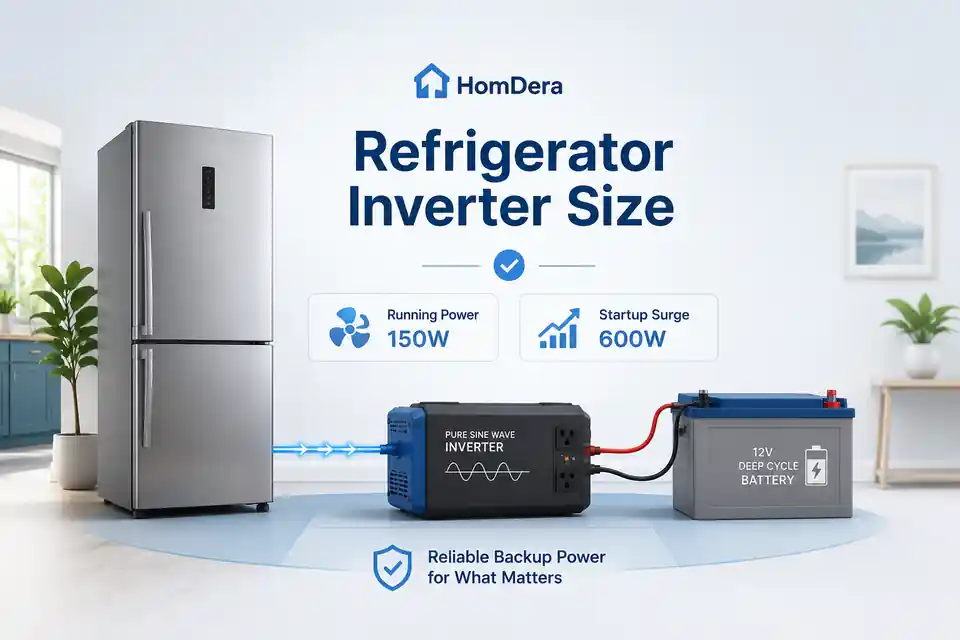
For many domestic refrigerators, a pure sine wave inverter in the 1,000–2,000 W class is a practical shortlist, but it is not a universal answer. The correct size depends on the refrigerator’s normal running demand, its highest startup or defrost demand, the inverter’s surge duration, and any other appliances that remain connected. A 500 W inverter can be enough for a measured low-power refrigerator, while another refrigerator may trip a nominally larger unit during compressor start.
This guide is for preliminary equipment selection. Refrigerator designs, inverter ratings, battery systems and installation rules differ. Confirm the appliance nameplate, technical documentation and inverter manual before purchase, and use a qualified professional for fixed wiring, transfer equipment, protection, grounding or earthing.
In this guide
The quick answer
Do not size the inverter from average daily energy use. Inverter power is a moment-by-moment limit. The refrigerator must fit within the inverter’s continuous output while running and within its short-duration surge output when the compressor starts. Voltage, frequency and waveform must also be compatible.
A practical first check
| What you know | How to use it | What still needs checking |
|---|---|---|
| Running watts and measured startup watts | Add other running loads, apply a reasonable planning reserve and compare both results with the inverter specifications | Surge duration, waveform, battery current and installation |
| Running watts but no startup figure | Use model-specific manufacturer data or measure the start; a broad multiplier is only a provisional estimate | Whether the inverter can sustain the real compressor start |
| Only volts and amps on the label | Volts × amps gives volt-amperes, which is useful for an upper electrical check but is not always the same as real watts | Power factor, compressor start and defrost demand |
| Annual energy use in kWh | Use it for battery-energy and operating-cost estimates | It does not directly select inverter wattage |
Do not assume that a product advertised as “1,000 W” can start every refrigerator. Check the continuous watt rating, the surge watt rating, how long that surge is available and the conditions under which the rating applies.
Three ratings decide whether the refrigerator will run
The ratings that matter
| Rating | What it means | Why it matters for a refrigerator |
|---|---|---|
| Continuous output | Power the inverter can deliver for normal sustained operation | Must cover the refrigerator while running, plus every other load operating at the same time |
| Surge or peak output | Extra output available for a limited time | Must cover compressor startup and any overlapping loads |
| Surge duration | How long the inverter can hold the peak before limiting or shutting down | A high peak lasting only milliseconds may not start a compressor that needs longer |
| Output waveform | The shape and quality of the AC voltage | Pure sine wave is the safest general choice for compressors and electronic controls |
| Output voltage and frequency | The AC supply specification, such as 120 V 60 Hz or 230 V 50 Hz | Must match the refrigerator nameplate and local version of the appliance |
The continuous rating and the surge rating solve different problems. A refrigerator that settles at 140 W may appear suitable for a 300 W inverter, yet still fail if the compressor briefly needs 900 W and the inverter can provide only 600 W at peak.
Start with the refrigerator, not a generic wattage chart
The best input is information from the actual appliance. Two refrigerators with similar cabinet sizes can use different compressors, controls, heaters, fans and ice-making systems. Age, ambient temperature and operating mode can also change what is seen at the plug.
- Find the model and electrical rating label, usually inside the cabinet, behind a lower cover or on the rear of the appliance.
- Record the required AC voltage and frequency.
- Look for watts, rated current, maximum current, compressor data or a separate defrost-heater rating.
- Check the owner’s manual and technical sheet for generator, UPS or inverter requirements.
- If startup power is not published, use a suitable power meter with peak capture or ask the appliance manufacturer or a qualified technician.
- List every other appliance that will stay powered while the refrigerator starts.
A plug-in energy meter that shows only average watts may miss a very brief startup peak. Use a meter with a suitable peak or inrush function, and make sure its voltage and current ratings are appropriate for the appliance.
Where common refrigerator numbers fit
| Number | Useful for | Do not confuse it with |
|---|---|---|
| Running watts | Continuous inverter load | Startup watts |
| Startup or inrush watts | Short-duration inverter surge check | Average energy use |
| Rated amps | Electrical input check at the stated voltage | A precise real-watt measurement in every operating mode |
| Annual kWh | Battery-energy planning over hours or days | Instantaneous inverter size |
| Circuit or breaker recommendation | Supply-circuit planning under local rules | The refrigerator’s normal running watts |
Why compressor startup changes the answer
A conventional compressor motor can draw much more current while it accelerates than after it reaches normal speed. The inverter sees this as a short peak. If the battery voltage sags, the DC cables are undersized or the inverter cannot hold its surge output long enough, the compressor may hum, attempt to start repeatedly or cause an overload shutdown.
Running watts can be small while the start is demanding
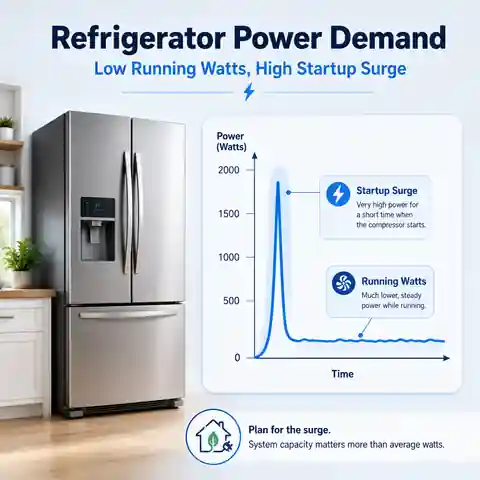
The refrigerator may spend much of the day cycling between low power and no compressor load.
Each compressor start creates a short demand that can be several times higher than the settled running power.
Other loads do not disappear during that start. Their running watts must remain in the peak scenario.
The inverter specification must state both the peak amount and the time for which it is available.
There is no reliable universal startup multiplier. Published appliance guidance may use roughly twice the running power in one context, while some inverter manuals use a much more conservative factor for compressor refrigerators. Model-specific data or measurement is more dependable than copying one number from a chart.
How to calculate a refrigerator inverter size
- Add the running watts of the refrigerator and all other loads that may operate at the same time.
- Apply a planning reserve to the combined continuous load. About 20–25% is often useful for an early estimate, but it is not a universal electrical rule.
- Create the startup scenario: replace the refrigerator’s running watts with its startup watts while leaving the other appliances at their normal running watts.
- Apply the same reserve to the startup scenario.
- Choose an inverter whose continuous watt rating is not below the continuous result.
- Choose an inverter whose surge watt rating is not below the startup result and whose surge duration is long enough.
- Confirm pure sine wave output, matching voltage and frequency, and enough battery-side current capability.
A refrigerator runs at 140 W and has a measured startup peak of 900 W. A router uses 20 W and two LED lights use 10 W each. With a 25% reserve, what inverter ratings should be checked?
Answer: Continuous load = 140 + 20 + 20 = 180 W. With 25% reserve: 180 × 1.25 = 225 W. Startup scenario = 900 + 20 + 20 = 940 W. With 25% reserve: 940 × 1.25 = 1,175 W.
Explanation: The preliminary target is at least 225 W continuous output and at least 1,175 W of surge output for sufficient duration. In practice, a pure sine wave inverter sold as 1,000 W continuous with a genuine surge rating above 1,175 W may be suitable, but the product manual, battery system and real startup test must confirm it.
Do not add only the refrigerator’s startup watts to an otherwise empty calculation if other appliances remain connected. The router, lights, freezer, boiler controls or other essential loads continue drawing power while the compressor starts.
What to do when startup watts are unknown
Unknown startup demand is the most common reason an apparently sensible inverter choice fails. A broad multiplier can help create a provisional shortlist, but it should not be presented as a measured fact. Refrigerator manufacturers, inverter manufacturers and generator guides use different assumptions because compressor types and overload capabilities are not identical.
Better and worse ways to handle missing surge data
| Approach | Reliability | How to use it |
|---|---|---|
| Model-specific technical data | Best available without testing | Confirm whether the figure includes compressor start, defrost and accessories |
| Peak or inrush measurement | Strong practical evidence | Repeat under realistic temperature and restart conditions |
| Advice from appliance and inverter manufacturers | Useful when both products are identified | Ask about waveform and required surge duration, not watts alone |
| Generic multiplier | Rough planning only | Use conservatively and keep a clear warning that the real start may differ |
| Guessing from annual kWh | Poor | Annual energy does not reveal the highest instantaneous demand |
If the refrigerator is essential and the surge figure is unknown, choose equipment from a seller or installer who can confirm compatibility and accept a return if the appliance cannot start under the stated conditions.
Pure sine wave or modified sine wave?
A pure sine wave inverter is the safest general recommendation for a refrigerator. It more closely reproduces normal utility AC and is the better starting point for compressor motors, electronic thermostats, variable-speed drives, fans, displays and control boards.
Waveform comparison for refrigerator use
| Output type | Possible advantage | Main concern |
|---|---|---|
| Pure sine wave | Broad appliance compatibility and normal-quality AC waveform | Usually costs more than a basic modified-wave unit |
| Modified sine wave | Lower purchase price in some markets | Some refrigerators may buzz, run hotter, draw more current, fail to start or behave unpredictably |
| Unknown or poorly specified waveform | None for a critical load | No reliable basis for checking appliance compatibility |
Do not rely on the phrase “suitable for appliances” without a waveform specification. Confirm that the inverter provides the voltage, frequency and pure sine wave output required by the refrigerator manufacturer.
The compressor is not the refrigerator’s only load
A refrigerator can change operating mode without warning. A frost-free model may energise a defrost heater. Fans, anti-condensation heaters, an ice maker or water-system components may also operate. The highest normal mode is not always the familiar compressor-running number seen on a plug-in meter.
Loads that may change the calculation
| Feature or condition | Possible effect | Planning response |
|---|---|---|
| Defrost heater | Can create a sustained load higher than compressor running watts | Check the maximum rated input or observe a complete operating cycle |
| Ice maker or water heater | Adds intermittent heating or motor loads | Include it if the feature remains enabled during backup operation |
| Internal and condenser fans | Add smaller loads and may start with the compressor | Use the appliance’s complete measured input rather than compressor watts alone |
| Warm room or recently loaded food | Increases compressor duty cycle | Affects battery runtime more than the inverter peak, but may expose a marginal system |
| Rapid restart after power loss | A compressor restarting against pressure may behave differently | Respect the appliance’s restart delay and test realistic outage recovery |
| Second refrigerator or freezer | Two starts may overlap | Model the worst credible combined start instead of assuming perfect sequencing |
Can a 500 W, 1,000 W or 2,000 W inverter run a refrigerator?
How to interpret common inverter sizes
| Inverter class | When it may work | Why it may fail |
|---|---|---|
| 500 W | A low-power refrigerator with verified startup demand below the inverter’s stated surge capability and no significant additional loads | Many 500 W units have limited surge duration, and battery-voltage drop can reduce real startup performance |
| 1,000 W | Often a realistic class for one efficient domestic refrigerator when the measured start and other loads fit the specifications | Not enough for every large, older or hard-starting refrigerator; the peak rating may still be too short or too low |
| 1,500–2,000 W | Provides more headroom for uncertain start demand, larger refrigerators or a few additional essential loads | A weak battery, BMS limit or undersized DC wiring can still cause shutdown |
| 3,000 W and above | May suit several appliances or a broader backup circuit | Higher cost and idle consumption, much larger DC current and more demanding installation; unnecessary oversizing does not fix poor wiring |
These are equipment classes, not promises. A well-documented 800 W pure sine wave inverter with a strong, correctly timed surge can outperform a poorly specified product carrying a larger marketing number.
Worked example with a refrigerator and freezer
A refrigerator runs at 160 W and starts at 1,000 W. A freezer runs at 120 W and starts at 700 W. A router and lighting use 60 W. What happens if only one compressor is expected to start at a time?
Answer: Continuous load = 160 + 120 + 60 = 340 W. Refrigerator-start scenario = 1,000 + 120 + 60 = 1,180 W. Freezer-start scenario = 700 + 160 + 60 = 920 W. The refrigerator start is the larger case. With a 25% reserve, the continuous guide is 425 W and the surge guide is 1,475 W.
Explanation: An inverter with at least 425 W continuous output and at least 1,475 W surge for sufficient duration is the calculated minimum guide. If both compressors can start together, the combined peak would be 1,000 + 700 + 60 = 1,760 W before reserve, so a separate overlapping-start scenario is required.
The battery must support the inverter
An inverter cannot create power that the battery system cannot deliver. As AC output rises, DC current becomes substantial, especially in a 12 V system. A useful early estimate is: battery current ≈ AC watts ÷ battery voltage ÷ inverter efficiency.
Approximate DC current at 90% efficiency
| AC output | 12 V battery system | 24 V battery system | 48 V battery system |
|---|---|---|---|
| 500 W | 46 A | 23 A | 12 A |
| 1,000 W | 93 A | 46 A | 23 A |
| 1,500 W | 139 A | 69 A | 35 A |
| 2,000 W | 185 A | 93 A | 46 A |
The table is not a cable, fuse, breaker, connector or BMS design. Real current changes with battery voltage under load, inverter efficiency, temperature, cable loss and startup demand. Follow the inverter and battery manufacturers’ installation requirements and applicable local rules.
A refrigerator can therefore trip an inverter even when the AC ratings appear adequate. The battery may be discharged, the battery-management system may limit peak current, a connection may be loose, or long and undersized DC cables may allow the inverter input voltage to collapse during compressor start.
Why the inverter trips when the refrigerator starts
Symptom, likely cause and useful check
| Symptom | Possible cause | Useful check |
|---|---|---|
| Immediate overload alarm | Startup demand exceeds peak output or surge duration | Measure inrush and compare it with the inverter’s time-based surge specification |
| Low-voltage alarm during start | Battery voltage sag, weak battery, BMS limit or DC cable loss | Measure voltage at the inverter input during the start attempt |
| Compressor hums but does not start | Insufficient surge, unsuitable waveform or appliance fault | Stop repeated attempts and obtain appliance and inverter support |
| Works with a full battery but not at lower charge | Less voltage headroom under load | Review battery condition, discharge limits and cable voltage drop |
| Runs until defrost begins | Defrost heater or accessory load exceeds continuous output | Observe a full cycle and check the maximum appliance input |
| Works alone but trips with lights or a freezer | Combined running or overlapping startup load is too high | Calculate the busiest credible operating scenario |
| Turns off in a closed cupboard | Inverter overheating or restricted ventilation | Follow clearance, temperature and mounting instructions |
Do not allow a compressor to make repeated failed starts. Switch off the load, identify the cause and follow the appliance manufacturer’s restart guidance. Repeated stalling or rapid cycling can damage equipment.
Installation points that the wattage calculation does not cover
- Correct DC cable size for current, length, temperature and installation method.
- Battery-side fuse, breaker, isolator and connector ratings.
- Battery and BMS continuous and peak-discharge limits.
- Grounding or earthing, bonding and neutral arrangement.
- Residual-current or ground-fault protection where required.
- Safe transfer between utility power, generator and inverter supply.
- Protection against backfeeding fixed household wiring.
- Ventilation, moisture, dust, ambient temperature and fire-safe mounting.
- The refrigerator manufacturer’s rules for extension leads, power strips, surge protectors and delayed restart.
Never energise household wiring by plugging an inverter into a wall outlet or socket. A fixed backup installation requires purpose-designed transfer equipment, protective devices and work that complies with local requirements.
A purchase checklist for a refrigerator inverter
- Match the refrigerator’s voltage and frequency.
- Choose pure sine wave output unless the appliance manufacturer explicitly approves another waveform.
- Compare the continuous W rating, not only VA or a large peak number.
- Confirm the surge wattage and how long it is available.
- Include all loads that may remain on during compressor start.
- Check the battery voltage, current capability and BMS peak limit.
- Review the required DC cable and protection sizes in the inverter manual.
- Check no-load or idle consumption because the inverter may stay on while the compressor is off.
- Confirm operating temperature, ventilation and noise.
- Prefer clear documentation, local support and a realistic return or compatibility policy.
- Test the completed system through several compressor starts and a full refrigerator cycle before relying on it.
Technical references used for this guide
The guide uses manufacturer and official product information to check the main principles: compressor loads can require substantial startup power; published rules of thumb differ; frost-free refrigerators may have a significant defrost load; and higher DC system voltage reduces current for the same power. These sources support the method, but the documentation for the actual refrigerator, inverter and battery remains the final product-specific reference.
Samlex pure sine wave inverter manual: startup loads and refrigerator sizing guidanceGE Appliances guidance on appliance running power, compressor surge and defrost loadVictron Energy Wiring Unlimited: DC current, cable selection and system voltageFrequently asked questions
Will a 1,000 W inverter run a refrigerator?
It can run many domestic refrigerators, but not all. Confirm that the refrigerator’s running demand fits within the continuous rating and that its startup demand, plus any other connected loads, fits within the stated surge rating for long enough. The battery and DC wiring must also support the peak.
Is a 500 W inverter enough for a fridge?
Sometimes, particularly for a small efficient refrigerator with a measured low startup peak. It should not be treated as a default size. Many 500 W inverters have limited surge capability, and a refrigerator that runs at only 80–150 W may still exceed that capability at startup.
Does a refrigerator need a pure sine wave inverter?
Pure sine wave is the safest general choice. Some basic refrigerators may operate on a modified waveform, but compatibility, noise, heat, current and reliable startup can become problems. Follow the appliance manufacturer’s instructions rather than assuming that any AC output is acceptable.
Does an inverter-compressor refrigerator need a smaller inverter?
It may have a softer or more controlled start than a traditional fixed-speed compressor, but that is not guaranteed across all models. Electronic controls remain waveform-sensitive, and the refrigerator may still have defrost heaters, fans and accessories. Use the actual model data or measurement.
Can I connect a refrigerator directly to a 12 V battery?
Not if it is an ordinary 120 V or 230 V AC refrigerator. It needs a compatible inverter. Only a refrigerator specifically designed for the battery system’s DC voltage should be connected as a DC load, using the manufacturer’s required wiring and protection.
Can a portable power station run a refrigerator?
Yes, when its AC inverter meets the refrigerator’s continuous and startup requirements. The watt-hour capacity then determines approximate runtime. Check whether the power station’s surge rating is documented, whether power-saving mode stays awake for the refrigerator controls and whether pass-through operation is permitted.
How big a battery is needed to run a refrigerator?
Battery capacity is a separate calculation from inverter power. It depends on the refrigerator’s energy use over time, inverter efficiency, idle consumption, battery voltage, usable depth of discharge, temperature and desired backup duration. Use measured watt-hours over a representative period where possible.
Why does the inverter beep even though the fridge uses few watts?
The beep may indicate overload, low DC voltage, high temperature or another fault. The compressor start can expose weak batteries, long cables, loose connections or limited surge performance that are invisible during the lower running load. Read the exact alarm code before changing equipment.
Choose from the real startup scenario
The most reliable refrigerator inverter size is not selected from cabinet volume, annual kWh or one generic chart. Add the real simultaneous running loads, model the compressor start, include a justified reserve and verify that the inverter can hold the required surge. Then check waveform, battery current, DC wiring and installation before depending on the system during an outage.
Calculate a refrigerator inverter size for your own load list