
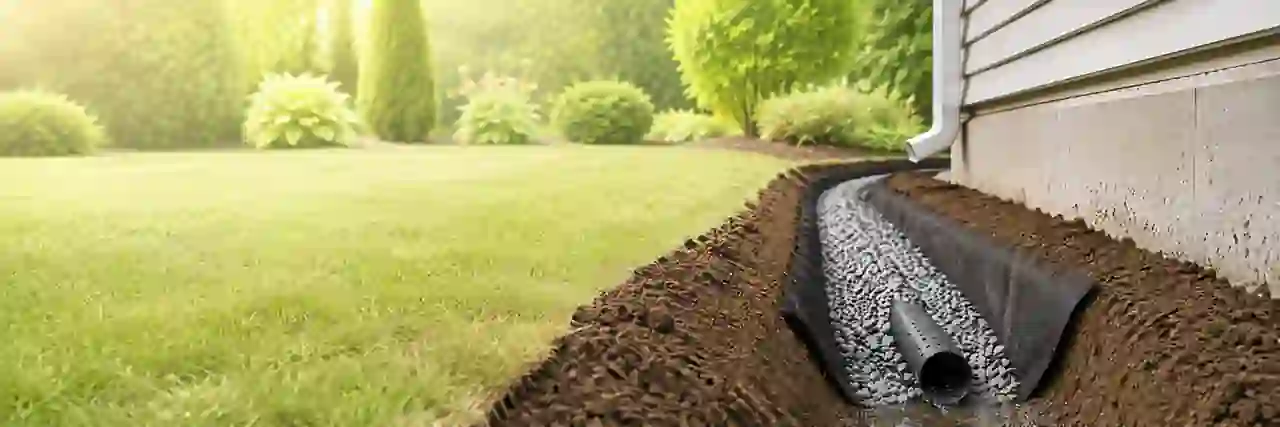
French drain material estimate at a glance
A French drain calculator converts the dimensions of a gravel-filled drainage trench into a material takeoff. Enter the run length, trench width, trench depth and perforated pipe size to estimate drainage stone, pipe, nonwoven filter fabric, excavation volume and the total fall that equals a 1% planning grade.
- Drainage gravel by cubic yard or cubic metre, with approximate tonnage
- Perforated pipe length with the selected material allowance
- Filter fabric area for a full wrap around the gravel envelope
- Minimum fabric width needed to wrap across the trench in one piece
- In-place trench excavation volume
- Total elevation fall corresponding to a 1% grade
- Measured slope percentage when an actual elevation drop is entered
This calculator is a material estimator, not a drainage-capacity model. It does not determine how much stormwater or groundwater must be handled, whether a French drain is the right remedy, or whether the proposed discharge location is permitted.
Four inputs are enough for the first takeoff
The main form is intentionally short. Most homeowners and installers can get a useful preliminary quantity from three trench dimensions and the pipe size. Measurements that are helpful but not essential are kept under Advanced settings instead of turning the calculator into a long drainage-design questionnaire.
What to measure before using the calculator
| Input | Measure this | Why it matters |
|---|---|---|
| Drain length | Follow the actual centerline route from the collection area to the outlet | Pipe, gravel and fabric all scale directly with run length |
| Trench width | Use the intended excavated width, not the pipe diameter | A wider trench can require substantially more stone |
| Trench depth | Measure from finished grade to the trench bottom | This controls excavation and the gravel envelope |
| Perforated pipe size | Choose the nominal pipe planned for the drain | The pipe occupies part of the gravel-filled volume |
| Soil or sod cover | Optional depth above the wrapped gravel | Use it when the drain will be hidden beneath topsoil rather than filled with stone to grade |
| Measured elevation drop | Optional difference between the high and low ends of the run | Lets the calculator convert the field measurement into an actual grade |
| Material allowance | Extra percentage for cuts, trench irregularity and ordering | The default is 10%; reduce or increase it to match the job |
Measure the route you will actually dig. A 50 ft straight-line distance on a site plan can become a longer pipe run after turns, cleanout positions and the path to a workable outlet are included.
How the French drain gravel calculation works
The gravel result is not simply trench length × width × depth. The calculator first removes any topsoil or sod cover from the gravel-filled depth, then subtracts the approximate cylindrical displacement of the selected perforated pipe. The material allowance is added only after that net stone volume is found.
- Excavation volume = length × trench width × full trench depth.
- Gravel depth = trench depth − optional soil/sod cover.
- Gross gravel envelope = length × width × gravel depth.
- Approximate pipe displacement = π × (pipe diameter ÷ 2)² × length.
- Net gravel = gross gravel envelope − pipe displacement.
- Order gravel = net gravel × (1 + material allowance ÷ 100).
Nominal pipe size is used as a planning diameter. Actual outside diameter varies by pipe material and product standard, so the displacement calculation is intentionally an estimate rather than a fabrication measurement.
Cubic yards versus tons: why both numbers matter
Bulk drainage stone may be quoted by volume or by weight. The calculator therefore keeps the geometric order volume and also provides approximate tonnage using 1550 kg/m³ as a planning bulk density. The actual conversion can change with stone type, grading, moisture and supplier practice, so a quarry or landscape supplier's figure should override the generic weight estimate.
Need a supplier-specific density, bag count or gravel cost? Use the Gravel & Aggregate CalculatorFilter fabric is calculated as a wrap, not a strip on the bottom
The fabric estimate assumes a burrito-style wrap around the gravel envelope. The required width crosses the bottom, rises up both sides, closes over the top and includes about 12 inches of overlap. The calculated fabric area then receives the same material allowance entered for the rest of the takeoff.
Why can a 4 ft landscape-fabric roll be too narrow for a 12 in × 20 in trench?
Answer: With a full wrap, the fabric must cover two trench widths, two gravel-filled depths and the overlap. A 12 in wide, 20 in deep gravel envelope needs about 76 in of wrap width before considering whether the actual product requires a different lap detail.
Explanation: Looking only at the trench bottom would seriously understate fabric width and could leave soil exposed to the drainage stone.
What does a 1% French drain grade mean?
A 1% grade means the drain drops 1 unit vertically for every 100 units of horizontal run. Over 50 ft, that is 0.5 ft or 6 in of total fall. Over 20 m, it is 0.2 m or 200 mm. The calculator displays this as a planning reference and can compare it with a measured elevation difference.
Do not treat 1% as a universal code minimum. Suitable grade depends on the drainage system, pipe, outlet, site elevations, soil and local requirements. A perfectly calculated slope also does not help if the drain has no reliable place to discharge.
Worked example: a 50 ft yard drain
What does the calculator return for a 50 ft drain, 12 in wide and 20 in deep, with a 4 in pipe and a 10% material allowance?
Answer: With no soil cover entered, the excavation is about 3.09 yd³. After approximate pipe displacement and the 10% allowance, the stone order is about 3.22 yd³, or roughly 4.2 short tons using the calculator's planning density. Pipe allowance gives 55 ft, filter fabric is about 348 ft², and a 1% grade requires 6 in of total fall.
Explanation: This is more useful than a trench-volume-only estimate because the quantities are separated into excavation, stone, pipe and fabric rather than treating every cubic foot as gravel.
One trench, several different quantities

Excavation is based on the full trench cross-section, while the gravel estimate can exclude a soil cap and the space occupied by the pipe.
Pipe is measured along the drain route and receives the chosen purchasing allowance.
Filter fabric is based on the wrap girth around the gravel, so both trench depth and width affect the roll width you need.
Slope is an elevation check; it should not be confused with material volume or pipe capacity.
Yard drainage and foundation drainage are not the same design problem
The same quantity formula can be useful for a shallow yard interceptor, a drainage trench beside a retaining area or a perimeter system near a foundation, but the design decisions are not interchangeable. Foundation waterproofing, footing elevations, discharge, frost conditions and structural details can matter far more than the number of cubic yards of gravel.
When the calculator is useful — and when more design work is needed
| Situation | Calculator use | Extra checks |
|---|---|---|
| Soggy lawn or low area | Good for a first material takeoff after a route is chosen | Confirm that water has a safe outlet and that a French drain addresses the actual source |
| Along a driveway or landscape edge | Useful for comparing trench sizes and quantities | Check surface grading, utilities and where concentrated flow will go |
| Near a basement or foundation | Useful only for material quantities | Waterproofing, footing elevation, discharge and local building requirements need project-specific review |
| Large runoff or unknown groundwater flow | Not a capacity-sizing tool | Hydrology, soil permeability and pipe/outlet capacity may require professional design |
Common French drain estimating mistakes
- Using pipe diameter as trench width
- Multiplying full trench volume by a gravel density without subtracting the pipe or top cover
- Measuring only the straight-line distance instead of the actual drain route
- Ignoring roll width and calculating filter fabric from bottom area only
- Adding a very large waste factor instead of measuring irregular trench sections separately
- Assuming a 1% planning grade automatically proves the drain will work
- Ordering stone by tons without checking the supplier's volume-to-weight conversion
- Digging before underground utilities and a legal discharge point have been identified
French drain calculator FAQ
How much gravel do I need for a French drain?
Multiply the gravel-filled trench length, width and depth, subtract the approximate volume occupied by the pipe, then add a reasonable ordering allowance. Because trench cross-sections vary widely, there is no single cubic-yards-per-foot number that is correct for every French drain.
Does the calculator include topsoil over the drain?
Yes, when you use the optional Soil or sod cover field. The full depth still counts toward excavation, while the entered cover is removed from the gravel-filled depth. Leave the field at zero when the wrapped gravel extends through the full entered trench depth.
Why is pipe length longer than the drain run?
The result applies the material allowance to the measured run. With the default 10%, a 50 ft route returns 55 ft of pipe. This is a purchasing allowance for cuts, connections and route uncertainty; set the allowance to zero if you want the theoretical centerline length only.
Can this calculator size the pipe for rainfall or groundwater flow?
No. The pipe-size selector is used for material displacement and takeoff. Hydraulic sizing requires information such as inflow, soil behavior, collection geometry, outlet conditions and pipe characteristics that are intentionally outside this short calculator.
Is a 4 inch pipe always enough?
No. Four-inch perforated pipe is a common residential product and is provided as the default option, but capacity and suitability cannot be chosen from trench dimensions alone. Use the size specified for the actual drainage design when one has been prepared.
What should I check before excavation?
Identify underground utilities, confirm start and outlet elevations, verify where the water is allowed to discharge, and make sure the proposed drain will not move water toward a building or neighboring property. For foundation or high-consequence drainage, get project-specific advice before relying on a material takeoff.
The calculator estimates quantities from the dimensions entered. Actual material use can change with trench collapse, bends, fittings, cleanouts, stone grading, fabric detailing and field conditions. Confirm final quantities with the installer and suppliers before a large order.