
Driveway gravel looks simple right up to the moment you try to order it. Then one supplier speaks in cubic yards, another in tons, someone else asks what depth you want, and a delivery company casually mentions truck capacity as if everybody keeps that information beside the toaster.
The good news is that the calculation is not complicated once the order is correct. Measure the driveway area, choose the finished gravel depth, calculate the volume, then convert that volume into weight or delivery units using the actual gravel type. That gives you a much better answer than guessing from the size of the driveway and hoping the pile somehow works itself out.
Quick answer: driveway area × gravel depth = volume. Then adjust for compaction or settlement, add a small allowance, and convert the result into cubic yards or cubic metres, tons or tonnes, bags or truckloads using the density of the gravel you plan to buy.
This guide helps estimate ordering quantity. It does not design the driveway structure for every soil, climate or vehicle load. The right gravel type, base depth, drainage detail, edging and compaction method depend on the site and the intended use.
How to estimate gravel for a driveway
The Three Numbers That Control the Result
Most driveway gravel estimates are controlled by just three inputs: the area, the finished depth and the gravel type. Area tells you how much surface must be covered. Depth tells you how thick the layer should be. Gravel type matters because different products have different densities and different jobs within the driveway build-up.
What each input actually changes
| Input | What it means | Why it matters |
|---|---|---|
| Driveway area | The length and width of the space to be covered | This controls the basic surface quantity |
| Finished depth | How thick the gravel layer should be after installation | A small change in depth can change the order noticeably |
| Gravel type | The specific material being delivered | This affects density, compaction behaviour, drainage and the tons-per-yard conversion |
Think in layers, not in one mysterious pile of stone
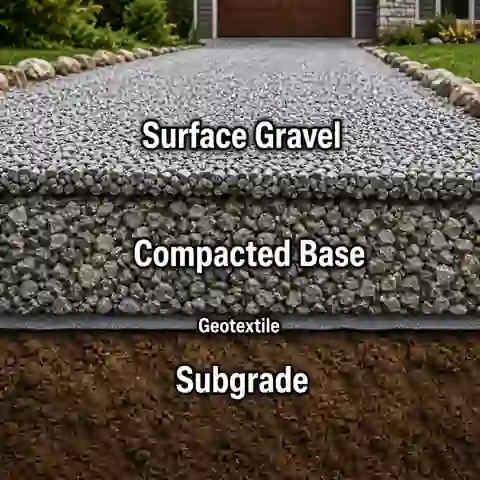
Many driveways use more than one gravel layer. A compacted base layer and a surface layer are often different products and may need separate calculations.
If you are building a new driveway, do not assume that the decorative top layer and the structural base should be ordered as one single material.
The safest approach is to calculate each layer separately, especially when the depths are different.
1. Measure the Driveway Area
For a simple rectangular driveway, measure the length and width and multiply them. If the driveway is curved, flared or made from more than one section, split it into smaller rectangles or simple shapes, calculate each area separately and add them together.
Measure the space that will actually receive gravel, not just the property boundary or the widest possible driveway outline. A tape measure, a quick sketch and a few labelled dimensions can prevent an expensive ordering mistake.
What is the area of a 40 ft × 12 ft driveway?
Answer: 480 sq ft.
Explanation: Area = 40 × 12 = 480 sq ft.
What is the area of a 10 m × 3 m driveway?
Answer: 30 m².
Explanation: Area = 10 × 3 = 30 m².
Irregular driveways are easier when you split them into sections
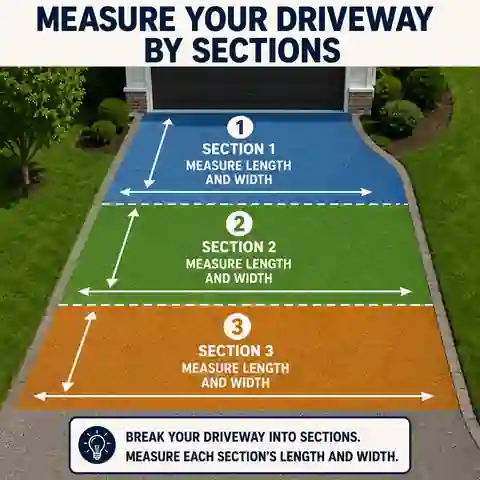
Break an L-shaped or widening driveway into smaller measurable zones.
Write the dimensions directly on a simple sketch so the total can be checked before ordering.
This is much more reliable than trying to estimate a complicated shape by eye from the gate and hoping confidence counts as geometry.
2. Choose the Gravel Depth
Depth is where many driveway estimates go wrong. People often know the length and width, but not whether they are calculating a thin topping layer, a new surface layer or the full structural gravel build-up. Those are not the same job, so they do not use the same depth.
Typical planning depths for driveway gravel
| Situation | Common starting depth | What to remember |
|---|---|---|
| Refreshing an existing gravel surface | About 1–2 in (25–50 mm) | This is often only a top-up, not a full rebuild |
| Surface gravel layer | About 2–3 in (50–75 mm) | Suitable depth depends on gravel type and how the driveway is used |
| Compacted base for a light-duty residential driveway | About 4–6 in (100–150 mm) | Site conditions, drainage and subgrade quality matter |
| Heavier use, weak subgrade or a more robust build-up | About 6–8 in (150–200 mm) or a site-specific design | Check local practice, supplier guidance or professional advice for the actual project |
There is no single magical driveway depth that fits every home. A short domestic driveway on good ground is not the same as a long sloping drive, a parking bay for heavier vehicles or a site with soft, wet subgrade.
If your driveway has both a base layer and a top layer, calculate them separately. For example, you might have 100 mm of compacted base aggregate and 50 mm of surface gravel. That is two different calculations, not one blended number.
3. Convert Area and Depth into Volume
Once you know the driveway area and the finished depth, you can calculate the gravel volume. The formula is simple: volume = area × depth. The only trick is keeping everything in one unit system and remembering that suppliers often deliver loose gravel, while your planned driveway depth is usually the compacted finished depth.
Useful driveway gravel formulas
| What you want | Formula | Notes |
|---|---|---|
| Cubic feet | sq ft × depth in ft | Convert inches to feet first |
| Cubic yards | sq ft × depth in ft ÷ 27 | There are 27 cubic feet in 1 cubic yard |
| Cubic metres | m² × depth in m | Convert millimetres to metres first |
| Order volume | finished volume × compaction factor × allowance | Use a separate uplift for settlement and a small waste or handling allowance |
If the planned depth is the compacted finished thickness, the loose-delivered quantity usually needs to be a bit higher. That is why many calculations include an extra percentage for compaction or settlement before delivery.
How many cubic yards are needed for a 40 ft × 12 ft driveway with a 4 in gravel layer?
Answer: About 5.93 cubic yards before compaction and allowance.
Explanation: Area = 480 sq ft. Depth = 4 in = 0.333 ft. Volume = 480 × 0.333 = about 160 cubic ft. Then 160 ÷ 27 = about 5.93 cubic yards.
How many cubic metres are needed for a 10 m × 3 m driveway with a 100 mm gravel layer?
Answer: 3.0 m³ before compaction and allowance.
Explanation: Area = 30 m². Depth = 100 mm = 0.1 m. Volume = 30 × 0.1 = 3.0 m³.
4. Add Compaction and a Small Allowance
A practical order often includes two small adjustments. The first is extra material for compaction or settlement, because loose-delivered aggregate can reduce in depth once spread and compacted. The second is a small allowance for uneven ground, trimming, handling loss and the fact that real driveways are rarely perfect mathematical theatre.
Typical planning adjustments
| Adjustment | Common planning range | Purpose |
|---|---|---|
| Compaction or settlement uplift | Often about 5–15% | Allows for the difference between loose material and the compacted finished layer |
| General allowance | Often about 3–8% | Covers unevenness, shaping and small ordering losses |
Do not use a huge extra percentage to hide uncertain measurements. It is usually better to measure the driveway again than to solve geometry with optimism.
5. Convert Cubic Yards or Metres into Tons or Tonnes
Suppliers often sell driveway gravel by weight rather than by volume. To convert the driveway volume into tons or tonnes, multiply by the density of the gravel. This is why the material type matters. Crushed stone, road base, decorative gravel and drain stone do not all weigh the same per cubic yard or per cubic metre.
Approximate planning densities for common gravel products
| Material | Approximate planning density | Important note |
|---|---|---|
| Pea gravel or rounded decorative gravel | Often around 1.2–1.4 US tons per cubic yard | Check the supplier value for the actual product |
| Crushed stone or #57-type aggregate | Often around 1.3–1.5 US tons per cubic yard | Size, moisture and source can change the result |
| Crusher run, road base or MOT Type 1 style material | Often around 1.4–1.7 US tons per cubic yard | This is only a planning range, not a guaranteed conversion |
| Metric bulk aggregate | Often around 1.5–1.9 tonnes per cubic metre | Use the exact declared bulk density where available |
Density is not a universal constant for 'gravel'. Moisture content, grading, fines and the exact stone source can all affect the weight. For a real purchase, use the supplier's figure whenever possible.
If the adjusted driveway order is 6.8 cubic yards and the selected gravel is estimated at 1.5 US tons per cubic yard, how many tons are needed?
Answer: About 10.2 short tons.
Explanation: Tons = 6.8 × 1.5 = 10.2 short tons.
If the adjusted driveway order is 3.45 m³ and the selected aggregate is estimated at 1.7 tonnes per m³, how many tonnes are needed?
Answer: About 5.87 tonnes.
Explanation: Tonnes = 3.45 × 1.7 = 5.865 tonnes, usually rounded according to the supplier's ordering method.
6. How Many Truckloads of Gravel Do You Need?
Truckloads are simply the total order divided by the truck capacity. The important part is using the capacity of the vehicle that will actually deliver the material. Some suppliers quote by cubic yards, some by tons, and a 'small load' means almost nothing until it becomes a real number.
Simple truckload calculation
| Known value | Formula | Result |
|---|---|---|
| Order in tons | total tons ÷ truck capacity in tons | Estimated number of loads |
| Order in cubic yards | total cubic yards ÷ truck capacity in cubic yards | Estimated number of loads |
| Order in tonnes or m³ | same unit ÷ matching truck capacity | Estimated number of loads |
If a driveway needs 10.2 tons of gravel and the supplier's truck carries 8 tons, how many loads are required?
Answer: 2 loads.
Explanation: 10.2 ÷ 8 = 1.275, so the result must be rounded up to 2 delivery loads.
A supplier quote often moves through three units
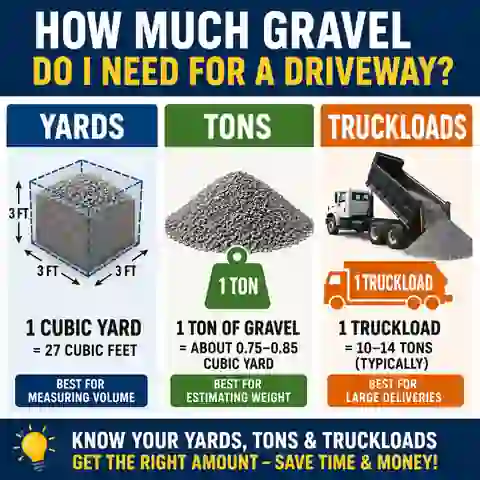
Your sketch and measurements usually produce area and depth first.
That becomes cubic yards or cubic metres, then tons or tonnes once the gravel density is known.
The final delivery plan often depends on truck capacity, not just on the theoretical material quantity.
Driveway Gravel Example: Full Imperial Calculation
Worked example for a 40 ft × 12 ft driveway
| Step | Calculation | Result |
|---|---|---|
| Area | 40 × 12 | 480 sq ft |
| Depth | 4 in | 0.333 ft |
| Basic volume | 480 × 0.333 | about 160 cubic ft |
| Cubic yards | 160 ÷ 27 | about 5.93 yd³ |
| Add 10% compaction | 5.93 × 1.10 | about 6.52 yd³ |
| Add 5% allowance | 6.52 × 1.05 | about 6.85 yd³ |
| Convert to tons at 1.5 tons/yd³ | 6.85 × 1.5 | about 10.28 tons |
| Truckloads at 8 tons per truck | 10.28 ÷ 8 | 2 loads |
This is the kind of estimate most people actually need: not just the raw volume, but the order quantity after practical adjustments and the likely delivery arrangement. That is also why a driveway can seem modest on paper but still need more than one trip from the supplier.
Metric Example for UK and General Metric Use
Worked example for a 10 m × 3 m driveway
| Step | Calculation | Result |
|---|---|---|
| Area | 10 × 3 | 30 m² |
| Depth | 100 mm | 0.1 m |
| Basic volume | 30 × 0.1 | 3.0 m³ |
| Add 10% compaction | 3.0 × 1.10 | 3.3 m³ |
| Add 5% allowance | 3.3 × 1.05 | 3.465 m³ |
| Convert to tonnes at 1.7 t/m³ | 3.465 × 1.7 | about 5.89 tonnes |
What Type of Gravel Should You Use for a Driveway?
The best gravel type depends on whether you are building the structural base, refreshing the surface or aiming for a particular appearance. For many driveways, the base layer uses a compactable material such as crushed stone, road base, crusher run or, in UK terminology, something similar to MOT Type 1. The upper visible layer may use a different angular or decorative gravel depending on drainage, appearance and how firmly you want the stones to lock together.
Common driveway gravel roles
| Material role | Common product style | Why it is used |
|---|---|---|
| Base layer | Crushed stone, road base, crusher run, MOT Type 1 style aggregate | Compacts well and helps create a stable foundation |
| Surface layer | Angular driveway gravel or selected decorative aggregate | Provides the finished appearance and wearing surface |
| Drainage-focused layer | Cleaner stone with fewer fines | Used where drainage is a priority, depending on the build-up |
Rounded pea gravel can look great, but it is not always the easiest choice for a sloping or heavily used driveway because it tends to move more under tyres and feet.
Common Driveway Gravel Estimating Mistakes
Mistake, consequence and better approach
| Mistake | What goes wrong | Better approach |
|---|---|---|
| Using area only | The order ignores depth and becomes meaningless | Always calculate volume from area and depth |
| Guessing the depth | The final quantity can be badly wrong | Decide whether you are topping up, surfacing or building the full layer |
| Ordering by tons without checking density | The weight conversion may be wrong for the actual gravel | Use the supplier's density for the chosen material |
| Skipping compaction uplift | The finished driveway may end up thinner than planned | Allow for loose-to-compacted difference where appropriate |
| Treating the whole driveway as one material | Base and surface quantities become mixed | Calculate separate layers separately |
| Assuming one truckload will do | Delivery planning and cost become messy | Check the supplier's real truck capacity first |
Frequently Asked Questions
How much gravel do I need for a 2-car driveway?
There is no single answer because 2-car driveways vary in width, length and depth. Measure the actual driveway, multiply length by width, then apply the planned gravel depth. The finished quantity may then need compaction and allowance adjustments before being converted to tons or truckloads.
How many cubic yards of gravel are in a ton?
That depends on the gravel density. There is no fixed universal conversion. A rough planning range is often somewhere around 1.2 to 1.7 US tons per cubic yard depending on the product, but the supplier's number for the exact material is the one that matters most.
Should I add extra gravel for compaction?
Usually yes when the entered depth is the compacted finished thickness. Loose-delivered aggregate often settles or compacts, so an uplift is commonly added before ordering. The exact percentage depends on the material and the site conditions.
How deep should gravel be on a driveway?
It depends on whether you are topping up an existing surface, laying a finish layer or building a full base. Light residential situations often start with a few inches for the surface and a deeper compacted base beneath, but the correct build-up depends on the ground, drainage and vehicle loads.
Is one truckload of gravel enough for a driveway?
Sometimes, but only after you compare your total quantity with the truck capacity. A modest driveway topping layer may fit in one load, while a full new base-and-surface build-up may need more than one.
A Practical Final Check Before Ordering
- The driveway area has been measured from the actual space to be covered.
- The gravel depth matches the real job: top-up, surface layer or full build-up.
- Base and surface layers have been calculated separately where needed.
- The delivered quantity includes a sensible compaction uplift if appropriate.
- A small allowance has been added for unevenness and handling.
- The tons or tonnes conversion uses the chosen gravel type rather than a random average.
- Truck capacity has been checked with the supplier before delivery is booked.
A good driveway gravel estimate is not just a volume number. It is an ordering plan. Once you know the area, depth, material and delivery unit, the calculation becomes much more dependable and much less stressful than staring at the driveway and trying to estimate stone by instinct.
Open the HomDera Gravel & Aggregate CalculatorIf the project also includes a concrete apron, edging or a small pad, it can be useful to calculate those materials separately before you order.
Use the HomDera Concrete Calculator for slabs, footings and bagsAnd if the driveway project includes edging, borders or a small retaining detail, this related quantity guide may help with that side of the job too.
Read: How Many Concrete Blocks Do I Need for a Wall?