
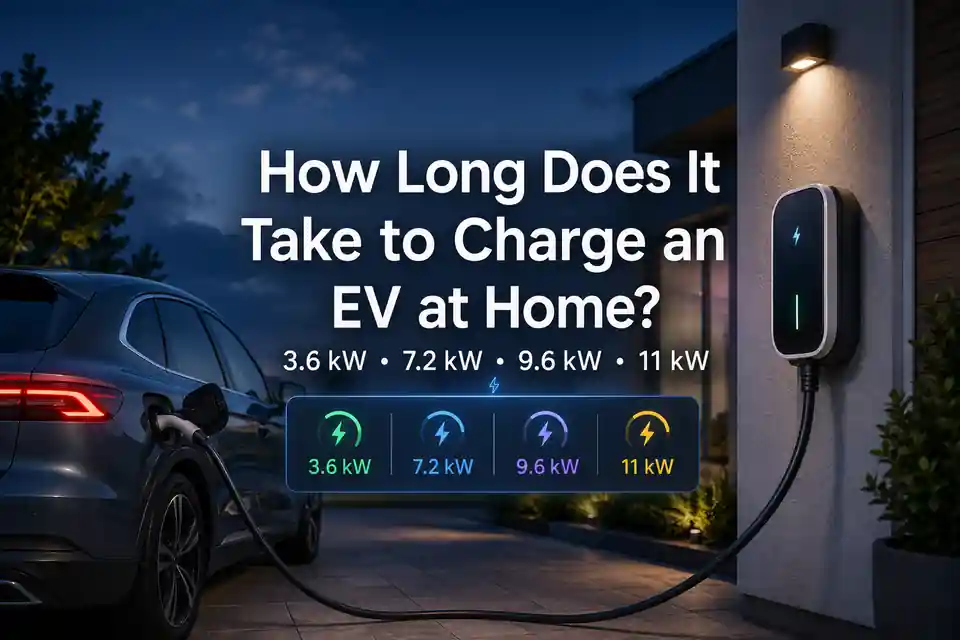
Home EV charging time depends mainly on two things: how much energy the battery needs and how much AC power the car actually receives. The power printed on the wallbox is only its maximum output. The vehicle’s onboard charger, the home electrical supply, load management, temperature and charging losses can all reduce the real charging rate.
This guide compares the four power levels using the same assumptions, so the differences are easy to see. It includes 20% to 80% and 10% to 100% tables for batteries from 40 to 100 kWh, explains the regional terminology used in the United States, Canada, the United Kingdom and Australia, and shows how to decide whether a faster home charger would actually change your daily routine.
This guide covers AC charging at home. It does not estimate charging time at public DC fast chargers, where power can change substantially during the session and the vehicle follows a model-specific charging curve.
Quick answer: for a 75 kWh usable battery charging from 20% to 80%, the estimated times are about 13 h 55 min at 3.6 kW, 6 h 55 min at 7.2 kW, 5 h 10 min at 9.6 kW and 4 h 35 min at 11 kW. These figures assume 90% grid-to-battery efficiency and that the vehicle accepts the full stated AC power.
This article estimates charging time; it does not approve a circuit, cable, socket, breaker, consumer unit, panel, service connection or chargepoint installation. Fixed EV charging equipment should be selected and installed by a qualified electrician under the rules that apply where the property is located.
Home EV charging time guide
What 3.6 kW, 7.2 kW, 9.6 kW and 11 kW Actually Mean
Kilowatts describe charging power: the rate at which electrical energy is supplied. Kilowatt-hours describe energy: the amount delivered over time. A charger operating at 7.2 kW for one hour supplies approximately 7.2 kWh from the electrical side before charging losses. It does not add 7.2% to every battery, because 7.2 kWh is a different percentage of a 40 kWh battery than of a 100 kWh battery.
How the four charging powers commonly appear
| Nominal power | Typical electrical context | Where it is commonly discussed | Important limitation |
|---|---|---|---|
| 3.6 kW | About 16 A on a 230 V single-phase supply, or a comparable lower-power AC setup | UK and Australian home charging; lower-current Level 2 or portable arrangements elsewhere | Large batteries may need more than one night after a deep discharge |
| 7.2 kW | About 32 A at 230 V or 30 A at 240 V, depending on the product and market | A common home-wallbox comparison in the UK, Australia, US and Canada | Some products are labelled 7.0, 7.2, 7.4 or 7.7 kW because voltage and current differ |
| 9.6 kW | 40 A at 240 V | North American Level 2 charging on a suitably designed circuit | The car may accept only 7.2 or 7.7 kW even when the EVSE can supply 9.6 kW |
| 11 kW | Usually three-phase AC at roughly 16 A per phase in 400 V markets | Many European, UK and Australian three-phase installations and compatible vehicles | A single-phase home or a vehicle without 11 kW three-phase AC support will not receive 11 kW |
The label may be a rounded nominal value. A 32 A charger can be described as 7.2, 7.4 or 7.7 kW depending on whether the assumed supply is about 230 V or 240 V and how the manufacturer presents the rating.
The Basic Home-Charging Formula
How long does a 75 kWh EV take to charge from 20% to 80% on a 7.2 kW home charger?
Answer: Approximately 6 hours 55 minutes under the table assumptions.
Explanation: The battery needs 75 × 0.60 = 45 kWh. Effective battery power is 7.2 × 0.90 = 6.48 kW. Then 45 ÷ 6.48 = 6.94 hours, which is about 6 hours 56 minutes and is rounded to 6 hours 55 minutes in the table.
Power passes through more than one component
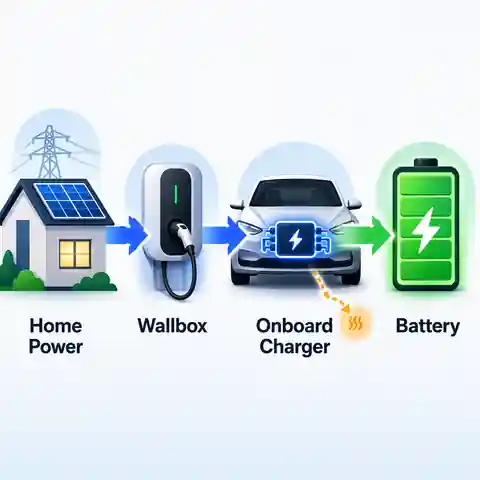
The wallbox or EVSE controls and safely supplies AC power, but the vehicle’s onboard charger converts that AC power to DC for the traction battery.
The usable charging rate is limited by the weakest point: the electrical supply, EVSE setting, cable, vehicle inlet, onboard charger or a temporary vehicle limit.
Some metered electricity powers conversion, battery conditioning, pumps, fans, electronics and thermal management instead of becoming stored battery energy.
Assumptions Used in the Charging-Time Tables
- Battery capacity means usable capacity, not necessarily the gross nameplate capacity.
- The vehicle accepts the full stated AC power throughout the calculated session.
- Grid-to-battery charging efficiency is 90%.
- No substantial power is diverted by load sharing with another vehicle.
- The battery is within a normal charging temperature range.
- There is no scheduled pause, utility control event or reduced-current setting.
- Times are rounded to the nearest five minutes.
- The figures are planning estimates, not model-specific promises.
For your own vehicle, replace the table assumptions with its usable battery capacity, actual onboard AC limit and a measured or manufacturer-supported efficiency figure. The HomDera calculator allows those values to be entered separately.
Find These Six Numbers Before Calculating
Where to find the information for your own EV
| Value | What to use | Where to find it |
|---|---|---|
| Usable battery capacity | The battery energy available to the driver, in kWh | Vehicle specification, owner’s manual or a reliable manufacturer data page |
| Starting state of charge | The battery percentage when charging begins | Vehicle dashboard or mobile app |
| Target state of charge | The percentage selected as the charging limit | Vehicle charging settings or mobile app |
| Wallbox or EVSE power | The maximum AC power the charging equipment can supply | Wallbox label, installation documents or app |
| Vehicle maximum AC power | The highest AC charging power the onboard charger can accept | Vehicle charging specification; do not use the DC fast-charging rating |
| Charging efficiency | The percentage of grid energy expected to reach the battery | Use measured charging history when available, or 90% as a preliminary comparison assumption |
Gross battery capacity and usable battery capacity are not always the same. If only the advertised battery size is available, the calculation can still provide a rough estimate, but the result may differ from the vehicle’s real charging time.
EV Charging Time from 20% to 80%
The 20% to 80% window replaces 60% of usable battery capacity. It is a useful comparison because many drivers charge within a partial window during normal use rather than repeatedly arriving at 0% and charging to 100%.
Estimated 20% to 80% home charging time at 90% efficiency
| Usable battery | 3.6 kW | 7.2 kW | 9.6 kW | 11 kW |
|---|---|---|---|---|
| 40 kWh | 7 h 25 min | 3 h 40 min | 2 h 45 min | 2 h 25 min |
| 50 kWh | 9 h 15 min | 4 h 40 min | 3 h 30 min | 3 h |
| 60 kWh | 11 h 05 min | 5 h 35 min | 4 h 10 min | 3 h 40 min |
| 75 kWh | 13 h 55 min | 6 h 55 min | 5 h 10 min | 4 h 35 min |
| 80 kWh | 14 h 50 min | 7 h 25 min | 5 h 35 min | 4 h 50 min |
| 100 kWh | 18 h 30 min | 9 h 15 min | 6 h 55 min | 6 h 05 min |
| 120 kWh | 22 h 15 min | 11 h 05 min | 8 h 20 min | 7 h 15 min |
| 130 kWh | 24 h 05 min | 12 h | 9 h | 7 h 55 min |
The 11 kW column applies only when the property can supply that power and the vehicle supports approximately 11 kW AC charging. Connecting an 11 kW wallbox to a car with a 7.2 kW onboard charger still produces roughly 7.2 kW before losses.
EV Charging Time from 10% to 100%
A 10% to 100% session replaces 90% of usable capacity, so it takes 50% longer than a 20% to 80% session under identical power and efficiency assumptions. Real full-charge sessions may also take longer if the vehicle reduces AC power near 100% or spends time balancing and conditioning the battery.
Estimated 10% to 100% home charging time at 90% efficiency
| Usable battery | 3.6 kW | 7.2 kW | 9.6 kW | 11 kW |
|---|---|---|---|---|
| 40 kWh | 11 h 05 min | 5 h 35 min | 4 h 10 min | 3 h 40 min |
| 50 kWh | 13 h 55 min | 6 h 55 min | 5 h 10 min | 4 h 35 min |
| 60 kWh | 16 h 40 min | 8 h 20 min | 6 h 15 min | 5 h 25 min |
| 75 kWh | 20 h 50 min | 10 h 25 min | 7 h 50 min | 6 h 50 min |
| 80 kWh | 22 h 15 min | 11 h 05 min | 8 h 20 min | 7 h 15 min |
| 100 kWh | 27 h 45 min | 13 h 55 min | 10 h 25 min | 9 h 05 min |
| 120 kWh | 33 h 20 min | 16 h 40 min | 12 h 30 min | 10 h 55 min |
| 130 kWh | 36 h 05 min | 18 h 05 min | 13 h 30 min | 11 h 50 min |
Do not plan every journey around a mathematical 100% finish time. The vehicle may complete the displayed charge later because of battery temperature, cell balancing, a reduced current limit or a charging schedule. Check the car’s own estimated completion time after the session begins.
How Much Energy Can Be Added Overnight?
Approximate battery energy added at 90% efficiency
| Plugged-in time | 3.6 kW | 7.2 kW | 9.6 kW | 11 kW |
|---|---|---|---|---|
| 6 hours | 19.4 kWh | 38.9 kWh | 51.8 kWh | 59.4 kWh |
| 8 hours | 25.9 kWh | 51.8 kWh | 69.1 kWh | 79.2 kWh |
| 10 hours | 32.4 kWh | 64.8 kWh | 86.4 kWh | 99.0 kWh |
| 12 hours | 38.9 kWh | 77.8 kWh | 103.7 kWh | 118.8 kWh |
An eight-hour window adds approximately 25.9 kWh at 3.6 kW, 51.8 kWh at 7.2 kW, 69.1 kWh at 9.6 kW or 79.2 kWh at 11 kW under the same assumptions. That is why charger selection should start with the energy you normally need to replace overnight, not with the largest wallbox available.
Is 3.6 kW enough for a driver who uses about 15 kWh per day?
Answer: Usually yes, provided the car is plugged in for a long enough window and the installation can safely supply the charger.
Explanation: At 90% efficiency, replacing 15 kWh takes about 4 hours 40 minutes at 3.6 kW. A regular overnight window leaves additional time for scheduling, but an occasional deep discharge of a large battery can still require more than one night.
Daily top-up and full recovery are different jobs
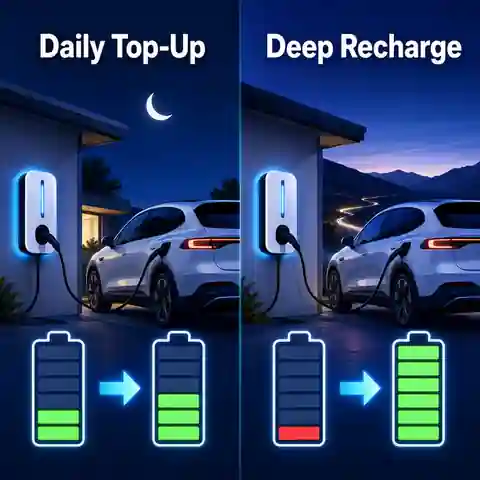
A commuter may need only 10–20 kWh after an ordinary day, even when the vehicle has a much larger battery.
A lower-power charger can cover routine daily use but take longer after a road trip, several missed charging nights or unusually cold-weather driving.
Choose power for the charging window that matters most: normal overnight recovery, occasional deep recovery or a strict departure deadline.
Which Home-Charging Power Is Enough?
3.6 kW: useful for regular overnight top-ups
A 3.6 kW charger can suit a driver with moderate daily mileage, a plug-in hybrid, a smaller battery or a long overnight parking window. It can add around 26 kWh to the battery in eight hours at 90% efficiency. The disadvantage appears after a deep discharge: a 75 kWh battery moving from 20% to 80% needs nearly fourteen hours under the comparison assumptions.
7.2 kW: a strong all-round home option
Around 7 kW is a common home-charging reference in the UK and Australia, while comparable North American products may be labelled 7.2 or 7.7 kW. It can replace about 52 kWh in eight hours at 90% efficiency, enough to move many medium-sized EV batteries through a substantial charging window overnight.
9.6 kW: faster North American Level 2 charging
A 9.6 kW EVSE corresponds to 40 A at 240 V and can be attractive for larger batteries, shorter parking windows or households that want quicker recovery after long trips. The advantage exists only when the vehicle’s onboard charger accepts approximately that power and the home electrical system can support the required continuous load.
11 kW: valuable when both three-phase supply and the car support it
An 11 kW AC charger is often associated with three-phase supplies in 400 V markets. It can charge a 75 kWh usable battery from 20% to 80% in about 4 hours 35 minutes under the table assumptions. It is not automatically available in every home, and many vehicles accept less than 11 kW on AC even if their DC fast-charging number is much higher.
Practical comparison of the four power levels
| Power | Eight-hour battery energy | Strongest use case | Main reason it may not help |
|---|---|---|---|
| 3.6 kW | About 25.9 kWh | Moderate daily use and long overnight parking | Slow recovery from a deeply discharged large battery |
| 7.2 kW | About 51.8 kWh | Broad everyday home use | Vehicle or supply may use a nearby rating such as 7.0, 7.4 or 7.7 kW |
| 9.6 kW | About 69.1 kWh | Large batteries or shorter North American charging windows | Onboard charger or household capacity may be lower |
| 11 kW | About 79.2 kWh | Compatible three-phase homes and vehicles | Not achievable from an ordinary single-phase installation or unsupported car |
The Car, Charger and Home Form a Power Bottleneck
For AC charging, usable power is approximately the lowest active limit in the chain. A 9.6 kW EVSE cannot force 9.6 kW through a vehicle with a 7.2 kW onboard charger. An 11 kW vehicle cannot take 11 kW when connected to a 3.6 kW supply. Smart load management can also temporarily lower the EVSE output when the home, apartment building or charging group is using more electricity elsewhere.
- Maximum power available from the property and dedicated circuit.
- Configured current limit of the EVSE.
- Cable and connector capability.
- Vehicle inlet and onboard AC charger rating.
- Single-phase or three-phase compatibility.
- Vehicle software charging-current setting.
- Dynamic load-management or power-sharing limit.
- Temporary battery-temperature or state-of-charge limit.
The smallest limit sets the charging rate
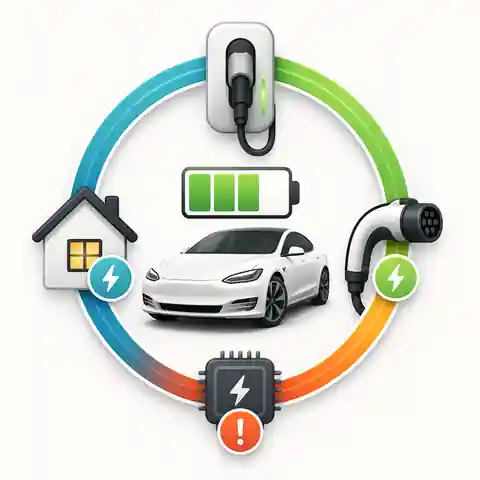
A 9.6 kW wallbox connected to a 7.2 kW onboard charger normally produces no more than the vehicle limit before losses.
An 11 kW three-phase-capable car connected to a 7.2 kW single-phase charger receives approximately the charger limit.
A load-managed charger may vary its output during the evening as cooking, water heating, air conditioning or another EV changes the available capacity.
What happens when an 11 kW wallbox charges a car with a 7.2 kW onboard AC charger?
Answer: The charging session is limited to approximately 7.2 kW before losses, not 11 kW.
Explanation: The wallbox advertises the maximum it can supply, while the onboard charger determines how much AC power the vehicle can convert. The effective power in the time calculation should therefore use the lower vehicle limit.
Why Home EV Charging Can Take Longer Than the Table
Factors that can extend charging time
| Factor | How it changes charging | What to check |
|---|---|---|
| Lower onboard charger limit | Caps AC power below the wallbox rating | Vehicle specifications for maximum AC charging power |
| Cold or hot battery | The car may spend energy on conditioning or reduce accepted power | Battery temperature, preconditioning and vehicle messages |
| Charging losses | Metered grid energy exceeds energy stored in the battery | Wallbox data, vehicle data or a measured session |
| Dynamic load management | EV power falls when other loads need capacity | Wallbox app, energy meter and configured site limit |
| Two vehicles sharing power | Available current is divided or scheduled | Power-sharing rules and whether both cars charge simultaneously |
| Reduced-current setting | The car or EVSE intentionally uses less current | Vehicle and wallbox settings |
| Voltage variation | Actual kW can be lower than the nominal calculation | Installer measurements and EVSE session data |
| High target state of charge | Some vehicles reduce AC power or perform additional balancing near full | Charge curve and the car’s estimated completion time |
| Scheduled charging | The car waits for a selected off-peak or departure window | Vehicle, wallbox and utility schedule settings |
| Software or communication interruption | Charging pauses or restarts | Notifications, fault history and connector status |
A 90% grid-to-battery assumption means 50 kWh stored in the battery requires about 55.6 kWh from the meter. The energy difference is not one single loss. It can include AC-to-DC conversion, cable and electronic losses, pumps, cooling or heating, battery management, computers and other systems that remain active during charging.
Low-power charging can sometimes show a lower overall percentage efficiency because the vehicle’s fixed background consumption continues for more hours. Efficiency varies by vehicle, temperature, power level and measurement boundary, so use a measured session when cost accuracy matters.
Does Charging Slow Down Above 80% at Home?
The dramatic charging curve seen at a DC fast charger should not be copied directly to home AC charging. Many EVs can hold their normal AC rate through most of the battery window because AC power is already much lower than peak DC capability. However, a vehicle may still reduce power near full charge, condition the battery, balance cells or change the finish time for battery-health and temperature reasons.
How to think about the final part of a home charge
| Charging window | Planning approach | Reason |
|---|---|---|
| 20% to 80% | The steady-power estimate is usually a useful comparison | The window avoids the nearly full region and represents a common daily scenario |
| 20% to 90% | Allow some model-specific variation | Battery strategy and temperature can begin to matter more |
| 10% to 100% | Use the car’s completion estimate after charging starts | The final percentage may involve reduced power, balancing or conditioning |
| Cold-soaked battery | Expect additional uncertainty at any SOC | Energy may first be used to warm the battery or charging power may be restricted |
Approximate Range Added per Hour
Illustrative range added using 3.5 mi/kWh or 5.6 km/kWh
| Nominal charger power | Battery energy per hour at 90% | Illustrative miles per hour | Illustrative kilometres per hour |
|---|---|---|---|
| 3.6 kW | 3.24 kWh | about 11.3 miles | about 18.1 km |
| 7.2 kW | 6.48 kWh | about 22.7 miles | about 36.3 km |
| 9.6 kW | 8.64 kWh | about 30.2 miles | about 48.4 km |
| 11 kW | 9.9 kWh | about 34.6 miles | about 55.4 km |
The range table uses one illustrative vehicle efficiency so the charging powers can be compared on equal terms. A less efficient SUV, pickup, van or cold-weather journey will add fewer miles or kilometres per charging hour. A smaller efficient car may add more.
Range added is not a fixed property of the wallbox. It depends on the vehicle’s real energy consumption, which changes with speed, weather, heating, air conditioning, tyres, elevation, towing, payload and driving style.
How to Estimate Home EV Charging Cost
Charging cost should normally use electricity drawn from the grid, not only energy stored in the battery. Grid energy = battery energy required ÷ charging efficiency. Session energy cost = grid energy × electricity price per kWh. Fixed daily supply charges usually exist whether or not the car charges, so they are not automatically assigned to one EV session.
What does a 75 kWh battery cost to charge from 20% to 80% at a rate of 0.18 per kWh?
Answer: Approximately 9.00 in whichever currency is used for the electricity tariff—for example, $9.00, C$9.00, £9.00 or A$9.00.
Explanation: The battery receives 45 kWh. Grid energy is 45 ÷ 0.90 = 50 kWh. At 0.18 per kWh, the session energy cost is 50 × 0.18 = 9.00. Use USD, CAD, GBP or AUD consistently; the arithmetic does not convert currencies.
- Use the actual off-peak, overnight or time-of-use rate when charging is scheduled into that window.
- Check whether a discounted rate applies to all household electricity or only to EV charging through a controlled device.
- Keep fixed daily, standing, customer or supply charges separate unless you intentionally want an all-in average.
- Include taxes or network charges when they are added per kWh and not already included in the entered tariff.
- For solar charging, compare the value of self-consumed solar with any export credit that would otherwise have been earned.
- For apartment or shared charging, include platform, access, parking or management fees when they are charged to the user.
Smart Charging, Off-Peak Tariffs and Departure Schedules
A faster charger does not automatically mean higher energy cost, because a given battery top-up needs approximately the same stored energy. Power mainly changes how quickly that energy is delivered. Cost changes when the faster charger moves more of the session into an expensive time window, increases a demand-related charge, or prevents use of a cheaper period because of scheduling choices.
- Set a departure time so the car finishes near the time it is needed.
- Use one scheduler—vehicle or wallbox—unless the two systems are confirmed to coordinate correctly.
- Check that the selected off-peak window is long enough for the required kWh at the real charging power.
- Use dynamic load management where the home supply cannot support the charger at full power alongside every other major load.
- Review charging history rather than assuming the nameplate power was maintained for the full session.
- Keep enough flexibility for unexpected journeys instead of scheduling the car to finish at the exact mathematical minute.
Charging an EV from Home Solar
Solar charging is limited by the surplus available after the home’s other loads, not only by the wallbox rating. A 7.2 kW charger does not require solar panels to produce 7.2 kW continuously; a smart charger may reduce current to follow surplus generation. The trade-off is that a lower solar-matched rate may need more daylight hours.
Three common solar-charging approaches
| Approach | How it works | Main trade-off |
|---|---|---|
| Fixed-rate daytime charging | The EV charges at a selected power while solar offsets part of the household demand | Grid import can rise when clouds or other loads reduce surplus |
| Solar-surplus tracking | A compatible charger varies current to use available export | Charging may be slow or pause during low generation |
| Battery-assisted charging | A home battery and grid can smooth the power supplied to the EV | Round-trip losses, battery cycling limits and system power ratings must be considered |
Do not size an EV charger from solar-panel nameplate power alone. The inverter, export limit, phase arrangement, home battery, minimum EV charging current, daytime household loads and local connection rules can all change the usable charging power.
Electrical Installation and Safety Checks
Home EV charging is a sustained high-power load. The required circuit, protective devices, cable, isolation, earthing or grounding arrangement, residual-current protection, weather rating, connector position and permitting process vary by jurisdiction and product. A calculator can estimate energy and time but cannot inspect the property.
- Confirm the home’s service or supply capacity and the effect of other large electrical loads.
- Use charging equipment certified or approved for the local market.
- Have fixed equipment and any new circuit installed by a qualified or licensed electrician.
- Follow the EVSE and vehicle manufacturers’ installation and operating instructions.
- Use outdoor-rated equipment where exposure is possible.
- Check cable reach without creating a trip hazard or placing strain on the connector.
- Provide required permits, inspection, utility notification or network approval.
- Use load management when the electrical capacity is insufficient for unrestricted full-power charging.
- Keep plugs, sockets and connectors clean, undamaged and correctly seated.
- Stop using equipment that overheats, smells abnormal, trips protection repeatedly or shows physical damage.
Regional terminology and planning checks
| Region | Common home-charging language | Planning check |
|---|---|---|
| United States | Level 1 at 120 V; Level 2 at 208/240 V | Dedicated-circuit, continuous-load, permit and local electrical-code requirements |
| Canada | Level 1 at 120 V; Level 2 at 208/240 V | Provincial or territorial rules, safety certification and licensed installation |
| United Kingdom | Home chargepoint or wallbox; standard and fast AC charging | IET Wiring Regulations, smart-chargepoint rules, installer and distribution-network requirements |
| Australia | Level 1 power-point charging; Level 2 wall charger | Licensed electrician, Regulatory Compliance Mark, state or territory rules and network requirements |
Do not use an ordinary extension lead, travel adaptor, improvised socket arrangement or damaged outlet for sustained EV charging unless the vehicle and charging-equipment manufacturers explicitly approve the complete arrangement. Repeated heating, loose connections and unsuitable wiring can create a serious fire risk.
How to Choose Between 3.6, 7.2, 9.6 and 11 kW
Match charger power to the real charging problem
| Your situation | Power worth comparing first | Why |
|---|---|---|
| Short daily commute and long overnight parking | 3.6 kW and 7.2 kW | Both may replace routine daily use; compare installation cost and recovery after exceptional trips |
| Medium or large battery with an eight-hour overnight window | 7.2 kW and 9.6 kW | The faster option adds about 17 kWh more battery energy over eight hours under the table assumptions |
| Frequent long trips or late arrival and early departure | 9.6 kW or 11 kW where supported | A shorter charging window makes additional accepted power more valuable |
| Three-phase property and 11 kW-capable vehicle | 11 kW | The property and car can use the power without paying for unused capacity |
| Vehicle limited to about 7.2 or 7.7 kW AC | Approximately 7 kW | A larger AC wallbox may add features or future capacity but will not charge the current car faster |
| Electrical service is constrained | Lower fixed power or dynamic load management | A controlled charger may avoid or reduce a costly supply upgrade |
| Two EVs at one home | Power-sharing system rather than two unrestricted chargers | Coordinated charging can use available capacity more effectively |
- Find the vehicle’s maximum AC charging power, not its headline DC fast-charging power.
- Estimate the kWh normally used between charging sessions.
- Define the shortest regular home parking window.
- Check how often a deep recharge must be completed in one night.
- Compare 3.6, 7.2, 9.6 and 11 kW using the same efficiency assumption.
- Ask an electrician what the property can support and whether load management changes the options.
- Compare total installed cost, including panel, consumer-unit, service, cable-run and permitting work.
- Consider future vehicles, but do not pay for power that the property or likely vehicles cannot use.
- Choose smart features for tariffs, solar, reporting or power sharing only when they solve a real need.
- Confirm connector, cable length, outdoor rating, warranty and local certification before purchase.
Common Home EV Charging-Time Mistakes
Mistake, consequence and better approach
| Mistake | What goes wrong | Better approach |
|---|---|---|
| Dividing the full battery by charger power | The estimate ignores the starting state of charge | Calculate only the percentage that must be replaced |
| Using gross battery capacity | The figure may not match energy available to the driver | Use usable battery capacity when it is known |
| Ignoring charging losses | Time and metered electricity are understated | Use a grid-to-battery efficiency assumption or measured session |
| Using the wallbox rating without the car limit | A larger charger appears faster than the vehicle can accept | Use the lower of EVSE power and onboard AC limit |
| Confusing AC and DC charging ratings | A 150 kW DC claim is treated as a home AC capability | Check maximum AC charging power separately |
| Assuming 11 kW is available on every home supply | A three-phase rating is applied to a single-phase property | Confirm supply phases and vehicle compatibility |
| Treating 7.2 and 7.7 kW as completely different charger classes | Regional voltage and current conventions create unnecessary confusion | Compare actual volts, amps and vehicle acceptance |
| Using range per hour as a fixed charger specification | The same charger appears to add identical range to every vehicle | Calculate range from battery kWh added and vehicle efficiency |
| Running two independent schedules | The vehicle and wallbox may wait for different start times | Use one primary charging schedule |
| Buying the largest wallbox before checking the property | Installation cost rises without a useful charging-speed benefit | Check service capacity, load management and actual daily energy first |
Frequently Asked Questions
How long does a 7.2 kW charger take to charge an EV?
A 7.2 kW charger takes about 4 h 40 min to move a 50 kWh usable battery from 20% to 80%, about 6 h 55 min for a 75 kWh battery and about 9 h 15 min for a 100 kWh battery under the 90% efficiency assumptions. The actual time can be longer when the vehicle accepts less power or charging is interrupted.
How long does an 11 kW charger take to charge an EV?
At 90% efficiency, an 11 kW charger takes about 3 hours for a 50 kWh battery from 20% to 80%, about 4 h 35 min for 75 kWh and about 6 h 05 min for 100 kWh. The vehicle and property must both support approximately 11 kW AC charging.
Can a 3.6 kW charger fully charge an EV overnight?
It depends on battery size, starting charge and the length of the night. In eight hours, the table assumption adds about 25.9 kWh to the battery. That can cover an ordinary daily top-up but may not fully recover a large battery from a low state of charge.
Is 7.2 kW twice as fast as 3.6 kW?
In the same vehicle and conditions, 7.2 kW can deliver approximately twice the power and halve the constant-power portion of charging time. It will not be twice as fast when the vehicle, electrical supply or load-management system limits power below 7.2 kW.
Is 11 kW much faster than 7.2 kW?
Under equal assumptions, 11 kW is about 53% more power than 7.2 kW. A 75 kWh battery from 20% to 80% falls from about 6 h 55 min to about 4 h 35 min. The advantage disappears when the vehicle accepts only 7.2 kW AC.
Why is my 7 kW charger showing only 6 kW?
Possible reasons include supply voltage, the vehicle’s current limit, dynamic load management, cable or EVSE settings, temperature, battery conditioning, another vehicle sharing power or the way the app reports input and battery power. Compare the EVSE current, vehicle limit and session energy before assuming a fault.
Does a faster home charger use more electricity?
For the same battery energy added, a faster charger does not automatically use proportionally more electricity. Efficiency can change with power and temperature, and time-of-use pricing can change cost, but the battery still needs approximately the same stored kWh.
Can I install an 11 kW charger on single phase?
An 11 kW AC rating is normally associated with three-phase supply at about 16 A per phase. Some North American single-phase products provide a nearby 11.5 kW at 48 A and 240 V, but that is a different electrical arrangement. The product, property and vehicle must be checked for the local system.
Should I charge to 80% or 100% at home?
Follow the vehicle manufacturer’s battery guidance. Many drivers use a lower daily charge limit and select 100% when the additional range is needed. Battery chemistry, model recommendations, departure timing and whether the car will remain at a high state of charge all matter.
How long does it take to charge an EV from 0% to 100% at home?
For a 75 kWh usable battery and 90% grid-to-battery efficiency, the preliminary 0% to 100% estimates are about 23 h 10 min at 3.6 kW, 11 h 35 min at 7.2 kW, 8 h 40 min at 9.6 kW and 7 h 35 min at 11 kW. A real full charge may take longer if the vehicle reduces power near 100%, balances cells or uses energy for battery conditioning.
What about charging from a standard 120 V outlet?
Standard 120 V Level 1 charging in the United States and Canada is slower than the four power levels compared in this guide. Many Level 1 arrangements provide around 1.4 kW, although the exact power depends on the circuit, charging cable and vehicle. Level 1 can replace ordinary daily driving when the car remains plugged in for a long time, but recovering a large battery from a low state of charge may take well over a day.
How accurate is a home EV charging-time calculator?
The arithmetic can be precise, but the estimate depends on accurate usable capacity, state of charge, actual AC power, efficiency and the vehicle’s behaviour. Charging history from the same car, wallbox and temperature range provides the strongest basis for refining the estimate.
Technical References Used for This Guide
The comparison tables are HomDera calculations using the assumptions stated in this article. The regional charging descriptions, installation cautions and equipment limitations were checked against government and manufacturer guidance. Product ratings and local rules can change, so the current vehicle, EVSE and electrical-installation documents take priority.
US Department of Energy Alternative Fuels Data Center: charging electric vehicles at homeUS Department of Energy: AC EVSE, onboard chargers and electrical infrastructureNatural Resources Canada: EV charging levels, times and range addedNatural Resources Canada: home charger selection and licensed installationUK Office for Zero Emission Vehicles: residential chargepoint technical specificationGOV.UK: Electric Vehicles Smart Charge Points RegulationsNSW Climate and Energy Action: installing a home EV chargerTesla Wall Connector: example 3.8, 7.7, 9.6 and 11.5 kW power levels and vehicle limitsHow Long Will Your EV Take to Charge at Home?
To estimate how long an EV will take to charge at home, calculate only the usable battery percentage that must be replaced, then divide that energy by the effective battery charging power. For a first AC estimate, effective power can be represented by the lower of the charger and vehicle limits multiplied by a charging-efficiency assumption.
A 3.6 kW charger can be enough for ordinary daily top-ups when the car remains parked overnight. Around 7.2 kW is a strong general-purpose home option. A 9.6 kW charger can shorten recovery for larger batteries in North American installations, while 11 kW is most useful where a compatible three-phase supply and vehicle are both available. The best option is not the largest number; it is the power that safely replaces your normal energy use within the available charging window.
Use the HomDera EV Charging Time and Cost Calculator with your usable battery capacity, starting and target charge, actual AC limit, efficiency and electricity tariff. Then compare the result with the car’s own completion estimate during a real session.