
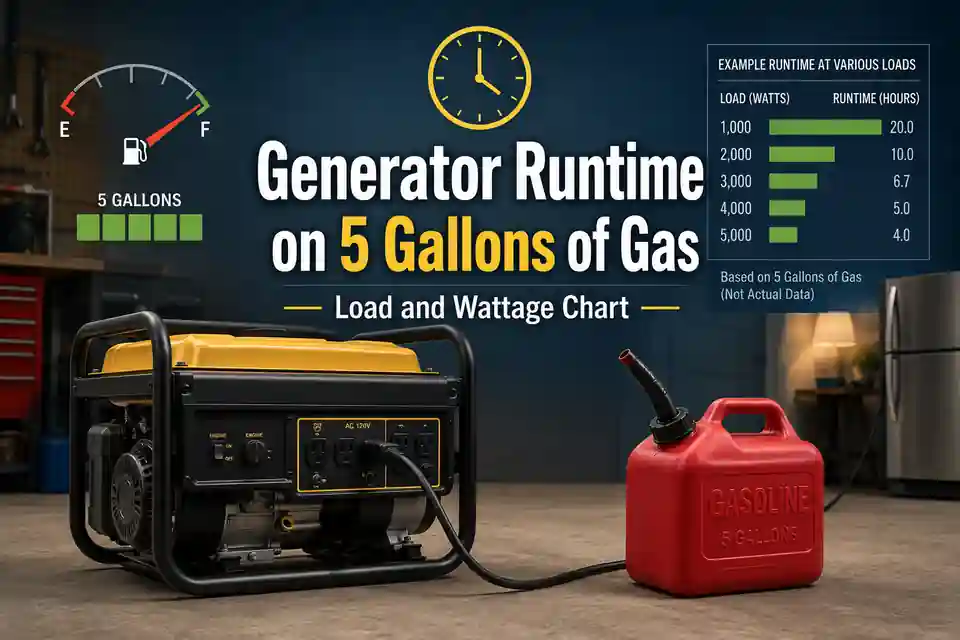
Five US gallons of gasoline can keep a small inverter generator running through a long outage, or disappear in only a few hours when a larger conventional generator carries a heavy load. The fuel can is the same size in both cases; the engine and electrical demand are not.
A useful runtime estimate starts with the generator’s rated running output, the average watts actually being supplied and the manufacturer’s fuel-consumption or tank-runtime data. Starting watts matter for whether motors can start, but average running load is the value that drives most of the fuel calculation over several hours.
Quick answer: at 50% average load, a nominal five-US-gallon gasoline supply may run a 2,000-watt generator for about 26 hours, a 5,000-watt generator for about 10.6 hours or a 10,000-watt generator for about 5.3 hours under the generalized model used here. For a 5,000-watt generator, the estimate ranges from about 16.4 hours at 25% load to 6.6 hours at full rated load. The exact model may run meaningfully longer or shorter.
These charts are planning estimates, not specifications for a particular generator. Use the exact model’s published runtime or fuel-rate table whenever it is available, especially before buying fuel or planning an unattended operating period.
Operate a portable fuel-powered generator outdoors only, well away from doors, windows and vents, with the exhaust directed away from buildings. Never run one inside a home, garage, basement, shed, enclosed porch or partly enclosed space. Carbon monoxide is odorless and can kill.
Five gallons, load and runtime
The Practical Answer Depends on Load, Not Only Gallons
The sentence “I have five gallons” answers only one part of the question. To estimate runtime, you also need to know how quickly the generator burns those gallons under the expected load. A 2 kW inverter generator supplying a few essential devices and a 10 kW conventional generator feeding several household circuits are not comparable fuel users.
The inputs that control five-gallon runtime
| Input | Why it changes runtime | Best source |
|---|---|---|
| Rated running output | Sets the generator capacity used to convert appliance watts into load percentage | Data plate, manual or manufacturer specification |
| Average running load | Higher sustained watts normally increase hourly fuel use | Load meter, transfer-switch monitor or measured appliance schedule |
| Fuel rate at that load | Converts the five-gallon supply into operating hours | Manufacturer fuel table or a controlled measurement |
| Usable fuel quantity | Not every drop should be treated as available for planning | Tank design, shutdown behaviour and a stated planning reserve |
| Generator design | Inverter speed control, engine displacement and alternator efficiency change the curve | Exact model documentation |
| Operating conditions | Altitude, heat, maintenance and fuel quality can change output and consumption | Owner’s manual and site conditions |
Use rated or running watts when calculating load percentage. Do not use the larger starting, surge or maximum number printed prominently on the generator.
Five US Gallons Equals About 18.9 Litres
This article uses the US liquid gallon because the search phrase “5 gallons of gas” normally refers to a five-US-gallon gasoline can in the United States and Canada. Five US gallons equals approximately 18.93 litres. It is not the same as five imperial gallons.
Do not mix gallon definitions
| Fuel quantity | Approximate litres | Planning note |
|---|---|---|
| 5 US gal | 18.93 L | Quantity used for all headline runtime charts in this guide |
| 5 imperial gal | 22.73 L | About 20% more fuel than five US gallons |
| 20 L | 5.28 US gal | Common metric can size; slightly more than the article’s five-gallon basis |
| 18 L | 4.76 US gal | Slightly less than five US gallons |
A US gallon and an imperial gallon are different volumes. Modern UK and Australian generator specifications normally use litres, while some older UK documents may use imperial gallons. Convert every fuel figure to one unit system before comparing it with this US-gallon runtime chart.
The Runtime Formula
When an hourly gasoline rate is known, the arithmetic is straightforward. Divide usable gasoline by the fuel consumed per hour at the relevant load. The difficult part is choosing a realistic hourly rate, not performing the division.
Generator runtime (hours) = usable gasoline (US gal) ÷ gasoline use at the expected load (US gal/h)
The charts below treat 95% of the nominal five-gallon supply as usable, leaving a small planning margin for residual fuel, measurement differences and the practical need to stop before the final drop. That gives 4.75 US gallons for the calculation. This is a planning convention, not a universal manufacturer instruction.
A 5 kW gasoline generator is estimated to use 0.45 US gal/h at 50% load. What runtime does a five-gallon supply provide with 95% treated as usable?
Answer: Approximately 10.6 hours.
Explanation: Usable fuel is 5 × 0.95 = 4.75 US gal. Dividing 4.75 by approximately 0.4495 US gal/h gives about 10.57 hours. Use the exact unrounded model-specific fuel rate when available.
Generator Runtime on 5 Gallons at 50% Load
Estimated runtime from a nominal five-US-gallon supply at 50% average load, with 4.75 US gal used for planning
| Rated running output | Average electrical load | Estimated gasoline rate | Planning runtime | Runtime range from ±20% fuel-rate uncertainty |
|---|---|---|---|---|
| 1.8 kW | 0.9 kW (900 W) | 0.16 US gal/h | 29.4 h | 24.5–36.7 h |
| 2 kW | 1 kW (1000 W) | 0.18 US gal/h | 26.4 h | 22.0–33.0 h |
| 3.5 kW | 1.75 kW (1750 W) | 0.31 US gal/h | 15.1 h | 12.6–18.9 h |
| 5 kW | 2.5 kW (2500 W) | 0.45 US gal/h | 10.6 h | 8.8–13.2 h |
| 6.5 kW | 3.25 kW (3250 W) | 0.58 US gal/h | 8.1 h | 6.8–10.1 h |
| 7.5 kW | 3.75 kW (3750 W) | 0.67 US gal/h | 7.0 h | 5.8–8.8 h |
| 8 kW | 4 kW (4000 W) | 0.72 US gal/h | 6.6 h | 5.5–8.2 h |
| 10 kW | 5 kW (5000 W) | 0.90 US gal/h | 5.3 h | 4.4–6.6 h |
| 12 kW | 6 kW (6000 W) | 1.08 US gal/h | 4.4 h | 3.7–5.5 h |
The range is deliberately broad because two generators with the same kW rating can use different engines, alternators and speed-control strategies. A small inverter model may outperform the generalized estimate at light load, while a large fixed-speed engine may consume more.
At 50% load, a five-gallon supply is roughly a 26-hour plan for a 2 kW generator, an 11-hour plan for a 5 kW generator and a 5-hour plan for a 10 kW generator under the generalized assumptions used here.
Load and Wattage Runtime Chart
Estimated hours from 5 US gal, with 4.75 US gal used in the calculation
| Generator rated output | 25% load | 50% load | 75% load | 100% load |
|---|---|---|---|---|
| 2 kW | 40.9 h | 26.4 h | 20.0 h | 16.4 h |
| 3.5 kW | 23.4 h | 15.1 h | 11.4 h | 9.4 h |
| 5 kW | 16.4 h | 10.6 h | 8.0 h | 6.6 h |
| 6.5 kW | 12.6 h | 8.1 h | 6.1 h | 5.0 h |
| 7.5 kW | 10.9 h | 7.0 h | 5.3 h | 4.4 h |
| 10 kW | 8.2 h | 5.3 h | 4.0 h | 3.3 h |
How to use the chart: find the generator’s rated running output, divide the average running watts supplied to your appliances by that output, and multiply by 100 to obtain the average load percentage. Then use the nearest row and load column. If your result falls between the listed values, use the HomDera calculator or the exact manufacturer fuel rate instead of treating the nearest table cell as an exact answer.
The same fuel can produces very different runtimes
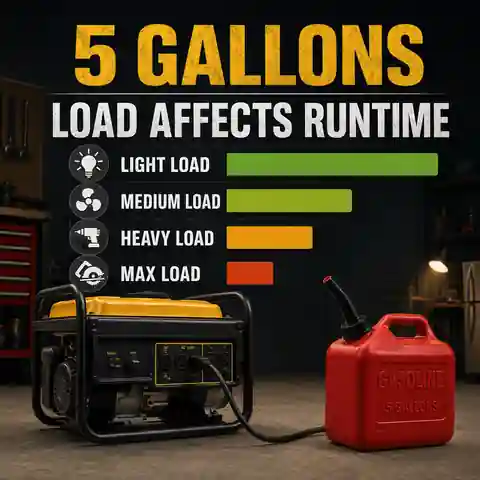
At low load, hourly fuel use falls, but the engine still consumes gasoline simply to remain running.
At higher load, the generator produces more useful power each hour but empties the same fuel supply sooner.
Runtime does not fall in exact proportion to watts because engine friction, cooling and electrical losses remain present.
The exact shape of the load-to-fuel curve varies by generator model and operating mode.
What 25%, 50%, 75% and 100% Load Mean in Watts
Convert generator load percentage to average running watts
| Rated running output | 25% load | 50% load | 75% load | 100% load |
|---|---|---|---|---|
| 2 kW | 500 W | 1000 W | 1500 W | 2000 W |
| 3.5 kW | 875 W | 1750 W | 2625 W | 3500 W |
| 5 kW | 1250 W | 2500 W | 3750 W | 5000 W |
| 6.5 kW | 1625 W | 3250 W | 4875 W | 6500 W |
| 7.5 kW | 1875 W | 3750 W | 5625 W | 7500 W |
| 10 kW | 2500 W | 5000 W | 7500 W | 10000 W |
Load percentage refers to the electrical power being delivered compared with the generator’s rated running output. A 5,000-watt generator supplying an average of 2,500 watts is at 50% load. The same 2,500-watt demand would be 25% load on a 10,000-watt generator, and those two engines may have very different hourly fuel rates.
Average load is not necessarily the number shown during the busiest second. Refrigerators, pumps and tools can create brief starting peaks; runtime planning should use a realistic average while generator sizing separately checks the peak.
A 5,000-Watt Generator: Five-Gallon Runtime by Actual Load
Generalized runtime for a 5 kW gasoline generator
| Average running load | Share of rated output | Estimated gasoline use | Runtime from nominal 5 US gal |
|---|---|---|---|
| 500 W | 10% | 0.21 US gal/h | 22.4 h |
| 1,000 W | 20% | 0.26 US gal/h | 18.0 h |
| 1,500 W | 30% | 0.32 US gal/h | 14.8 h |
| 2,000 W | 40% | 0.39 US gal/h | 12.3 h |
| 2,500 W | 50% | 0.45 US gal/h | 10.6 h |
| 3,000 W | 60% | 0.51 US gal/h | 9.4 h |
| 3,500 W | 70% | 0.57 US gal/h | 8.4 h |
| 4,000 W | 80% | 0.62 US gal/h | 7.7 h |
| 4,500 W | 90% | 0.67 US gal/h | 7.1 h |
| 5,000 W | 100% | 0.72 US gal/h | 6.6 h |
This table is useful when you know the average watts rather than only the percentage. It also shows why switching off one high-wattage resistance appliance can make a noticeable difference, while removing one small LED lamp may barely move the runtime.
A 5 kW generator supplies an average 2,000 W during an outage. What is the generalized five-gallon runtime?
Answer: About 12.3 hours using 4.75 US gallons as the usable planning quantity.
Explanation: Two thousand watts is 40% of a 5 kW rating. Interpolating the generalized fuel curve gives approximately 0.386 US gal/h. Then 4.75 ÷ 0.386 ≈ 12.3 hours.
Running Watts and Starting Watts Have Different Jobs
Running watts describe the power appliances need after they have started. Starting or surge watts describe a short higher demand from motors, compressors, pumps and some electronic equipment. A generator can have enough fuel for many hours and still be unable to start a refrigerator or pump if its surge capability is too low.
Use each wattage value for the correct decision
| Value | Use it for | Do not use it for |
|---|---|---|
| Average running watts | Estimating sustained load and fuel runtime | Proving that every motor can start |
| Maximum simultaneous running watts | Checking continuous output capacity | Assuming the load stays at that level all day |
| Starting or surge watts | Checking short motor-start demand | Calculating multi-hour fuel use as though the surge were continuous |
| Rated generator running output | Converting watts to load percentage | Replacing the model’s actual fuel table |
Do not reduce generator size solely to improve fuel economy until starting watts, continuous load, voltage quality and manufacturer operating limits have been checked.
Real Manufacturer Examples Show Why Models Differ
Published tank capacity and runtime can be converted into an average hourly rate, then scaled to a five-gallon supply for comparison. This does not mean the generator can physically accept five gallons in its built-in tank; it simply compares equal fuel quantities under the stated test conditions.
Illustrative runtime scaled from published gasoline data using 4.75 US gal
| Generator example | Published gasoline information | Calculated average rate | Planning runtime from a nominal five-gallon supply |
|---|---|---|---|
| Honda EU2200i | 0.95 US gal tank; about 8.1 h at 1/4 load and 3.2 h at rated load | About 0.117 US gal/h at 1/4 load; 0.297 US gal/h at rated load | About 40.5 h at 1/4 load; 16.0 h at rated load |
| Generac iQ5200DF, models G0089450 and G0089470 | 3.2 US gal tank; about 15 h at 25% load and 9 h at 50% load | About 0.213 US gal/h at 25% load; 0.356 US gal/h at 50% load | About 22.3 h at 25% load; 13.4 h at 50% load |
| Generac GP6500 COsense, models 7680 and 7683 | 7.9 US gal tank; about 16.5 h at 25% load and 11.5 h at 50% load | About 0.479 US gal/h at 25% load; 0.687 US gal/h at 50% load | About 9.9 h at 25% load; 6.9 h at 50% load |
These figures are arithmetic scaling of published tank-runtime tests to the same 4.75-US-gallon planning quantity used elsewhere in this guide. They are not direct five-gallon field tests, and each result applies only to the stated model, fuel and load point.
The examples demonstrate that generator architecture matters. A compact inverter model can run much longer at light load than a larger conventional generator, even when both are described simply as portable gasoline generators.
Honda generator comparison: fuel tank capacity and runtime at rated and quarter loadGenerac iQ5200DF specification: gasoline tank capacity and runtime at 25% and 50% loadGenerac GP6500 COsense specification: tank capacity and runtime at 25% and 50% loadWhy Your Five Gallons May Last Less—or More—Than the Chart
Conditions that move real runtime
| Factor | Possible effect | Better check |
|---|---|---|
| Inverter or eco mode | Can reduce engine speed and fuel use during light load | Confirm the mode is permitted for the connected equipment |
| Cycling appliances | Average load may be much lower than the combined nameplate total | Measure energy or power over a representative period |
| Frequent motor starts | Creates repeated high-demand events and throttle changes | Sequence loads and record the actual operating cycle |
| High altitude | Reduces available engine power and can change mixture requirements | Apply the manufacturer’s altitude guidance |
| High ambient temperature | Can reduce output and increase cooling stress | Check derating and ventilation requirements |
| Dirty air filter or poor maintenance | Can increase fuel use and reduce available power | Service the engine according to the manual |
| Old or contaminated fuel | Can cause difficult starting and unstable operation | Follow approved fuel-storage and replacement guidance |
| Long, undersized extension leads | Voltage drop can make appliances run poorly while the engine still works | Use suitable cable size, length and connectors |
| Incorrect load estimate | Makes every runtime result misleading | Measure the real average watts at the generator or transfer equipment |
Usable Fuel Is Not Always the Number on the Can
A five-gallon can may contain nearly five gallons, but the complete amount may not become useful generator runtime. Some fuel remains in the can, funnel or tank; the generator may stop before every drop is drawn; measurements are rarely laboratory-precise; and a prudent plan should not depend on an engine stopping exactly as the last appliance finishes.
Five-gallon planning choices
| Assumption | Fuel used in calculation | When it may be used |
|---|---|---|
| Full arithmetic quantity | 5.00 US gal | Comparing published model runtimes under identical assumptions |
| Small 5% planning reserve | 4.75 US gal | General outage planning in the charts in this article |
| 10% planning reserve | 4.50 US gal | Greater uncertainty, remote refuelling or a conservative operating plan |
| Exact measured usable amount | Your measured value | Best after a safe, repeatable test on the actual generator |
A planning reserve does not replace the manufacturer’s fuel-capacity, shutdown or refuelling instructions. Never overfill a generator tank to force the entire can inside.
Can All Five Gallons Go Into the Generator Tank?
Only when the generator’s approved tank capacity and filling instructions permit it. Many portable generators have tanks smaller than five gallons. In that case, “runtime on five gallons” means the total operating time available across one or more safe refuelling cycles, not one uninterrupted tank.
- Check the stated fuel-tank capacity and the correct fill level.
- Use approved fuel containers and transfer methods.
- Stop the generator and allow it to cool before refuelling.
- Do not attach an improvised auxiliary tank, open container, hose or gravity-feed system.
- Plan refuelling before the tank is empty, while preserving the required safe shutdown and cooling period.
- Follow local limits for storing gasoline and keep it away from ignition sources and living spaces.
Never refuel a running or hot generator. Gasoline vapour or spilled fuel can ignite on hot engine and exhaust components.
Plan an Overnight Outage Step by Step
- List only the appliances that must operate overnight.
- Record their measured running watts and identify cycling devices.
- Create the highest credible starting-watt scenario for refrigerators, freezers, pumps and fans.
- Confirm that the generator can support both the continuous and starting demand.
- Estimate the average load over the entire night rather than adding every nameplate watt continuously.
- Use the generator manufacturer’s fuel rate at the nearest load point, or use the HomDera generalized estimate as a preliminary value.
- Divide the usable part of the five-gallon supply by that hourly rate.
- Check oil, service and duty intervals; tank runtime is not permission to ignore maintenance.
- Plan outdoor placement, weather protection, CO alarms, cables and safe transfer equipment before the outage.
- Schedule a supervised shutdown and refuelling period if the built-in tank cannot cover the whole night.
A 5 kW generator carries about 2 kW average overnight load. Is five gallons likely to cover a 10-hour night?
Answer: The generalized estimate is about 12.3 hours, so the arithmetic suggests that 10 hours may be covered.
Explanation: A 2 kW average load equals 40% of a 5 kW generator. The generalized rate is about 0.386 US gal/h, and 4.75 ÷ 0.386 ≈ 12.3 hours. Verify the exact model, starting loads, maintenance interval and outdoor operating plan before relying on it.
Load Scheduling Can Stretch the Fuel Supply
The most useful fuel-saving action is often not switching everything off, but preventing several large loads from running together. A pump can operate, then a kettle or microwave can be used after the pump stops. A refrigerator and freezer can remain connected while discretionary resistance loads are limited.
Give large loads separate appointments
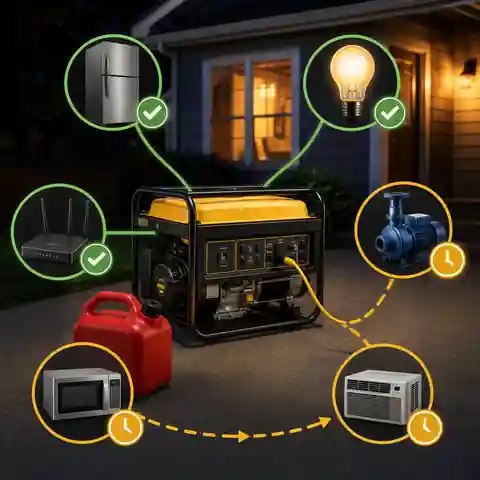
Keep essential low-power equipment running while scheduling brief high-power appliances one at a time.
Avoid overlapping pump, compressor and tool starts where practical.
Use eco mode only when the generator and connected equipment manufacturers permit it.
Measure the result: a clever schedule is useful only when it actually lowers the average watts without creating unsafe starts or interruptions.
Changes that can improve runtime
| Action | Why it may help | Important limit |
|---|---|---|
| Turn off unnecessary electric heating loads | Resistance heaters, kettles and hot plates add large sustained watts | Do not compromise essential heat, health or safety needs |
| Run large appliances sequentially | Reduces the average and peak simultaneous load | Some equipment must operate continuously or automatically |
| Use a smaller well-matched generator | Can reduce light-load engine losses | It must still start every required motor safely |
| Use inverter or eco mode | May reduce speed during light load | Not suitable for every surge-sensitive or rapidly changing load |
| Repair poor maintenance conditions | Restores normal combustion and airflow | Use the specified service procedure and parts |
| Measure actual watts | Replaces guesses with a realistic load profile | Use suitable meters and observe complete appliance cycles |
Five Gallons: Runtime Versus Electricity Delivered
Longer runtime does not necessarily mean more electricity delivered. At low load, the generator runs longer but spends a larger share of fuel keeping the engine itself operating. At higher load, runtime is shorter, yet more electrical energy may be produced from the same fuel quantity.
Generalized 5 kW example using 4.75 US gal
| Average load | Electrical output | Estimated runtime | Approximate electricity delivered |
|---|---|---|---|
| 25% | 1.25 kW | 16.4 h | 20.5 kWh |
| 50% | 2.50 kW | 10.6 h | 26.4 kWh |
| 75% | 3.75 kW | 8.0 h | 30.0 kWh |
| 100% | 5.00 kW | 6.6 h | 32.8 kWh |
This comparison explains fuel efficiency, not a recommended operating point. Continuous rating, cooling, starting reserve, noise, maintenance and the exact manufacturer guidance still control safe operation.
Tank Runtime Is Not the Same as Safe Continuous Runtime
Fuel arithmetic answers when the gasoline may run out. It does not answer how long the generator may operate without an oil check, service action, inspection or shutdown. Some portable models have maintenance requirements that can occur before a five-gallon reserve is consumed, especially at light load or when several smaller tankfuls are used.
- Check the generator’s continuous, prime, standby or intermittent duty description.
- Follow oil-level, oil-change, air-filter and spark-plug intervals in the manual.
- Inspect cables, plugs, weather protection and the operating area during long use.
- Do not defeat low-oil shutdowns or other protective systems to extend runtime.
- Plan supervision and a response to fuel leaks, abnormal sound, overload, overheating or CO-alarm activation.
- Respect local noise, fire and fuel-storage requirements.
Portable Generator Safety Belongs in the Runtime Plan
Run a portable generator outdoors only and keep it well away from doors, windows and vents. US and Canadian safety guidance commonly uses at least 20 ft (about 6 m) as a placement reference, with exhaust directed away from buildings. Follow the generator manual and local requirements when they demand more.
Safety checks before planning a long run
| Hazard | Essential control | Why runtime calculations do not solve it |
|---|---|---|
| Carbon monoxide | Outdoor placement, exhaust away, working CO alarms | A generator can produce deadly CO throughout the entire calculated runtime |
| Fire during refuelling | Stop, cool and refuel with approved containers | Fuel remaining in the reserve does not make hot refuelling safe |
| Backfeeding utility lines | Use approved transfer equipment installed as required | A five-gallon plan says nothing about safe electrical connection |
| Electric shock and wet conditions | Suitable weather protection, cables and protective devices | Long operation increases exposure time to rain, damage and poor connections |
| Overload and motor starting | Check continuous and surge capacity | Enough gasoline does not create extra generator wattage |
| Fuel storage | Follow container, quantity, location and fire rules | A larger reserve can increase consequences if stored incorrectly |
Common Five-Gallon Runtime Mistakes
Mistake, consequence and correction
| Mistake | What goes wrong | Better approach |
|---|---|---|
| Using starting watts as the continuous load | Fuel use is greatly overstated | Use measured or realistic average running watts for runtime |
| Using only the generator’s advertised maximum watts | Load percentage is calculated from the wrong rating | Use rated running output |
| Assuming half load means half the full-load fuel rate | Runtime is overstated because engines still burn fuel at low load | Use the model’s load-specific table or a nonlinear estimate |
| Treating every five-gallon can as exactly full and usable | The plan has no reserve for measurement or residual fuel | State the usable-fuel assumption explicitly |
| Confusing US and imperial gallons | Fuel quantity can be wrong by about 20% | Convert everything to one unit system |
| Ignoring tank capacity | The user expects one uninterrupted run when several refuelling cycles are required | Check built-in tank size and safe shutdown intervals |
| Assuming an inverter generator and conventional generator behave alike | Light-load runtime may be very different | Use exact model data |
| Planning from fuel alone | The generator may be overloaded, unsafe or overdue for service | Check watts, starting demand, placement and maintenance separately |
Frequently Asked Questions
Will five gallons of gas run a generator all night?
Often, but not always. In the generalized chart, a 5 kW generator at 50% load runs about 10.6 hours, while a 10 kW generator at the same percentage runs about 5.3 hours. A small inverter generator at light load may run considerably longer. Check the exact model, average watts, tank size, maintenance interval and outdoor operating plan.
How long will a 5,000-watt generator run on five gallons?
The generalized estimate is about 16.4 hours at 25% load, 10.6 hours at 50%, 8.0 hours at 75% or 6.6 hours at full load, using 4.75 US gallons as the usable planning quantity. Manufacturer data may differ.
How long will a 7,500-watt generator run on five gallons?
The generalized estimate is about 10.9 hours at 25% load, 7.0 hours at 50%, 5.3 hours at 75% or 4.4 hours at full load. Use the gasoline rating for the exact model and do not substitute its propane output or runtime.
How long will a 2,000-watt generator run on five gallons?
The generalized estimate is about 41.0 hours at 25% load, 26.4 hours at 50%, 20.0 hours at 75% or 16.4 hours at full load. Some inverter models can differ substantially at light load.
Does a generator last longer with fewer appliances?
Usually yes, because the average electrical load falls. Runtime does not increase in exact inverse proportion to watts, however, because the engine still consumes fuel to remain running, cooled and ready.
Does eco mode make five gallons last longer?
It can on a compatible inverter generator at light or changing load because the engine may reduce speed. The benefit is model- and load-specific, and eco mode may not be suitable for every motor-starting or rapidly changing appliance.
Should I calculate runtime from starting watts or running watts?
Use realistic average running watts for multi-hour fuel runtime. Check starting watts separately to confirm that compressors, pumps and motors can start without overloading the generator.
Is generator runtime proportional to the number of gallons?
Approximately, when the generator, load and operating conditions remain the same. If a model runs ten hours on five gallons at one stable load, ten gallons would suggest about twenty hours of fuel availability, but tank size, refuelling, maintenance and changing load can interrupt that simple scaling.
Can I refuel the generator while it is running?
No. Stop the generator and allow it to cool before refuelling. Follow the manufacturer’s procedure and keep gasoline away from hot engine and exhaust components.
Is five gallons of petrol the same as five gallons of gas?
Gasoline and petrol refer to the same fuel category, but the gallon must be identified. Five US gallons is about 18.9 L, while five imperial gallons is about 22.7 L.
Can a five-gallon can be connected directly to a generator?
Do not use an improvised direct connection, gravity feed, open container or unapproved auxiliary tank. Use only fuel systems and accessories approved for the exact generator, and follow all installation and fire-safety requirements.
How accurate is a five-gallon generator runtime calculator?
It can be strong when you enter the manufacturer’s fuel rate at the relevant load. A generalized estimate based only on generator kW and load has wider uncertainty because engine design, eco mode, altitude, temperature, maintenance and fuel quality are unknown.
Final Five-Gallon Runtime Check
- The fuel quantity is five US gallons, not five imperial gallons.
- The generator value is rated running output, not surge watts.
- Average load reflects the appliances that will really operate over time.
- Starting demand has been checked separately.
- The exact manufacturer fuel rate is used where available.
- The usable-fuel assumption and reserve are stated.
- The built-in tank capacity and required refuelling cycles are known.
- Oil, service and duty intervals permit the planned operating schedule.
- The generator is outdoors with exhaust directed away from buildings.
- CO alarms, safe cables and approved transfer equipment are in place.
- Fuel storage and refuelling follow the manual and local requirements.
Five gallons of gasoline does not correspond to one universal generator runtime. Under the generalized assumptions in this guide, the same supply may last about 26 hours in a 2 kW generator at 50% load, about 11 hours in a 5 kW generator or about 5 hours in a 10 kW generator. The actual answer belongs to the exact generator, its real average load and its published fuel curve.
Use the charts for early planning, then replace the generalized rate with manufacturer data or a safe measured result. Finally, check tank capacity, starting watts, maintenance, outdoor placement, carbon-monoxide protection and refuelling intervals. A good runtime plan keeps both the appliances and the people around them operating safely.
Open the HomDera Generator Fuel Consumption CalculatorCompare gasoline, propane and diesel generator fuel use per hourCheck generator running watts and starting-watt requirementsExplore HomDera energy and backup-power guides