
In this guide
Two inverters can show the same voltage on the label and still behave very differently with the same appliance. The difference is often the AC waveform: one inverter produces a smooth sine wave, while another produces a stepped approximation commonly called modified, simulated or quasi-sine wave.
For a lamp or a simple charger, that difference may appear unimportant. For a refrigerator compressor, circulation pump, boiler control board, audio system or computer power supply, it can affect noise, heat, starting behaviour, efficiency and whether the device operates at all. The sensible choice therefore depends on the load, not only on the inverter price or wattage printed on the box.
This guide is for preliminary equipment selection. It does not confirm that a particular inverter is compatible with a particular appliance or that a permanent backup system is correctly installed. Check the manuals for the inverter and every critical load. Fixed wiring, transfer arrangements, protective devices, earthing or grounding, neutral configuration and local electrical requirements should be reviewed by a qualified professional.
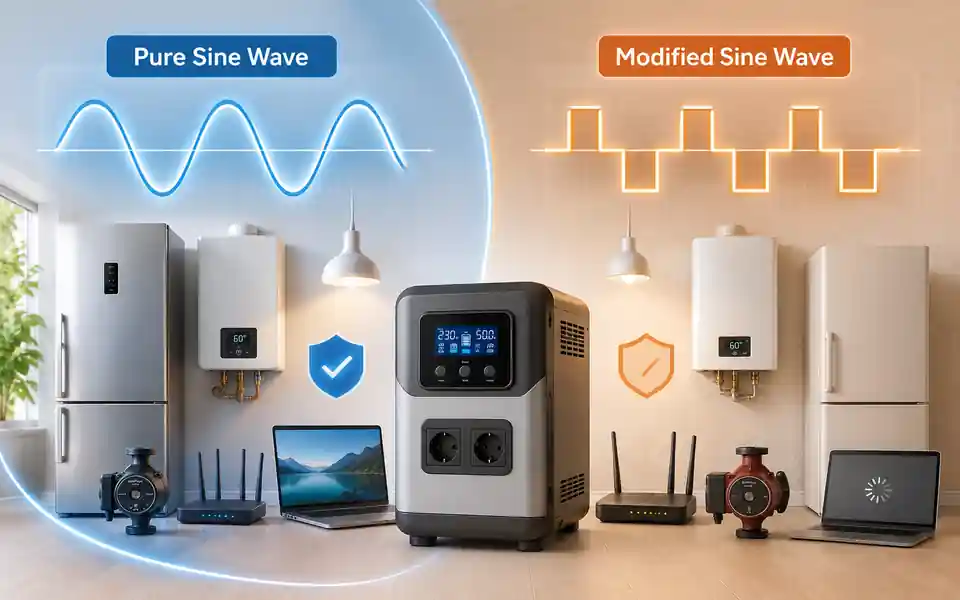
Quick answer: pure sine wave is the safer general-purpose choice
Choose a pure sine wave inverter when the system may power refrigerators, freezers, pumps, boilers, modern computers, audio equipment, medical devices, variable-speed tools or any load whose manufacturer requires sine wave input. Pure sine wave output is closer to normal utility or grid power and is the more flexible option when several different appliances may be connected over the life of the system.
A modified sine wave inverter can still be reasonable for a small, low-cost and clearly defined setup containing simple, non-critical loads that the equipment manufacturer allows. The important word is clearly. Buying modified sine wave first and deciding what to connect later can turn a lower purchase price into a second inverter purchase.
Pure sine wave and modified sine wave at a glance
| Question | Pure sine wave | Modified sine wave |
|---|---|---|
| Output shape | Smooth alternating waveform with relatively low distortion | Stepped or block-like approximation with more harmonic content |
| Appliance compatibility | Suitable for the widest range of household and electronic loads | Compatibility depends strongly on the device and its internal electronics |
| Motors and compressors | Usually the preferred waveform for quieter and cooler operation | May cause extra noise, heat, reduced performance or failed starting |
| Sensitive electronics | Usually the lower-risk choice | Some devices work normally; others buzz, reset, overheat or reject the input |
| Audio and radio interference | Generally lower when the inverter and installation are well designed | More likely to create audible hum or electrical interference |
| Purchase price | Normally higher for comparable power and build quality | Normally lower |
| Best use | General home backup and mixed or unknown future loads | Simple, confirmed-compatible, non-critical loads |
When one inverter will supply a mixed group of household loads, choose for the most waveform-sensitive essential device, not for the easiest device in the group.
Why the waveform matters even when the voltage looks correct
Household AC power changes direction repeatedly. With a conventional sine wave supply, voltage rises and falls smoothly through each cycle. A pure sine wave inverter attempts to reproduce that shape with low distortion. A modified sine wave inverter changes between a smaller number of voltage levels, creating flat sections and sharper transitions.
Those sharp transitions contain harmonic frequencies that are not present to the same degree in a clean sine wave. Some loads largely ignore them. Other loads respond with additional heat, audible noise, electromagnetic interference, inaccurate timing, unstable control behaviour or a higher peak current. This is why two outputs with the same nominal voltage and frequency are not automatically equivalent.
The word pure should also be read sensibly. Real inverters are not mathematically perfect. Compare the manufacturer's total harmonic distortion, usually written as THD, together with voltage regulation, frequency stability and performance under load. A product called pure sine wave can still be poorly built, undersized or unsuitable for the installation.
Modified sine wave, simulated sine wave, stepped sine wave and quasi-sine wave are often used for broadly similar products, but the terms are not applied consistently. Read the technical specification instead of relying on the marketing name alone.
The awkward middle ground: a device may run without running well
Waveform compatibility is not always a simple yes-or-no test. A device may switch on from modified sine wave and still operate less efficiently, make more noise, run hotter or behave unpredictably in one operating mode. A refrigerator may start several times successfully and fail on the next hot day. A charger may appear normal while becoming warmer than it does on grid power. A digital clock may run but keep the wrong time.
Four possible outcomes when an appliance is connected
| Outcome | What you may observe | What it means |
|---|---|---|
| Works normally | Normal sound, temperature, output and controls | The device may be compatible, but critical use still requires manufacturer confirmation |
| Works with side effects | Buzzing, extra heat, screen noise, slower motor operation or inaccurate timing | The load is receiving power but may not be operating as intended |
| Starts and then stops | Reset, fault code, overload alarm or shutdown after a short period | The waveform, surge demand, voltage drop or inverter capacity may be unsuitable |
| Will not start | No operation or immediate inverter trip | Do not keep repeating the test without identifying the cause |
Do not treat one successful start as proof of long-term compatibility. Temperature, battery voltage, compressor pressure, pump condition and the number of other connected loads can all change the next start.
Appliance compatibility guide
The table below is a planning guide, not an approval list. Appliances with the same everyday name can contain very different motors, power supplies and controls. Check the exact model, especially when the device is expensive, safety-critical or expected to run unattended.
Typical waveform choice by household load
| Load | Planning recommendation | Why |
|---|---|---|
| Incandescent lamp or simple resistive load | Modified sine wave may be acceptable when the manufacturer permits it | A basic resistive element is usually less sensitive to waveform shape, although high power can still make the system impractical |
| LED lamp | Check the driver; pure sine wave is the more predictable choice | Some LED drivers work normally while others flicker, buzz or run hotter |
| Phone or ordinary laptop charger | Many work, but compatibility is not universal | Switch-mode power supplies vary; monitor abnormal heat or noise and follow the manufacturer's guidance |
| Router and optical network terminal | Often tolerant through their adapters, but pure sine wave or a suitable direct-DC solution is preferable for dependable backup | Small adapters can vary, and an oversized AC inverter may waste energy at a light load |
| Modern desktop computer with active PFC power supply | Pure sine wave recommended | Some simulated-wave UPS or inverter outputs can cause shutdown, instability or power-supply stress |
| Television, audio system or studio equipment | Pure sine wave recommended | Modified output can create audible hum, picture interference or power-supply noise |
| Refrigerator or freezer | Pure sine wave strongly recommended unless the appliance manufacturer confirms otherwise | The compressor is an inductive load with startup demand and may run hotter, noisier or less reliably on modified output |
| Circulation pump, water pump or fan motor | Pure sine wave normally preferred | Motors and their capacitors can be sensitive to harmonics and starting conditions |
| Gas boiler or heating controls | Pure sine wave normally recommended | The system may combine electronic controls, a fan, ignition components and one or more pumps |
| Microwave oven | Pure sine wave recommended | Modified output can reduce performance and increase noise or heat; the load also requires substantial power |
| Variable-speed power tool or electronically controlled appliance | Pure sine wave or explicit manufacturer approval | Speed controls and electronic switching can respond poorly to a stepped waveform |
| CPAP or other medical equipment | Use only a power source approved by the equipment manufacturer | Humidifiers, heaters, alarms and medical electronics may have specific waveform and backup requirements |
Loads that may tolerate modified sine wave
Modified sine wave is most defensible when every connected load is simple, non-critical, inexpensive and confirmed as compatible. That can include some basic lamps, uncomplicated resistive devices, older electronics or chargers designed with a wide input tolerance. Even within these groups, model-specific differences matter.
- The appliance manual does not require pure sine wave and the manufacturer confirms inverter use.
- The load has no compressor, precision timing, sensitive audio path or critical control function.
- Occasional noise or slightly lower efficiency would not create a safety or reliability problem.
- The device can be observed while operating and is not being relied on for medical, heating or flood protection.
- The inverter still has adequate continuous power, surge capacity and battery-side current capability.
A simple heater may care less about waveform than a refrigerator, but it can care much more about battery capacity. A 1,500 W or 2,000 W heating load can empty a modest battery quickly even when the inverter waveform is suitable.
Loads that usually justify pure sine wave
Pure sine wave becomes the practical default when the load contains a motor, compressor, transformer, active power factor correction, precision clock, audio circuit, medical function or control board. It is also the better choice when the inverter will be part of a permanent home system or when future loads are not yet known.
- Refrigerators, freezers, pumps, fans and other motor-driven appliances.
- Boilers, heating controls, circulation pumps and equipment with electronic ignition or monitoring.
- Desktop computers, workstations and servers with active PFC power supplies.
- Audio systems, recording equipment, home cinema equipment and radio-sensitive devices.
- Appliances with digital clocks, electronic timers or speed controls.
- Medical or assistive equipment when the manufacturer specifies sine wave input.
- Mixed household backup systems where different devices may be connected during an outage.
Refrigerators, freezers, pumps and other motor loads
A motor does not behave like a fixed resistor. Its current, torque, temperature and efficiency depend on the supply and the mechanical load. The harmonic content of modified sine wave can contribute to additional heating and noise in motors, transformers and capacitors. Some devices continue working but sound different or deliver less useful output.
Starting demand is a separate problem. A refrigerator may use modest average energy over a day but require a much larger brief surge when the compressor starts. Pure sine wave does not compensate for an inverter that is too small, a battery that cannot provide the current, or cables that allow excessive voltage drop. Waveform, continuous power and surge performance must all be checked.
Read how refrigerator wattage, compressor startup and battery capacity affect backup runtimeBoilers and heating systems
A fuel-fired boiler may have a relatively small electrical rating, but its backup supply can support several different components: a control board, combustion fan, ignition system, valves, thermostats and one or more circulation pumps. These components do not all respond to poor waveform quality in the same way.
Pure sine wave is normally the sensible starting point for boiler backup, but it is not the only requirement. The UPS or inverter must also provide the correct voltage and frequency, adequate starting power, an acceptable transfer time and a neutral or earthing arrangement compatible with the boiler and local installation. Some boilers are particularly sensitive to how the supply reference is created, so manufacturer and installer guidance matters.
Estimate boiler load, inverter power and battery capacityComputers, chargers and active PFC power supplies
Many modern computers use active power factor correction in the power supply. Some of these supplies operate normally from a simulated or modified waveform, while others may shut down, make noise or behave unpredictably when a UPS changes to battery output. A sine wave UPS or inverter is the more dependable choice for important computers, workstations and servers.
Small phone and laptop chargers are often more tolerant because their switch-mode inputs accept a wide voltage range and immediately convert AC internally. That does not make every charger compatible. Stop using the setup if the adapter becomes unusually hot, buzzes, repeatedly reconnects or causes interference that is absent on normal grid power.
A UPS may pass normal grid power while electricity is available and produce a different waveform only in battery mode. Test and verify the actual battery-output specification rather than assuming that normal operation proves compatibility.
Audio equipment, clocks, timers and lighting
Waveform problems are sometimes heard before they are measured. Audio amplifiers, powered speakers, fans, transformers and some lighting drivers may produce a noticeable hum. Radios can pick up interference. Devices that derive timing information from the AC waveform may run fast, run slow or lose synchronisation.
- A lamp flickers only when the inverter is supplying power.
- A fan or transformer develops a stronger hum than on grid power.
- A radio, speaker or television develops interference or background noise.
- A digital clock or timer gains or loses time during backup operation.
- A charger or power supply becomes noticeably warmer than normal.
Pure sine wave does not automatically mean a good inverter
Waveform is one specification, not the entire product. A pure sine wave inverter can still have poor voltage regulation, inadequate surge duration, high idle consumption, weak cooling or unsuitable protection. It can also be connected to a battery that is too small or installed with cables that create excessive voltage drop.
Specifications to check alongside waveform
| Specification | Why it matters | What to verify |
|---|---|---|
| Continuous output power | Sets the load the inverter can support for normal operation | Use realistic simultaneous running watts, not only the largest single appliance |
| Surge power and duration | Motors and compressors may require a brief starting peak | Check both the surge value and how long the inverter can sustain it |
| Output voltage and frequency | Connected equipment must receive the supply it was designed for | Match the appliance rating and local system |
| Total harmonic distortion | Lower distortion generally means output closer to a sine wave | Look for a stated THD figure under realistic operating conditions |
| Efficiency curve | Efficiency changes with load and affects battery runtime | Do not rely only on a single best-case maximum efficiency number |
| No-load or idle consumption | A large inverter can waste meaningful energy while powering a small load | Check ordinary idle use and any search or power-saving mode |
| Transfer time | Some devices reset if the change from grid to battery is too slow | Check the UPS or inverter mode and the needs of critical electronics |
| Protection and installation requirements | Overcurrent protection, cooling, cables and earthing affect safety and reliability | Follow the exact manual and local electrical requirements |
How to identify the waveform before buying
Do not assume that the word inverter means pure sine wave. Product listings may place the waveform deep in the specification or use a softer term such as simulated sine wave. If the waveform is not stated clearly, treat that as missing information rather than proof of sine wave output.
- Find the exact model number, not only the product family or seller title.
- Open the manufacturer data sheet or manual and locate output waveform.
- Look for pure sine wave, sine wave, modified sine wave, simulated sine wave or stepped approximation.
- For a pure sine wave claim, check whether total harmonic distortion is specified.
- Confirm continuous watts, surge watts, surge duration, output voltage and frequency.
- Ask the appliance manufacturer whether the exact device is approved for the proposed inverter or UPS output.
- Keep written confirmation for critical or expensive equipment instead of relying on a marketplace comment.
A useful question for a seller is not only “Is it pure sine wave?” Ask for the manual, the THD specification, the continuous and surge ratings, and the output waveform while operating from the battery.
Worked example: choosing an inverter for essential home loads
A backup system may run a refrigerator rated at 120 W while operating, a gas boiler and pump using 180 W, a router and optical network terminal using 20 W, and a laptop charger using up to 90 W. The refrigerator may require a much higher brief startup surge. Is a low-cost modified sine wave inverter a sensible choice?
Answer: The listed running loads add to approximately 410 W, but the final inverter rating must also include realistic simultaneous operation, planning reserve and the refrigerator's startup demand. Pure sine wave is the more appropriate waveform because the system includes a compressor, heating controls, a pump and electronic power supplies.
Explanation: Waveform and power rating solve different problems. Pure sine wave reduces compatibility risk, while adequate continuous output and surge duration help the inverter start and sustain the loads. The battery, BMS, DC cables, fuses and connections must also support the resulting current. The exact appliance and inverter specifications still need to be checked before purchase or installation.
A 500 W inverter would look close to the 410 W arithmetic total, but it could leave too little reserve and may not handle compressor startup. A much larger inverter is not automatically the answer either: it can have higher idle consumption and may require much heavier DC wiring. Build the load list first, then compare continuous power, the highest realistic starting event and the battery-side current.
Estimate continuous load, surge power and battery currentA simple decision process
- List the exact appliances that may operate from the inverter at the same time.
- Mark motors, compressors, pumps, transformers, medical devices, audio equipment and electronically controlled loads.
- Check each manual for waveform restrictions or contact the manufacturer.
- If any essential load requires sine wave output, select pure sine wave for the shared inverter.
- Add realistic running watts and identify the largest starting event rather than adding every possible surge together blindly.
- Compare inverter continuous power, surge value, surge duration, voltage, frequency, THD and transfer time.
- Check battery voltage, battery discharge capability, BMS current, cable size, fuse or breaker requirements and inverter idle consumption.
- Have permanent or high-power systems reviewed and installed according to local requirements.
If an appliance manual explicitly requires pure sine wave, do not replace that requirement with a seller's statement that modified sine wave “usually works”. The equipment manufacturer has the more relevant compatibility information.
What not to do
- Do not choose waveform from price alone and plan to test expensive equipment afterwards.
- Do not assume that the same nominal voltage means the same power quality.
- Do not use a successful five-minute test as proof that a motor or charger will remain cool during long operation.
- Do not confuse pure sine wave with adequate power; the inverter may still be too small for startup demand.
- Do not compare inverter surge numbers without checking how long each product can sustain them.
- Do not ignore inverter idle consumption when the main load is a small router, controller or standby device.
- Do not connect medical equipment, critical heating, flood protection or safety systems without explicit compatibility confirmation.
- Do not modify fixed wiring, transfer switches, neutral-earth connections or protective devices based only on an online comparison.
Signs that a device does not like the inverter output
Symptoms to investigate
| Symptom | Possible explanation | Safer response |
|---|---|---|
| Loud hum or buzzing | Waveform harmonics, transformer vibration, motor behaviour or electrical interference | Disconnect the load and check the equipment and inverter guidance before continuing |
| Unusual heat | Additional losses in a motor, charger, transformer or internal capacitor | Stop use, allow the device to cool and verify compatibility |
| Repeated reset or shutdown | Waveform rejection, transfer delay, overload, voltage drop or insufficient surge capacity | Do not keep restarting; identify the actual cause |
| Motor starts slowly or sounds strained | Insufficient surge power, voltage sag or unsuitable waveform | Switch off and review inverter, battery and motor requirements |
| Clock or timer becomes inaccurate | The control may use supply transitions or frequency as a timing reference | Use a compatible sine wave supply or another approved timing method |
| Radio, screen or speaker interference | Electrical noise from the inverter output or installation | Check inverter quality, cable routing, earthing and device compatibility |
| Inverter overloads below the expected wattage | Peak current, harmonic interaction, low battery voltage or high-resistance DC connections | Measure the system and verify surge and DC-side capability |
Disconnect the appliance if it develops abnormal heat, a burning smell, smoke, repeated protection trips, severe vibration or a sound that is clearly different from normal operation. Do not bypass protection or increase fuse ratings to force the system to keep running.
Waveform and battery runtime are different questions
Choosing pure sine wave does not tell you how long the battery will last. Runtime depends on usable battery energy, the real average load, inverter efficiency, idle consumption, cable losses, temperature and battery condition. A compatible inverter can still provide only a short backup time when the battery is small or the load is large.
The reverse is also true: a battery may store enough energy for many hours while the inverter cannot start the compressor or is not compatible with the appliance waveform requirement. Treat energy capacity, inverter power and waveform as three separate checks.
Estimate battery runtime from capacity, load and inverter lossesLearn how battery voltage, amp-hours, usable capacity and inverter efficiency determine runtimeWhen a modified sine wave inverter can still make sense
Modified sine wave has not disappeared because it is useless. It can provide an economical AC source where the load list is narrow and uncomplicated. The strongest case is a temporary or mobile setup with a few known devices, not a general household backup system expected to power whatever becomes important during the next outage.
- The connected loads are simple and confirmed as compatible by their manufacturers.
- No critical motor, compressor, boiler, medical device or sensitive audio equipment is included.
- The system is supervised rather than left running important equipment unattended.
- The lower purchase cost matters more than future flexibility.
- You accept that replacing or expanding the load list may also require replacing the inverter.
For a mixed home system, pure sine wave often costs less in the long term because it reduces the chance that a future appliance makes the first inverter unsuitable. Compare not only today's purchase price but also the cost of restricted use, noise, wasted energy and replacement equipment.
When professional review is the better next step
- The inverter or UPS will be permanently connected to home wiring.
- The system includes a transfer switch, changeover device or automatic backup function.
- A boiler, circulation pump, well pump, sump pump or refrigeration system is an essential load.
- The battery bank can deliver high fault current or the inverter requires heavy DC cabling.
- The neutral, earthing or grounding arrangement is unclear or changes between grid and inverter operation.
- Several motors may start close together or the manufacturer's startup data is unavailable.
- Local rules require permits, inspection, isolation or specific protective equipment.
- The appliance is medical, life-safety, flood-protection or otherwise critical.
An online guide can help you compare equipment, but it cannot inspect cable terminations, protection settings, ventilation, battery condition, fault current, transfer arrangements or the local wiring system. Those details can determine whether a technically suitable inverter works safely in the real installation.
Frequently asked questions
Can a modified sine wave inverter damage appliances?
Some appliances operate normally, while others can experience extra heat, noise, poor performance, shutdowns or electrical stress. Damage is not guaranteed, but neither is compatibility. Check the exact appliance documentation, and stop using the setup if behaviour or temperature differs noticeably from normal grid operation.
Can a modified sine wave inverter run a refrigerator?
It may run some refrigerators, but pure sine wave is normally the better choice for dependable backup. A refrigerator contains a compressor motor with startup demand, and modified output may increase noise, heat or starting difficulty. Confirm the exact refrigerator and inverter combination rather than relying on a generic wattage list.
Do phone and laptop chargers need pure sine wave?
Many modern chargers work from a broad AC input range and may tolerate modified sine wave, but this is not universal. Use the charger and device manufacturer's guidance. Unusual heat, buzzing, repeated connection loss or interference are reasons to stop and reassess the power source.
Does a pure sine wave inverter make the battery last longer?
Not automatically. Runtime depends on the efficiency and idle consumption of the exact inverter together with the load and battery. A motor or transformer may operate more efficiently on a suitable sine wave supply, but a large pure sine wave inverter with high idle consumption can still waste more energy at a very small load than a well-matched smaller unit.
Is simulated sine wave the same as modified sine wave?
The terms are often used for stepped approximations rather than a low-distortion sine wave, but manufacturers do not use them consistently. Check the waveform description, THD specification and compatibility guidance for the exact inverter or UPS model.
Does a gas boiler need pure sine wave?
Pure sine wave is normally recommended because a boiler system can include electronic controls, a fan, ignition components and circulation pumps. However, waveform is only one part of compatibility. Check transfer time, voltage, frequency, output reference, earthing or grounding arrangement, startup demand and the boiler manufacturer's requirements.
Can an ordinary multimeter confirm that an inverter is pure sine wave?
An ordinary multimeter may show voltage and frequency but does not reliably display the waveform shape or harmonic content. Proper assessment requires suitable test equipment and safe measurement practices. Do not probe mains-voltage inverter output with an oscilloscope or improvised setup unless you are trained and the equipment is appropriate for the measurement.
Final answer
Pure sine wave is the better all-round inverter choice for a home because it is compatible with a wider range of motors, compressors, electronic controls, computers and audio equipment. It is particularly appropriate for refrigerators, freezers, pumps, boilers, active-PFC computers, sensitive electronics and mixed backup loads.
Modified sine wave can still be useful when the load is simple, non-critical and explicitly confirmed as compatible. Do not decide from wattage or price alone. Verify waveform, continuous power, surge duration, output voltage and frequency, battery current, idle consumption and installation requirements as separate parts of the same decision.
When the appliance list contains even one essential motor, compressor, boiler or sensitive electronic device, pure sine wave is usually the more practical place to start. Then size the inverter and battery from real loads rather than from the waveform label alone.