
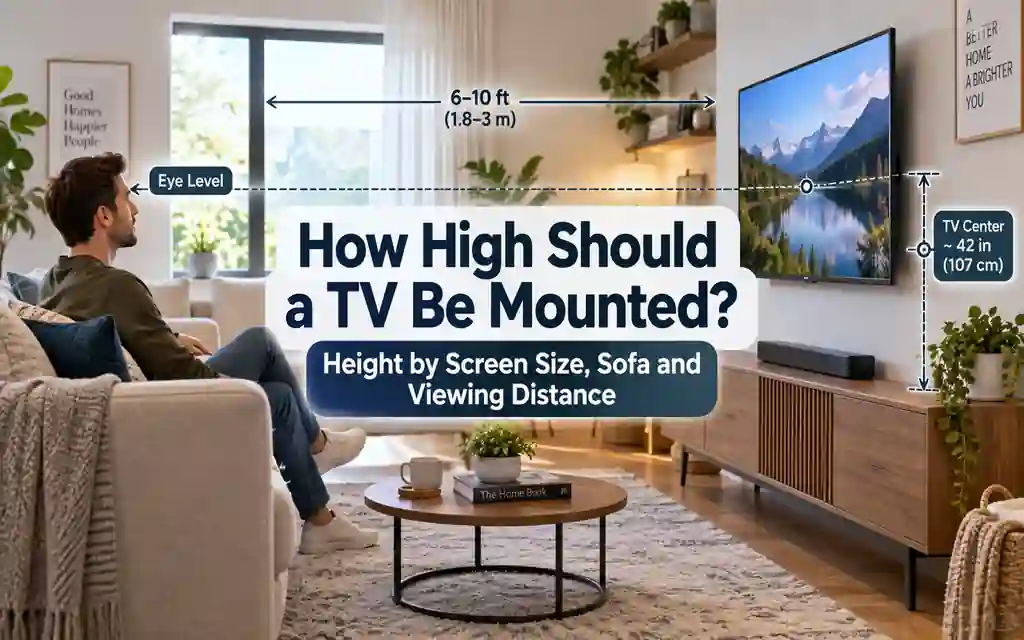
A TV can be perfectly centered on a beautiful feature wall and still feel wrong every evening. The usual problem is not the screen size or the bracket. It is height. Mount the screen too high and ordinary sofa viewing turns into a small neck exercise. Mount it too low and the TV can collide with a console, soundbar or the practical reality of the room.
The most useful starting point is simple: sit where you normally watch and measure your eye height from the finished floor. On an open wall, the center of the screen can begin near that eye line. Screen size then tells you where the top and bottom edges land. Sofa height, recline, furniture and viewing distance decide whether that first position needs to move.
Quick answer: for normal seated viewing, start with the center of the TV close to your seated eye level. Around 42 in (107 cm) from the floor is a common reference for a sofa, but your own measured eye height is more useful. A larger TV does not automatically need a higher center; it simply extends farther above and below the same center line.
This guide uses TV size to mean the advertised diagonal of a standard 16:9 screen. The real outside cabinet height can differ slightly, so use the manufacturer dimensions of your exact model before drilling.
Find the height with your sofa, screen and wall in the same calculation
Start With Seated Eye Level, Not a Magic TV Height
You will often see one number repeated in TV-mounting advice: 42 inches from the floor to the center of the screen. It is useful as a sense check because it is close to a common seated eye height, but it is not a building standard and it is not equally comfortable for every sofa. Deep cushions, a low lounge seat, a tall upright sofa and a recliner can put the viewer's eyes at noticeably different heights.
What should set the first TV center line?
| Viewing setup | Best starting measurement | Why |
|---|---|---|
| Upright sofa or armchair | Your eye height while sitting normally | This is the most direct baseline for everyday living-room viewing |
| Deep sofa or recliner | Eye height in the posture you actually use | Recline changes both eye position and the direction your head naturally faces |
| Bed | Eye height and sightline in your usual supported position | A bedroom TV is often watched semi-reclined rather than from an upright chair |
| Floor cushions or low seating | Eye height from that low seat | A generic 42 in center can be much too high |
| High stools or a room watched mainly while standing | Eye height for the dominant viewing posture | The correct target can be higher than a normal sofa installation |
Do the measurement with the actual sofa, cushions and usual posture in place. Measuring an empty room and guessing where somebody's head will be is how a comfortable 42-inch calculation becomes a 52-inch surprise.
Measure the viewer first
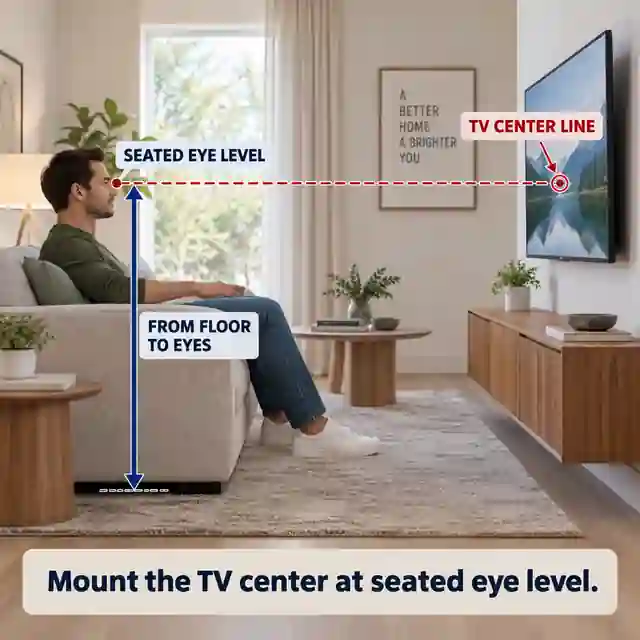
Sit in the main viewing position exactly as you normally watch TV.
Measure vertically from the finished floor to your eyes.
Transfer that height to the wall as the first candidate for the screen center.
Then use the real screen height to mark the top and bottom edges before judging the position.
TV Size Changes the Top and Bottom — Not Automatically the Center
This is the part that causes a lot of confusing search results. People ask for the correct mounting height for a 55-inch, 65-inch or 75-inch TV as though every larger screen must move upward. On an unobstructed wall, that is not how the geometry works. If the viewer's eye level stays at 42 inches, the center can stay near 42 inches. A larger TV simply reaches farther down and farther up.
Approximate 16:9 screen height by TV size
| TV diagonal | Approx. picture height | Half-height above and below center | Bottom edge if center is 42 in |
|---|---|---|---|
| 43 in | 21.1 in / 53.5 cm | 10.5 in / 26.8 cm | 31.5 in |
| 50 in | 24.5 in / 62.3 cm | 12.3 in / 31.1 cm | 29.7 in |
| 55 in | 27.0 in / 68.5 cm | 13.5 in / 34.3 cm | 28.5 in |
| 65 in | 31.9 in / 81.0 cm | 16.0 in / 40.5 cm | 26.0 in |
| 75 in | 36.8 in / 93.4 cm | 18.4 in / 46.7 cm | 23.6 in |
| 85 in | 41.7 in / 105.9 cm | 20.8 in / 53.0 cm | 21.2 in |
| 98 in | 48.0 in / 121.9 cm | 24.0 in / 61.0 cm | 18.0 in |
These numbers describe the visible 16:9 picture area, not the guaranteed outside dimensions of every television. Modern bezels are small, but cabinets, speaker housings and electronics sections still vary. Once you know the exact model, replace estimated screen height with the manufacturer's actual TV height for the final wall marks.
How high should a 55-inch TV be mounted with a 42-inch seated eye height?
Answer: A 55-inch 16:9 picture is about 27.0 inches high. If its center is at 42 inches, the picture area extends about 13.5 inches each way. That places the approximate bottom at 28.5 inches and the top at 55.5 inches from the floor.
Explanation: The viewer sets the center line. The TV size determines how far the panel extends around it.
How high should a 65-inch TV be mounted with the same 42-inch eye height?
Answer: A 65-inch 16:9 picture is about 31.9 inches high. With the center at 42 inches, the approximate bottom is 26.0 inches and the top is 58.0 inches from the floor.
Explanation: The 65-inch screen is larger, but there is no reason to raise its center on an open wall just because the diagonal increased.
One center line, several TV sizes
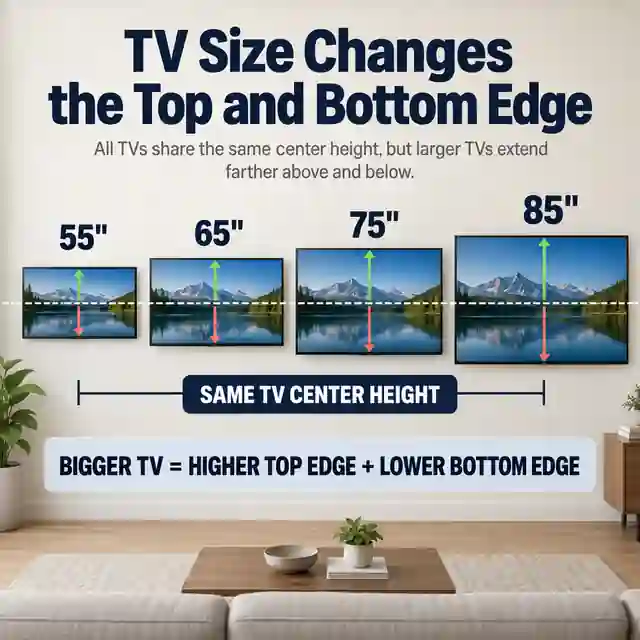
The center line can stay at the same seated eye height.
A 55-inch screen leaves more clearance below the TV.
A 75-inch or 85-inch screen extends much farther downward and can meet a media console even when the center has not moved.
That furniture conflict—not the diagonal by itself—is what often forces a large TV higher.
The Sofa Can Change the Answer More Than the Screen Size
Two households can own the same 65-inch TV and need different mounting heights because their seating is different. A firm sofa that holds you upright can place your eyes several inches higher than a soft sectional where you sink back. Reclining changes something else too: your natural sightline tilts upward, so a screen mounted above strict upright eye level may still feel comfortable.
- Measure more than one regular viewer if several people use the room every day.
- Use the primary seat, not the most distant occasional chair, as the main reference.
- For a very wide sectional, check the sightline from both central and end seats.
- If you recline, judge the screen while reclined; do not force your head into an upright measuring posture you never use.
- If children regularly watch from the floor, consider whether the TV position still works safely and comfortably from that lower eye line.
Viewing Distance Matters Most When the TV Has to Go Higher
Viewing distance and mounting height are related, but they solve different questions. Screen size and resolution help determine how close you may want to sit for an immersive, detailed picture. Eye height sets the simplest vertical center. Distance becomes especially important when furniture, a mantel or room layout forces the screen upward: the same vertical rise creates a smaller viewing angle when the sofa is farther away.
What viewing distance changes in a height calculation
| Situation | What distance changes | What it does not automatically change |
|---|---|---|
| TV centered at your eye line | Very little about the vertical center-height decision | It does not require the center to rise just because the sofa is farther away |
| TV raised above eye level | The upward sightline angle becomes smaller as viewing distance increases | It does not make a thermally unsafe fireplace position safe |
| Very large 4K screen | It affects immersion and how much of your field of view the screen occupies | It does not replace measuring the actual seating eye height |
| Bedroom or reclined viewing | Distance combines with a naturally upward sightline | It does not create one universal bedroom mounting height |
Vertical angle to a screen point = arctan(vertical rise ÷ viewing distance)

Example:
vertical rise to top edge = 24 in
viewing distance = 96 in
angle = arctan(24 ÷ 96) ≈ 14°
What happens if a 65-inch TV is raised so its center is 50 inches while eye height is 42 inches?
Answer: The top of the approximate picture area is about 66 inches, or 24 inches above the viewer's eye line. At an 8 ft viewing distance, that top-edge angle is about 14°. At 6 ft, the same TV position produces an angle of about 18.4°.
Explanation: Nothing about the wall changed. Moving the sofa closer made the upward sightline steeper, which is why viewing distance matters when the screen is mounted above eye level.
HomDera uses 15° to the top edge as a planning review point in the TV Mounting Height Calculator. Treat it as a prompt to reconsider a raised screen, not as a universal comfort law. Posture, recline, mount tilt, screen use and personal preference still matter.
The same raised TV feels different from 6 ft and 10 ft away
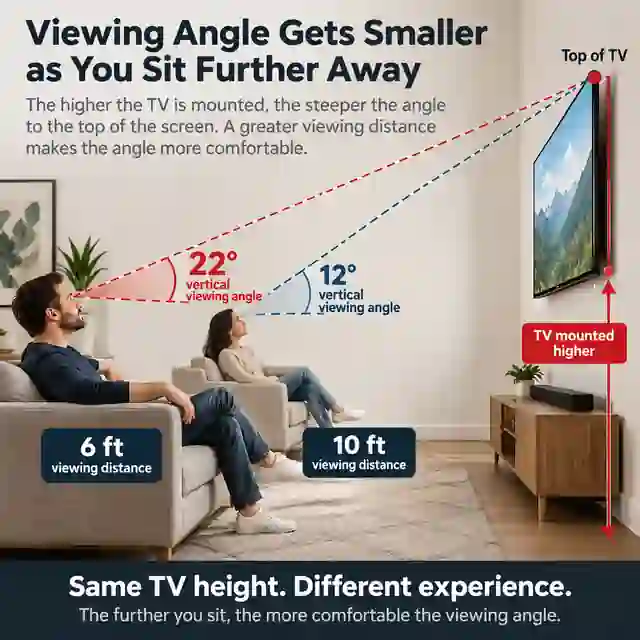
A fixed vertical rise creates a steeper angle from a close seat.
Moving farther back reduces that angle without changing the wall position.
This is why a slightly raised TV can feel acceptable in one room and uncomfortable in a shallow room.
Distance is most useful as a check after a console, mantel or other constraint has pushed the TV above the natural eye line.
TV Above a Console or Soundbar: Let the Bottom Edge Expose the Trade-Off
A media console changes the geometry because a large screen centered at eye level may extend into the furniture. The clean way to solve this is not to invent a universal gap such as 6 or 10 inches. First calculate the eye-level position. Then mark the TV's bottom edge. If it clashes with the console, soundbar, turntable lid, center speaker or decorations that actually need to stay, decide the lowest acceptable bottom edge and see how far the screen center must rise.
What can control the TV's minimum bottom edge?
| Constraint | What to check before choosing the height | Why a generic gap is unreliable |
|---|---|---|
| Media console | Furniture height plus the visual gap you actually want | Consoles range from very low benches to tall cabinets |
| Soundbar | Bar height, upward-firing speakers, controls and any manufacturer placement guidance | Soundbars vary greatly in depth, height and acoustic design |
| Center speaker | Cabinet height and acoustic path to the main seats | A large speaker can require far more space than a slim soundbar |
| Turntable or equipment lid | Full opening height and hand access | A beautiful 4-inch gap is useless if the lid needs 14 inches to open |
| Decor or lighting | Whether those items are permanent or just styling for the photo | Do not redesign the viewing height around an object that can simply move |
A 65-inch TV has a 42-inch eye-level center, but the bottom must be at least 34 inches from the floor. What happens?
Answer: Half of the approximate 65-inch picture height is about 16 inches. A 34-inch bottom edge therefore requires a center near 50 inches. The furniture has pushed the center about 8 inches above the original eye line.
Explanation: This is a real compromise you can evaluate. Once the center moves up, add the viewing distance and check the resulting sightline before drilling.
TV Above a Fireplace: Height Is Only One of the Problems
A fireplace often pushes a television far above seated eye level because the firebox, surround and mantel already occupy the most comfortable part of the wall. That makes the geometry easy to describe but harder to justify: the screen center rises, the viewing angle gets steeper and a tilting mount may be needed just to point the panel back toward the seats.
Do not use a TV-height formula to invent fireplace clearance. Heat exposure, mantel projection, ventilation and permitted clearances depend on the fireplace, TV and mount instructions. Samsung, for example, advises against mounting its TVs over a fireplace and specifically warns about heat exposure. Check the current instructions for your exact products.
If a fireplace location is unavoidable and permitted by the manufacturers, treat the minimum safe or required TV position as an external constraint. Put that bottom-edge height into the geometry, calculate the new center and inspect the sightline from the actual sofa. A pull-down or tilting mount can change viewing posture, but it does not remove heat, structure or clearance requirements.
A fireplace can force the TV out of the comfort zone
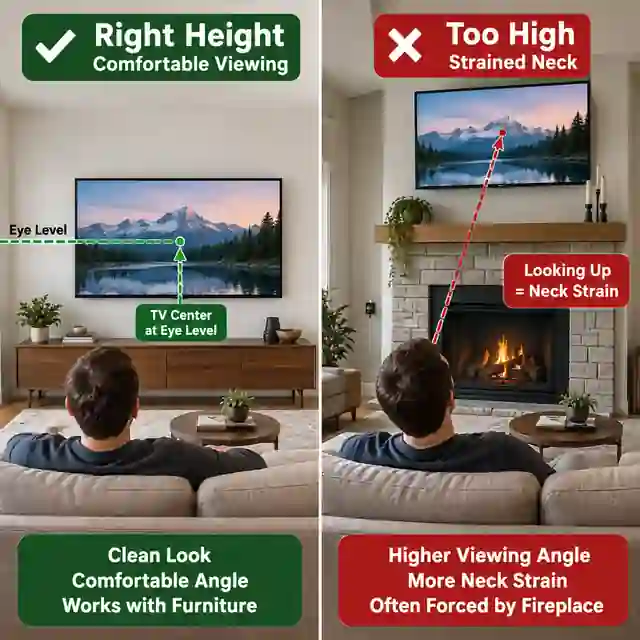
A low media console often allows the center to remain close to seated eye level.
A mantel can raise the bottom edge enough to push the entire screen upward.
The higher position should be checked for viewing angle and not described as ideal simply because it fits.
Fireplace heat and clearances are separate product and construction questions.
Bedroom TV Height: Measure the Position You Actually Watch From
A bedroom TV is one of the few cases where strict sofa-style eye-level mounting can feel obviously too low. Many people watch while supported by pillows with the head and chest reclined, so the natural line of sight already points upward. The useful measurement is therefore not a generic bedroom TV height. It is your eye position, viewing distance and sightline in the posture you actually use.
- Set the pillows and headboard support exactly as they are used at night.
- Measure eye height from the floor or use a helper to transfer the eye position to the wall.
- Check whether your natural gaze already points above horizontal.
- Tape the proposed TV rectangle on the wall and watch that outline for a few minutes from bed.
- If the TV is high, consider a mount with appropriate tilt while still following the mount and TV instructions.
- Do not block ventilation or hide the TV where curtains, doors or wardrobes can strike it.
If Several People Use the TV, Design for the Main Viewing Zone
You do not need a separate TV height for every person in the household. Measure the regular viewers in their normal positions and look for a sensible shared center. In most living rooms the differences between seated eye heights are smaller than the compromises introduced by furniture or a fireplace. What matters more is avoiding an extreme position that works beautifully for one seat and poorly for everyone else.
A practical approach for several seats
| Room situation | Useful approach | What to avoid |
|---|---|---|
| One main sofa | Prioritise the central or most-used seat | Designing around a rarely used side chair |
| Sectional with several daily viewers | Compare eye heights across the main seating zone and use a balanced center | Choosing the tallest person's eye line by default |
| Open-plan room | Prioritise the seated viewing area where long-form TV is watched | Raising the TV mainly for occasional standing views from the kitchen |
| Gaming setup | Give extra weight to the primary gaming seat and long-session posture | A high decorative placement that becomes tiring during extended play |
| Mixed sofa and floor seating | Keep the screen reasonably low and check visibility from both levels | Mounting high simply to clear decorative objects |
A Tilting Mount Can Help a Raised TV — but It Does Not Reset the Height
Tilting the TV downward can improve the way a raised screen faces the viewer and can reduce some reflection problems, but it does not move the screen center back to eye level. Your eyes still look upward. Treat tilt as a useful adjustment for a necessary compromise, not as permission to mount the TV wherever the empty wall looks most dramatic.
If you already know the TV must sit above your natural eye line, choose the mount type before finalising the position. A fixed mount, tilt mount and full-motion arm can place the TV at different distances from the wall and offer very different adjustment ranges.
The TV Center Is Not the Same as the Wall-Plate or Drill Height
First decide where the television itself should be. Only then convert that position into bracket holes. The VESA mounting pattern may sit above, below or around the TV's physical center, and the bracket rails can slide or hook into a wall plate at a different elevation. That is why one universal formula for 'drill 8 inches below the TV center' cannot be trusted.
Three different heights that are often confused
| Measurement | What it means | Where it comes from |
|---|---|---|
| TV screen or cabinet center | The visual center of the television on the wall | Your viewing-height calculation |
| VESA hole position | The mounting holes on the back of the TV | Exact TV model dimensions |
| Wall-plate drill position | Where the bracket attaches to the wall | The specific mount geometry and installation template |
A comfortable TV height does not prove that the wall or fixings can support the load. Confirm wall construction, bracket capacity, TV weight, permitted fixings, stud or structural locations where required, and the installation instructions before drilling.
Plan Power, Cables and Equipment Before the TV Hides the Wall
The best mounting height can still produce an untidy result if the power point, HDMI route and equipment location were planned for a different TV position. Mark the full TV rectangle first, then check where sockets and cable entries will sit relative to the mount. Leave access for plugs and do not trap power cords, signal cables or ventilation openings behind the bracket.
- Power outlet location and whether the plug clears the mount
- HDMI, antenna or aerial, Ethernet and optical cable routes
- Soundbar or center-speaker cable path
- Game console, streaming box and receiver location
- Access to ports that face sideways or downward
- Service loops so equipment can be moved without pulling connectors tight
- Any local electrical requirements for concealed mains wiring
Check Windows and Reflections Before You Commit
A TV at the perfect ergonomic height can still be unpleasant if it reflects a bright window for six hours every afternoon. Before drilling, tape the screen outline and look at the wall at the times you normally watch. A small change in lateral position, mount tilt, curtain strategy or lighting may solve a reflection without pushing the entire TV higher.
- Look for direct window reflections from the main seats.
- Check lamps and ceiling lights in the dark scene areas of the taped rectangle.
- Remember that a full-motion mount changes both angle and distance from the wall.
- Do not raise the TV simply to escape glare until you have tested easier changes.
- If the room is being renovated, coordinate the TV wall with lighting and window treatments before closing the wall.
Common TV Mounting Height Mistakes
Mistake, result and better approach
| Mistake | What usually happens | Better approach |
|---|---|---|
| Mounting by wall symmetry alone | The TV looks centered on the wall but sits too high for the sofa | Start with the viewer, then refine the wall composition |
| Using 42 in as a fixed rule | A low or reclined sofa gets an uncomfortable screen | Measure the actual seated eye height |
| Raising a larger TV just because it is larger | The center climbs for no ergonomic reason | Keep the center tied to the viewer unless another constraint intervenes |
| Ignoring the TV's bottom edge | A large screen collides with the media console | Calculate the full screen rectangle, not only its center |
| Choosing a universal gap above furniture | The screen may be unnecessarily high or still clash with equipment | Use the real console, soundbar and equipment dimensions |
| Treating viewing distance as irrelevant | A raised TV feels much steeper from a close sofa | Check the vertical angle when the TV must sit high |
| Copying a fireplace photo | Heat and viewing height are both ignored | Follow product clearances and calculate the actual sightline |
| Drilling from the desired screen center | The TV lands in the wrong place because VESA holes are offset | Transfer the specific mount geometry only after positioning the TV |
| Skipping a tape mock-up | The mistake is discovered after holes are drilled | Tape the entire TV outline and live with it briefly |
| Ignoring cables and outlets | The TV height is correct but cords, plugs or devices do not fit | Plan services inside the marked TV rectangle before mounting |
Worked Examples: 65-Inch and 85-Inch TVs
65-inch TV on an open wall
| Input or result | Value | Planning note |
|---|---|---|
| TV diagonal | 65 in | Standard 16:9 screen |
| Measured seated eye height | 42 in / 107 cm | Main sofa position |
| Approximate picture height | 31.9 in / 81 cm | Use actual cabinet height for final marks |
| Candidate center | 42 in / 107 cm | Matches seated eye line |
| Approximate bottom | 26.0 in / 66 cm | No furniture conflict in this example |
| Approximate top | 58.0 in / 147 cm | Tape this edge before drilling |
| Viewing distance | 8 ft / 2.44 m | Useful if the TV later has to move higher |
What changes with an 85-inch TV when a console requires the bottom edge to be at least 34 inches high?
Answer: An 85-inch 16:9 picture is about 41.7 inches high, so half-height is about 20.8 inches. Eye-level centering at 42 inches would put the bottom near 21.2 inches, which conflicts with the console. To keep the bottom at 34 inches, the center must rise to about 54.8 inches and the top to about 75.7 inches.
Explanation: The large screen extends much farther below its center. The console—not the 85-inch label by itself—forces the center nearly 13 inches above the viewer's eye line. That is the moment to add the real viewing distance and check the angle.
Frequently Asked Questions
How high should 55, 65, 75 and 85-inch TVs be mounted?
Start each size with the center near the measured seated eye height. At a 42-inch center, the approximate bottom edges of 55, 65, 75 and 85-inch 16:9 pictures are 28.5, 26.0, 23.6 and 21.2 inches from the floor. The bigger screen reaches lower; it does not automatically need a higher center. Raise it only when furniture, architecture or viewing posture creates a real reason.
Is 42 inches always the correct TV center height?
No. It is a useful reference because it is close to a common seated eye height, not a universal rule. Measure the actual viewer in the actual seat. A low sectional, recliner, bed or high stool can change the better starting point.
How far above a console should a TV be, and what about a fireplace?
There is no single gap that works for every console. Calculate the eye-level position first and see what gap it creates; if equipment needs more room, set the lowest practical bottom edge and review the raised viewing angle. A fireplace adds a separate safety problem: use the exact fireplace, TV and mount instructions for heat, ventilation and clearances rather than borrowing a generic spacing number.
Should the wall-mount plate be centered on the TV?
Do not assume so. The TV's VESA holes and the bracket's wall plate can be offset from the physical screen center. Decide the desired TV position first, then use the exact television and mount instructions to calculate the drilling position.
Useful Manufacturer and Mounting References
Samsung — wall mounting guidance, eye-level placement, heat and ventilation considerationsSony — recommended TV viewing distance by display type and screen sizeSANUS HeightFinder — model- and mount-specific wall-mount placement toolFinal Check Before You Drill
- Seated eye height was measured from the real sofa, chair or bed position.
- The proposed TV center begins near that eye line unless the room requires a deliberate compromise.
- The full top and bottom edges were calculated from the TV height, not guessed from the diagonal alone.
- The actual outside cabinet height of the selected TV has replaced the 16:9 estimate for final marks.
- The media console, soundbar, speakers and equipment have enough real clearance.
- Viewing distance was checked if the TV had to move above eye level.
- A fireplace position was checked separately for heat, ventilation and manufacturer clearances.
- Windows, lamps and likely reflections were reviewed from the main seat.
- Power, HDMI, antenna or aerial, network and audio routes are planned inside or around the TV rectangle.
- The exact VESA hole position and bracket geometry are known before drill points are marked.
- The wall construction, TV weight, mount rating and permitted fixings have been verified.
- The complete TV outline was mocked up with painter's tape and viewed from the real seats before installation.
The best TV mounting height is usually not a secret number attached to the screen size. It is the point where the viewer, the screen and the room agree. Start with seated eye level, use the TV's real height to mark its edges, and only move the center when furniture, architecture or viewing posture gives you a real reason. That is why two 65-inch TVs can belong at different heights—and why a 55-inch and an 85-inch TV can sometimes share the same center line.
Open the HomDera TV Mounting Height Calculator