
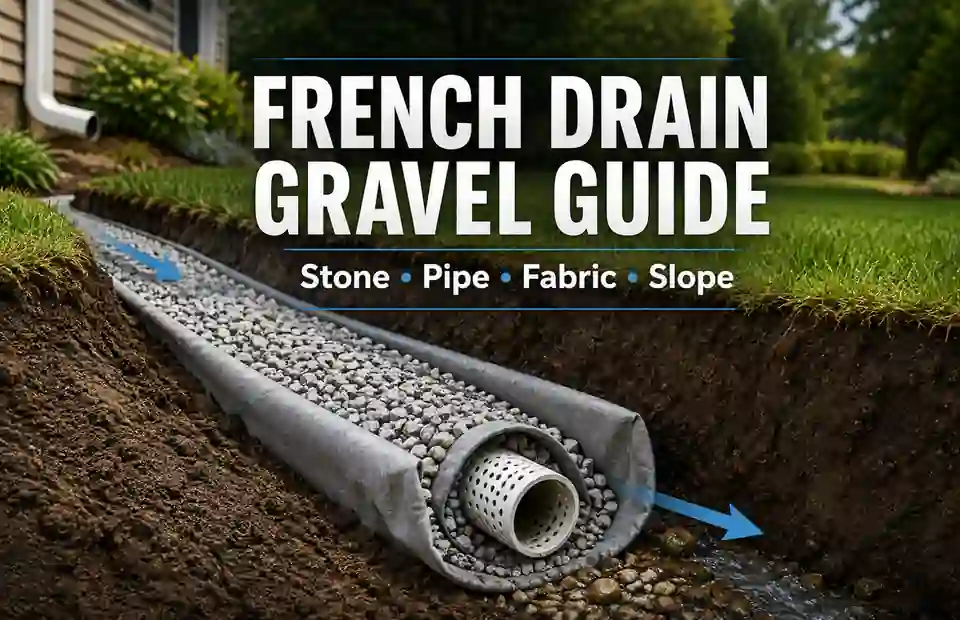
A French drain looks deceptively simple: dig a trench, add stone, lay a perforated pipe and give the water somewhere lower to go. The surprise usually arrives when the shopping list starts. A trench that looks modest on the lawn can swallow several cubic yards of stone, a narrow fabric roll may not wrap the trench at all, and a perfectly straight pipe can still fail to drain if the outlet is too high.
This guide focuses on the quantity side of a typical gravel-filled French drain or land drain. It shows how trench length, width and depth change the gravel order, how to allow for the pipe, how much filter fabric a full wrap can require, and how to turn a chosen grade into an actual elevation difference you can measure on site.
Quick answer: gravel quantity is based on the gravel-filled trench volume minus the space occupied by the pipe, plus a sensible ordering allowance. For a 50 ft drain that is 12 in wide and 20 in deep with a 4 in pipe and 10% allowance, the HomDera method gives about 3.22 yd³ of drainage stone. A 1% planning grade over the same 50 ft requires 6 in of total fall.
A material estimate is not a drainage design. The correct route, depth, pipe capacity, outlet, groundwater strategy, foundation detail and legal discharge point depend on the site and local requirements. Near foundations, retaining structures, unstable slopes or major water problems, get project-specific advice before digging.
French drain quantities without the guesswork
Start With the Problem, Not the Pipe
Before calculating stone, decide what the drain is meant to collect. A French drain is useful when water is moving through or saturating the ground and you want to provide a lower-resistance path toward a safe outlet. It is not automatically the best answer for every puddle, roof downspout or flooded area.
Different water problems can need different drainage solutions
| Situation | A French drain may help when… | Check before choosing it |
|---|---|---|
| Soggy strip of lawn | Groundwater or subsurface flow repeatedly saturates the same route | Surface grading, soil permeability and where the drain can discharge |
| Water moving across a slope | An interceptor trench can collect subsurface flow before it reaches a lower area | Slope stability, route and a reliable lower outlet |
| Water beside a driveway or path | The issue is water in the adjacent ground rather than a large sheet of fast surface runoff | Whether a channel drain or surface grading would collect runoff more directly |
| Basement or foundation moisture | The drainage detail is part of a designed foundation-waterproofing system | Footing elevation, waterproofing, sump or discharge design and local building requirements |
| Downspout discharge | The goal is to disperse or move water after a suitable inlet and solid conveyance section | Do not assume a perforated pipe beside the house is the correct first section for concentrated roof water |
The cheapest cubic yard of gravel is the one you do not order for the wrong drainage problem. Confirm the water source and the outlet before optimising the trench dimensions.
French Drain, Land Drain, Filter Drain: The Wording Changes by Region
In North American DIY discussions, “French drain” commonly means a gravel-filled trench containing perforated pipe and filter fabric. In Britain and other markets, you may also see terms such as land drain, filter drain or interceptor drain. The names overlap but are not perfect synonyms, so product specifications matter more than the label.
Useful English terms when buying materials
| US / Canada wording | UK / wider metric wording | What you actually need to identify |
|---|---|---|
| Drainage stone, washed stone, clean gravel | Clean gravel, drainage gravel, shingle, pipe bedding aggregate | A clean, free-draining aggregate suitable for the specified drain |
| Perforated drain pipe | Perforated land drainage pipe / land drain | Pipe diameter, perforation pattern, stiffness and installation instructions |
| Nonwoven filter fabric / geotextile | Permeable geotextile | A filtration/separation fabric suitable for burial and the surrounding soil |
| Cubic yards / short tons | Cubic metres / tonnes | The supplier's actual selling unit and bulk density |
The Gravel Formula Is Simple — the Cross-Section Is the Important Part
If the entire trench were solid stone, the volume would be length × width × depth. A practical French drain estimate usually needs two corrections: any topsoil or sod layer above the wrapped stone is not gravel, and the pipe itself occupies part of the stone envelope.
Excavation volume = trench length × full trench width × full trench depth

Gravel-filled depth = trench depth − soil/sod cover

Gross gravel envelope = length × width × gravel-filled depth

Approximate pipe volume = π × (pipe diameter ÷ 2)² × length

Net gravel volume = gross gravel envelope − pipe volume

Order volume = net gravel volume × (1 + allowance ÷ 100)
The pipe subtraction is not huge in every trench, but it keeps the estimate honest. More importantly, the calculation forces you to distinguish the full excavation from the part that will actually be filled with stone. That distinction becomes significant when the drain is hidden under several inches of soil and turf.
Calculate French drain gravel, pipe, fabric and slopeQuick Gravel Estimates for a 12-Inch-Wide Drain
The table below is useful for a first sense-check. It assumes a 12 in wide trench, a 4 in perforated pipe, no soil cap inside the stated depth and a 10% material allowance. It is not a standard trench specification — change any dimension and the quantity changes with it.
Approximate drainage stone to order — imperial example
| Drain length | 18 in gravel-filled depth | 24 in gravel-filled depth |
|---|---|---|
| 25 ft | about 1.44 yd³ | about 1.95 yd³ |
| 50 ft | about 2.88 yd³ | about 3.90 yd³ |
| 100 ft | about 5.76 yd³ | about 7.79 yd³ |
That difference between 18 and 24 inches is why “How many yards per 50 feet?” has no universal answer. Six extra inches of gravel-filled depth in a 12-inch-wide, 50-foot trench adds roughly one cubic yard to the order before the supplier has even discussed density or delivery.
Approximate drainage stone to order — metric example
| Drain length | 300 mm wide × 500 mm gravel-filled depth, 100 mm pipe, 10% allowance |
|---|---|
| 10 m | about 1.56 m³ |
| 15 m | about 2.35 m³ |
| 20 m | about 3.13 m³ |
| 30 m | about 4.69 m³ |
Volume is the more portable quantity. Weight varies with aggregate type, grading and moisture. If your supplier sells by ton or tonne, use its bulk-density or coverage figure rather than assuming every drainage stone weighs the same.
Trench Width Has a Bigger Effect Than the Pipe Diameter Suggests
A 4 in pipe does not mean a 4 in trench. The trench needs enough space for the specified stone envelope, fabric and practical installation. The required width depends on the drain design, pipe system, soil, expected flow and the installation detail. Manufacturer guidance for some residential systems discusses relatively narrow trenches, while other land-drain details use much wider gravel zones.
What makes a French drain trench wider?
| Reason | Effect on the trench | Effect on material quantity |
|---|---|---|
| Larger pipe or drainage bundle | Needs more room around the product | More gravel and usually more fabric |
| More gravel around the pipe | Creates a wider free-draining envelope | Volume rises directly with width |
| Weak or collapsing soil | Excavation may become wider than the neat design dimension | Field use can exceed the theoretical estimate |
| Need for safe access or excavation support | Working width may be governed by safety rather than the pipe | Spoil and backfill quantities change |
| Multiple pipes or special collector detail | Cross-section becomes project-specific | Calculate the actual section instead of using a generic French-drain rule |
What happens if a 50 ft × 20 in deep trench grows from 12 in to 16 in wide?
Answer: Before allowing for the pipe and waste, the gross stone envelope increases from about 3.09 yd³ to about 4.12 yd³ — roughly one extra cubic yard simply because the trench is four inches wider.
Explanation: Length and depth did not change. Width alone increased the cross-sectional area by one third.
Depth Is About Intercepting Water, Not Reaching a Magic Number
There is no single correct French drain depth. A shallow garden drain and a foundation drainage system solve very different problems. NDS notes that many general water-diversion projects may fall somewhere around 8 inches to 2 feet deep, while foundation and sub-ground applications can be deeper. Treat that as a broad practical range, not a design rule.
The useful question is: at what elevation does the drain need to intercept the water, and can that elevation still reach a safe outlet with the required fall? Digging deeper for no reason can increase spoil, stone, fabric and labour while making the outlet problem harder.
One extra six inches follows you for the whole drain
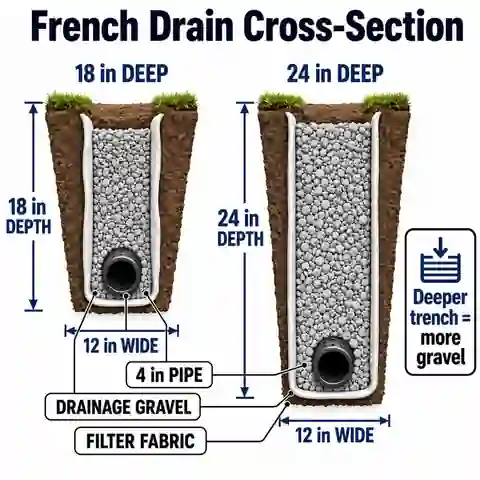
Increasing depth adds gravel along every foot or metre of the route, not only at the low point.
If the drain is covered with soil or sod, separate the full excavation depth from the gravel-filled depth.
A deeper trench also needs a wider fabric wrap and creates more spoil to remove or reuse.
Before digging deeper, confirm that the outlet elevation still works.
Choose Clean Drainage Aggregate, Not Just Something Called “Gravel”
A French drain relies on open voids around the pipe, so the surrounding aggregate is normally clean and free-draining rather than a compactable base containing lots of fines. Supplier names vary dramatically: clean stone, washed stone, drainage gravel, shingle and pipe-bedding gravel can all appear in different regions.
Questions to ask the aggregate supplier
| Ask | Why it matters |
|---|---|
| Is this product intended for drainage around perforated pipe? | A road-base or crusher-run product may contain fines intended to compact rather than preserve drainage voids |
| What is the grading or particle-size range? | The product name alone may not identify the actual material |
| Is it washed or otherwise low in fines? | Soil-like fines can reduce void space and contribute to clogging |
| What bulk density should I use for tonnage? | A generic conversion is only an estimate |
| Is it sold by yard/metre, ton/tonne, bag or minimum truck load? | Your calculated volume must be rounded to a quantity the supplier actually sells |
A familiar aggregate name is not a specification. “Pea gravel”, “drain rock”, “shingle” and “clean stone” can describe different products depending on the supplier and country. Use the material required by the drainage detail or pipe-system instructions.
Pipe Size Affects Capacity — but the Gravel Calculator Cannot Choose It for You
Four-inch (about 100 mm) perforated pipe is common in residential French-drain work and is the default in the HomDera material calculator, but “common” is not the same as “always enough”. Pipe capacity depends on inflow, slope, pipe characteristics, outlet conditions and how the drain collects water.
Pipe questions the material takeoff does not answer
| Question | Why a trench calculator cannot decide it |
|---|---|
| 4 in or 6 in pipe? | Capacity depends on expected flow, grade, product and outlet conditions |
| Rigid PVC or flexible corrugated pipe? | Strength, roughness, fittings and installation requirements differ |
| Holes up or holes down? | Perforation patterns and intended collection details differ; follow the exact pipe and system instructions |
| Where should cleanouts go? | Access depends on route, bends, maintenance strategy and local practice |
| Can the pipe discharge to a sewer, ditch or soakaway? | Legal and hydraulic requirements vary by location |
Do not copy a universal “holes up” or “holes down” rule from a photo. Some pipes are perforated around their circumference; half-perforated products may be installed differently depending on whether they collect or disperse water.
Filter Fabric Is a Full Wrap, Not a Strip Under the Pipe
The fabric separates the clean drainage aggregate from the surrounding soil. If the design uses a full wrap, you need enough width to cross the bottom, rise up both sides, close over the top and overlap. This is why a roll that looks wide beside the pipe can suddenly become too narrow when the trench is measured.
Approximate full-wrap width =
2 × trench width + 2 × gravel-filled depth + overlap

HomDera planning example uses about 12 in (300 mm) of overlap.
Will a 4 ft fabric roll wrap a 12 in wide × 20 in deep gravel envelope?
Answer: Not with the HomDera full-wrap planning method. The cross-section needs about 76 in, or 6.33 ft, of fabric width before any length allowance.
Explanation: Two widths = 24 in, two depths = 40 in, and a 12 in overlap brings the total to 76 in. A 4 ft roll is only 48 in wide.
The fabric has to go around the drain

Measure the gravel envelope, not only the pipe diameter.
Allow for the bottom, both side walls, the top closure and the specified overlap.
Check the actual roll width before ordering by total square footage.
Use a geotextile suitable for filtration and burial; a decorative landscape fabric is not automatically equivalent.
What a 1% French Drain Slope Actually Looks Like
A 1% grade means one unit of vertical fall for every 100 units of horizontal run. That is 1:100, 10 mm per metre, or about 0.12 in per foot. It is a convenient planning reference because the arithmetic is easy to check with real site elevations.
Total fall at a 1% planning grade
| Run | Required fall |
|---|---|
| 25 ft | 3 in |
| 50 ft | 6 in |
| 75 ft | 9 in |
| 100 ft | 12 in |
| 10 m | 100 mm |
| 15 m | 150 mm |
| 20 m | 200 mm |
| 30 m | 300 mm |
Do not treat 1% as a universal legal or technical minimum. NDS uses 1% as a common French-drain planning recommendation, while other land-drain guidance may use gentler grades in some situations. Pipe type, soil, inflow, outlet and local requirements still control the real design.
Slope is an elevation budget
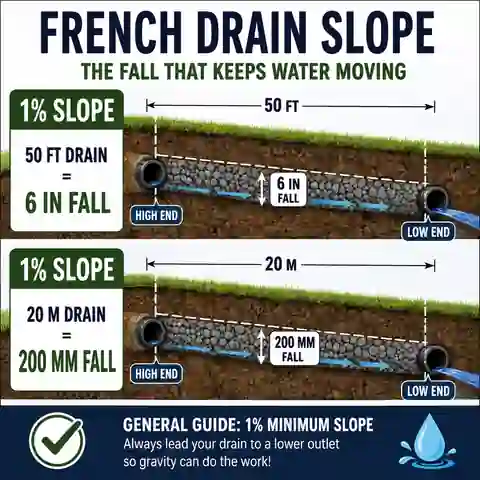
Mark the high-point and outlet elevations before the full trench is excavated.
A 50 ft route at 1% consumes 6 in of elevation from start to finish.
Check the trench bottom or pipe grade repeatedly rather than assuming the ground surface has the same fall.
The outlet must be lower than the route you are trying to build.
Measure the Route and Elevations Before You Order Stone
- Identify the wet area or line of subsurface flow.
- Choose a discharge point that is physically lower and permitted for the site.
- Mark the real drain route, including bends and connections.
- Measure the route length along the trench centreline.
- Record the start and outlet elevations with a laser level, builder's level, water level or another suitable method.
- Choose the trench cross-section and pipe detail for the actual drainage design.
- Calculate gravel, pipe and fabric from those dimensions.
- Check access for excavation, spoil removal, stone delivery and future maintenance before work starts.
A tape measure can tell you the route length. It cannot tell you whether the outlet is low enough. Check length and elevation as two separate measurements.
Worked Example: 50 ft Yard French Drain
Example inputs
| Input | Value | Planning note |
|---|---|---|
| Drain length | 50 ft | Measured along the actual route |
| Trench width | 12 in | Example width, not a universal specification |
| Trench depth | 20 in | Stone extends through the full entered depth |
| Perforated pipe | 4 in | Common residential planning size |
| Material allowance | 10% | For order uncertainty and minor field variation |
| Planning grade | 1% | Used only as an elevation reference |
- Full excavation volume: 50 ft × 1 ft × 1.667 ft ≈ 83.3 ft³, or about 3.09 yd³.
- Approximate 4 in pipe displacement: about 4.36 ft³.
- Net stone before allowance: about 78.97 ft³.
- Stone with 10% allowance: about 86.87 ft³, or about 3.22 yd³.
- At HomDera's generic planning density of 1,550 kg/m³, that is roughly 4.2 US short tons — but supplier density should override it.
- Pipe purchase length with 10% allowance: 55 ft.
- Full-wrap fabric width: about 76 in, or 6.33 ft.
- Fabric area with 10% allowance: about 348 ft².
- Total fall at a 1% planning grade: 6 in.
The most useful part of the example is not the final 3.22 yd³. It is seeing why the stone order, excavation volume, pipe length, fabric area and slope are different quantities. If you change the trench depth, add a 4 in soil cap or widen the trench around a difficult section, each result changes in a different way.
Worked Metric Example: 15 m Drain
How much stone is needed for a 15 m drain that is 300 mm wide and 500 mm deep with a 100 mm pipe and 10% allowance?
Answer: The gross gravel envelope is 2.25 m³. The 100 mm pipe occupies about 0.118 m³ when nominal 100 mm diameter is used for this simplified example. After subtracting the pipe and adding 10%, the order is about 2.35 m³ of drainage aggregate.
Explanation: The calculation uses the full 500 mm as gravel-filled depth. If, for example, the upper 100 mm were reserved for soil and turf, the gravel quantity would be materially lower and the full excavation volume would stay the same.
At 1%, the same 15 m run would need 150 mm of total fall. If a field measurement shows only 90 mm between the proposed start and outlet, the arithmetic is warning you about an elevation problem before the stone arrives.
Topsoil or Stone to the Surface?
Some French drains remain visible as a gravel strip. Others are wrapped below grade and covered with soil or sod so the lawn continues across the top. The quantity calculation must match the actual detail.
Visible gravel and buried drains use the same trench differently
| Finish | Gravel quantity | Fabric wrap | Maintenance / appearance |
|---|---|---|---|
| Stone to surface | Most or all of the trench depth may be gravel-filled | Wrap detail must suit the open top design | Drain remains visually obvious and surface debris may need management |
| Soil or sod cover | Subtract the cover depth from the gravel-filled depth | Fabric closes over the gravel before soil is placed | Lawn can hide the drain, but access and settlement still need consideration |
| Paved or structural surface above | Do not use a generic lawn detail | Must match the designed pavement/drainage assembly | Loads, sub-base and drainage interfaces become project-specific |
The Outlet Controls the Whole Project
A French drain is not finished when water reaches the pipe. The water still needs a legal, stable and maintainable destination. Depending on the site, that might be daylight at a safe lower location, an approved stormwater connection, a designed soakaway or dry well, a sump system, or another permitted drainage facility.
- Do not discharge water against the same foundation you are trying to protect.
- Do not assume you can send concentrated water onto a neighbouring property or public land.
- Do not create erosion at a daylight outlet.
- Keep the outlet accessible enough to inspect and maintain where practical.
- Protect outlets against blockage, animals and backflow where the design requires it.
- Check whether local drainage, environmental or planning rules restrict the proposed discharge.
If the outlet has not been identified, the French drain is not yet designed. Ordering the gravel first only makes the unresolved part heavier.
Common French Drain Mistakes That Change the Material Order
Mistake, consequence and better check
| Mistake | What goes wrong | Better approach |
|---|---|---|
| Using pipe diameter as trench width | Stone quantity is badly understated | Calculate the actual excavated cross-section |
| Using full trench depth as gravel depth when soil will cover the drain | Too much stone is ordered | Separate excavation depth from gravel-filled depth |
| Buying aggregate by tons from a generic density | The delivery may not match the supplier's material | Use supplier density or coverage |
| Buying fabric by square footage only | The roll area is sufficient but the roll is too narrow to wrap the trench | Check both total area and required wrap width |
| Assuming every French drain needs exactly 1% slope | A planning number is mistaken for a universal rule | Use the grade required by the actual system and site |
| Digging the full trench before confirming the outlet | The low end can finish below the only possible discharge | Survey start and outlet elevations first |
| Using compactable aggregate with many fines | The stone envelope may lose free-draining void space | Use the specified clean drainage material |
| Copying a universal pipe-hole orientation | The pipe may be installed contrary to its design | Follow the exact product instructions |
| Ignoring trench collapse or over-excavation | Field stone use exceeds the neat calculation | Re-measure sections that differ from the planned width or depth |
| Digging before buried services are located | Creates severe safety and property risks | Use the local utility-location process before excavation |
Five mistakes worth catching before the truck arrives
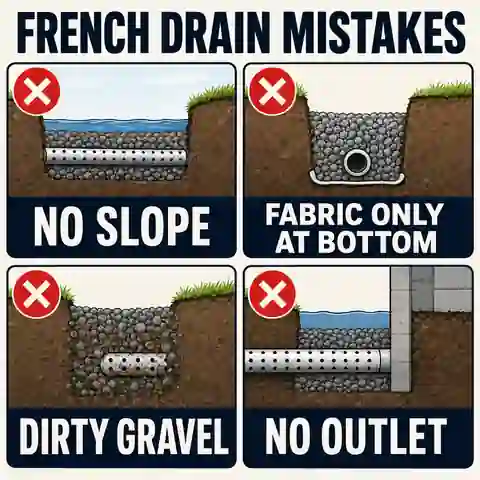
Trench dimensions control gravel volume more than the pipe diameter alone.
Fabric must be wide enough to wrap the entire stone envelope.
Clean drainage aggregate should remain separated from surrounding soil.
Slope must be checked against the real outlet elevation.
The discharge point is part of the design, not an afterthought.
Before You Dig: Utilities and Excavation Safety
Even a garden drainage trench can cross electricity, gas, water, communications, irrigation or private services. In the United States, the 811 system directs users to their state process for utility marking before digging. In the UK, HSE guidance stresses planning, locating underground services and controlling excavation-collapse risks before work begins. Other countries have their own systems.
Do not assume a shallow trench is harmless. Buried services can be close to the surface, and unsupported ground can collapse unpredictably. Follow the safety and utility-location requirements that apply where you live.
Frequently Asked Questions
How much gravel do I need for a 50 ft French drain?
There is no single number without trench width and gravel-filled depth. With a 12 in width, 20 in gravel-filled depth, 4 in pipe and 10% allowance, the HomDera example is about 3.22 yd³. The same 50 ft route can require much more or less stone if the cross-section changes.
How much gravel do I need for a 100 ft French drain?
For a 12 in wide trench with an 18 in gravel-filled depth, 4 in pipe and 10% allowance, the estimate is about 5.76 yd³. At 24 in deep, the same assumptions produce about 7.79 yd³. Use the real trench dimensions rather than a per-foot rule.
Is 4-inch perforated pipe enough for a French drain?
Four-inch pipe is common for residential drainage, but a material calculator cannot prove that it has enough hydraulic capacity. Flow, slope, soil, collection area, pipe characteristics and outlet conditions all matter. Use the size required by the actual drainage design.
What gravel is best for a French drain?
Use the clean, free-draining aggregate specified for the drain or pipe system. In different markets it may be sold as clean stone, washed drainage stone, drainage gravel, shingle or pipe-bedding gravel. Avoid choosing solely by a generic name; confirm grading, fines and suitability with the supplier.
Does a French drain need landscape fabric?
Many modern gravel French-drain details use a permeable geotextile to separate soil from the stone and reduce migration of fines. The exact fabric type and wrap detail depend on the soil and system. Use a product intended for filtration and burial rather than assuming any weed-control fabric is suitable.
What slope should a French drain have?
One percent, or 1:100, is a common planning reference and equals 1 ft of fall per 100 ft, 6 in per 50 ft, or 10 mm per metre. It is not universal. Some systems and land-drain details use different grades, so verify the requirement for the pipe, outlet and site.
Can a French drain be level?
Some subsurface drainage systems can collect or redistribute water with very gentle grades, but a conventional drain intended to carry collected water to a specific outlet needs an elevation strategy that works. Do not assume “level is fine” or “1% is mandatory” without checking the intended system.
Should the perforated pipe holes face up or down?
Follow the exact pipe manufacturer's installation instructions. Fully perforated corrugated pipe may have openings around the circumference, while half-perforated products can use different orientations depending on whether the pipe is collecting or dispersing water. A universal rule is unreliable.
Should I cover the French drain with soil or leave gravel visible?
Either can be part of a valid design. If soil or sod covers the wrapped stone, subtract that cover depth when estimating gravel. If stone remains open to the surface, plan for surface debris and confirm the fabric and finishing detail are appropriate.
Practical References
The references below are useful examples of why French-drain dimensions, slope, geotextile, aggregate and excavation safety need to be checked against the actual system and location rather than copied from one universal diagram.
NDS: French Drain Installation Guide — pipe, aggregate, trench and slope considerationsPavingexpert: Installing a land drain — UK-style geotextile, gravel and perforated-pipe example811: US utility-location information before excavationUK HSE: excavation safety and underground-service risksFinal French Drain Quantity Check
- The drainage problem and water source have been identified.
- A safe and permitted outlet is known before excavation starts.
- Start and outlet elevations have been measured.
- Drain length follows the real route rather than a straight-line guess.
- Trench width and depth come from the intended drainage detail.
- Soil or sod cover is separated from gravel-filled depth.
- The pipe size and product are appropriate for the actual design.
- Drainage aggregate is clean, free-draining and confirmed with the supplier.
- Filter fabric is suitable for burial and wide enough for the planned wrap.
- The stone order uses volume first and supplier density for final tonnage.
- The selected slope is treated as a project requirement, not a universal internet rule.
- Buried utilities and excavation hazards have been addressed before digging.
- Delivery access, spoil handling and maintenance access are included in the plan.
A dependable French drain estimate is a chain of small checks: identify the water problem, confirm the outlet, measure the route and elevations, define the trench cross-section, calculate the stone volume, size the fabric wrap and only then convert the order into tons, tonnes, bags or truckloads. The formula is simple; the useful part is making sure the dimensions belong to the drain you are actually going to build.
Open the HomDera French Drain CalculatorExplore HomDera construction and outdoor calculatorsHow HomDera handles assumptions, unit conversion, allowances and calculator limitations