
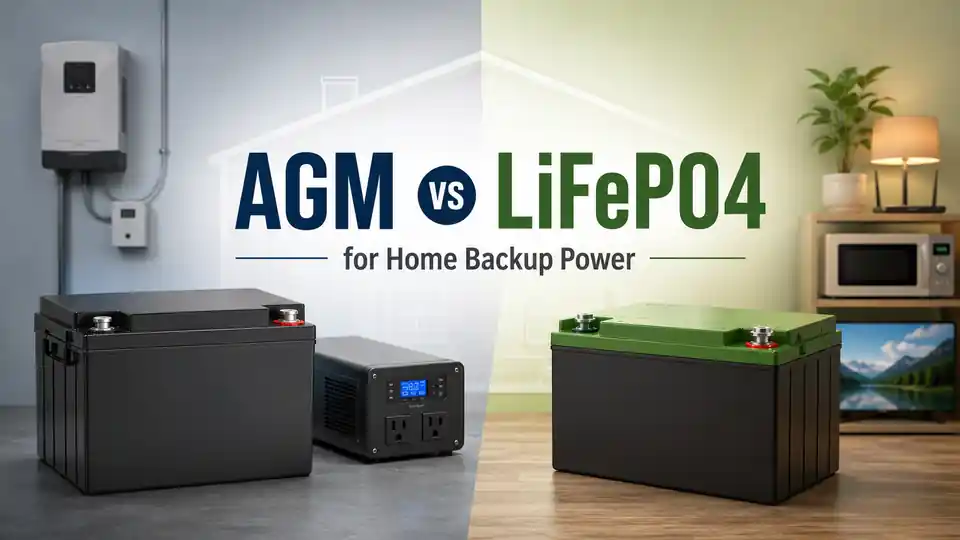
AGM and LiFePO4 batteries can both power a home backup system, but they suit different patterns of use. An AGM battery can be a sensible low-cost choice for occasional outages, an existing UPS designed for lead-acid batteries or an unheated location where lithium charging would be difficult. A LiFePO4 battery usually becomes more attractive when outages are frequent, the battery is cycled deeply, faster recharging matters or weight and space are limited.
The important comparison is not simply 100Ah versus 100Ah. You need to compare usable watt-hours, permitted discharge depth, inverter current, charge settings, temperature limits, expected cycles and the cost of replacing the battery over the life of the system.
Quick answer: choose AGM when the system is used rarely, purchase price matters most and the existing charger or UPS is specifically designed for AGM. Choose LiFePO4 when the battery will be used often, deeper usable capacity and faster recovery are valuable, or you want more backup energy from less weight and space. Always verify the battery, charger, inverter and temperature limits as one complete system.
This guide is for preliminary planning. Batteries can deliver very high fault current, and incorrect charging, undersized cables, missing overcurrent protection or unsuitable installation locations can create fire, shock and equipment-damage risks. Permanent home backup systems should be selected and installed in accordance with the equipment instructions and local electrical and fire-safety rules, with professional review where required.
The decision in one minute
AGM vs LiFePO4 for home backup power
| Question | AGM | LiFePO4 |
|---|---|---|
| Initial purchase price | Usually lower | Usually higher |
| Usable energy from the same Ah rating | Often planned around about 50% depth of discharge for longer life | Often planned around 80–90% depth of discharge, subject to the battery specification |
| Cycle life | Commonly hundreds of deep cycles; premium designs can achieve more | Commonly thousands of cycles when operated within specification |
| Recharge behaviour | Usually slower near full charge because of the absorption stage | Often accepts a higher charge rate and reaches a useful state of charge faster |
| Weight and space | Heavy and relatively bulky | Much lighter for a similar usable energy target |
| Partial state of charge | Long periods without a full recharge can promote sulfation | Generally more tolerant of partial charging |
| Cold-weather charging | Can often be charged below 0°C / 32°F with the correct manufacturer-approved temperature compensation | Many models must not be charged below 0°C / 32°F; some specify a higher cut-off or include heating |
| High-current loads | Voltage sag and the Peukert effect can reduce available capacity | Usually maintains voltage better, but the BMS current limit must not be exceeded |
| Existing lead-acid UPS | Usually the intended replacement chemistry | Only when the UPS manufacturer explicitly approves lithium compatibility |
| Best general use | Rare outages, standby duty and lower upfront cost | Frequent outages, daily cycling, long runtime and solar-linked systems |
That table gives the direction, not a universal specification. A high-quality AGM battery may outperform a poor LiFePO4 pack, and a lithium battery with an undersized battery management system can shut down even when its energy capacity appears adequate. Compare actual datasheets, warranty conditions and current limits rather than relying on the chemistry name alone.
AGM and LiFePO4 comparison
What AGM and LiFePO4 actually mean
A BMS is a protection layer, not permission to ignore system design. The fuse, disconnect, cable size, inverter settings, charger profile and installation environment still have to be correct.
Why the same 100Ah label does not mean the same backup time
Compare usable watt-hours, not amp-hours alone
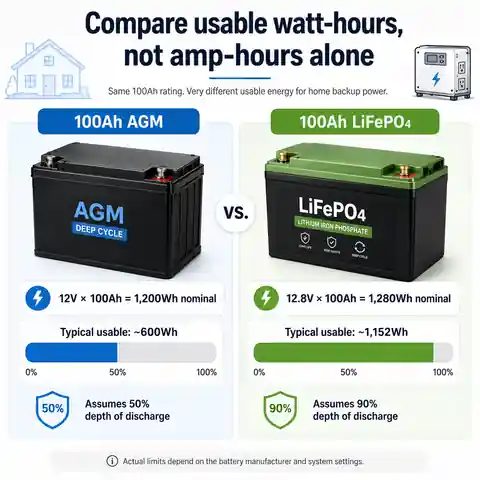
A typical 12V 100Ah AGM battery stores about 1,200Wh at its nominal rating. A 12.8V 100Ah LiFePO4 battery stores about 1,280Wh.
For a conservative planning comparison, the AGM may be limited to 50% depth of discharge while the LiFePO4 battery may allow 90%. This gives about 600Wh versus 1,152Wh before inverter losses.
The exact limit must come from the battery manufacturer. Some AGM batteries are designed for deeper cycling, and some lithium systems reserve capacity internally.
Nominal energy can be estimated as battery voltage multiplied by amp-hours. Usable output energy is lower because you normally retain some battery reserve and the inverter or UPS loses part of the energy during conversion.
Planning formula: usable AC energy in Wh ≈ battery voltage × battery capacity in Ah × usable depth of discharge × inverter efficiency
How much AC energy could a 12V 100Ah AGM battery provide?
Answer: About 540Wh in a simple planning example.
Explanation: 12V × 100Ah = 1,200Wh nominal. At 50% usable depth of discharge, 600Wh remains. With a 90% efficient inverter, about 540Wh reaches the AC load. Real output may be lower at high current, low temperature or as the battery ages.
How much AC energy could a 12.8V 100Ah LiFePO4 battery provide?
Answer: About 1,037Wh in the same type of planning example.
Explanation: 12.8V × 100Ah = 1,280Wh nominal. At 90% usable depth of discharge, 1,152Wh remains. With a 90% efficient inverter, about 1,037Wh reaches the AC load. The result still depends on the BMS cut-off, discharge current, temperature and inverter settings.
Load size changes the comparison
A battery that performs well with a router and a few lights may behave very differently with a refrigerator, circulation pump, microwave or other high-power load. The inverter draws current from the battery side, and that current rises quickly in a 12V system.
What battery current is required to supply a 1,000W load through a 90% efficient 12V inverter?
Answer: About 93A before allowing for voltage sag and other losses.
Explanation: Battery current ≈ 1,000W ÷ (12V × 0.90) = 92.6A. This is a demanding continuous current for many small batteries, cables and connectors. At 24V the current would be roughly half, and at 48V roughly one quarter, for the same power.
Lead-acid capacity is often stated at a 20-hour discharge rate. When an AGM battery is discharged much faster, the Peukert effect reduces the capacity that can be recovered before voltage falls to the cut-off point. LiFePO4 batteries are less affected by this phenomenon and generally hold a flatter voltage during discharge.
LiFePO4 still has firm current limits. A 100Ah battery with a 100A continuous BMS may appear suitable for a large inverter, but startup surge, battery temperature, parallel-battery sharing and the inverter's low-voltage cut-off can still cause shutdown. Check both the continuous and peak discharge ratings and confirm how long the peak rating is allowed.
What to check for a high-power inverter load
| Check | Why it matters |
|---|---|
| Battery continuous discharge current | Must exceed the expected DC current with an appropriate margin |
| Peak or surge discharge current | Must support motor, compressor and transformer starting demand for the required duration |
| BMS limit on LiFePO4 | The BMS can disconnect the battery even when energy remains |
| Voltage sag on AGM | The inverter may reach its low-voltage cut-off before the battery is chemically empty |
| Cable and connection resistance | Small voltage losses become significant at high current and create heat |
| Fuse and disconnect rating | Protection must interrupt the possible fault current safely |
| System voltage | 24V or 48V can reduce current and cable losses for larger systems |
A fairer size comparison: 200Ah AGM vs 100Ah LiFePO4
Comparing equal amp-hour ratings is useful for showing why LiFePO4 often runs longer, but it is not how an equivalent backup bank is normally designed. A fairer comparison starts with the same usable energy target. The example below uses 50% of a 12V AGM bank, 90% of a 12.8V LiFePO4 battery and 90% inverter efficiency.
Two battery banks designed to deliver about 1kWh of usable AC energy
| Design point | 12V 200Ah AGM bank | 12.8V 100Ah LiFePO4 battery |
|---|---|---|
| Nominal stored energy | 2,400Wh | 1,280Wh |
| Planning depth of discharge | 50% | 90% |
| Energy before inverter losses | 1,200Wh | 1,152Wh |
| Usable AC energy at 90% inverter efficiency | About 1,080Wh | About 1,037Wh |
| Approximate runtime at a 300W average load | About 3.6 hours | About 3.5 hours |
| Typical physical arrangement | Often two matched 12V 100Ah batteries in parallel | Often one 12.8V 100Ah battery |
| Behaviour at high discharge current | Available capacity and voltage may fall more noticeably | Usually steadier, subject to the BMS and cell-current limits |
This comparison explains why a 100Ah LiFePO4 battery is often discussed alongside a roughly 200Ah AGM bank. It is only a planning equivalence: the exact result changes with the battery datasheet, discharge rate, temperature, age, inverter cut-off and permitted reserve.
Where AGM is still the practical choice
AGM is not obsolete simply because LiFePO4 offers more cycles. A battery used for a few brief outages each year may never approach the cycle life of either chemistry. In that situation, the lower purchase cost and straightforward compatibility with a conventional UPS can matter more than the theoretical lifetime energy throughput.
- You already own a UPS, inverter charger or alarm system that is designed and approved for AGM or other VRLA batteries.
- The battery will spend most of its life on standby and will be discharged only occasionally.
- The installation location can become colder than the LiFePO4 charging limit and adding a heated enclosure is not practical.
- Upfront cost is the main constraint and the required runtime is modest.
- The system needs a familiar, widely available replacement battery with no change to charger settings.
- The battery is part of equipment whose warranty or certification requires the original lead-acid chemistry.
AGM also tolerates a conventional float-charging standby arrangement when the charger is set correctly. That is one reason it remains common in UPS systems. The disadvantages are weight, lower usable energy, slower recovery near full charge and sensitivity to repeated deep discharge or long periods at partial state of charge.
For rare emergency use, calendar ageing may matter more than cycle life. Paying for 3,000 or more potential lithium cycles has little value if the system is expected to complete only a few dozen discharge events before other components are replaced.
Where LiFePO4 earns its higher purchase price
LiFePO4 becomes easier to justify when the backup battery is part of everyday life rather than equipment waiting for a rare emergency. Frequent power cuts, daily solar cycling and long evening loads turn usable capacity, efficiency and recharge speed into practical benefits.
- The battery will be discharged and recharged frequently.
- You need long runtime but have limited floor space or cannot handle a very heavy battery bank.
- Fast recharging between repeated outages is important.
- The system regularly operates at a partial state of charge, such as a solar-linked backup system.
- High-current loads cause unacceptable voltage sag with a similar-size lead-acid battery.
- You expect to keep the system long enough to benefit from the higher cycle count.
- The charger, inverter and monitoring equipment have a documented LiFePO4 mode or configurable settings approved by the battery manufacturer.
LiFePO4's flatter discharge voltage can also make the remaining charge harder to estimate from voltage alone. A compatible battery monitor that counts energy in and out is often more useful than a simple voltmeter. The BMS may disconnect the battery abruptly at a protection limit, so a system should not depend on a slowly falling voltage as its only warning.
Cycle life: useful only when the test conditions match your use
Cycle-life claims are easy to compare badly. One battery may be rated at 50% depth of discharge, another at 80% or 100%. End of life may mean 80% remaining capacity for one product and a different threshold for another. Temperature, discharge rate, charge voltage and rest periods can also change the result.
Questions to ask when reading a cycle-life claim
| Question | Why it matters |
|---|---|
| At what depth of discharge was the test performed? | Shallower cycling normally produces more cycles |
| What remaining capacity defines end of life? | A battery may still work after the rated point but provide less runtime |
| At what temperature was it tested? | Heat can accelerate ageing, while cold changes available capacity and charging behaviour |
| What charge and discharge rates were used? | Gentle laboratory rates may not match a large home inverter |
| Does the warranty cover the expected use? | A long cycle claim does not automatically mean a long full-replacement warranty |
| Is the battery designed for standby or cyclic service? | Two AGM batteries with the same Ah rating can have very different intended uses |
| Are BMS events or deep-discharge shutdowns recorded? | Some lithium warranties limit operation outside specified conditions |
As a broad planning distinction, standard deep-cycle AGM batteries are commonly measured in hundreds of deep cycles, while LiFePO4 batteries are commonly measured in thousands. Premium AGM designs can exceed the usual range, and low-quality lithium packs may fail long before an attractive cycle number. Use the specific datasheet rather than treating a chemistry-wide range as a promise.
Charging compatibility is the part most often overlooked
A battery replacement is not complete until the charger has been checked. AGM and LiFePO4 use different charge behaviour, and a charger with one fixed lead-acid profile may not be suitable for a lithium battery even when both are sold as 12V.
Charging differences that affect a home backup system
| Charging issue | AGM | LiFePO4 |
|---|---|---|
| Bulk and absorption | Uses a manufacturer-specified absorption voltage and time | Uses manufacturer-specified lithium settings; long lead-acid absorption may be inappropriate |
| Float or standby | Common in UPS and standby service when set correctly | May use a lower float setting or no conventional float stage, depending on the manufacturer |
| Equalisation | Do not use unless the AGM manufacturer specifically permits it | Must not be exposed to a lead-acid equalisation programme |
| Temperature compensation | Charge voltage commonly changes with battery temperature | Do not apply a generic lead-acid temperature-compensation curve |
| Low-temperature charging | May be permitted with correct settings within the AGM specification | Often blocked below 0°C / 32°F or a higher stated threshold |
| Charge current | Often limited to a moderate fraction of capacity | Can often accept more current, but the cell and BMS limits still apply |
| Full recharge | Regular full charging helps prevent sulfation | Does not need to remain at 100% state of charge for normal health |
Never leave a lead-acid equalisation mode enabled for LiFePO4. Do not guess charge voltages from a forum table. Use the exact battery manual and confirm that the charger, solar controller, alternator charger or inverter charger can follow those limits.
Can an AGM charger charge LiFePO4?
Sometimes, but only when the charger's actual voltage stages, time limits and restart behaviour fall within the LiFePO4 battery manufacturer's requirements. A label that says “lead-acid charger” or “AGM mode” is not enough evidence. Desulfation pulses, equalisation stages, excessive float voltage or an unsuitable restart threshold can cause problems.
Can LiFePO4 replace AGM inside a UPS?
Do not assume so. The UPS may expect the voltage curve, charging response, internal resistance and fault behaviour of a specific sealed lead-acid battery. A lithium replacement can also have a BMS that disconnects suddenly or draws charge current the UPS was not designed to provide. Use lithium only when the UPS or replacement-battery manufacturer explicitly approves the combination.
Cold garages, utility rooms and outdoor enclosures
Discharging in the cold and charging in the cold are different questions
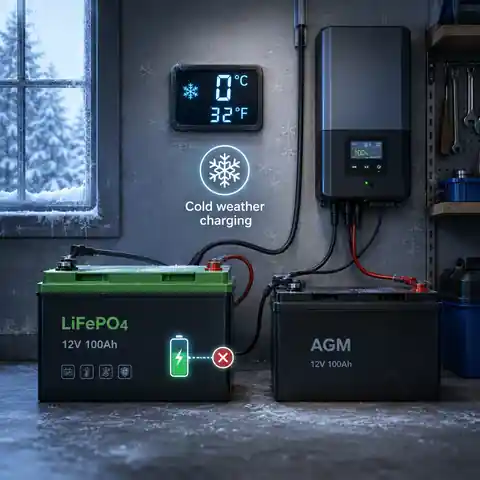
Many LiFePO4 batteries can discharge below freezing, but their charging limit may be 0°C / 32°F, +5°C / 41°F or another value set by the manufacturer.
A low-temperature BMS cut-off prevents charging when the cells are too cold. A heated battery may warm itself before accepting charge, but the heater also consumes energy and has installation requirements.
AGM can often be charged in colder conditions with the correct temperature-compensated profile, although available capacity still falls as temperature drops.
For an unheated space, consider the coldest battery temperature rather than the average room temperature. A charger may start automatically early in the morning when the cells are colder than the surrounding air. A temperature sensor should represent the battery, not a warm inverter mounted above it.
Heat is also harmful. High temperatures accelerate ageing in both chemistries. Do not place a battery beside a boiler, radiator, hot inverter exhaust or in a sealed sun-heated cabinet. Follow the specified operating and storage temperature range and provide the ventilation or clearances required by the manufacturer.
Safety and installation: different risks, same need for care
AGM and LiFePO4 fail in different ways, but neither is a harmless box of stored electricity. A short circuit across either battery can produce destructive current. Protection must be selected for the battery system voltage, prospective fault current, cable size and connected equipment.
Installation concerns by chemistry
| Concern | AGM | LiFePO4 |
|---|---|---|
| Gas and ventilation | VRLA batteries recombine most gas in normal operation but can vent under overcharge, heat or failure; follow ventilation instructions | Does not produce hydrogen as part of normal charging, but enclosure and fire-safety requirements still apply |
| Battery protection | Charger controls and external protection are essential | A suitable BMS is essential in addition to external fuse and disconnect protection |
| Electrolyte or cell damage | Contains lead and sulfuric acid; damaged cases require careful handling | Damaged, swollen, overheated or water-affected packs must be isolated and assessed according to manufacturer guidance |
| Short-circuit current | Very high | Very high |
| Installation position | Follow the product's permitted orientation and mounting instructions | Secure the pack as specified and protect terminals from mechanical damage |
| Series and parallel use | Use matched batteries of the same model, age and state of charge | Only connect in series or parallel when the manufacturer permits it and follow balancing and BMS rules |
| End-of-life handling | Widely recycled through established lead-acid battery systems | Use an approved lithium-battery collection or recycling route |
- Install a correctly rated fuse or circuit breaker close to the battery positive connection where the system design requires it.
- Use cables, lugs, busbars and disconnects rated for the expected continuous current and fault conditions.
- Protect terminals from tools, jewellery and loose conductive objects.
- Do not place the battery where water, condensation, direct heat or physical impact is likely.
- Do not mix AGM and LiFePO4 in one battery bank.
- Do not mix old and new batteries, different capacities or unrelated models unless the manufacturer provides a specific method.
- Stop using a battery that is swollen, cracked, leaking, unusually hot, giving off an abnormal smell or repeatedly triggering protection.
- Use equipment with appropriate certification or conformity for the country where it is installed.
A complete home battery system connected to fixed wiring, a distribution panel, breaker box or consumer unit is not the same as plugging a small UPS into an appliance. Isolation, earthing, transfer switching, neutral arrangements and local approval may require a qualified electrician or system designer.
Weight and space become part of the electrical decision
A typical 100Ah AGM battery can weigh around 25–32kg (55–71lb), although products vary. A 100Ah LiFePO4 battery is often much lighter. The difference becomes important when the bank must be carried upstairs, placed on shelving, installed in a mobile cabinet or expanded to provide several kilowatt-hours of usable energy.
Do not use a shelf rating based only on one battery. Include every battery, enclosure, inverter, charger and cable, and consider whether the structure can support that concentrated load. Heavy lead-acid batteries also require a safe lifting plan and secure placement where they cannot tip or slide.
Purchase price and lifetime cost answer different questions
AGM usually wins the first invoice. LiFePO4 often wins the cost-per-cycle calculation. Neither result automatically identifies the better purchase because a rarely used battery may age before its cycle potential is consumed, while a frequently used AGM battery may need replacement several times.
A useful comparison is: purchase and installation cost ÷ expected usable energy per cycle ÷ realistic number of cycles in your application
Can a battery that costs 2.5 times more still have a lower lifetime energy cost?
Answer: Yes, when it provides more usable energy per cycle and completes many more cycles.
Explanation: Imagine an AGM option with a cost index of 1, about 0.6kWh usable per cycle and 600 cycles, compared with a LiFePO4 option costing 2.5, providing about 1.15kWh usable per cycle and completing 3,000 cycles. The simplified lifetime-energy index is 1 ÷ (0.6 × 600) for AGM and 2.5 ÷ (1.15 × 3,000) for LiFePO4. The lithium result is lower, but only if the system actually reaches a substantial part of that cycle life. This example is not a product guarantee and excludes installation, degradation, financing and replacement labour.
Which battery fits your home backup scenario?
Practical choice by type of use
| Home backup situation | Likely better starting point | Reason |
|---|---|---|
| A small UPS runs a router and ONT during a few outages each year | AGM or the original approved UPS battery | Low cycle count and direct compatibility may matter more than weight or maximum cycle life |
| A refrigerator, internet equipment and lights are backed up during frequent outages | LiFePO4 | More usable capacity, better high-current behaviour and faster recovery can be valuable |
| The battery is charged by solar and cycled most days | LiFePO4 | Partial-state operation, efficiency and cycle life strongly affect long-term performance |
| The battery sits in an unheated detached garage below freezing | AGM, or heated/low-temperature-protected LiFePO4 after a proper design review | Cold charging is the deciding issue |
| An existing UPS has fixed AGM charging and no lithium approval | AGM | A same-chemistry replacement is less likely to conflict with the charger and protection logic |
| The battery must be carried upstairs or mounted where weight is limited | LiFePO4 | Substantially lower mass for a similar usable energy target |
| The system is needed for one short emergency season on a strict budget | AGM may be adequate | The higher lithium cycle potential may not recover its purchase cost |
| Outages can repeat before the battery has fully recharged | LiFePO4 with a compatible high-current charger | Faster charge acceptance can restore useful capacity sooner |
| A large 12V inverter must support high continuous power | Often LiFePO4, but consider moving to 24V or 48V | BMS, current and cable limits still need careful design |
Ten questions to answer before buying
- Which devices must remain powered, and what are their running watts and startup surge?
- How many hours of backup are genuinely required?
- How often do outages occur, and could the battery be cycled daily?
- What usable depth of discharge does the specific battery manufacturer allow for the desired service life?
- What continuous and peak current can the battery and its BMS provide?
- Can the inverter, UPS, solar controller or charger use the exact required charging profile?
- What is the lowest and highest battery temperature during charging and discharge?
- Will the installation location support the battery weight and required clearances?
- What fuse, disconnect, cable and enclosure are required for the prospective fault current?
- What warranty, cycle conditions, certification, service support and recycling route are available?
When comparing quotations, ask suppliers to state the usable battery energy, continuous output current, permitted temperature range and expected cycle conditions in writing. A quotation that lists only volts and amp-hours leaves out several of the factors that determine whether the system will work as expected.
Where AGM-to-lithium comparisons go wrong
Shortcuts that lead to the wrong battery choice
| Shortcut | Why it fails | What to verify instead |
|---|---|---|
| Replacing AGM with LiFePO4 without checking the charger | Incorrect charge stages, BMS trips or reduced battery life | Confirm written compatibility and use the specified lithium profile |
| Comparing only amp-hours | Runtime expectations can be wrong by a large margin | Compare usable watt-hours after discharge limits and inverter losses |
| Choosing a battery only by cycle count | The current limit, warranty or cold-weather behaviour may not suit the system | Compare the complete datasheet and actual operating conditions |
| Assuming every LiFePO4 battery can be connected in series | BMS damage or unsafe operation | Use only configurations specifically allowed by the manufacturer |
| Keeping AGM partially charged after every outage | Sulfation and early capacity loss | Provide enough charger capacity and time for a proper full recharge |
| Charging cold LiFePO4 cells because the room is above freezing | Cell temperature may still be below the safe charging limit | Use battery-temperature protection or a correctly designed heated installation |
| Sizing a 12V battery for a large inverter without checking current | Voltage drop, hot cables, nuisance shutdowns or damaged connections | Calculate DC current and consider a higher system voltage |
| Relying on the BMS instead of a fuse | A cable fault may not be cleared safely | Use external overcurrent protection selected for the system |
Continue planning the backup system
How Long Will a 100Ah Battery Last? 12V Runtime ChartWhat Size Battery Backup Do I Need? Home Sizing GuideBattery Backup for a Wi-Fi Router and ONT: Runtime GuideFrequently asked questions
Is a 100Ah LiFePO4 battery equivalent to a 200Ah AGM battery?
It can be close in usable energy under common planning assumptions, but it is not an exact equivalence. A 12.8V 100Ah LiFePO4 battery used to 90% provides about 1.15kWh before inverter losses. A 12V 200Ah AGM bank used to 50% provides about 1.2kWh. High discharge current, temperature, battery age and voltage cut-off can reduce the AGM result more noticeably.
Which battery lasts longer during a power outage?
For the same nominal amp-hour rating, LiFePO4 usually provides longer runtime because more of its stored energy is usable and it maintains voltage better under load. Compare watt-hours, permitted depth of discharge, BMS current and inverter efficiency for the actual products.
Can AGM batteries be discharged below 50%?
Many AGM batteries can physically be discharged deeper, and some are rated for deep cycling. The 50% figure is a common planning choice intended to balance usable energy and service life, not a universal hard cut-off. Use the manufacturer's cycle-life data at different depths of discharge.
Can LiFePO4 be discharged to 100%?
Some batteries permit the full rated capacity to be used, while others recommend retaining a reserve or already hide a reserve through the BMS. Repeated operation at protection cut-off can also leave no margin for surge or unexpected load. Follow the specified depth of discharge and low-voltage settings.
Does LiFePO4 need ventilation?
LiFePO4 does not normally generate hydrogen during charging as lead-acid batteries can, but that does not mean it can be placed anywhere. The battery, BMS, inverter and charger still have temperature, clearance, enclosure and fire-safety requirements. Follow the complete system instructions and local rules.
Is AGM safer than LiFePO4?
The risks are different rather than absent. AGM contains lead and acid and can vent gas under abnormal charging. LiFePO4 is considered a thermally stable lithium chemistry, but a damaged, poorly manufactured or incorrectly installed pack can still overheat or fail. Product quality, protection, certification and installation are more useful safety questions than a one-word chemistry comparison.
Which battery is better for a solar backup system?
LiFePO4 is usually better suited to frequent solar cycling because it is efficient, accepts partial charging well and offers high cycle life. AGM can still suit a small, low-cost system that is rarely discharged, provided it receives regular full charging and the solar controller uses the correct AGM profile.
How long can an AGM battery remain on a UPS charger?
An AGM battery designed for standby service can remain connected to a correctly configured float charger, but heat and excessive float voltage shorten its life. Follow the UPS and battery replacement schedule, inspect for swelling or heat and test runtime periodically.
Choose for the way the battery will actually be used
AGM is often the sensible answer for a low-cost standby system that is used rarely, already has an AGM-compatible UPS and may operate in cold conditions. LiFePO4 is usually the stronger long-term choice for frequent outages, daily cycling, long runtime, fast recharge and installations where weight or space matters.
Do not choose from chemistry alone. Start with the essential loads and required hours, calculate battery-side current, compare usable watt-hours, then verify charging, temperature, BMS, protection and installation requirements. The best battery is the one that fits the complete backup system and the way your home will actually use it.