
In this guide
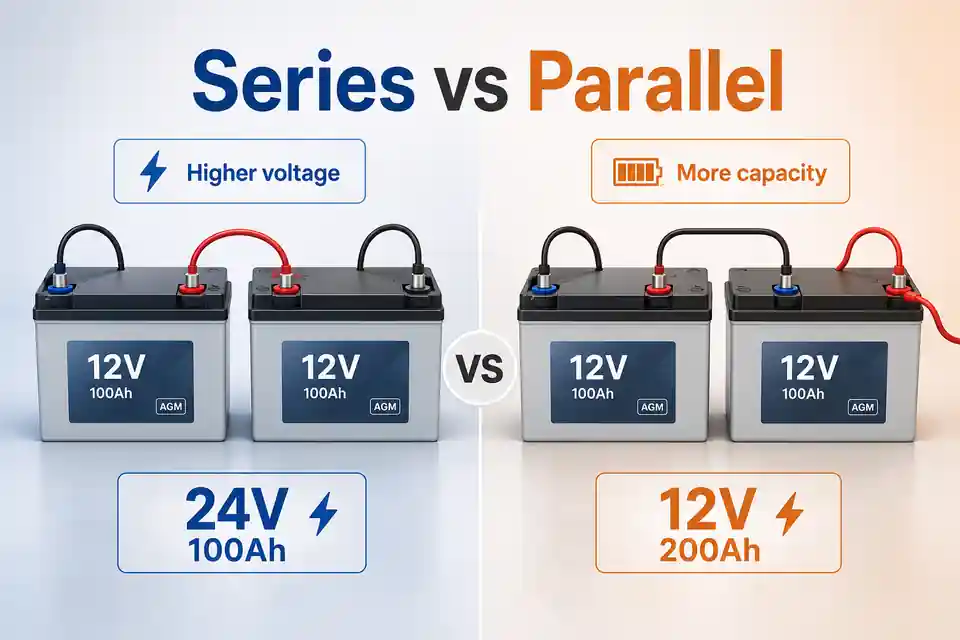
Connecting batteries in series or parallel can use the same number of batteries to create very different systems. A series connection raises the bank voltage. A parallel connection keeps the voltage the same but increases the amp-hour capacity. A series-parallel bank does both.
The arithmetic is simple. The practical decision is not. The inverter, charger, battery management system, cables, fuses or circuit breakers, battery age and the manufacturer's connection limits all have to suit the finished bank. A configuration that looks correct on paper can still produce uneven current sharing, early shutdown or damaged equipment if those details are ignored.
This guide is for preliminary planning and comparison. Follow the battery, inverter and charger manufacturers' instructions. Connection limits, cable sizes, protective devices, ventilation, grounding or earthing arrangements and installation rules depend on the equipment and local requirements. High-current, multi-battery or permanently installed systems should be designed or checked by a qualified specialist.
Series vs parallel: the difference in one minute
What changes when identical batteries are connected together
| Connection | Bank voltage | Bank capacity in Ah | Typical reason for using it |
|---|---|---|---|
| Series | Battery voltages are added | Stays the same as one battery | To build a higher-voltage bank such as 24V or 48V |
| Parallel | Stays the same as one battery | Battery amp-hours are added | To increase stored energy while keeping the same system voltage |
| Series-parallel | Voltage is increased by each series string | Capacity is increased by adding matching strings in parallel | To increase both voltage and total capacity |
What happens when two identical 12V 100Ah batteries are connected in series or parallel?
Answer: In series, they form a 24V 100Ah bank. In parallel, they form a 12V 200Ah bank. In both cases, the nominal stored energy is approximately 2,400Wh.
Explanation: Series adds voltage: 12V + 12V = 24V, while capacity remains 100Ah. Parallel keeps the voltage at 12V and adds capacity: 100Ah + 100Ah = 200Ah. Energy is voltage multiplied by amp-hours, so 24V × 100Ah and 12V × 200Ah both equal 2,400Wh.
What changes—and what does not
People often compare series and parallel as though one configuration creates more energy than the other. It does not. If the same identical batteries are used, the nominal watt-hours remain approximately the same. The connection changes how that energy is delivered: at a higher voltage and lower current, or at a lower voltage and higher current.
Battery-bank energy (Wh) = bank voltage (V) × bank capacity (Ah)

Two 12V 100Ah batteries in series:
24V × 100Ah = 2,400Wh

Two 12V 100Ah batteries in parallel:
12V × 200Ah = 2,400Wh
When comparing battery banks, use watt-hours or kilowatt-hours for stored energy. Amp-hours only make sense when the system voltage is also known.
The same batteries can build two very different systems
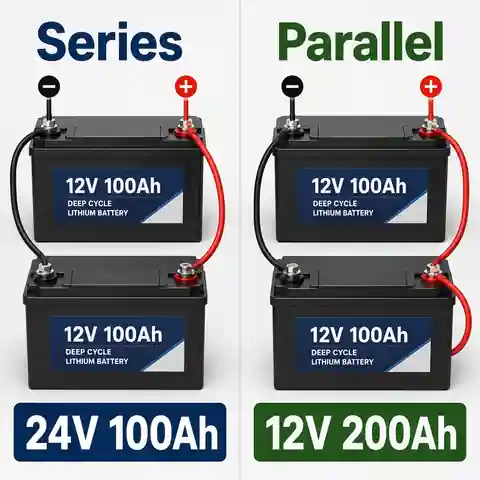
A 24V 100Ah series bank and a 12V 200Ah parallel bank contain roughly the same nominal energy.
The 24V bank can supply the same power at about half the current of the 12V bank, before allowing for conversion losses.
The inverter and charger must match the completed bank voltage. They are not selected from the label on one individual battery.
Batteries connected in series
In a series connection, the positive terminal of one battery is connected to the negative terminal of the next. The remaining free positive and negative terminals become the output of the complete bank. Current passes through every battery in the string.
- The battery voltages are added together.
- The amp-hour rating remains the same as one battery in the string.
- Every battery carries the same series current.
- The weakest or least-charged battery can limit the usable performance of the whole string.
- The charger, inverter and connected DC equipment must suit the total series voltage.
- A 12V accessory should not be powered from only one battery in a 24V or 48V string unless the system is specifically designed with an appropriate converter or balancing arrangement.
Series bank voltage = V1 + V2 + V3 + ...
Series bank capacity (Ah) = capacity of one matched battery

Example:
4 × 12V 100Ah batteries in series = 48V 100Ah
Nominal energy = 48V × 100Ah = 4,800Wh
Why a higher battery-bank voltage can help
For a given power level, raising the battery-bank voltage reduces the approximate DC current. Lower current can reduce voltage drop and cable heating and may make high-power systems more practical. It does not remove the need for correctly sized conductors and protection, and it does not make a 48V system automatically safer or simpler.
Approximate current for a 2,000W DC load before losses
| Nominal bank voltage | Approximate current | What this illustrates |
|---|---|---|
| 12V | About 167A | Very high current, with demanding cable and connection requirements |
| 24V | About 83A | Approximately half the current of a 12V bank |
| 48V | About 42A | Approximately one quarter of the current of a 12V bank |
The real battery current will normally be higher when an inverter is supplying a 2,000W AC load because inverter losses and system overhead must also be supplied. Nominal labels such as 12V, 24V and 48V are planning categories; actual operating voltage depends on battery chemistry, state of charge and equipment settings.
Never connect a 12V inverter or charger to a 24V or 48V battery bank. Matching connectors do not mean matching voltage. Overvoltage can damage equipment and create a serious fault.
Batteries connected in parallel
In a parallel connection, all positive terminals are connected together and all negative terminals are connected together. The bank voltage remains the same as one battery, while the nominal amp-hour capacity is the sum of the connected batteries.
- The bank voltage remains unchanged.
- The amp-hour capacities are added together when the batteries are compatible and equally rated.
- The available stored energy increases as batteries are added.
- Current should be shared between the parallel batteries, but cable resistance and connection layout can make that sharing unequal.
- The charger must match the bank voltage and be suitable for the total battery capacity and chemistry.
- Maximum charge and discharge current may increase, but only within the limits stated for each battery, BMS, cable, busbar and protective device.
Parallel bank voltage = voltage of one matched battery
Parallel bank capacity (Ah) = Ah1 + Ah2 + Ah3 + ...

Example:
4 × 12V 100Ah batteries in parallel = 12V 400Ah
Nominal energy = 12V × 400Ah = 4,800Wh
Parallel batteries should see similar current paths
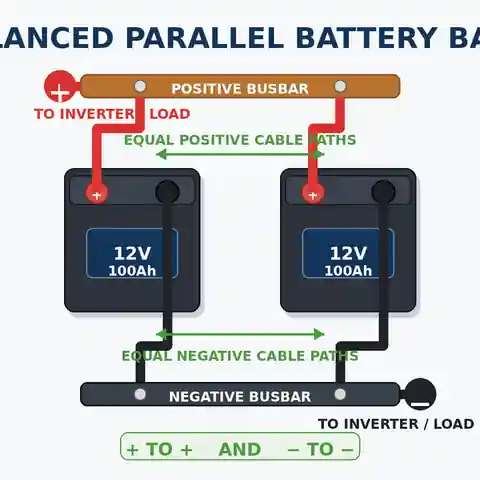
A battery connected through a shorter or lower-resistance path may carry more of the load and receive more charging current.
For two batteries, an opposite-end or diagonal connection is often used to improve sharing. Larger banks commonly use properly rated busbars and equal-length battery leads.
Connection quality matters as much as nominal cable size. Loose, corroded or poorly crimped terminals add resistance and heat.
Parallel connection is not simply a matter of adding another positive and negative cable wherever there is space. The current path from each battery to the common load and charger should be considered as a complete circuit. A neat-looking bank can still be electrically unbalanced if one battery has a much easier path than the others.
Do not place batteries with significantly different voltages or states of charge directly in parallel. The higher-voltage battery may drive a very large equalisation current into the lower-voltage battery. Charge, inspect and prepare batteries according to the manufacturer's instructions before interconnection.
Series-parallel battery banks
A series-parallel bank uses matched series strings connected in parallel. This can create the required system voltage while also increasing total capacity. The strings should have the same number and type of batteries, the same nominal voltage and capacity, and closely matched condition and state of charge.
How can four identical 12V 100Ah batteries form a 24V 200Ah bank?
Answer: Connect two batteries in series to create one 24V 100Ah string. Build a second identical 24V 100Ah string. Connect the two completed strings in parallel. The final bank is 24V 200Ah, with approximately 4,800Wh of nominal energy.
Explanation: Each series string raises voltage from 12V to 24V while remaining at 100Ah. Connecting the two matched strings in parallel keeps the bank at 24V and increases capacity from 100Ah to 200Ah. This arrangement is commonly described as 2S2P: two batteries in series and two strings in parallel.
Three ways to configure four identical 12V 100Ah batteries
| Configuration | Resulting bank | Nominal energy | Equipment requirement |
|---|---|---|---|
| 4 in series — 4S | 48V 100Ah | 4,800Wh | 48V-compatible inverter and charger |
| 2 series strings in parallel — 2S2P | 24V 200Ah | 4,800Wh | 24V-compatible inverter and charger |
| 4 in parallel — 4P | 12V 400Ah | 4,800Wh | 12V-compatible inverter and charger, with very high current possible at larger loads |
A 2S2P bank must be treated as two complete strings
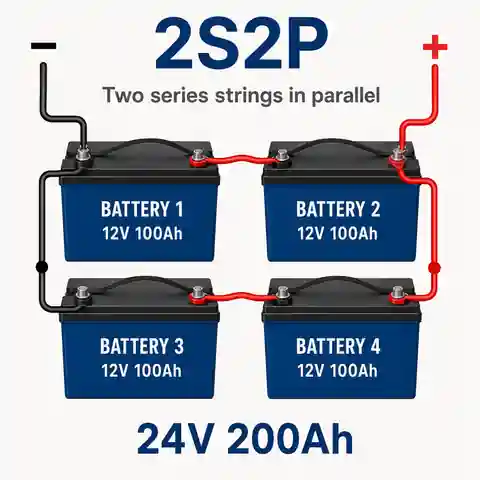
Build and verify each series string before paralleling the strings.
The strings should use matching batteries and similar cable paths to the common positive and negative points.
String-level protection, isolation and monitoring may be required depending on the battery, inverter and installation design.
Which configuration fits your inverter?
The inverter's DC input voltage is the first fixed requirement. If the inverter is designed for a 24V battery bank, the batteries must be arranged to provide the voltage range specified by that inverter. Adding capacity in parallel does not change this voltage. Adding batteries in series does.
How system voltage affects a typical home backup design
| System voltage | Often considered for | Main planning concern |
|---|---|---|
| 12V | Small backup systems, portable setups and modest DC loads | Current becomes very high as inverter power increases |
| 24V | Medium inverter systems and larger battery banks | All batteries, charger and DC accessories must suit a 24V bank |
| 48V | Higher-power inverters and larger stationary systems | Equipment compatibility, isolation, protection and professional design become increasingly important |
There is no universal wattage at which every system should move from 12V to 24V or from 24V to 48V. The decision depends on inverter specifications, cable length, allowable voltage drop, battery current limits, available equipment, future expansion and local installation requirements.
Estimate runtime using the completed battery-bank voltage and capacityCompatibility checks before connecting batteries
Batteries that share a bank should not be chosen only because their labels all say 12V. The internal chemistry, usable voltage range, capacity, age, BMS behaviour and charging requirements can be different even when the nominal voltage looks similar.
- Confirm that the manufacturer permits the intended series, parallel or series-parallel connection.
- Check the maximum permitted number of batteries or strings.
- Use the same battery chemistry, model, nominal voltage and rated capacity wherever possible.
- Avoid mixing new and heavily aged batteries in the same bank.
- Bring batteries to the state of charge or voltage specified by the manufacturer before connecting them.
- Confirm that the inverter and charger voltage ranges match the complete bank.
- Check continuous and surge current limits for every battery and BMS.
- Plan cable size, cable length, busbars, terminals, isolation and protective devices for the possible fault current.
- Confirm whether the batteries require communication cables, a master battery or specific addressing.
- Check temperature, ventilation, spacing, mounting and enclosure requirements.
What should match in a multi-battery bank
| Battery characteristic | Why it matters |
|---|---|
| Chemistry | Different chemistries need different charging voltages and protection |
| Nominal voltage | Parallel batteries must operate at compatible voltages; series equipment must suit the total voltage |
| Capacity and model | Mismatched batteries can reach charge or discharge limits at different times |
| Age and condition | A weaker battery can limit a series string or carry current differently in parallel |
| State of charge | Large differences can create unwanted equalisation current |
| BMS connection limits | Some lithium batteries permit only a stated number in series or parallel, while others prohibit one of these arrangements |
Do not assume that every 'drop-in' lithium battery can be connected in series. Some products are designed only for parallel expansion, some permit a limited series configuration, and some require communication or specific firmware. The product manual is the deciding document.
Lithium batteries, BMS limits and communication
A lithium battery normally includes a battery management system, or BMS, that monitors voltage, current and temperature and can disconnect the battery when a limit is reached. When several batteries are interconnected, the behaviour of one BMS can affect the whole bank.
- In a series string, one battery reaching a high- or low-voltage limit may interrupt current through the entire string.
- In parallel, one battery may disconnect while the remaining batteries continue carrying the load, increasing current through them.
- The combined bank must remain within the inverter's input-voltage range during charging, normal discharge and low-temperature operation.
- Some systems require data communication between batteries and the inverter or charger.
- A BMS current rating is not the same as recommended continuous system power; surge duration, temperature and manufacturer derating still matter.
- Cell balancing inside one battery does not automatically correct unequal current paths between several separate batteries.
Charging a series or parallel battery bank
How the connection changes the charger requirement
| Battery-bank connection | Charger voltage | Capacity consideration |
|---|---|---|
| Series | Must match the full series-bank voltage and battery chemistry | Ah remains the same as one matched battery |
| Parallel | Remains the same nominal voltage as one battery | Total Ah increases, so charging may take longer unless suitable charge current is available |
| Series-parallel | Must match the full series-string voltage | Must also account for the combined capacity of all parallel strings |
A charger should use the charging profile specified for the battery chemistry and complete bank. Too little charge current may simply extend charging time, while excessive current, incorrect voltage or an unsuitable profile can trigger protection or damage batteries. Limits may apply to each battery, each parallel string and the whole bank.
Do not connect a charger, DC load or monitoring device to the midpoint of a series string unless the manufacturer provides a specific design for it. Drawing 12V from one battery in a 24V bank can unbalance the string because one battery is discharged more deeply than the other.
Cable layout can make a parallel bank unequal
Every cable, terminal, fuse, busbar and connection has resistance. In a high-current battery bank, small differences can change how much current each parallel battery supplies. The battery closest to the load should not automatically become the hardest-working member of the bank.
Common parallel-bank layouts
| Layout | Advantage | Potential problem |
|---|---|---|
| Load and charger connected to the same nearest battery | Simple and uses little cable | The nearest battery may carry more current and age faster |
| Opposite-end or diagonal connection for two batteries | Helps make the total current path through each battery more similar | Still depends on matched cables, terminals and battery condition |
| Each battery connected to common busbars | Can provide controlled, similar cable paths and easier isolation | Busbars, protection and cable lengths must be correctly designed and rated |
- Use conductor cross-sectional area in mm² or the appropriate AWG size for the real current, length, temperature and installation method.
- Keep parallel battery leads equal in length and construction where the system design requires equal paths.
- Use properly rated lugs, terminals, busbars and protective devices.
- Follow the specified tightening torque and recheck connections as required by the manufacturer.
- Protect cables against abrasion, movement, accidental short circuit and contact with sharp edges.
- Measure voltage drop and battery current sharing during a controlled test when the system design allows it.
What happens when one battery is weaker?
How a weak or mismatched battery can affect the bank
| Connection | Possible effect |
|---|---|
| Series | The weaker battery may reach low-voltage or high-voltage limits first, reducing the usable capacity of the whole string |
| Parallel | Current may not divide equally; the stronger battery can carry more load while another contributes less or disconnects early |
| Series-parallel | One weak battery can limit its complete series string and create unequal sharing between parallel strings |
A bank monitor may show a normal total voltage while one battery or one string is already outside its healthy operating range. Larger banks may therefore need individual battery, midpoint or string monitoring in addition to a single overall voltage reading. The correct approach depends on battery chemistry and manufacturer guidance.
Common mistakes that cause trouble
- Mixing battery chemistries, capacities, models or very different ages in one bank.
- Connecting parallel batteries before checking and matching their state of charge as instructed.
- Assuming the inverter can accept the higher voltage created by a series connection.
- Using the charger for one 12V battery on a complete 24V or 48V series bank.
- Powering a 12V load from the midpoint of a 24V bank and gradually unbalancing the batteries.
- Daisy-chaining many parallel batteries so the first battery has the shortest current path.
- Assuming parallel batteries will always divide current exactly equally.
- Adding batteries without checking the manufacturer's maximum series or parallel count.
- Sizing cables from average current while ignoring inverter surge and possible fault current.
- Leaving exposed terminals or tools where an accidental short circuit can occur.
- Bypassing a fuse, breaker, isolator, BMS or other protective device because it trips during testing.
- Treating a calculated watt-hour total as proof that the bank can provide the required current.
A safer planning sequence
- List the appliances and determine the realistic continuous and surge power.
- Choose an inverter whose DC input voltage and output characteristics suit the load.
- Estimate the battery energy required for the target runtime.
- Select a battery chemistry and model that permits the required connection.
- Choose series, parallel or series-parallel only after checking voltage, capacity and current limits.
- Confirm the matching charger or inverter-charger and its charge profile.
- Design cables, busbars, isolation and protective devices for normal and fault conditions.
- Prepare and balance batteries as specified before interconnection.
- Have high-current or permanently installed systems checked by a qualified specialist.
- Test the completed bank under a controlled load and confirm temperature, voltage drop, current sharing and protection operation before relying on it.
Frequently asked questions
Can I connect batteries with different amp-hour ratings in series?
It is generally better to use matched batteries. The same current passes through every battery in a series string, but a lower-capacity, older or differently charged battery may reach its limit first and restrict the whole string. Use a mixed arrangement only when the battery manufacturer or a qualified system designer explicitly supports it.
Can I add a new battery in parallel with an old battery?
It may operate, but it is not an ideal bank. The batteries can have different internal resistance, actual capacity and self-discharge. This can create unequal charge and discharge current and may reduce the benefit of the new battery. Check the manufacturer guidance and test the existing battery before planning an expansion.
Do two batteries in parallel provide twice the maximum current?
Not automatically. The theoretical combined current limit may increase when compatible batteries share the load, but actual current is limited by each battery and BMS, current sharing, cables, busbars, fuses, terminals, temperature and the manufacturer's system limits. Do not size an inverter from a simple multiplication alone.
Do two 12V batteries in series make 24V?
Yes, two compatible 12V batteries connected in series form a nominal 24V bank while retaining the amp-hour capacity of one battery. The inverter and charger must be designed for the complete 24V bank, and the batteries must permit series connection.
Can I take 12V from one battery in a 24V series bank?
This should normally be avoided because one battery will support the 12V load while the other will not, causing the string to become unbalanced. Use a properly selected 24V-to-12V DC converter or a manufacturer-approved balancing solution instead.
Is series or parallel better for a home inverter?
Neither is universally better. The inverter's DC input voltage determines the required series arrangement, while the target stored energy may require additional batteries or strings in parallel. Higher bank voltage reduces current for the same power, but the complete equipment set and installation must be designed for that voltage.
Will series and parallel give the same runtime?
With the same identical batteries, the same usable energy and similar conversion efficiency, the theoretical runtime for the same load can be similar because total watt-hours are unchanged. Real results can differ because inverter efficiency, cable losses, current level, battery limits and current sharing change with the configuration.
Choose the bank voltage first, then build capacity around it
Series and parallel are not competing methods. They solve different parts of the same design. Series creates the voltage required by the inverter or DC system. Parallel adds capacity at that voltage. A series-parallel bank combines the two when one string does not store enough energy.
Start with the required load and inverter voltage, then calculate the energy needed for the target runtime. Only after that should you decide how many matched batteries and strings are required. Check the product manuals, connection limits, charging method, BMS behaviour, cable paths and protection before purchasing or interconnecting the bank.
Continue with the practical guide to battery runtime for household appliances