
Battery charging time looks like a simple division problem: take the missing amp-hours and divide them by the charger current. That calculation is useful, but it is only the starting point. A charger may reduce current as the battery approaches full charge, an active load may use part of the available output, and the battery management system may limit charging because of temperature or cell conditions.
Quick answer: a 100Ah battery that is 50% discharged has about 50Ah to replace. With a charger delivering 10A to the battery, the simple estimate is 50Ah ÷ 10A = 5 hours. A full charge usually takes longer, especially for lead-acid batteries, because current reduces during the final charging stage.
Use only a charging profile approved for the battery chemistry, voltage and model. Incorrect charging voltage, excessive current, reversed polarity, damaged wiring or charging outside the permitted temperature range can damage the battery, create fire or gas hazards, and shorten battery life. The battery and charger manuals take priority over general estimates in this guide.
Charging time, without the guesswork
Start with the amp-hours that are actually missing
You do not normally need to replace the battery's entire rated capacity. A 100Ah battery at 70% state of charge has roughly 30Ah missing, while the same battery at 20% state of charge has roughly 80Ah missing. Charging time should therefore start with the amount removed, not automatically with the full number printed on the label.
The four values needed for a first estimate
| Value | What it means | Where to find it |
|---|---|---|
| Battery capacity in Ah | The rated charge capacity of one battery or the complete bank | Battery label or data sheet |
| Starting state of charge | How full the battery is before charging begins | Battery monitor, BMS app, hydrometer where appropriate, or a rested-voltage estimate |
| Charger output current in A | The current the charger can deliver at the battery voltage | Charger output label, display or manual |
| Battery chemistry and charge profile | Determines voltage limits, current limits and how the final stage behaves | Battery and charger manuals |
Simple charging time in hours = battery capacity in Ah × fraction to refill ÷ charger output current in A
How long will a 10A charger take to recharge a 100Ah battery from 50%?
Answer: The simple charging estimate is 5 hours.
Explanation: The battery has about 50Ah to replace: 100Ah × 50% = 50Ah. Then 50Ah ÷ 10A = 5 hours. Treat this as the ideal current-delivery time, not a promise that the charger will declare the battery full after exactly five hours.
This formula works best during the part of the cycle when the charger can maintain nearly constant current. It becomes less exact near full charge, when voltage limits cause the charger to reduce current. It also assumes the charger is not simultaneously powering lights, an inverter, a refrigerator or another load from the same battery system.
Why capacity divided by current is not the whole answer
Charging current does not stay constant all the way to full
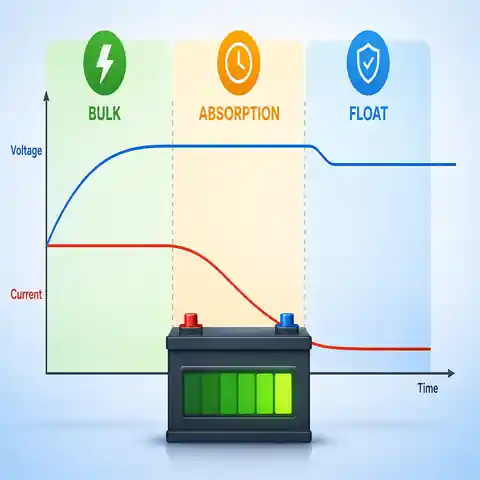
During the bulk stage, a compatible charger usually supplies its allowed current until the battery reaches the target charging voltage.
During absorption, the charger holds voltage while the battery accepts progressively less current. This is why the final part of charging can take longer than the basic Ah calculation suggests.
Float is a maintenance stage used by many lead-acid chargers after the battery is considered charged. LiFePO4 charging behaviour and float requirements depend on the battery and charger design.
For many lead-acid systems, the bulk stage restores most of the removed capacity and the absorption stage completes the charge more slowly. LiFePO4 batteries can usually accept strong current for a larger part of the cycle, so their final constant-voltage period is often shorter, but cell balancing, BMS limits and charger settings can still extend the finish.
What can add time after the simple calculation
| Factor | Why charging slows | Where it matters most |
|---|---|---|
| Absorption stage | Current tapers as the charger holds the target voltage | Flooded lead-acid, AGM and gel batteries |
| Battery efficiency | Some input energy becomes heat or supports chemical processes rather than stored charge | All batteries, especially older or warm lead-acid batteries |
| Active loads | Part of the charger output powers equipment instead of charging the battery | Backup systems, boats, caravans, RVs and off-grid homes |
| Charger derating | The charger reduces output because of temperature, input limits or protective settings | Hot equipment spaces, generators and weak AC supplies |
| BMS control | Charging may pause or reduce while the battery protects cells or balances them | Lithium batteries |
| Cold-temperature protection | Many lithium batteries restrict or stop charging when the cells are too cold | Unheated outdoor or vehicle installations |
Use the charger output rating, not the wall-plug current
A charger normally has separate input and output ratings. The input may say 120V or 230V AC and show the current drawn from the wall. The output may say 14.4V DC, 20A. For an amp-hour charging-time estimate, use the DC output current delivered to the battery, not the AC input current.
- AC input tells you what the charger takes from the mains or generator. It is useful for supply planning, but it is not the charging current used in the Ah formula.
- DC output tells you the battery voltage profile and maximum charging current. A label such as 14.4V DC, 20A describes a nominal 12V battery charger with up to 20A output.
- A configurable inverter-charger may have a higher maximum rating but a lower current limit selected in its settings. Use the configured or measured value.
A charger says 230V AC, 2A input and 14.4V DC, 20A output. Which current belongs in the charging formula?
Answer: Use 20A, provided the charger is actually configured and able to deliver that output.
Explanation: The 2A figure describes current on the mains side at a much higher voltage. The 20A figure is the maximum DC current supplied to the battery. Actual current may still be lower because of charger settings, temperature, battery state or an input-power limit.
Ideal charging-time table for missing capacity
The table below starts with the amp-hours that need to be replaced. It can be used for a small battery or a large bank as long as the charger current and battery-bank capacity are expressed at the same system voltage.
Simple time before tapering, losses and active loads
| Capacity to replace | 5A charger | 10A charger | 20A charger | 50A charger |
|---|---|---|---|---|
| 10Ah | 2 h | 1 h | 0.5 h | 0.2 h |
| 25Ah | 5 h | 2.5 h | 1.25 h | 0.5 h |
| 50Ah | 10 h | 5 h | 2.5 h | 1 h |
| 80Ah | 16 h | 8 h | 4 h | 1.6 h |
| 100Ah | 20 h | 10 h | 5 h | 2 h |
| 200Ah | 40 h | 20 h | 10 h | 4 h |
These are ideal current-delivery times. Do not add a universal fixed percentage for every battery. The extra time depends on chemistry, charger logic, temperature, battery age, active loads and how the charger defines full charge.
Example: a 100Ah AGM battery at 50% state of charge
How long will a 10A charger take to fully charge a 100Ah AGM battery from 50%?
Answer: Five hours is the simple bulk estimate, but reaching a confirmed full charge will take longer.
Explanation: About 50Ah must be replaced. Dividing by 10A gives five hours, but an AGM charger normally reduces current during absorption. The remaining time depends on the battery's approved voltage settings, condition, temperature and the charger's termination logic. Use the manufacturer's charge table when the finish time matters.
Example: a 100Ah LiFePO4 battery at 20% state of charge
How long will a 20A charger take to recharge a 100Ah LiFePO4 battery from 20%?
Answer: The simple estimate is 4 hours, plus any time required by the charger and BMS near full charge.
Explanation: The battery has about 80Ah to replace: 100Ah × 80% = 80Ah. Then 80Ah ÷ 20A = four hours. This assumes the battery permits 20A charging, the charger can sustain 20A, no large load is operating and low-temperature or cell-balancing limits do not reduce current.
Battery chemistry changes the last part of charging
Flooded lead-acid batteries
Flooded lead-acid batteries commonly use bulk, absorption and float stages. They may accept the charger's rated current while deeply discharged, then take progressively less current as they approach full charge. Ventilation, electrolyte level, temperature compensation and the manufacturer's specified finishing current all matter. Equalisation is a separate controlled maintenance process for selected flooded batteries, not a way to make every charge faster.
- Expect the final absorption stage to make full charging slower than the basic Ah calculation.
- Use a ventilated charging location and follow the manufacturer's precautions for gas and electrolyte.
- Do not assume a higher-current charger will always shorten the complete cycle proportionally.
- Do not equalise a battery unless its manufacturer specifically permits the procedure and provides the settings.
AGM and gel batteries
AGM and gel batteries are sealed lead-acid types, but they are not interchangeable charging profiles. Both normally require controlled voltage and an absorption stage. Gel batteries can be particularly sensitive to excessive voltage, while AGM limits vary by product line. Select the exact battery type on a compatible charger and do not use flooded-battery equalisation settings unless the sealed-battery manufacturer explicitly allows them.
LiFePO4 batteries
LiFePO4 batteries often retain a higher charging current until they are close to full, which can make their total charging time more predictable than lead-acid. However, the charger must use a compatible voltage profile, and the battery's BMS may limit current or stop charging because of cell voltage, temperature or imbalance.
- Check the battery's maximum and recommended charge current, not only the BMS maximum rating.
- Confirm that the charger is approved for LiFePO4 or can be configured to the battery manufacturer's settings.
- Allow extra time when a nearly full battery is balancing cells at reduced current.
- A BMS disconnect is protection, not a normal target for ending every charge cycle.
- Do not assume that a lead-acid charger is suitable merely because its connector and nominal voltage match.
Charging LiFePO4 cells when they are too cold can damage them. Many batteries restrict charging around freezing conditions, but the exact threshold and heating behaviour vary. Check the battery manual and BMS status before charging at or below 0°C / 32°F.
How much charger current should you use?
Charge current is often compared with battery capacity using C-rate. For a 100Ah battery, 0.1C is 10A, 0.2C is 20A and 0.5C is 50A. C-rate makes different battery sizes easier to compare, but it is not a universal recommendation. A current that is routine for one LiFePO4 battery may be excessive for a particular lead-acid, gel or small lithium battery.
Charge current expressed as C-rate
| Battery capacity | 0.05C | 0.1C | 0.2C | 0.5C |
|---|---|---|---|---|
| 50Ah | 2.5A | 5A | 10A | 25A |
| 100Ah | 5A | 10A | 20A | 50A |
| 200Ah | 10A | 20A | 40A | 100A |
| 300Ah | 15A | 30A | 60A | 150A |
Do not choose a charger from this C-rate table alone. The safe current is limited by the battery manual, BMS, charger profile, cable size, fusing, connectors, ambient temperature and the capacity of the charging source. A larger charger can require changes throughout the system.
Series and parallel battery banks change the calculation
For batteries in series, voltage increases while amp-hour capacity stays the same. For batteries in parallel, voltage stays the same while amp-hour capacity increases. The charger must match the voltage of the complete bank, and the time calculation must use the bank capacity at that voltage.
How bank arrangement affects a 20A charging estimate
| Battery arrangement | Bank rating | Compatible charger voltage | Time to replace 50% at 20A |
|---|---|---|---|
| One 12V 100Ah battery | 12V 100Ah | 12V battery profile | 2.5 h ideal |
| Two 12V 100Ah batteries in series | 24V 100Ah | 24V battery profile | 2.5 h ideal |
| Two 12V 100Ah batteries in parallel | 12V 200Ah | 12V battery profile | 5 h ideal |
| Four 12V 100Ah batteries in series-parallel | 24V 200Ah | 24V battery profile | 5 h ideal |
A 24V 20A charger transfers about twice the charging power of a 12V 20A charger. The current is the same, but the system voltage is different. This is why charger voltage and current must always be read together.
Charging from mains power, solar panels or a vehicle
AC battery charger
A dedicated AC charger is the easiest source to estimate because it can often maintain its rated output during the bulk stage. Confirm that the available mains or generator supply can support the charger, and check whether a selectable low-current mode or battery-size setting is active.
Inverter-charger
An inverter-charger may share the available AC input between battery charging and connected loads. If a generator or shore-power input limit is set, the charger can reduce battery current whenever appliances use more power. The front-panel maximum therefore may not be the current that reaches the battery throughout the cycle.
Solar charge controller
Solar charging is variable. Panel power changes with sunlight, temperature, shading, panel angle and controller limits. A controller rated at 30A does not necessarily provide 30A all day. For a realistic estimate, use expected daily energy production and subtract daytime loads, rather than multiplying the controller's maximum current by the number of daylight hours.
Solar charging follows the sun, not the controller label
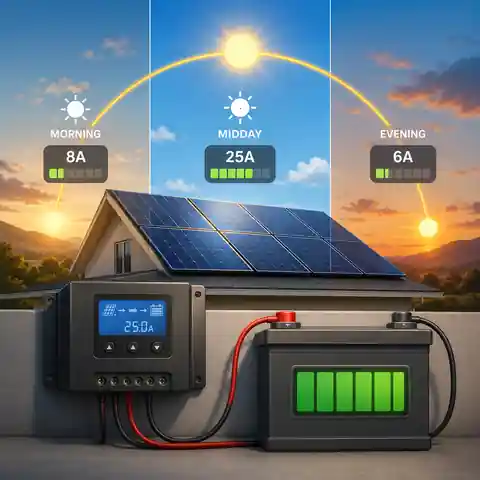
A controller can reach its rated current around strong midday sun, then produce much less in the morning, evening, cloud or partial shade.
Daytime appliances take energy before it reaches the battery, so charger history may show 25A while the battery monitor shows only 16A flowing into storage.
For outage recovery, compare the energy that must be replaced with realistic daily solar harvest. Maximum controller amps are a system limit, not a promise of constant charging.
Can a 30A solar controller replace 90Ah in exactly three hours?
Answer: Only under unusually steady conditions where it delivers close to 30A for the full three hours and no significant loads are using the energy.
Explanation: Cloud, shading, morning and evening sun, hot panels, controller limits and active loads all reduce the average current. Solar charging should be planned from realistic energy harvest, not only the controller's nameplate current.
Vehicle alternator and DC-DC charger
In a vehicle, the useful charging current is normally controlled by a correctly selected DC-DC charger or another manufacturer-approved system. Alternator voltage, smart-alternator behaviour, cable length, engine speed and vehicle loads can change the result. Use the DC-DC charger's delivered output for the estimate, not the alternator's total rated current.
Do not connect a high-capacity lithium battery bank directly to a vehicle alternator unless the vehicle, battery and charging system manufacturers explicitly support that arrangement. Excessive or uncontrolled current can overheat wiring or the alternator and may interfere with vehicle electronics.
Why charging takes longer than expected
Symptom, likely cause and first check
| What you notice | Possible reason | What to check first |
|---|---|---|
| Current is high at first, then gradually falls | Normal absorption or constant-voltage charging | Charger stage and battery state of charge |
| Charger never reaches its rated output | Low-current mode, AC input limit, temperature derating or weak source | Settings, ventilation and input supply |
| Battery charges slowly while equipment is running | Connected loads are using part of the charger current | Measure net battery current, not only charger output |
| Lithium charging stops when the weather is cold | BMS low-temperature protection | Battery temperature and BMS app or warning indicator |
| Voltage rises quickly but little capacity is restored | High resistance, aged battery, loose connection or undersized cable | Terminal condition, voltage drop and battery health |
| Parallel batteries charge unevenly | Unbalanced cable paths, different batteries or poor connections | Cable layout, terminal voltage and individual battery condition |
| Solar charger repeatedly leaves bulk mode | Changing sunlight or loads are moving the operating point | Solar history, shading and daytime consumption |
| Charger reports full much earlier than expected | Battery was not as discharged as assumed, capacity has declined, or settings are incorrect | State-of-charge calibration, battery capacity test and charge profile |
A practical way to estimate your own charging time
- Identify the exact battery chemistry, nominal voltage and rated capacity.
- Read the battery manual for the approved charge voltage, recommended current, maximum current and temperature limits.
- Determine the starting state of charge as accurately as the system allows.
- Calculate the missing capacity: battery-bank Ah × fraction to refill.
- Find the charger's actual DC output current at the battery voltage and confirm any configured current limit.
- Subtract the average current used by loads that remain active while charging.
- Divide missing amp-hours by the net charging current to estimate the constant-current part of the cycle.
- Allow additional time for absorption, balancing, reduced solar production, thermal derating and other limits that apply to your system.
- Confirm the result with charger history or a battery monitor after several real cycles.
- Stop and investigate if the battery, charger, cables or connectors become unusually hot, smell abnormal, swell or behave inconsistently.
A 200Ah battery bank is at 40% state of charge. A 30A charger is running, while the system has an average 6A DC load. What is the first estimate?
Answer: About 5 hours for the constant-current part of the recharge.
Explanation: The bank is missing about 120Ah: 200Ah × 60% = 120Ah. Net battery current is approximately 24A: 30A charger output minus 6A load. Then 120Ah ÷ 24A = 5 hours. Add chemistry-specific finishing time and any period when the charger cannot maintain 30A.
When the estimate should be checked by a specialist
A basic calculation is useful for planning a replacement charger or estimating outage recovery time. It is not a substitute for system design when charging current is high, batteries are permanently installed, several charge sources operate together or the installation forms part of a home's fixed electrical system.
- The charger requires new fixed AC wiring, a larger circuit or changes inside an electrical panel, breaker box or consumer unit.
- Battery charging current is being increased substantially and cable, fuse or connector ratings are uncertain.
- The bank contains many batteries in parallel or a high-voltage series arrangement.
- Lithium batteries, an inverter-charger, solar controller and generator must communicate or coordinate charge limits.
- The battery repeatedly trips its BMS, overheats, swells, vents, smells unusual or shows damaged terminals.
- A flooded battery uses electrolyte faster than expected or needs frequent equalisation.
- The equipment supplies essential heating, medical, communications or safety systems where an incorrect estimate has serious consequences.
Local electrical rules, battery-location requirements, ventilation, overcurrent protection and permitted wiring methods vary by country and installation. Have fixed or high-power work checked by a suitably qualified person and follow the instructions supplied with every component.
Related battery guides
Battery Charge Time Calculator — Ah, Amps and State of ChargeHow Long Will a 100Ah Battery Last? Runtime Formula, Examples and CalculatorWhat Size Battery Backup Do I Need? Home Sizing GuideHow to Calculate Battery Runtime With an Inverter: Formula, Efficiency and ExamplesFrequently asked questions
How long does a 10A charger take to charge a 100Ah battery?
From completely empty, the simple calculation is ten hours. From 50% state of charge, it is five hours. Real full-charge time is longer when current tapers, the charger powers an active load, or the battery requires an extended absorption stage. Battery manufacturers often discourage routine complete discharge, so calculate from the actual starting state rather than assuming 0%.
Can I use a 20A charger on a 100Ah battery?
A 20A charger represents 0.2C for a 100Ah battery. That may be suitable for many batteries, but it is not automatically safe for every flooded, AGM, gel or lithium model. Check the battery's recommended and maximum charge current, the charger's voltage profile, cable and fuse ratings, and temperature limits.
Why does the charger reduce amps before the battery is full?
The charger may have reached its target voltage and entered absorption or constant-voltage mode. It then reduces current as the battery accepts less. Current can also fall because of charger temperature, an input-power limit, BMS control or a battery that is cold, imbalanced or showing high resistance.
Can I use the battery while it is charging?
Many properly designed backup and off-grid systems power loads while charging, but the loads reduce the net current available to the battery. If a 20A charger supports a 7A load, the battery receives roughly 13A before other losses. Confirm that the equipment is designed for simultaneous charging and use, and do not improvise connections around the charger or BMS.
Does a larger charger always charge the battery proportionally faster?
Only while the battery, charger and source can accept the higher current. Doubling current may nearly halve the bulk-stage time, but it does not necessarily halve absorption time. The battery or BMS may impose a lower limit, and the larger charger may derate because of heat or restricted input power.
Is the float stage included in charging time?
For a lead-acid charger, the battery is normally considered charged before or when the charger enters float. Float then maintains the battery against self-discharge and small standby loads. It should not be added as a fixed number of hours to every charging-time calculation. Lithium float behaviour depends on the battery and charger manufacturer's instructions.
The realistic answer
To estimate battery charging time, calculate the amp-hours that are missing and divide by the net current reaching the battery. That gives a clear first answer and makes it easy to compare a 5A, 10A, 20A or 50A charger. Then adjust your expectations for the part that simple division cannot describe: absorption, cell balancing, active loads, changing solar output, temperature limits and charger protection.
The fastest charger is not automatically the best charger. A well-matched unit follows the correct chemistry profile, stays within the battery's approved current, works with the wiring and protection, and has enough input power to deliver its rating. Use the formula for planning, but use the battery and charger manuals to decide what the system is actually allowed to do.