
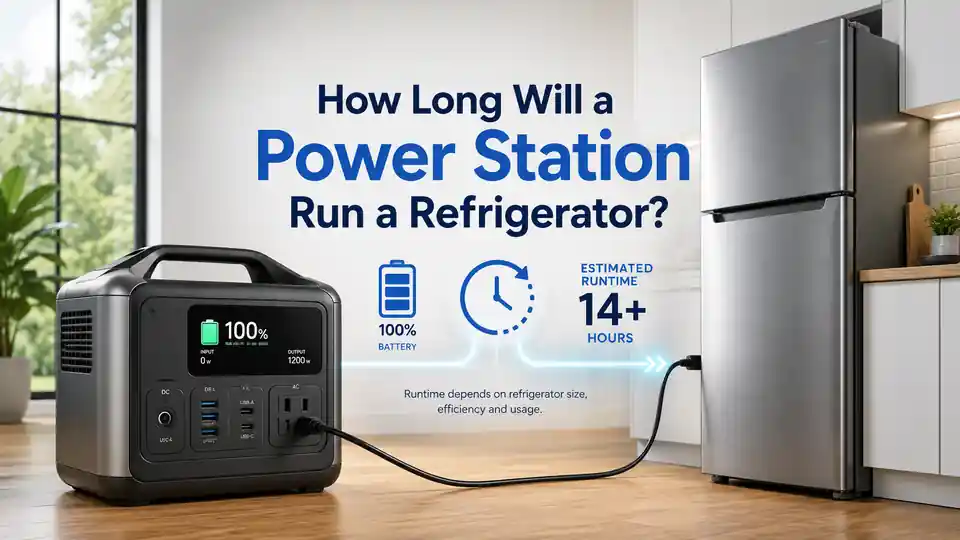
A portable power station may run a refrigerator for a few hours, overnight or for more than a day. The answer cannot be taken from the refrigerator's running watts or the station's advertised watt-hours alone. Refrigerators cycle on and off, may use extra power for defrosting, and briefly demand more power when the compressor starts. The power station also loses some stored energy through its inverter and internal electronics.
A useful first estimate is: power station runtime = usable AC energy ÷ the refrigerator's average power over time. Then make a separate check that the station can handle compressor startup, defrost demand and any other connected loads.
Illustrative refrigerator runtime from a power station
| Power station rating | Fridge uses 0.6 kWh/day | Fridge uses 1.0 kWh/day | Fridge uses 1.5 kWh/day |
|---|---|---|---|
| 300 Wh | About 10 hours | About 6 hours | About 4 hours |
| 500 Wh | About 17 hours | About 10 hours | About 7 hours |
| 1,000 Wh | About 34 hours | About 20 hours | About 14 hours |
| 1,500 Wh | About 51 hours | About 31 hours | About 20 hours |
| 2,000 Wh | About 68 hours | About 41 hours | About 27 hours |
The table assumes that 85% of the station's labelled capacity reaches the refrigerator through the AC output. It is a comparison chart, not a promise for a particular model. Actual usable energy can be higher or lower, especially at light loads, in cold or hot conditions, with an ageing battery, or when the station's AC inverter remains active while the compressor is off.
In this guide
The two checks that answer the question
A power station has an energy limit and a power limit. They are related, but they answer different questions. Confusing them is the main reason refrigerator backup estimates go wrong.
Capacity and output are not interchangeable
| Specification | Usually shown as | What it tells you |
|---|---|---|
| Battery energy capacity | Wh or kWh | Approximately how much energy is stored and therefore how long the refrigerator may operate |
| Continuous AC output | W or kW | Whether the station can supply the refrigerator and any other loads while they are running |
| Surge or peak output | W or kW for a stated time | Whether the station can support the brief starting demand of the compressor |
| AC output voltage and frequency | V and Hz | Whether the electrical supply matches the refrigerator's requirements |
A 1,000 W station is not necessarily a 1,000 Wh station. One rating describes how much power can be delivered at a moment; the other describes stored energy. A station could have enough inverter output to start the refrigerator but too little capacity to run it through the night. Another could store plenty of energy but shut down every time the compressor attempts to start.
Check the separate startup question: What Size Inverter Do I Need for a Refrigerator?Estimate continuous load, startup surge and inverter outputWhy the refrigerator's running watts do not give the runtime
For runtime, use energy measured over time: Wh over several hours, kWh per day or kWh per year. Use instantaneous watts mainly to check running load, startup and the effect of additional appliances.
Find the refrigerator's energy use before calculating
There are four useful ways to obtain a refrigerator energy figure. They are not equally accurate, but each can produce a better estimate than guessing from cabinet size or one momentary watt reading.
Ways to estimate refrigerator energy consumption
| Source | How to use it | Main limitation |
|---|---|---|
| Annual energy label or product sheet | Divide annual kWh by 365 to estimate kWh per day | The figure comes from standard test conditions and may not match your room temperature, settings or use |
| Plug-in energy meter | Measure kWh for at least 24 hours, preferably several normal days | A short test may miss defrost cycles, unusually warm weather or recent loading |
| Power station app or display | Record energy delivered during a controlled test rather than looking only at current watts | Some displays round small loads or report battery-side and output-side energy differently |
| Running watts and duty-cycle estimate | Multiply running watts by the approximate fraction of time the compressor operates | The duty cycle is difficult to guess and does not fully include defrosting, fans or station self-consumption |
When using an annual label, convert the figure carefully. A refrigerator listed at 365 kWh per year is approximately 1 kWh per day under the label's test method. That equals an average of about 41.7 W over 24 hours, even though the appliance may draw much more than 41.7 W whenever the compressor is actually running.
Do not treat annual label consumption as a worst-case figure. Hot weather, poor ventilation, frequent door opening, warm food, colder settings, ice production, ageing seals and defrost behaviour can all increase real energy use.
The practical power station runtime formula
If the refrigerator's average power is known, use: runtime in hours = power station capacity in Wh × AC delivery factor ÷ average refrigerator power in W. If daily refrigerator energy is known, use: runtime in hours = power station capacity in Wh × AC delivery factor × 24 ÷ refrigerator energy in Wh per day.
The AC delivery factor combines the energy that the power station allows you to use with conversion losses and internal consumption. Use the manufacturer's tested usable AC energy when available. Otherwise, a planning assumption such as 0.80 to 0.90 can be used for comparison, but it should not be presented as a guaranteed efficiency for every load or every station.
How long could a 1,024 Wh power station run a refrigerator rated at 365 kWh per year?
Answer: The label figure is approximately 1,000 Wh per day. Assuming 85% of the station capacity is delivered through the AC output, usable energy is 1,024 × 0.85 = 870 Wh. Estimated runtime is 870 × 24 ÷ 1,000 = about 20.9 hours.
Explanation: This calculation uses energy over time, so it already allows for the compressor cycling under the label's test conditions. It still does not guarantee startup compatibility, and real runtime may change with room temperature, door openings, defrost cycles, other connected loads and the station's own consumption.
For a conservative purchase comparison, repeat the calculation with a higher refrigerator energy figure and a lower AC delivery factor. For example, compare the result at 1.0 kWh/day and 1.3 kWh/day, or at 85% and 75% delivered energy. A range is more useful than one precise-looking answer when the appliance has not been measured.
Build a refrigerator and essential-load backup scenarioSee the full battery-runtime method, efficiency assumptions and worked examplesUsing a separate battery and inverter? Compare battery voltage, Ah, chemistry and usable depth of dischargeWhat a 500 Wh, 1 kWh or 2 kWh station may mean in practice
Capacity classes are useful for creating a shortlist, but not for declaring that one size always runs a refrigerator for a fixed number of hours. The same 1 kWh station can produce very different results with an efficient small fridge, an older refrigerator-freezer in a hot room or a model that frequently defrosts and makes ice.
How to interpret common power station sizes
| Capacity class | What it may cover | What to verify before relying on it |
|---|---|---|
| Around 300–500 Wh | Several hours to part of a day for many refrigerator scenarios | Compressor startup, low-capacity margin and whether the outage may exceed the estimate |
| Around 700–1,000 Wh | Often a useful overnight or near-day comparison range | Actual daily kWh, usable AC energy, defrost demand and any router or lighting loads added to the station |
| Around 1.5–2 kWh | Potentially more than a day for lower-energy refrigerators or roughly a day for demanding scenarios | Recharge time, station weight, expansion options and whether other appliances will consume the reserve |
| Expandable systems above 2 kWh | Longer outages or several essential appliances | Combined continuous load, simultaneous startup, charging source, safe distribution and installation scope |
Do not buy from a capacity chart before checking output power. A small station may contain enough watt-hours for the desired runtime but still fail at compressor start. A large station can also be unsuitable if its voltage, frequency, waveform or operating mode is incompatible with the refrigerator.
Why real runtime can be shorter than the calculation
Factors that change refrigerator runtime
| Factor | How it affects the estimate | A better planning response |
|---|---|---|
| Room temperature | A warmer room normally increases compressor operating time | Measure during the season and room conditions in which backup is most important |
| Door opening | Warm humid air enters and must be cooled again | Keep the door closed and organise frequently used items before the outage |
| Warm food or drinks | The refrigerator must remove additional heat | Avoid loading large amounts of warm food during a battery-only period |
| Defrost cycle | A heater may create a higher temporary load and add meaningful energy use | Use a multi-day measurement that is likely to include normal defrost operation |
| Ice maker, water dispenser or anti-condensation heater | Accessories may add intermittent or continuous demand | Disable optional functions only when the appliance manual permits it |
| Power station AC overhead | The inverter and controls consume energy even when the compressor is off | Check no-load consumption and use measured usable AC energy where possible |
| Battery temperature and age | Available energy and output capability may fall | Operate within the stated temperature range and allow for normal ageing |
| Other connected loads | A router, lights or laptop can remove several hours from the refrigerator reserve | Calculate the complete backup group, not the refrigerator in isolation |
Power station efficiency is also load-dependent. A conversion percentage measured near one output level may not describe a refrigerator that spends much of the day with the compressor off. The station's fixed AC overhead becomes more significant at low average loads, which is why a full end-to-end test can differ from a simple capacity multiplied by a headline efficiency figure.
Check ECO mode, automatic shutdown and compressor restart
Some power stations reduce their own consumption by switching off the AC output when the connected load is very low. That can be helpful for many devices, but a refrigerator deliberately falls to a low standby load between compressor cycles. If the station does not detect the controls or cannot wake quickly enough when the compressor requests power, the refrigerator may remain off even though the battery still has charge.
- Check whether AC output has an automatic timeout or minimum-load threshold.
- Find out whether ECO or power-saving mode can be disabled when needed.
- Confirm what happens after an overload: automatic restart, manual reset or AC output remaining off.
- Test several compressor starts, not only the first successful start.
- Allow the refrigerator to reach normal temperature and observe a complete operating cycle.
- Check that the station remains stable when a defrost heater, fan or ice maker operates.
Do not assume that a station is suitable because the refrigerator ran for five minutes. A useful compatibility test includes repeated starts, low-load waiting periods, normal cycling and enough time for other automatic functions to appear.
A safer way to test your actual refrigerator and station
A controlled test is the best way to replace assumptions with model-specific information. It should be planned so that food is not placed at risk and the station is not left in an unsuitable location.
- Read the refrigerator and power station manuals, including voltage, frequency, waveform, grounding or earthing, ventilation and extension-lead rules.
- Charge the station fully and update any settings before the test rather than during an outage.
- Let the refrigerator reach its normal stable temperature on grid power.
- Connect only the refrigerator for the first test so the result is easy to interpret.
- Use a refrigerator thermometer and avoid testing to full depletion with vulnerable perishable food inside.
- Record starting battery percentage, time, displayed watts and, where available, accumulated output energy.
- Observe several compressor starts and confirm that ECO mode does not switch the appliance off between cycles.
- Repeat in warmer conditions or with realistic additional loads if those conditions matter to the backup plan.
- Stop with a practical energy reserve instead of designing normal use around an emergency shutdown at 0%.
How can a partial test estimate full runtime without deliberately draining the station?
Answer: If the refrigerator uses 25% of the station over a representative six-hour test, a simple projection is about 24 hours from 100% to the same lower limit. Apply an additional reserve if the test did not include hot weather, frequent door opening, defrosting or battery ageing.
Explanation: A partial-cycle projection is safer for food and leaves the battery available. It becomes more reliable when the test is long enough to include several compressor cycles and the station percentage display is reasonably calibrated.
Can solar input keep the refrigerator running longer?
Solar panels can extend runtime or recharge the station, but they do not create a fixed number of extra hours. The useful result depends on sunlight, panel orientation, shading, season, temperature, charge-controller limits and how much charging power the station accepts while supplying the refrigerator.
Compare energy, not only panel watts. A 200 W panel does not provide 200 W continuously from sunrise to sunset. The relevant question is whether daily solar energy delivered to the battery is greater than the refrigerator's daily consumption plus conversion and charging losses. Even a balanced daily total may still require enough battery capacity to cover night-time and cloudy periods.
For an outage plan, calculate refrigerator runtime with no solar first. Treat expected solar production as a possible extension and recharging source, not as guaranteed replacement energy.
Using a power station as EPS or pass-through backup
Some portable stations can remain connected to grid power and switch their AC output to battery when the grid fails. Product names such as EPS, UPS, backup or pass-through do not always describe identical behaviour. Transfer time, supported loads, charging limits, grounding arrangement and long-term pass-through rules vary by model.
- Confirm that the manufacturer permits continuous pass-through use with a refrigerator.
- Check the transfer time and whether the refrigerator restarts normally after the changeover.
- Verify whether output power is reduced while the station is charging.
- Check whether a power cut, low battery or overload leaves AC output on, off or waiting for manual action.
- Understand whether the displayed battery percentage includes a protected reserve.
- Test recovery after grid power returns, including charging and compressor restart.
A refrigerator usually does not need millisecond-level computer UPS continuity, but that does not make every pass-through mode suitable. The actual refrigerator and station should be tested together according to both manufacturers' instructions.
Keep food temperature separate from battery percentage
A runtime estimate is an equipment-planning tool, not a food-safety test. Battery percentage does not show whether food remained at a safe temperature. If the station shuts down, keep the refrigerator door closed and follow the food-safety guidance that applies in your location.
Official guidance from the UK Food Standards Agency and the US FDA uses roughly four hours as an important reference for an unopened refrigerator during a power cut, while also stressing that temperatures and conditions vary. A refrigerator thermometer provides more useful information than guessing from elapsed time alone. People at higher risk from foodborne illness may need more cautious advice.
Do not taste food to decide whether it is safe. When storage temperature or outage history is uncertain, use official local food-safety guidance rather than relying on the power station's estimated runtime.
What to check before choosing a power station for a refrigerator
- Find the refrigerator's annual or measured daily energy consumption.
- Choose a target runtime and include a reserve for uncertain conditions.
- Compare labelled capacity with documented or tested usable AC energy.
- Check continuous AC output against the refrigerator and all simultaneous loads.
- Confirm surge output and surge duration against compressor startup.
- Match voltage and frequency, and prefer pure sine wave unless the appliance manufacturer explicitly allows another output.
- Check AC no-load consumption, ECO thresholds and automatic shutdown settings.
- Verify what the station does after overload, low battery and grid restoration.
- Compare recharge time from mains power, solar and any other approved input.
- Confirm pass-through or EPS conditions if the station will remain connected.
- Review operating temperature, ventilation, moisture protection, noise, cable and extension-lead requirements.
- Test the complete setup before depending on it during an emergency.
A refrigerator connected directly to a portable station according to the manuals is different from a system that supplies fixed household wiring. Any connection to selected circuits, a distribution board, consumer unit or breaker panel requires appropriate transfer equipment, protection and professional electrical design.
Never feed a home circuit by connecting a power station or inverter to a wall socket or outlet with an improvised plug-to-plug lead. Backfeeding can create a lethal shock risk, energise wiring unexpectedly and damage equipment.
Common calculation and setup mistakes
Mistake, consequence and better approach
| Mistake | What goes wrong | Better approach |
|---|---|---|
| Treating 1,000 W as 1,000 Wh | Output power is confused with stored energy | Check both continuous watts and battery watt-hours |
| Multiplying running watts by every hour | Cycling is ignored and runtime may be greatly understated | Use daily kWh or a multi-hour energy measurement |
| Using the label capacity as fully deliverable AC energy | Conversion and internal losses are omitted | Use tested usable AC energy or a transparent delivery factor |
| Ignoring compressor startup | The station may overload despite a long calculated runtime | Check surge power, duration and battery output separately |
| Testing for only a few minutes | Repeated starts, ECO mode and defrosting are missed | Observe a complete representative operating period |
| Adding other devices later | The refrigerator reserve quietly disappears | Calculate the complete load group from the start |
| Assuming solar panel watts equal continuous charging watts | Expected daytime extension is overstated | Estimate daily solar energy under realistic local conditions |
| Running to 0% as normal practice | There is no reserve for a longer outage or display error | Plan a lower operational limit and recharge window |
Technical references used for this guide
The runtime method in this guide is based on energy capacity, average load and an explicit allowance for conversion losses. Official energy-labelling information confirms that refrigerator energy consumption can be expressed in kWh per year, while inverter documentation shows why no-load consumption remains important. Food-safety guidance is included because electrical runtime and safe food temperature are separate questions.
EcoFlow: estimating and testing portable power station runtime before an emergencyEUR-Lex: EU energy-labelling requirements for refrigerating appliancesVictron Energy: inverter efficiency, operating conditions and no-load consumptionFood Standards Agency: food safety during a power cutUS FDA: food and water safety during power outagesFrequently asked questions
How long will a 500 Wh power station run a refrigerator?
At an assumed 85% delivered AC energy, a 500 Wh station provides about 425 Wh to the appliance. That is approximately 17 hours for a refrigerator using 0.6 kWh per day, 10 hours at 1.0 kWh per day or 7 hours at 1.5 kWh per day. The station must still support compressor startup, and actual AC energy may differ.
How long will a 1,000 Wh power station run a fridge?
With the same 85% assumption, about 850 Wh reaches the refrigerator. The simplified estimate is roughly 34 hours at 0.6 kWh per day, 20 hours at 1.0 kWh per day or 14 hours at 1.5 kWh per day. Use the refrigerator's own annual label or measured daily energy for a better answer.
Will a 2 kWh power station run a refrigerator for two days?
It can in a lower-energy scenario, but not automatically. At 85% delivered energy, a 2 kWh station provides about 1.7 kWh through the AC output. A refrigerator using 0.8 kWh per day could run for about 51 hours under simplified assumptions, while one using 1.2 kWh per day would be closer to 34 hours. Other loads and hot conditions reduce those figures.
Can I calculate runtime from the watts shown on the station?
Only if the displayed value represents a reliable average over time. A reading taken while the compressor is running will usually be much higher than the 24-hour average, while a reading between cycles may be very low. Accumulated Wh or kWh over a representative period is more useful than one instant on the display.
Why does the power station switch off while the fridge is waiting?
The station may have an AC timeout, ECO threshold or low-load shutdown. Between compressor cycles, the refrigerator may draw too little power to keep that mode awake. Review the settings and test whether the station detects the next compressor start. Disable power-saving features only where the manufacturer permits it.
Does a refrigerator need a pure sine wave power station?
Pure sine wave is the safest general choice for a domestic refrigerator with a compressor and electronic controls. Another waveform should be used only when the refrigerator manufacturer explicitly confirms compatibility. Wattage alone does not show waveform suitability.
Can solar panels make the refrigerator run indefinitely?
Only when solar production, battery capacity and charging limits are sufficient across real day-and-night conditions. A sunny-day energy balance does not guarantee operation through several cloudy days. The station needs enough stored energy for periods when solar input is below the refrigerator load.
Can the same station run a refrigerator and freezer?
Possibly, but add both daily energy figures and check the worst realistic simultaneous startup condition. Two compressors may not normally start together, but the station should not be chosen on the assumption that simultaneous starting can never occur. Defrost heaters and other loads must also fit within the continuous output.
The practical answer
To estimate how long a power station will run a refrigerator, start with the refrigerator's kWh per day or kWh per year, not only its running watts. Convert the station's labelled capacity into an honest usable AC-energy estimate, divide by the refrigerator's average energy demand and keep a reserve. Then separately confirm continuous output, startup surge, pure sine wave compatibility, ECO behaviour and restart after overload. A label-based calculation is useful for shopping; a multi-cycle test with the actual refrigerator and station is the result to trust for emergency planning.