
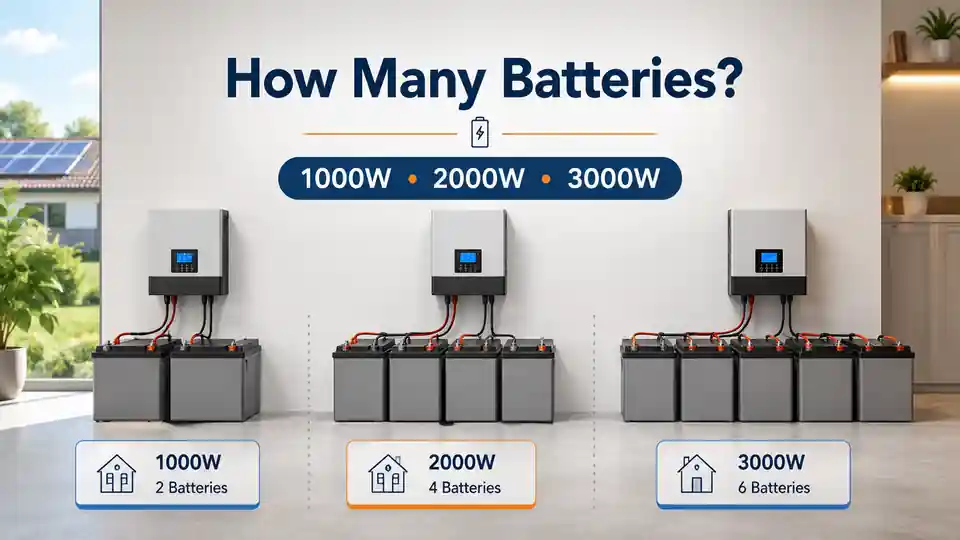
There is no fixed battery count for a 1,000 W, 2,000 W or 3,000 W inverter. The inverter may be capable of delivering that much power, but the batteries only have to supply the load that is actually connected — for as long as you want it to run.
A 3,000 W inverter powering a 300 W refrigerator, router and several lights needs far less stored energy than the same inverter supplying a 2,800 W workshop load. Battery chemistry, bank voltage, usable depth of discharge, inverter efficiency and battery-management-system limits can all change the final number.
This guide is for preliminary sizing, not final electrical design. High-power battery systems can produce dangerous fault currents. Confirm the permitted series or parallel arrangement, continuous and surge discharge limits, cable size, fusing, isolation, ventilation and installation requirements with the equipment manufacturers and a qualified specialist.
The Quick Answer — If the Load Really Uses the Full Inverter Rating
The table below gives a direct starting point for a common battery size: one 12.8 V 100 Ah LiFePO4 battery. It assumes 80% of the labelled capacity is used and the inverter is 90% efficient. Under those assumptions, one battery delivers about 922 Wh of usable AC energy.
Approximate number of 12.8 V 100 Ah LiFePO4 batteries at full continuous load
| Required runtime | 1,000 W load | 2,000 W load | 3,000 W load |
|---|---|---|---|
| 1 hour | 2 batteries | 3 batteries | 4 batteries |
| 2 hours | 3 batteries | 5 batteries | 7 batteries |
| 4 hours | 5 batteries | 9 batteries | 14 batteries |
| 8 hours | 9 batteries | 18 batteries | 27 batteries |
These are energy-based minimums before adding a reserve and before arranging the batteries into a compatible bank. A 24 V inverter using 12 V batteries needs complete two-battery series strings; a 48 V inverter needs complete four-battery strings. A result of five batteries may therefore become six in a 24 V bank or eight in a 48 V bank.
Most systems do not run at the inverter's full rating continuously. Use the real simultaneous load whenever possible. Sizing every battery bank from the largest number printed on the inverter can turn a sensible backup system into a very expensive collection of batteries.
In this guide
Start With the Load, Not the Number Printed on the Inverter
The Inverter Rating Is a Power Ceiling, Not an Energy Requirement

The inverter's continuous rating shows how much AC power it can supply at one time under specified conditions. It does not mean the inverter constantly draws that amount from the battery.
Battery capacity is an energy question. A 600 W load operating for four hours uses about 2,400 Wh before conversion losses. The same 600 W load needs roughly the same stored energy whether it is connected to a 1,000 W, 2,000 W or 3,000 W inverter.
The larger inverter may still have different standby losses, surge capability and minimum battery requirements, so its manual remains important even when the connected load is modest.
Figures that actually determine the battery count
| Figure | Why it matters | Typical source |
|---|---|---|
| Simultaneous running load | Sets the normal rate at which energy leaves the battery | Appliance labels, manufacturer data or a power meter |
| Required operating time | Turns power in watts into energy in watt-hours | Your backup plan |
| Battery voltage and Ah or kWh | Shows the nominal energy stored in each battery or module | Battery label and data sheet |
| Usable capacity | Prevents treating every labelled watt-hour as available | Battery or BMS documentation |
| Inverter efficiency and idle use | Accounts for energy lost before it reaches the appliances | Inverter efficiency curve and no-load specification |
| Battery discharge limit | Determines whether the bank can supply the required current | BMS rating, battery data sheet and system manual |
| System voltage | Determines the number of batteries required in each series string | Inverter DC input specification |
The Calculation That Turns a Load Into a Battery Count
For a first estimate, calculate how much usable AC energy one battery can provide, then divide the required load energy by that figure.
Usable AC energy per battery (Wh) ≈ Battery voltage × Battery capacity in Ah × Usable capacity fraction × Inverter efficiency
Battery count ≈ Load in watts × Runtime in hours ÷ Usable AC energy per battery
Always round the result up. Then check whether the total can be arranged into complete series strings for the inverter voltage and whether the bank can supply the required continuous and surge current.
- Add the watts of all appliances that may run at the same time.
- Choose the required operating time in hours.
- Find the nominal energy of one battery from its Wh rating or from voltage × Ah.
- Apply the usable capacity permitted for that battery and operating strategy.
- Apply a realistic inverter efficiency.
- Divide the required AC watt-hours by the usable AC watt-hours from one battery.
- Round up to a whole battery.
- Round up again if necessary to create complete 12 V, 24 V or 48 V strings.
- Check BMS current, battery discharge current, surge demand and manufacturer connection limits.
- Add an appropriate planning reserve for ageing, temperature, unexpected load and criticality.
How many 12.8 V 100 Ah LiFePO4 batteries are needed for a 600 W load running for four hours?
Answer: The energy calculation gives 2.61 batteries, so the minimum is 3 batteries. A 24 V inverter using 12.8 V batteries would require complete pairs, so the practical minimum becomes 4 batteries. A 48 V inverter would also require at least 4 batteries to form one complete series string.
Explanation: One battery provides approximately 12.8 × 100 × 0.80 × 0.90 = 921.6 Wh of usable AC energy. The appliances require 600 × 4 = 2,400 Wh. Dividing 2,400 by 921.6 gives 2.61. The energy calculation says three, but system voltage decides whether three can actually be connected in a valid bank.
A Battery Bank Has to Pass Two Separate Tests
Enough Energy Does Not Always Mean Enough Current

The energy test asks whether the bank contains enough usable watt-hours for the required operating time.
The current test asks whether the batteries, BMS, terminals, busbars, cables and protection devices can deliver the power without exceeding their continuous or short-duration limits.
A small battery may contain enough energy for a brief task but still shut down immediately if the inverter asks for more current than the battery or BMS permits.
Energy test: will it run for long enough?
Energy is measured in watt-hours or kilowatt-hours. A load of 1,000 W running for two hours needs 2,000 Wh at the AC output. The batteries must store more than this because part of their nominal capacity is intentionally unused and part is lost in the inverter and wiring.
Current test: can it deliver the power?
The same power requires much more current at a lower battery voltage. The figures below assume 90% inverter efficiency and use nominal bank voltage. Real current changes with battery voltage, load, efficiency and inverter operating conditions.
Approximate DC current at the inverter's full continuous rating
| AC load | 12 V bank | 24 V bank | 48 V bank |
|---|---|---|---|
| 1,000 W | About 93 A | About 46 A | About 23 A |
| 2,000 W | About 185 A | About 93 A | About 46 A |
| 3,000 W | About 278 A | About 139 A | About 69 A |
Do not assume that dividing total current equally between parallel batteries makes the design safe. Current sharing can be affected by cable resistance, connection layout, battery condition, temperature and internal BMS behaviour. The battery manufacturer must permit the planned parallel arrangement and the complete bank needs correctly designed busbars, cables and overcurrent protection.
Higher system voltage can reduce current for the same power, which can make a high-power inverter easier to connect efficiently. It does not create free energy: a 48 V bank still needs enough total watt-hours for the required runtime.
Battery Counts for Realistic Loads
The inverter may spend most of its time well below its maximum rating. The next table uses the same 12.8 V 100 Ah LiFePO4 planning assumptions as the quick answer: 80% usable capacity and 90% inverter efficiency. The counts are energy minimums before series-string rounding and reserve.
Approximate 100 Ah LiFePO4 battery count from actual load
| Inverter size | Actual continuous load | 1 hour | 4 hours | 8 hours |
|---|---|---|---|---|
| 1,000 W | 300 W | 1 | 2 | 3 |
| 1,000 W | 600 W | 1 | 3 | 6 |
| 1,000 W | 1,000 W | 2 | 5 | 9 |
| 2,000 W | 600 W | 1 | 3 | 6 |
| 2,000 W | 1,200 W | 2 | 6 | 11 |
| 2,000 W | 2,000 W | 3 | 9 | 18 |
| 3,000 W | 900 W | 1 | 4 | 8 |
| 3,000 W | 1,800 W | 2 | 8 | 16 |
| 3,000 W | 3,000 W | 4 | 14 | 27 |
The repeated results are intentional. A 600 W load needs approximately the same stored energy whether the inverter is rated at 1,000 W or 2,000 W. The larger inverter may have different idle consumption and battery requirements, but the appliances still consume 600 W.
A table can provide a useful first estimate, but the result should not be treated as a shopping list until the battery voltage, permitted connection layout, BMS current and inverter manual have been checked.
Three Worked Examples That Show Why the Answer Changes
Example 1: 1,000 W inverter, 600 W load, four-hour target
How many 100 Ah LiFePO4 batteries are needed?
Answer: Three 12.8 V 100 Ah batteries provide the required energy under the stated assumptions. A 12 V inverter may use three suitable batteries in an approved parallel bank. A 24 V inverter using 12.8 V units needs an even number, so the practical result is four. A 48 V inverter needs four units in series for one string.
Explanation: Required AC energy is 600 × 4 = 2,400 Wh. One battery provides about 921.6 Wh of usable AC energy. 2,400 ÷ 921.6 = 2.61, which rounds up to three before voltage-string rules are applied.
Example 2: 2,000 W inverter, 1,200 W load, three-hour target
How many 100 Ah LiFePO4 batteries are needed?
Answer: Four batteries meet the energy calculation. Four 12.8 V units can form a 12 V parallel bank, two 24 V series strings in parallel, or one 48 V series string, provided the batteries and manufacturer permit the chosen configuration.
Explanation: The load requires 1,200 × 3 = 3,600 Wh. Dividing by 921.6 Wh per battery gives 3.91, which rounds up to four. The current check is still separate: the bank and BMS must support the load and any startup surge.
Example 3: 3,000 W inverter, 2,200 W load, two-hour target
How many 100 Ah LiFePO4 batteries are needed?
Answer: The energy calculation gives five batteries. A 24 V bank made from 12.8 V units must use complete pairs, so it becomes six. A 48 V bank must use complete sets of four, so it becomes eight. Alternatively, two compatible 51.2 V 100 Ah modules may provide a cleaner 48 V solution, subject to their discharge and parallel limits.
Explanation: The load requires 2,200 × 2 = 4,400 Wh. 4,400 ÷ 921.6 = 4.77, which rounds up to five. The 48 V arrangement cannot be built from five 12.8 V batteries, so the next complete arrangement is two parallel strings of four batteries.
Why 12 V, 24 V and 48 V Can Change the Final Number
When identical 12 V batteries are connected in series, their voltages add but the amp-hour value of the string does not. When identical batteries are connected in parallel, voltage remains the same and the amp-hour capacity adds. Total watt-hours are the clearest way to compare the energy in different arrangements.
Complete strings when using nominal 12 V batteries
| Inverter DC input | Batteries in one series string | Example with 100 Ah batteries |
|---|---|---|
| 12 V | 1 | One battery is one string; additional suitable batteries are normally added in parallel |
| 24 V | 2 | Two 12 V 100 Ah batteries in series create approximately 24 V 100 Ah |
| 48 V | 4 | Four 12 V 100 Ah batteries in series create approximately 48 V 100 Ah |
Two 12 V 100 Ah batteries in series contain approximately the same total energy as two in parallel: about 2.4 kWh using nominal 12 V values. The series bank delivers 24 V at 100 Ah, while the parallel bank delivers 12 V at 200 Ah. The inverter must match the completed bank voltage.
Never place batteries in series or parallel merely because their labels show the same voltage. Check that the exact model permits the arrangement and follow the manufacturer's limits. Batteries in a bank should normally match in chemistry, model, capacity, age, condition and state of charge.
LiFePO4 and AGM Batteries Do Not Produce the Same Practical Result
A battery count based only on amp-hours can be misleading. Different chemistries may allow different usable depths of discharge and behave differently under a heavy load. The planning assumptions below are deliberately visible so they can be replaced with values from the product data sheet.
Illustrative one-hour battery counts at full inverter load
| Battery unit | Planning assumptions | Usable AC energy per unit | 1,000 W | 2,000 W | 3,000 W |
|---|---|---|---|---|---|
| 12.8 V 100 Ah LiFePO4 | 80% usable, 90% inverter efficiency | About 922 Wh | 2 | 3 | 4 |
| 12.8 V 200 Ah LiFePO4 | 80% usable, 90% inverter efficiency | About 1,843 Wh | 1 | 2 | 2 |
| 25.6 V 100 Ah LiFePO4 | 80% usable, 90% inverter efficiency | About 1,843 Wh | 1 | 2 | 2 |
| 51.2 V 100 Ah LiFePO4 | 80% usable, 90% inverter efficiency | About 3,686 Wh | 1 | 1 | 1 |
| 12 V 100 Ah AGM | 50% usable, 85% inverter efficiency | About 510 Wh before high-rate effects | 2 | 4 | 6 |
The table compares energy only. Each battery must match the inverter's DC voltage directly or be arranged in an approved series or parallel bank. The battery's continuous discharge current, BMS limit and high-rate performance may require a larger bank than the energy calculation suggests.
Lead-acid capacity is commonly measured at a specified discharge rate. Drawing power much faster can reduce the capacity available in practice, especially at the high currents created by large 12 V inverters. Battery age, temperature and state of charge can reduce it further.
The Hidden Limiter: BMS and Continuous Discharge Current
Many LiFePO4 batteries include a battery management system that disconnects the output if current, voltage or temperature moves outside permitted limits. The BMS rating is not automatically the same as the battery's Ah rating. Two 100 Ah batteries from different manufacturers may have very different continuous and surge current limits.
- Maximum continuous discharge current of one battery or module
- Peak or surge current and how long it is permitted
- Maximum number of batteries allowed in series and in parallel
- Whether the inverter manufacturer specifies a minimum battery capacity
- Low-voltage cutoff and BMS disconnect settings
- Permitted operating and discharge temperature
- Required external fuse or circuit protection
- Terminal current and torque limits
- Compatibility with the charger or inverter-charger
Can one 12 V 100 Ah LiFePO4 battery with a 100 A continuous BMS run a 3,000 W inverter at full load?
Answer: No, not at full output under the stated limit. A 3,000 W AC load requires roughly 278 A from a nominal 12 V bank at 90% efficiency, before allowing for voltage variation or surge. The single 100 A BMS would reach its current limit well before the inverter delivered 3,000 W.
Explanation: Adding parallel batteries may increase the bank's total current capability when the manufacturer permits it, but the design still needs current-sharing margin, correct cabling, individual or string protection where required, and enough energy for the target runtime. Moving to a compatible 24 V or 48 V system can reduce the current substantially.
Do not select the number of parallel batteries by dividing inverter current by a BMS rating and rounding up with no margin. Surge duration, uneven current sharing, battery temperature, low state of charge and product-specific limits can all cause an earlier shutdown.
Do You Need More Batteries for Startup Surge?
Startup surge usually lasts too briefly to add much energy to the runtime calculation, but it can determine whether the system starts at all. Refrigerators, freezers, pumps, compressors, power tools and some power supplies may draw several times their normal running power for a short period.
How different loads affect battery sizing
| Load behaviour | Energy calculation | Power and current check |
|---|---|---|
| Steady resistive or electronic load | Use its measured or stated running watts | Confirm continuous inverter and battery current |
| Refrigerator or freezer | Use average energy over time for runtime | Check compressor starting surge separately |
| Pump or motor | Use realistic running time or duty cycle | Check start current, repeated starts and surge duration |
| Kettle, heater or cooking appliance | Use full running watts for every minute it operates | Confirm the high continuous current and short battery runtime |
| Several appliances | Add loads that may genuinely operate together | Model the worst credible startup while other loads are already running |
The inverter must support the required surge for long enough, and the battery bank must remain above its voltage and current limits during that surge. A large surge figure printed on an inverter is useful only when the battery, cables and protection system can support it.
Why a 3,000 W Inverter Often Deserves a 24 V or 48 V Discussion
A 3,000 W inverter can exist in a 12 V system, but the full-load DC current is very high. Higher current increases voltage drop and places greater demands on cables, terminals, fuses, busbars and battery connections. For this reason, many larger installations use 24 V or 48 V equipment, although the correct choice depends on the product ecosystem, required loads, installation length, charging sources and local rules.
Changing from 12 V to 48 V cuts the current for a given power to roughly one quarter, but it also changes the inverter, charger, battery arrangement, DC equipment and protection design. It is a system decision, not a single-component upgrade.
Common Battery-Bank Buying Mistakes
- Sizing the bank from the inverter rating without calculating the real simultaneous load
- Buying the inverter first and checking battery compatibility afterwards
- Treating 100 Ah as the same amount of energy at 12 V, 24 V and 48 V
- Assuming all of the labelled battery capacity is usable
- Ignoring inverter efficiency and no-load consumption
- Calculating watt-hours but never checking continuous discharge current
- Using the BMS peak current as though it were a continuous rating
- Forgetting that 24 V and 48 V banks made from 12 V batteries require complete series strings
- Mixing batteries of different age, capacity, chemistry or condition
- Assuming every battery model permits unlimited series or parallel connection
- Ignoring startup surge from pumps, refrigerators, compressors or tools
- Failing to include cable, fuse, busbar, isolation, rack and charging costs
- Designing for the first month of battery life with no allowance for ageing or cold conditions
- Expecting the charger to refill a large bank quickly without calculating charging time and available input power
A More Reliable Buying Sequence
- Decide which appliances are essential during an outage.
- Measure or estimate their normal running power.
- Identify any startup or short-duration surge.
- Set a realistic operating time for each load.
- Calculate the required usable energy in Wh or kWh.
- Choose a battery chemistry and product family with documented discharge limits.
- Select a suitable system voltage for the inverter power and installation.
- Round the energy result to complete battery strings or compatible modules.
- Check continuous current, BMS, surge, low-voltage cutoff and charging compatibility.
- Add a reserve appropriate to battery ageing, temperature, load variation and the consequences of early shutdown.
- Design cables, busbars, fuses, disconnects, earthing or grounding, enclosure and ventilation to the applicable local requirements.
- Confirm the complete system with the relevant manufacturers or a qualified installer before purchase.
Specifications to Verify Before Ordering
Documents and figures worth checking
| Document or specification | What to confirm |
|---|---|
| Inverter manual | DC input voltage, continuous power conditions, surge power and duration, efficiency, idle consumption, low-voltage cutoff and recommended battery capacity |
| Battery data sheet | Nominal Wh, usable discharge limit, continuous and peak current, temperature range, terminal limit and cycle-life test conditions |
| BMS documentation | Continuous current, short-duration current, cutoff behaviour, reset conditions and series or parallel restrictions |
| Connection guide | Approved string layout, maximum number of batteries, cable arrangement, busbars and balancing requirements |
| Protection guidance | Fuse or breaker location, rating, interrupt capacity, disconnect requirements and permitted conductor sizes |
| Charger or inverter-charger manual | Battery chemistry profile, charging voltage, current limit, temperature restrictions and expected recharge time |
Generic online figures are useful for comparing scenarios, but product documents control the final design. A manufacturer may require a larger minimum bank than the simple energy calculation, restrict the number of parallel units or reduce output under particular temperatures.
Related HomDera Guides
These guides explain the calculations behind the battery count and help separate stored energy, operating time and inverter output.
How to Calculate Battery Runtime With an Inverter: Formula, Efficiency and ExamplesHow Long Will a 100Ah Battery Last? 12V Runtime ChartWhat Size Battery Backup Do I Need? Home Sizing GuideFrequently Asked Questions
Can one 100 Ah battery run a 1,000 W inverter?
It may run a smaller load connected to a 1,000 W inverter, and some suitable batteries may support a 1,000 W load for a short time. However, a nominal 12 V system would draw roughly 93 A at 1,000 W and 90% efficiency. The battery, BMS, terminals and cables must all support that current. Runtime may be around one hour or less for a 100 Ah battery depending on chemistry, usable capacity and high-rate performance.
How many 100 Ah batteries are needed for a 2,000 W inverter for eight hours?
If the load genuinely remains at 2,000 W for eight hours, the baseline used in this guide gives 18 × 12.8 V 100 Ah LiFePO4 batteries before string rounding and reserve. The appliances would use 16 kWh at the AC output, so this is a large battery system. A lower real load can reduce the requirement dramatically.
Can a 3,000 W inverter use a 12 V battery bank?
Some 3,000 W inverters are designed for 12 V banks, but full output can require around 278 A at 90% efficiency using nominal 12 V. The battery bank, current distribution, cables and protection must be designed for this demand. A 24 V or 48 V system may be more practical for some installations, but it requires compatible equipment throughout.
Do batteries in series increase runtime?
Adding identical batteries in series increases bank voltage and total watt-hours, so it can increase runtime when the inverter matches the higher voltage. The string's Ah rating remains the same. Two 12 V 100 Ah batteries in series provide about 24 V 100 Ah, which contains roughly twice the energy of one battery.
Is one larger battery better than several smaller batteries?
A larger module can reduce the number of interconnections, fuses and balance concerns, while several smaller batteries may be easier to move, expand or replace individually. The better choice depends on discharge current, redundancy, serviceability, permitted connection limits, available space and total installed cost.
Should battery size be based on inverter wattage?
Use the real simultaneous load and target runtime for the energy calculation. Then use the inverter's maximum output, surge behaviour and manufacturer requirements to check the bank's current capability and minimum permitted size. Both checks matter, but they answer different questions.
How much reserve should be added?
Avoid designing a bank that only just meets the target on paper. The reserve should reflect battery ageing, temperature, uncertain appliance use, inverter overhead and the consequences of an early shutdown. A non-critical lighting system may tolerate a modest margin; heating protection, pumps, communications or other important loads may need a more conservative design and professional review.
Before You Place the Battery Order
The useful answer is not simply “two batteries for 1,000 W” or “six batteries for 3,000 W”. Those figures only make sense after the load, runtime, chemistry, voltage and assumptions have been stated.
- Confirm the real load rather than assuming full inverter output.
- Calculate energy in watt-hours or kilowatt-hours.
- Use the battery manufacturer's usable-capacity guidance.
- Round the battery count up to complete voltage strings.
- Check continuous and surge current at the battery-bank voltage.
- Verify BMS and manufacturer series or parallel limits.
- Include inverter idle use and likely charging losses in the wider energy plan.
- Add a realistic reserve rather than relying on the last available watt-hour.
- Budget for the complete installation, not only the battery cases.
- Have high-current or permanently installed systems reviewed by a qualified specialist.
For a quick preliminary comparison, the baseline in this guide suggests about 2, 3 or 4 × 12.8 V 100 Ah LiFePO4 batteries to support a full 1,000 W, 2,000 W or 3,000 W load for one hour. Longer runtime increases the count almost in direct proportion, while 24 V and 48 V arrangements may require additional rounding to complete strings.
Use those figures as the beginning of the design, not the end. The final bank must store enough energy, deliver enough current, match the inverter voltage, survive the expected surge and comply with the battery and inverter manufacturers' connection rules.
Explore all backup power, battery and inverter guides