
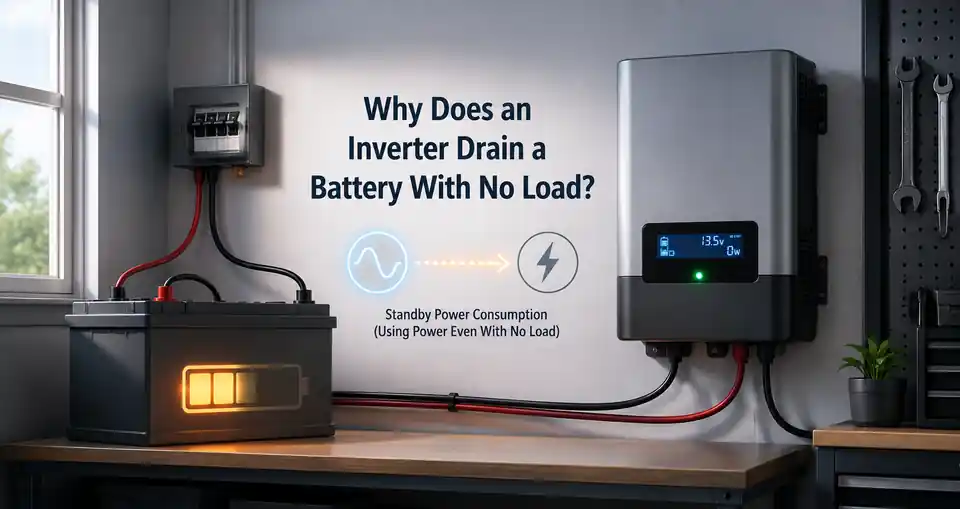
You switch off every appliance, the inverter display shows little or no output, and the battery still loses charge. That does not automatically mean the battery is faulty. An inverter must power its own electronics whenever it is awake and ready to produce AC electricity, so a real no-load condition is not the same as zero battery consumption.
The useful question is whether the drain is normal for that inverter, caused by a hidden load, increased by an unsuitable setting or high enough to suggest a fault. The answer can usually be found by separating the inverter's own idle consumption from everything else connected to the battery and AC output.
Quick answer: an inverter drains a battery with no external load because its control board, switching stage, output regulation, display, relays, communication modules and sometimes cooling fan remain powered. A few watts can become a substantial daily energy loss. Check the model's published zero-load power or no-load current, then measure the actual DC current at the battery side.
Battery cables can carry destructive fault current even when the AC output is off. Do not loosen battery terminals, open an inverter or place a handheld multimeter in series with a high-current battery cable unless the equipment is isolated and the work is within your competence. Use an installed shunt, a suitable DC clamp meter or a qualified technician. Fixed home backup systems must also follow local electrical and fire-safety rules.
Inverter battery drain: causes, measurements and fixes
No load does not mean the inverter is doing nothing
The AC sockets may be empty while the DC side remains active
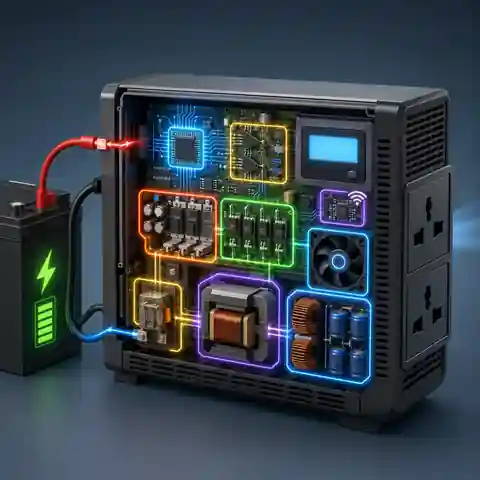
To provide stable AC voltage immediately, the inverter keeps its control processor, voltage sensing, gate drivers and switching electronics ready.
Depending on the design, the output filter, transformer, transfer relay, display, Bluetooth or Wi-Fi module and cooling controls may also remain energised.
This internal demand is usually described in the manual as zero-load power, no-load draw, idle current, standby consumption or self-consumption. These terms are related, but they may refer to different operating modes.
An inverter rated at 2,000W does not consume 2,000W while idle. The rating describes the output it can supply, not its own continuous demand. However, a larger inverter often has more circuitry to keep active, so it may use more energy at no load than a smaller unit designed for the same small appliance.
Four states that are often confused
| Inverter state | What is happening | Expected battery draw |
|---|---|---|
| On, with no AC load | Full AC output is available and the inverter is ready to supply power instantly | Normal idle or zero-load consumption |
| ECO, search or power-saving mode | The main output stage sleeps and wakes briefly to look for a load | Usually much lower, but not zero |
| Remote off | The AC output is disabled, but the remote receiver or control circuit may remain alive | Often only a few milliamps, but model-dependent |
| Battery isolated | A correctly rated disconnect or removed fuse separates the inverter from the battery | No inverter draw, although other battery-side devices may still consume power |
First prove that the AC side is really unloaded
A socket with no obvious appliance running is not always a no-load condition. Many devices consume power in standby, and one small load can keep an inverter out of its low-power search mode. Hard-wired circuits are particularly easy to overlook because the load may be in another room or hidden inside equipment.
Loads that commonly remain active
| Hidden or overlooked load | Why it is easy to miss |
|---|---|
| Television, monitor or audio equipment | The screen is off, but the standby supply and remote receiver remain powered |
| Microwave, oven, coffee machine or appliance clock | A display or control board can draw power continuously |
| Phone chargers, laptop adapters and USB power supplies | Some consume a small amount even when the device is disconnected |
| Wi-Fi router, optical network terminal, switch or smart-home hub | These are quiet continuous loads and may be on a different outlet |
| Refrigerator or freezer | The compressor may be off between cycles while the control electronics remain active |
| Boiler, circulation pump controller or thermostat | Heating equipment can appear idle while its control system waits for demand |
| Surge protector, power strip, smart plug or transfer equipment | Indicator lights, relays and monitoring electronics may stay energised |
| Hard-wired branch circuit | A light, alarm, extractor fan controller or another device may be connected beyond the visible inverter outlet |
- Switch off and unplug every device from the inverter output, rather than relying only on appliance standby buttons.
- If the inverter supplies a distribution circuit, open the individual AC branch breakers one at a time while observing battery current.
- Wait long enough for refrigerator cycles, relay delays, fans and control boards to settle.
- Compare the reading with the inverter's published no-load value in the same operating mode.
- If the current falls when one circuit or appliance is disconnected, the system did not have a true no-load condition.
An AC plug-in watt meter can help find standby loads, but it does not measure the inverter's own battery-side consumption. For that, the useful measurement point is the DC current leaving the battery.
How much no-load consumption is normal?
There is no universal normal value. Inverter size, topology, system voltage, output voltage, waveform quality, transformer design, communication hardware and operating mode all affect idle demand. A compact inverter may use only a few watts, while a large inverter or inverter-charger can use tens of watts before it powers a single appliance.
Manufacturer specifications show how wide the range can be. Some small 12V pure sine wave inverters publish a no-load current below 0.3A, which is below 3.6W at 12V. In one current inverter range, published zero-load values run from about 8W to 20W depending on model and battery voltage, while its ECO figures are roughly 0.6W to 3.2W. These are examples, not target values for every inverter.
Manual terms worth checking before judging the reading
| Specification | What it tells you |
|---|---|
| Zero-load power (W) | The inverter's approximate DC power demand while on with no external AC load |
| No-load or idle current (A) | Battery current in a specified voltage version; convert to watts before comparing different system voltages |
| Standby, ECO or search consumption | Expected demand when the output stage is cycling or sleeping |
| Wake-up or search threshold | The minimum AC load that makes the inverter return to normal operation |
| Search interval | How often the inverter briefly tests for a load |
| Remote-off current | Residual consumption when the inverter is disabled by a remote switch rather than fully isolated |
| Fan operating rule | Whether the fan responds to temperature, load, charging activity or all three |
Do not compare idle current in amps without considering battery voltage. A 0.8A draw at 12V and a 0.4A draw at 24V both represent about 9.6W.
Why a small idle load empties a battery surprisingly quickly
Idle power is continuous. A 10W loss may look insignificant beside a 1,000W appliance, but it uses 240Wh every 24 hours. That is energy the battery cannot deliver to the refrigerator, lights, boiler or internet equipment during an outage.
Useful planning formulas: Idle power (W) ≈ battery voltage (V) × measured current (A) Daily idle energy (Wh) = idle power (W) × 24 Daily battery use (Ah) ≈ daily idle energy (Wh) ÷ battery voltage (V)
What does a 0.8A no-load current mean on a 12.8V battery?
Answer: About 10.2W, 246Wh per day or 19.2Ah per day.
Explanation: 12.8V × 0.8A = 10.24W. Over 24 hours, that becomes about 246Wh. Dividing 246Wh by 12.8V gives 19.2Ah. A 100Ah battery could therefore lose a meaningful part of its usable capacity each day even though no appliance energy appears on the AC output display.
What continuous idle power becomes over one day
| Idle power | Energy used in 24 hours | Approximate battery use at 12.8V | Time to use 1,152Wh of planned usable energy |
|---|---|---|---|
| 3W | 72Wh | 5.6Ah | About 16 days |
| 5W | 120Wh | 9.4Ah | About 9.6 days |
| 10W | 240Wh | 18.8Ah | About 4.8 days |
| 20W | 480Wh | 37.5Ah | About 2.4 days |
| 30W | 720Wh | 56.3Ah | About 1.6 days |
The final column uses a simple planning example of 1,152Wh of usable battery energy, such as 90% of a nominal 12.8V 100Ah battery. Real time can be shorter because the battery monitor, BMS, wiring, temperature, age and low-voltage cut-off also affect the result. Lead-acid batteries may provide less usable energy when discharged quickly or kept at a low state of charge.
Calculate battery runtime with inverter lossesWhy the drain may be higher than the datasheet value
1. The inverter is much larger than the continuous load
A large inverter may be necessary for a short compressor, pump or tool surge, but keeping it awake to supply a 10W router can be inefficient. At very low output, the inverter's fixed internal demand can equal or exceed the appliance load. The issue is not that the inverter is overloaded; it is that a large conversion stage is running for a very small job.
2. ECO or search mode is disabled
Normal mode keeps continuous AC voltage at the output. ECO or search mode usually shuts down much of the power stage when the detected load falls below a threshold, then wakes briefly to check whether power is needed. Depending on the inverter, this can reduce no-load demand dramatically.
3. A tiny load keeps the inverter awake
A power adapter, appliance display or relay coil may be too small to notice in normal household use but large enough to stay above the inverter's sleep threshold. The inverter then remains in full operating mode around the clock. In other systems, the opposite happens: the load is too small to wake the inverter, so the appliance never starts correctly.
4. Extra inverter functions remain active
An inverter-charger can contain a transfer switch, charger controls, grid monitoring, communications, remote display, data logger and network module. Bluetooth, Wi-Fi, cellular gateways and external control relays can add a small but continuous demand. A fan that continues running because of charging activity, high ambient temperature or an internal hot spot will add more.
5. Remote off is not the same as complete isolation
Many remote switches operate a low-power control circuit rather than disconnecting the main battery cable. Some inverter manuals specify a residual remote-off current of only a few milliamps; others may keep more monitoring hardware active. This is normally small, but it matters during long storage periods or with a modest battery.
6. The inverter or measurement is not behaving normally
A current reading far above the manual value can come from an inverter fault, a fan that never stops, an internal relay problem, damaged power electronics, incorrect configuration or a measurement that includes other DC loads. It can also be an inaccurate state-of-charge estimate rather than actual current loss. Measure current directly before concluding that the inverter is defective.
ECO mode saves energy, but it is not suitable for every load
A sleeping inverter has to recognise when an appliance needs power
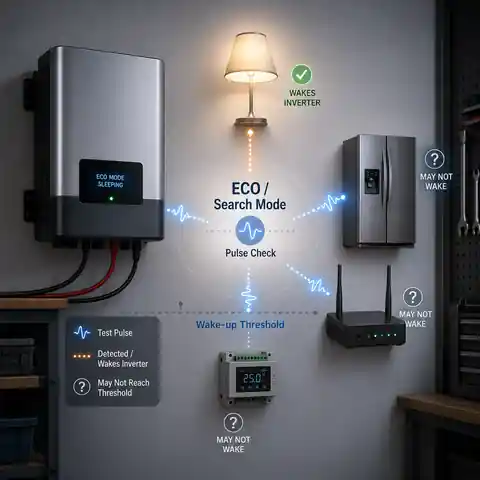
In search mode, the inverter may energise the output briefly every few seconds and remain on only when it detects a load above the configured threshold.
A simple lamp may wake it reliably, while a refrigerator control board, boiler electronics, smart charger or low-power network device may not present the expected load at the right moment.
Some equipment can reset, click, fail to start or lose its clock during repeated search pulses. Test the actual appliance and use continuous mode when uninterrupted AC is required.
When power-saving mode needs extra care
| Load or system | Possible issue | Safer planning approach |
|---|---|---|
| Refrigerator or freezer | The control electronics may be below the wake threshold before the compressor requests power | Test a complete cooling cycle and confirm reliable restart after long idle periods |
| Gas boiler or heating controller | Control boards, thermostats and pumps may not tolerate interrupted or pulsed supply | Use the equipment manufacturer's requirements and test every operating state |
| Router, ONT or network switch | The load can be too small to wake the inverter or may reboot during each search interval | Use continuous AC or an appropriate direct-DC backup arrangement |
| Battery charger or electronic power supply | Input filtering may not look like a steady load during the detection pulse | Verify compatibility rather than lowering the threshold blindly |
| Medical, alarm or safety-critical equipment | A delayed wake-up or momentary power loss may be unacceptable | Use a continuously powered, approved backup solution |
| Mixed household circuit | One tiny standby load can keep the inverter awake continuously | Separate essential always-on loads from loads that can use search mode |
Do not reduce a search threshold or extend a search interval until the connected equipment has been tested. An energy-saving setting is not useful if a refrigerator, boiler, pump or safety device fails to start when needed.
Measure the drain without guessing
The most useful test compares several clearly defined states. Use the same battery voltage and allow the system to settle before each reading. If solar, grid charging or another charger is active, the measured current may be the net result of charging and discharging rather than the inverter demand alone.
Measure all current that leaves the battery
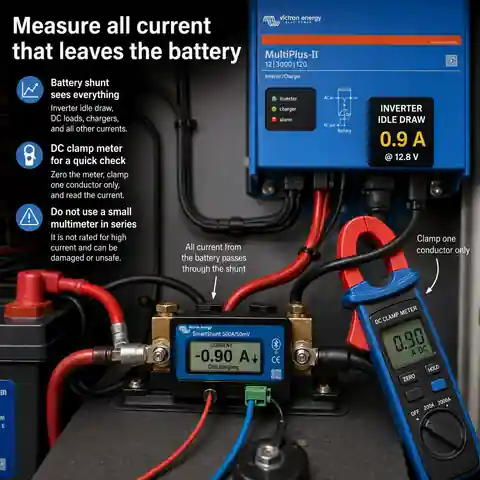
A correctly installed battery shunt records current flowing into and out of the battery and is the most useful tool for observing a system over time.
A suitable DC clamp meter can provide a spot reading without opening the battery circuit, but it must be zeroed correctly and clamped around one conductor only.
A small handheld multimeter should not be inserted into a high-current inverter cable. Its current input and test leads are not a substitute for a battery-rated shunt.
- Charge the battery to a known state and record its resting voltage and temperature.
- Pause or isolate charging sources so the reading represents discharge current clearly.
- Disconnect all AC loads, including hard-wired branches, and wait for delayed fans or relays to stop.
- Record battery current with the inverter on in normal mode.
- Enable ECO or search mode, wait through several search cycles and record the average current.
- Use the manufacturer's remote-off method and record any remaining current.
- If the installation has a correctly designed battery disconnect, isolate the inverter and check whether another DC load remains.
- Convert each current reading to watts using the actual battery voltage, then compare the correct operating state with the manual.
What the measurement pattern usually means
| Observation | Likely interpretation | Next check |
|---|---|---|
| Normal-mode draw is close to the datasheet | The inverter's own idle consumption is probably normal | Calculate the daily energy cost and decide whether ECO mode or scheduled shutdown is worthwhile |
| Current drops sharply in ECO mode | Power-saving mode is working | Test whether every connected appliance wakes and runs correctly |
| Current drops only after one AC branch is opened | That circuit contains a real or standby load | Reconnect devices individually to identify it |
| Current remains after the inverter is isolated | Another DC device is using power | Check the BMS, battery monitor, communication gateway, relays, DC-DC converters and controllers |
| Current is much higher than the published no-load value | Wrong mode, active fan, hidden load, measurement error or inverter fault | Repeat the isolated test and contact the manufacturer or technician if the result persists |
| State of charge falls but measured current is near zero | Monitor calibration, battery self-discharge or reduced battery capacity may be involved | Check battery health and resynchronise the monitor according to its manual |
The inverter may not be the only device draining the battery
A battery can support several devices on the DC side before any power reaches the inverter. A lithium battery's BMS, Bluetooth module, shunt monitor, solar controller, automatic relay, remote panel, alarm, DC-DC converter or communications gateway can each use a small amount. The total can remain visible even when the inverter is off.
Symptoms that can be mistaken for inverter drain
| Symptom | Possible cause | How to separate it |
|---|---|---|
| Battery percentage falls while current appears very low | Battery monitor is out of synchronisation or estimating state of charge from incomplete data | Compare measured amp-hours, battery voltage and a confirmed full charge |
| Battery voltage falls quickly under a small load | Ageing, sulfation, cold temperature, high internal resistance or poor connections | Test the battery and measure voltage directly at the battery and inverter terminals |
| Battery loses charge during long storage | Battery self-discharge plus BMS, monitor and remote-control demand | Measure with the inverter physically isolated and follow the battery storage instructions |
| Current changes at night or with weather | Solar controller, charger or automatic system mode is changing | Review current history rather than relying on one momentary reading |
| Inverter trips on low voltage before expected runtime | Voltage drop in undersized cables or loose connections | Measure voltage at both ends under load and inspect the protected DC circuit |
| Only the battery percentage looks wrong | The current may be normal but the capacity setting or charge-detection parameters are incorrect | Check monitor configuration against the battery specification |
Battery self-discharge is normally a slow background process, not an explanation for a large overnight loss in a healthy system. If a battery appears to lose a substantial amount with every external connection removed, battery condition, temperature, internal electronics and the accuracy of the state-of-charge estimate need to be checked.
Practical ways to reduce inverter idle drain
- Use ECO, search or standby mode when every connected load has been tested for reliable wake-up and continuous operation.
- Turn the inverter off with the approved local or remote control when AC power is not needed, and check the manual for residual remote-off current.
- Choose an inverter whose continuous rating and surge capacity fit the real loads instead of keeping a very large inverter awake for a few watts.
- Separate small always-on loads from occasional high-power loads so they do not require the same inverter to run continuously.
- Where the equipment manufacturer permits it, power suitable low-voltage devices through an efficient regulated DC supply rather than converting DC to AC and back to DC.
- Remove unused chargers, appliance clocks and standby adapters from the inverter circuit.
- Disable unneeded communication modules, displays or network gateways only when the equipment manual allows it and essential monitoring is preserved.
- Keep ventilation clear so a temperature-controlled fan does not run longer than necessary.
- Use a shunt or energy log to compare daily idle use before and after each change rather than relying on battery percentage alone.
A worked diagnostic example
Why is a 12.8V battery losing about a quarter of a kilowatt-hour each day with no appliance running?
Answer: The inverter is drawing about 0.9A in normal mode, which is approximately 11.5W or 276Wh per day.
Explanation: With all AC loads disconnected, the shunt shows 0.9A. At 12.8V, 12.8 × 0.9 = 11.52W. ECO mode reduces the average current to 0.12A, or about 1.5W. Remote off reduces it to 0.03A, or about 0.38W. The normal-mode reading is not automatically a fault if it matches the manual, but leaving the inverter awake uses roughly 239Wh more per day than ECO mode in this example. The next step is to confirm that every required appliance starts reliably from ECO mode before keeping that setting.
This comparison is more useful than looking only at battery voltage. Battery voltage changes with state of charge, load, chemistry, temperature and rest time. Current measured over time shows where the energy is actually going.
When high no-load draw may indicate a problem
- The measured DC power remains substantially above the published zero-load value after all AC and other DC loads have been separated.
- The cooling fan runs continuously in a cool location with no charging and no output load.
- The inverter case becomes unusually warm while idle.
- Relays chatter, the output repeatedly starts and stops, or the display resets without a changing load.
- Idle current has increased noticeably compared with earlier measurements under the same conditions.
- The inverter produces an abnormal smell, visible discoloration, buzzing that was not present before or repeated fault codes.
- The battery cables or terminals become warm at no load.
- The inverter continues to draw a large current in an off state that should consume only milliamps according to its manual.
Stop using the system if there is overheating, damaged insulation, smoke, swelling, leakage, repeated protection trips or an abnormal smell. Do not bypass a fuse, BMS, low-voltage cut-off or thermal protection to keep the inverter running. Have the battery, cables and inverter assessed by the manufacturer, supplier or a qualified technician.
What to record before contacting support
- Inverter model, firmware version, battery-system voltage and operating mode.
- Battery chemistry, capacity, age, state of charge and temperature.
- Measured DC current and voltage in normal, ECO/search and remote-off modes.
- Whether the AC output and every hard-wired branch were physically disconnected.
- Whether chargers, solar controllers and other DC equipment were active during the test.
- Fan state, case temperature, indicator lights and any fault or event log.
- The manual's published no-load power, idle current and remote-off current.
- How long the battery takes to fall from one confirmed state of charge to another.
A support request that includes measured volts, amps, operating mode and a clear isolation test is much easier to diagnose than a report that the battery percentage falls quickly.
Continue planning the backup system
How to Calculate Battery Runtime With an Inverter: Formula, Efficiency and ExamplesHow Long Will a 100Ah Battery Last? 12V Runtime ChartAGM vs LiFePO4 for Home Backup Power: Which Battery Is Better?Frequently asked questions
Does an inverter use power when nothing is plugged in?
Yes. When it is on and producing AC voltage, the inverter uses battery power to operate its own electronics even with no appliance connected. The manual may call this no-load power, idle current or self-consumption.
How many amps should an inverter draw with no load?
There is no single acceptable current. Small inverters may draw a fraction of an amp at 12V, while larger units can draw considerably more. Use the specification for the exact model and battery-voltage version, then convert current to watts before comparing different systems.
Can an inverter drain a battery when switched off?
It depends on how it is switched off. A front switch may fully disable normal operation, while a remote switch may leave a small control circuit active. Inverter-chargers and networked systems may also keep monitoring functions alive. Check the published off-state or remote-off current.
Should an inverter be left on all the time?
Continuous operation is appropriate when equipment needs uninterrupted AC power and the battery or charging system is sized for the idle energy. When AC power is required only occasionally, approved remote off, scheduling or a compatible ECO mode can preserve runtime. Reliability of the connected loads comes before the energy saving.
Why does the inverter fan run with no load?
The fan may respond to internal temperature, recent high load, battery charging, ambient heat or a component that remains warm after operation. Some models also run a fan during particular charger or test states. Continuous fan operation in a cool, unloaded and non-charging system should be compared with the manual and investigated if it is unusual for that model.
Does a higher-voltage battery system reduce inverter idle loss?
It reduces current for the same power, but it does not guarantee lower idle power. A 24V inverter drawing 0.4A and a 12V inverter drawing 0.8A both use about 9.6W. Compare watts from the specific datasheets rather than amps alone.
Treat idle consumption as a real continuous load
An inverter that drains a battery with no appliance running is often behaving normally: it is using energy to remain ready. The problem appears when that fixed demand is ignored, when a hidden appliance prevents sleep mode or when the measured current is much higher than the model's specification.
Start with a true no-load test, measure current on the battery side, convert it to daily watt-hours and compare the same operating mode with the manual. Then decide whether ECO mode, a smaller inverter, separate circuits or scheduled shutdown can reduce the loss without making essential equipment unreliable.