

Floor screed may be ordered by volume, mixed from bulk materials or bought as a pre-blended dry product in bags. The arithmetic is simple when the base is flat: area multiplied by thickness gives volume. Real rooms are less cooperative. The floor may rise near one wall, dip around old services or need a deliberate fall toward a drain, so the quantity depends on average thickness rather than one convenient measurement.
For bagged screed, the most dependable calculation uses the manufacturer’s consumption figure, bag yield or stated coverage. Two products in identical 25 kg bags can produce different volumes, accept different layer thicknesses and require different amounts of water. Bag weight alone is not a coverage specification.
Quick answer: calculate the floor area, establish the average screed thickness, use the exact product’s consumption or yield, add a reasoned allowance for surface variation and handling, then round up to complete bags.
This guide estimates quantity, not structural suitability. Required thickness, reinforcement, joints, curing, moisture limits, underfloor-heating cover and substrate preparation depend on the screed system, floor build-up, loads, product instructions and local practice. Confirm the specification with the manufacturer, installer or project designer.
Plan the screed quantity
First Confirm What You Are Calling Floor Screed
The word “screed” is used for several different products. A traditional sand-and-cement screed, a rapid-setting pre-blended screed and a thin self-levelling or self-leveling compound do not share one universal consumption rate. They may also be installed at very different thicknesses.
Products that are often confused
| Material | Typical purpose | Quantity information to find |
|---|---|---|
| Traditional sand-and-cement screed | Creating a substantial floor layer, level or fall | Designed wet volume, mix proportions and bulk material quantities |
| Pre-blended bagged screed | A ready-proportioned screed mixed with the stated water quantity | kg/m²/mm, kg/m²/cm, litres per bag or coverage at a stated depth |
| Self-levelling or smoothing compound | Correcting smaller irregularities before a floor finish | kg/m²/mm and the permitted thickness range |
| Repair mortar | Local holes, edges, ramps or damaged areas | Yield per bag and permitted repair depth |
| Structural concrete | A structural slab or designed concrete element | Concrete volume and a structural specification, not a screed bag estimate |
Do not replace a specified screed with a self-levelling compound simply because both can make a floor look level. Application depth, strength, drying behaviour and cost may be completely different.
The Five Inputs You Need
- The net floor area that will actually receive screed, in m² or ft².
- The average layer thickness, in mm or inches.
- The exact product consumption, yield or coverage stated on the technical data sheet or bag.
- The bag weight or pack size when the material is sold as dry mix.
- A project allowance based on measurement confidence, substrate variation, handling and the practical need to finish the pour.
Measure Levels, Not Just Length and Width
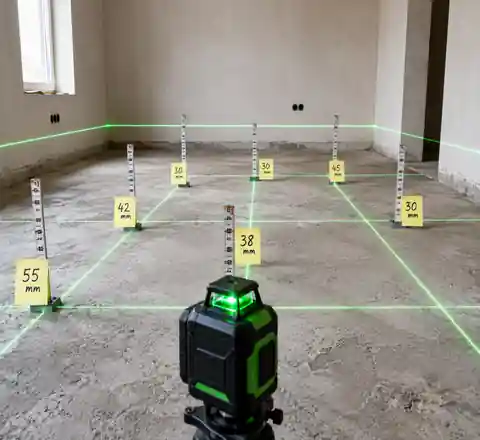
A tape measure gives the floor area, but it cannot reveal how much the base rises and falls.
Use a laser level, rotating level or another suitable surveying method to record the required screed depth at several points.
For an irregular room, divide the floor into zones or use a grid of readings instead of relying on the deepest point or the doorway measurement.
Three Ways to Calculate the Quantity
Choose the method that matches the product information
| Available product data | Calculation | Result |
|---|---|---|
| Wet volume or project dimensions | Area × average thickness | m³, litres or ft³ |
| Consumption in kg/m²/mm or kg/m²/cm | Area × thickness × consumption | Dry-mix weight, then bags |
| Yield in litres or ft³ per bag | Required volume ÷ bag yield | Number of bags |
| Coverage per bag at a stated thickness | Adjusted area ÷ coverage per bag | Number of bags |
Method 1: calculate screed volume
In metric units, screed volume in m³ = floor area in m² × average thickness in mm ÷ 1,000. To express the result in litres, multiply m³ by 1,000. This also means that 1 m² at 1 mm thickness equals exactly 1 litre of volume.
What volume is required for 18 m² at an average thickness of 45 mm?
Answer: 0.81 m³, or 810 L, before any allowance.
Explanation: 18 × 45 ÷ 1,000 = 0.81 m³. The same room is about 194 ft² and the layer is about 1.77 in, giving approximately 28.6 ft³.
In imperial units, screed volume in ft³ = floor area in ft² × average thickness in inches ÷ 12. Keep the units consistent. Multiplying ft² directly by millimetres or m² by inches produces a number with no useful meaning.
Method 2: use consumption per area and thickness
Many pre-blended products state consumption as kilograms per square metre per millimetre of thickness. Dry-mix weight = area × thickness × product consumption. If the label uses kg/m² per centimetre, first convert the layer thickness to centimetres.
An 18 m² floor averages 45 mm. The selected screed uses 1.9 kg/m²/mm and comes in 25 kg bags. How many bags are needed with a 7% allowance?
Answer: Approximately 1,647 kg, rounded up to 66 complete bags.
Explanation: Base weight: 18 × 45 × 1.9 = 1,539 kg. With 7% allowance: 1,539 × 1.07 = 1,646.73 kg. Bag count: 1,646.73 ÷ 25 = 65.87, so purchase 66 bags.
Use the consumption for the exact product and application. A generic density can help with an early budget, but the technical data sheet is better for the final bag count.
Method 3: use bag yield or stated coverage
When the manufacturer states a mixed yield, divide the required screed volume by that yield. If coverage is stated at one specific depth, convert it to the actual planned thickness or use the manufacturer’s own chart.
A 20 m² floor needs 40 mm of screed. One bag yields 12.5 L. How many bags are required with 5% allowance?
Answer: 68 bags.
Explanation: Base volume: 20 × 40 = 800 L. Adjusted volume: 800 × 1.05 = 840 L. Bag count: 840 ÷ 12.5 = 67.2, which rounds up to 68 complete bags.
Average Thickness Is the Number That Changes Everything
The planned nominal thickness may not be the quantity thickness. If the design calls for a 40 mm layer but the substrate has a 15 mm hollow over part of the room, the average placed depth will be greater than 40 mm. Conversely, using the deepest measurement across the whole floor can produce a large overestimate.
Record the depth from the required finished screed level to the existing base at several points. For a reasonably regular floor, the arithmetic mean can provide a planning average. For a highly irregular floor, calculate separate zones so that one local hollow does not distort the entire room.
Example level survey for a small room
| Measurement point | Required screed depth |
|---|---|
| Near the entrance | 38 mm (1.50 in) |
| Left wall | 42 mm (1.65 in) |
| Centre | 51 mm (2.01 in) |
| Right wall | 47 mm (1.85 in) |
| Far corner | 52 mm (2.05 in) |
| Simple average | 46 mm (1.81 in) |
Set the required finished level before measuring depth. A carefully surveyed base is not enough if the threshold, door clearance, tile build-up or adjoining room level has not been decided.
For a uniform slope, average the thin and thick ends
If the screed changes evenly from one thickness to another across a simple rectangular area, average thickness = (thin end + thick end) ÷ 2. This works for a uniform plane, not for an irregular bowl-shaped or patched substrate.
A 12 m² floor slopes evenly from 32 mm to 58 mm. What thickness should be used for volume?
Answer: 45 mm average thickness, giving 0.54 m³ before allowance.
Explanation: (32 + 58) ÷ 2 = 45 mm. Then 12 × 45 ÷ 1,000 = 0.54 m³, or 540 L.
For an irregular base, calculate by zones
One 10 m² zone averages 35 mm and another 6 m² zone averages 55 mm. What is the total volume?
Answer: 0.68 m³, or 680 L.
Explanation: Zone 1: 10 × 35 ÷ 1,000 = 0.35 m³. Zone 2: 6 × 55 ÷ 1,000 = 0.33 m³. Total: 0.68 m³. Across the full 16 m², the equivalent average thickness is 42.5 mm.
A Complete Bag Calculation for One Room
Consider a rectangular living area where the required screed depth was checked on a grid. The readings range from 36 mm to 54 mm and produce an estimated average of 44 mm. The chosen pre-blended screed states 2.0 kg/m²/mm and is supplied in 25 kg bags.
Project inputs
| Input | Metric | Approximate imperial equivalent |
|---|---|---|
| Floor length | 5.2 m | 17.1 ft |
| Floor width | 3.8 m | 12.5 ft |
| Net area | 19.76 m² | 212.7 ft² |
| Average thickness | 44 mm | 1.73 in |
| Product consumption | 2.0 kg/m²/mm | Use the manufacturer’s imperial coverage or yield |
| Bag size | 25 kg | 55.1 lb |
| Planning allowance | 6% | 6% |
- Area: 5.2 × 3.8 = 19.76 m².
- Screed volume: 19.76 × 44 ÷ 1,000 = 0.869 m³, or about 869 L.
- Base dry-mix weight: 19.76 × 44 × 2.0 = 1,738.88 kg.
- Weight with 6% allowance: 1,738.88 × 1.06 = 1,843.21 kg.
- Bag count: 1,843.21 ÷ 25 = 73.73.
- Purchase quantity: round up to 74 complete bags.
Volume and consumption are two ways of describing the same project, but they may not match perfectly because the product’s stated consumption reflects its own formulation, test method and rounding. For purchasing bags, use the manufacturer’s product data.
Quick Volume Reference
Volume for every 10 m² of floor
| Average thickness | Volume | Litres |
|---|---|---|
| 10 mm | 0.10 m³ | 100 L |
| 20 mm | 0.20 m³ | 200 L |
| 30 mm | 0.30 m³ | 300 L |
| 40 mm | 0.40 m³ | 400 L |
| 50 mm | 0.50 m³ | 500 L |
| 60 mm | 0.60 m³ | 600 L |
| 75 mm | 0.75 m³ | 750 L |
Volume for every 100 ft² of floor
| Average thickness | Volume |
|---|---|
| 1/4 in | 2.1 ft³ |
| 1/2 in | 4.2 ft³ |
| 3/4 in | 6.3 ft³ |
| 1 in | 8.3 ft³ |
| 1 1/2 in | 12.5 ft³ |
| 2 in | 16.7 ft³ |
| 2 1/2 in | 20.8 ft³ |
| 3 in | 25.0 ft³ |
These tables show volume only. They do not convert directly to bags until you apply the yield, consumption or coverage of the chosen screed.
How Much Extra Screed Should You Allow?
An allowance is not a substitute for measuring the floor. Its purpose is to cover smaller uncertainties such as surface texture, local variation between survey points, material left in containers, handling losses and the need to complete a continuous area without stopping one bag short.
Choose an allowance from the project conditions
| Project condition | Planning approach | Check before increasing the allowance |
|---|---|---|
| Simple area, good level survey and clear product yield | A small allowance may be sufficient | Thresholds, edges, surface profile and bag rounding |
| Typical renovation floor with moderate variation | Use a measured allowance and round to complete bags | Extra depth around services, old repairs and wall edges |
| Irregular substrate, several rooms or uncertain levels | Calculate zones first, then cover only the remaining uncertainty | Whether local hollows should be repaired separately |
| Large continuous pour or remote delivery | Prioritise continuity and supply reliability | Batch availability, storage, delivery access and return policy |
| Thin specialised compound | Follow the stated coverage closely | Primer demand, permitted thickness and whether aggregate extension is allowed |
Do not add an arbitrary 10% to a badly measured project and assume the estimate is now safe. On a 50 m² floor, a 10 mm error already equals 0.5 m³ of material before any allowance.
Read the Bag Before Trusting the Bag Count
The Useful Number May Be Below the Product Name
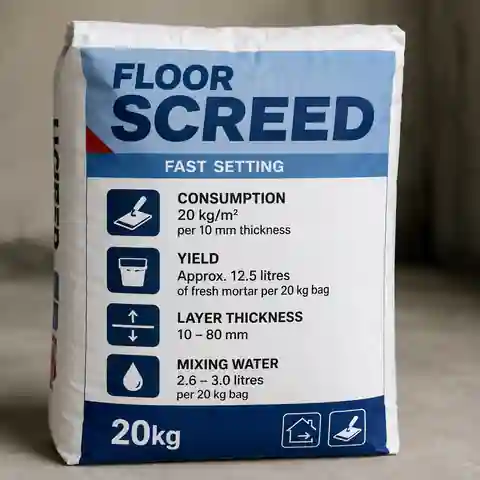
Look for consumption, yield, permitted layer thickness, mixing-water range and whether the figure refers to dry powder or fresh mortar.
Check whether coverage is stated per millimetre, per centimetre or at one specific depth.
Use the latest technical data sheet for the exact regional product rather than a similarly named product sold in another market.
- Consumption in kg/m²/mm or kg/m²/cm.
- Yield in litres, m³ or ft³ per bag.
- Coverage per bag at a stated layer thickness.
- Minimum and maximum thickness per application.
- Bag weight and the number of bags on one pallet.
- Required mixing water and permitted range.
- Whether additional aggregate may be used at greater depths.
- Working time and whether the planned team can place each batch in time.
- Substrate, primer, bonding layer, reinforcement and curing requirements.
Equal bag weight does not mean equal yield
A 20 kg bag of one smoothing compound may cover a larger area than a 25 kg bag of a denser screed at the same thickness. Formulation, aggregate size, density and intended application all affect yield. Compare coverage at the required depth, not the largest number printed on the front.
Do not add mixing water to the dry bag volume
If a 25 kg bag requires 2.5 L of water, that does not mean the final screed volume equals the loose powder volume plus 2.5 L. Water fills spaces, hydrates the binder and changes workability. Use the manufacturer’s mixed yield or consumption.
Site-mixed screed needs a mix design
For screed mixed from separate sand, cement, water and admixtures, first establish the required finished volume. The quantities of each component should then come from the specified mix design, expected moisture in the sand, batching method and supplier information. Multiplying finished m³ by a generic ratio without accounting for bulk volume and compaction can produce an inconsistent estimate.
For ready-mixed or pumped screed, give the supplier the measured area, average depth, floor build-up, access conditions and required application. The supplier may apply its own order allowance, minimum load or pump-line allowance.
What Can Change the Final Quantity?
Factors that move the estimate
| Factor | How it changes quantity | Better check |
|---|---|---|
| Uneven substrate | Raises average depth above the nominal layer | Take level readings on a grid or calculate zones |
| Deliberate drainage fall | Creates a thickness range | Use the average of thin and thick ends for a uniform plane |
| Doorways and thresholds | Add small areas missed in room-only dimensions | Include every area that will receive screed |
| Columns or fixed bases | Reduce area only if screed will not pass around or beneath them | Subtract only clearly excluded footprints |
| Pipes and conduits | May require extra cover or local thickening | Confirm the designed floor build-up |
| Surface texture and porosity | Can raise real consumption | Follow substrate preparation and product guidance |
| Spillage and material left in equipment | Reduce material reaching the floor | Plan handling, mixing and pump-line needs |
| Bag rounding | Moves a fractional result to the next complete bag | Round after applying the allowance |
Common Calculation Mistakes
Mistake, consequence and correction
| Mistake | Likely result | Better approach |
|---|---|---|
| Using minimum depth as the average | Material runs out over lower areas | Survey the floor and calculate the real average |
| Using the deepest point for the whole room | Large over-order | Use multiple readings or divide into zones |
| Treating all screeds as the same density | Incorrect weight and bag count | Use the selected product’s consumption or yield |
| Forgetting to convert mm to m | The m³ result is 1,000 times too large | Use area × mm ÷ 1,000 |
| Mixing metric and imperial units | A plausible-looking but unusable result | Complete the calculation in one unit system |
| Adding water volume to bag yield | Overestimated mixed volume | Use the stated mixed yield |
| Rounding every intermediate step | Small errors accumulate | Round only the purchase quantity |
| Ordering from area alone | Thickness is ignored | Never calculate screed without a depth |
A Better Order for Measuring and Buying
- Confirm the complete floor build-up and required finished level.
- Identify whether the screed is bonded, unbonded, floating, heated, sloped or only a thin levelling layer.
- Measure the net area, including doorways and small recesses that will be filled.
- Survey the base and calculate average depth or separate depth zones.
- Select the exact screed product or approved mix design.
- Check permitted application thickness and whether local deep sections need another treatment.
- Calculate volume and cross-check it against product consumption or yield.
- Add a reasoned allowance and round up to complete bags or the supplier’s delivery unit.
- Check pallet quantity, lifting weight, storage space and access to the mixing area.
- Confirm that water, equipment and enough people are available for the product’s working time.
Frequently Asked Questions
How do I calculate how much floor screed I need?
Multiply the floor area by the average screed thickness to obtain volume. Then use the chosen product’s consumption, yield or coverage to convert that volume into dry-mix weight or bags. Add a measured allowance and round up.
How many litres of screed are needed per square metre?
Each 1 mm of thickness over 1 m² equals 1 L of volume. Therefore, 1 m² at 40 mm requires 40 L, and 1 m² at 60 mm requires 60 L, before allowance.
How many bags cover 1 m²?
There is no universal answer because coverage depends on thickness and product yield. At 50 mm, the same square metre requires five times as much material as it does at 10 mm. Use the exact product data.
Should I use minimum, maximum or average thickness?
Use average thickness for quantity, while also checking that every local point remains within the product’s permitted application depth. An average calculates volume; it does not prove the layer is suitable everywhere.
Do I subtract kitchen cabinets, baths or fitted furniture?
Subtract an item only when its permanent base is already present and the screed will definitely not pass beneath it. Future cabinets, removable appliances and furniture normally do not reduce the area.
Is floor screed the same as self-levelling compound?
Not necessarily. Screed often forms a thicker floor layer, while self-levelling compound is commonly a thinner smoothing layer. Their permitted depths, consumption and preparation must be checked separately.
Can screed quantity be calculated from bag weight alone?
No. Bag weight must be paired with yield, consumption or coverage. A 25 kg label tells you how much dry product you are carrying, not how many square metres it covers at your thickness.
How accurate is a floor screed calculator?
The arithmetic can be precise, but the result is only as reliable as the area, average thickness and product data entered. The largest errors usually come from unmeasured floor variation or a generic consumption rate.
Final Quantity Check
- The material is the specified screed, not a different levelling or repair product.
- The measured area includes every section that will receive screed.
- The average thickness comes from level readings or calculated zones.
- Local depths remain acceptable for the chosen system.
- Consumption or yield comes from the exact product data.
- The calculation uses one consistent unit system.
- The allowance has a clear reason rather than being added automatically.
- The result is rounded up to complete bags or the supplier’s order unit.
- Delivery, storage, mixing rate and working time are practical for the quantity.
The useful estimate is not simply “area times a standard number of bags”. It is a chain of checks: correct material, measured area, realistic average thickness, product-specific yield and a controlled allowance. Once those inputs are known, the calculation becomes straightforward and the risk of stopping halfway through the floor becomes much smaller.
Open the HomDera Floor Screed CalculatorHow Many Floor Tiles Do I Need? A Simple Tile Quantity GuideHow Many Packs of Laminate Flooring Do I Need?Explore HomDera material planning guides