
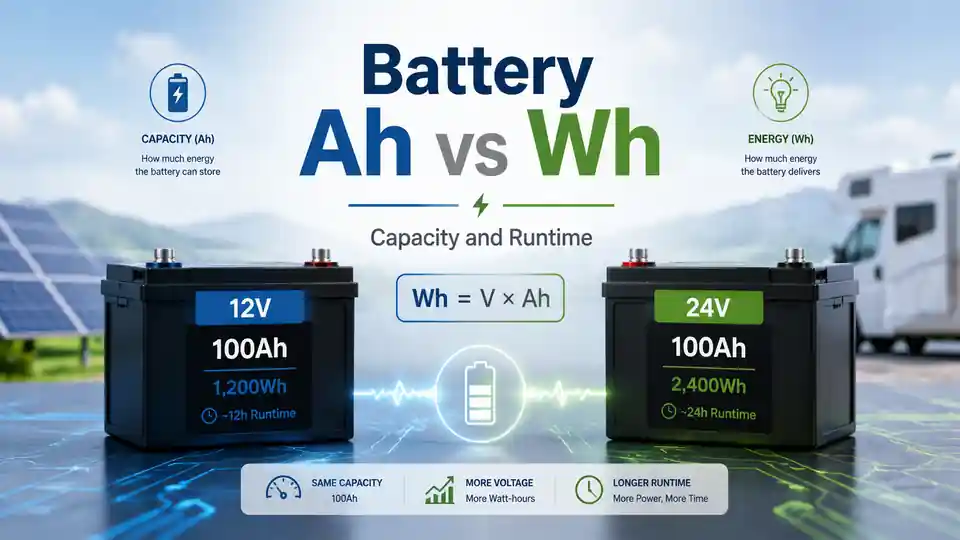
A battery marked 100 Ah may store about 1.2 kWh, 2.4 kWh or 4.8 kWh. The amp-hour number is identical in each case; the voltage is not. That is why Ah is useful inside a known battery system, while Wh is usually the clearer unit for comparing batteries, power stations and expected runtime.
The practical rule is simple: use amp-hours together with voltage, convert the result to watt-hours, and only then apply usable-capacity and conversion losses. This prevents a common buying mistake — choosing the largest-looking Ah figure without checking how much energy is actually behind it.
Quick answer: Wh = V × Ah. A nominal 12 V 100 Ah battery is about 1,200 Wh; a 24 V 100 Ah battery is about 2,400 Wh; a 48 V 100 Ah battery is about 4,800 Wh. These are nominal figures, not guaranteed energy delivered to an appliance.
The same 100 Ah label can represent very different energy
| Battery label | Nominal calculation | Nominal energy |
|---|---|---|
| 12 V 100 Ah | 12 × 100 | 1,200 Wh (1.2 kWh) |
| 12.8 V 100 Ah | 12.8 × 100 | 1,280 Wh (1.28 kWh) |
| 24 V 100 Ah | 24 × 100 | 2,400 Wh (2.4 kWh) |
| 25.6 V 100 Ah | 25.6 × 100 | 2,560 Wh (2.56 kWh) |
| 48 V 100 Ah | 48 × 100 | 4,800 Wh (4.8 kWh) |
| 51.2 V 100 Ah | 51.2 × 100 | 5,120 Wh (5.12 kWh) |
The small differences between 12 V and 12.8 V, or 48 V and 51.2 V, often reflect the nominal voltage used for a particular battery chemistry or module design. For an exact comparison, use the nominal voltage and watt-hour rating stated by the manufacturer rather than replacing them with a convenient rounded voltage.
In this guide
Ah and Wh Answer Different Questions
Charge Is Not the Same as Energy

Amp-hours describe how much electrical charge a battery can supply under stated test conditions. A 100 Ah rating can be read as 5 A for 20 hours in an idealised example, but the real result depends on the battery specification and discharge conditions.
Watt-hours describe energy. They combine the quantity of charge with the electrical potential represented by voltage.
When two batteries operate at different voltages, the Ah figures alone do not reveal which one stores more energy.
What does Ah mean on a battery?
Ah means amp-hour or ampere-hour. One amp-hour is the amount of charge transferred by a current of one ampere for one hour. Battery manufacturers use Ah to state capacity at defined conditions, which may include a particular discharge rate, temperature and cutoff voltage.
A 100 Ah label does not promise that every load can draw any current for exactly the matching number of hours. For example, it does not automatically mean 100 A for one hour, and it says nothing by itself about the battery's maximum continuous current, BMS limit or ability to start a large motor.
What does Wh mean on a battery?
Wh means watt-hour. It is a unit of energy: one watt used for one hour equals one watt-hour. A 1,200 Wh battery contains enough nominal energy for a theoretical 120 W load for ten hours, or a 600 W load for two hours. Real runtime is shorter when only part of the capacity is used or energy is lost in the inverter, wiring and battery.
What each battery unit tells you
| Unit | What it describes | What it does not tell you alone |
|---|---|---|
| A (amps) | Current flowing at a particular moment | Stored capacity or operating time |
| Ah (amp-hours) | Electrical charge capacity over time | Energy unless voltage is also known |
| W (watts) | Power being used or delivered at a particular moment | How long the power can be sustained |
| Wh (watt-hours) | Energy stored or consumed over time | Maximum current, surge ability or usable fraction |
| kWh (kilowatt-hours) | 1,000 Wh, convenient for larger batteries and home systems | Battery chemistry, power limit or installation compatibility |
How to Convert Battery Ah to Wh
The basic conversion uses the battery's nominal voltage. If the battery already states an official Wh value, use that figure; it may be based on a more precise nominal voltage than the rounded value printed prominently on the case.
Battery energy (Wh) = Nominal voltage (V) × Capacity (Ah)
How many watt-hours are in a 12.8 V 100 Ah battery?
Answer: The nominal energy is 1,280 Wh, or 1.28 kWh.
Explanation: 12.8 V × 100 Ah = 1,280 Wh. This is the nameplate energy before applying a usable depth of discharge, inverter efficiency or other losses.
How many watt-hours are in a 25.6 V 50 Ah battery?
Answer: The nominal energy is also 1,280 Wh.
Explanation: 25.6 V × 50 Ah = 1,280 Wh. The Ah number is only half as large as in the previous example, but doubling the voltage gives the same nominal energy.
Common Ah-to-Wh conversions
| Capacity label | Nominal voltage | Nominal energy |
|---|---|---|
| 7 Ah | 12 V | 84 Wh |
| 20 Ah | 12.8 V | 256 Wh |
| 50 Ah | 12 V | 600 Wh |
| 50 Ah | 24 V | 1,200 Wh |
| 100 Ah | 12.8 V | 1,280 Wh |
| 100 Ah | 25.6 V | 2,560 Wh |
| 200 Ah | 12 V | 2,400 Wh |
| 100 Ah | 51.2 V | 5,120 Wh |
How to convert mAh to Wh
Small batteries and power banks often use milliamp-hours. Divide mAh by 1,000 to convert it to Ah, then multiply by nominal voltage. A 20,000 mAh pack is 20 Ah, but its Wh rating still depends on the voltage used for the capacity specification.
Battery energy (Wh) = Capacity (mAh) × Nominal voltage (V) ÷ 1,000
What is the energy of a 20,000 mAh battery rated at 3.7 V?
Answer: The nominal energy is 74 Wh.
Explanation: 20,000 × 3.7 ÷ 1,000 = 74 Wh. Do not multiply the cell-capacity figure by a 5 V USB output voltage; conversion electronics create the 5 V output and introduce losses.
How to convert Wh back to Ah
Battery capacity (Ah) = Energy (Wh) ÷ Nominal voltage (V)
What Ah capacity is equivalent to 2,400 Wh at 24 V?
Answer: The equivalent nominal capacity is 100 Ah.
Explanation: 2,400 Wh ÷ 24 V = 100 Ah. At 12 V the same 2,400 Wh would be 200 Ah, while at 48 V it would be 50 Ah.
Use nominal battery voltage for these conversions, not the charger output, absorption voltage, fully charged open-circuit voltage or an inverter's AC output voltage. If the data sheet provides a Wh or kWh rating, that manufacturer value should normally take priority.
Why Equal Ah Does Not Mean Equal Battery Capacity
The Missing Number Is Voltage

A 12 V 100 Ah battery stores roughly one quarter of the nominal energy of a 48 V 100 Ah battery.
This does not make one voltage universally better. The battery must match the inverter, charger, loads and complete system design.
Watt-hours make the energy difference visible without pretending that unlike battery systems are interchangeable.
One Ah figure, four different energy values
| Battery | Ah rating | Nominal energy | Theoretical time at 200 W |
|---|---|---|---|
| 12 V battery | 100 Ah | 1,200 Wh | 6 hours |
| 24 V battery | 100 Ah | 2,400 Wh | 12 hours |
| 36 V battery | 100 Ah | 3,600 Wh | 18 hours |
| 48 V battery | 100 Ah | 4,800 Wh | 24 hours |
The runtime column is deliberately theoretical: it divides nominal Wh by 200 W and ignores depth of discharge, conversion losses, battery behaviour and cutoffs. Its purpose is to show the scale of the energy difference, not to predict an appliance's final runtime.
The reverse situation is also possible. Batteries with very different Ah ratings can contain the same energy. A 12 V 200 Ah battery, a 24 V 100 Ah battery and a 48 V 50 Ah battery are each approximately 2.4 kWh when rounded nominal voltages are used.
Wh is usually the fairest first comparison across different voltages. Compatibility still has to be checked separately: equal Wh does not mean equal DC voltage, output current, chemistry, weight, cycle life or price.
Nominal Wh Is Not the Same as Usable Energy
Multiplying volts by amp-hours gives a useful nameplate figure, but a real system rarely delivers every nominal watt-hour to the appliance. Some energy remains unused to protect the battery, some is lost during conversion, and some may be unavailable because of temperature, high discharge rate, ageing or voltage cutoffs.
Approximate usable AC energy (Wh) = Nominal Wh × Usable capacity fraction × Inverter efficiency
What can reduce the energy that reaches the load
| Factor | What it changes | Where to find a better value |
|---|---|---|
| Permitted depth of discharge | How much of the nominal capacity you plan or are allowed to use | Battery manual, warranty terms and system settings |
| Inverter efficiency | Energy lost while converting DC battery power to AC | Efficiency curve at a similar load |
| Inverter idle consumption | Energy used by the inverter even before the appliance load | No-load or standby specification |
| Discharge rate | Available capacity, especially for lead-acid batteries under heavy load | Capacity table at the relevant hour rate |
| Temperature | Available capacity and permitted charge or discharge behaviour | Battery temperature-performance data |
| Battery age and condition | Actual capacity compared with the new-battery rating | Capacity test and battery history |
| BMS or low-voltage cutoff | The point at which output stops even if some chemical energy remains | Battery and inverter settings |
| Cable and connection losses | Voltage drop and energy lost as heat | Measured voltage drop and installation design |
What usable AC energy might a 12.8 V 100 Ah battery provide if 80% is used and the inverter is 90% efficient?
Answer: The planning estimate is about 922 Wh of usable AC energy.
Explanation: Nominal energy is 12.8 × 100 = 1,280 Wh. Then 1,280 × 0.80 × 0.90 = 921.6 Wh. The 80% and 90% figures are example assumptions, not universal values for every battery and inverter.
What usable AC energy might a 12 V 100 Ah battery provide if 50% is used and the inverter is 85% efficient?
Answer: The planning estimate is about 510 Wh before any additional high-rate or temperature effects.
Explanation: 12 × 100 × 0.50 × 0.85 = 510 Wh. This illustrates why two batteries with the same 100 Ah label can give very different practical results when chemistry, operating strategy and equipment losses differ.
How to Estimate Runtime From Wh
Once usable energy has been estimated, runtime is easier to understand. Divide the usable watt-hours by the total power drawn from the battery system. For an AC appliance, this calculation should either include inverter efficiency in the usable-energy figure or include inverter losses and idle consumption in the load — but not count the same loss twice.
Approximate runtime (hours) = Usable energy (Wh) ÷ Total load (W)
- Find the battery's Wh rating or calculate nominal Wh from voltage × Ah.
- Use the manufacturer's guidance to decide how much capacity is available for the planned use.
- Allow for inverter or DC-converter efficiency where relevant.
- Add the watts of appliances that may operate at the same time.
- Include inverter idle consumption or other continuous system overhead.
- Divide usable Wh by the total watts.
- Treat the result as a planning estimate and allow a reserve for uncertainty, ageing and important loads.
How long might a 12.8 V 100 Ah battery run a 120 W AC load?
Answer: Using 80% usable capacity and 90% inverter efficiency, the estimate is about 7.7 hours. If the inverter also consumes 10 W continuously and that overhead was not already included, the estimate falls to about 7.1 hours.
Explanation: Usable AC energy is 1,280 × 0.80 × 0.90 = 921.6 Wh. At 120 W, 921.6 ÷ 120 = 7.68 hours. With a combined 130 W appliance-plus-idle load, 921.6 ÷ 130 = 7.09 hours.
Illustrative runtime from 100 Ah batteries at different voltages
| Battery | Nominal Wh | Usable AC Wh at 80% and 90% | Runtime at 100 W |
|---|---|---|---|
| 12.8 V 100 Ah | 1,280 Wh | About 922 Wh | About 9.2 hours |
| 25.6 V 100 Ah | 2,560 Wh | About 1,843 Wh | About 18.4 hours |
| 51.2 V 100 Ah | 5,120 Wh | About 3,686 Wh | About 36.9 hours |
Do not use a simple Wh ÷ W result as proof that a battery can supply the load. The battery, BMS, terminals, cables and inverter must also support the continuous current and any startup surge. Energy capacity and power capability are separate checks.
Why Real Capacity Can Differ From the Ah Rating
An Ah rating belongs to test conditions, even when those conditions are not printed in large letters on the case. This matters most when comparing lead-acid batteries, where the stated capacity may change noticeably with the discharge period. A battery may have one Ah rating at a 20-hour rate and a lower rating at a five-hour rate.
A Faster Discharge Can Change the Available Capacity

A capacity test spreads the discharge over a defined period and stops at a defined voltage. Changing those conditions can change the measured result.
Lead-acid batteries are generally more affected by high discharge rates than LiFePO4 batteries, although every product still has specified current and temperature limits.
The data sheet is more useful than a generic chemistry rule because it shows how the exact battery was rated.
Conditions hidden behind a simple capacity number
| Condition | Why it matters |
|---|---|
| Discharge period or C-rate | A heavier load may reduce available capacity, particularly for lead-acid batteries |
| Test temperature | Cold conditions can reduce available capacity and may change charge or discharge limits |
| End voltage | A test that stops at a lower voltage may report more capacity than equipment with an earlier cutoff can use |
| Battery age | Capacity normally declines with use, calendar time and unfavourable conditions |
| State of charge | A partly charged battery does not begin with its full rated energy |
| Cell balance and BMS behaviour | A weak or imbalanced cell can trigger protection before the pack appears fully empty |
| Measurement method | Ah counted by a monitor and energy measured at the output may not describe exactly the same losses |
This does not make Ah an unreliable unit. It means the rating has to be read in context. Two products should be compared using similar test conditions, and critical runtime should be checked with measured consumption and product-specific performance data.
When Ah Is Still the Most Useful Unit
Wh is excellent for comparing stored energy, but Ah remains useful whenever voltage is fixed and current is the working quantity. Battery monitors often count charge in and out in Ah, charger sizes are stated in amps, and C-rate calculations begin with the Ah capacity.
- Comparing two batteries from the same voltage and product family
- Setting the capacity in a compatible battery monitor
- Estimating charge time from charger current, with allowance for the charging profile and losses
- Calculating C-rate from current ÷ Ah capacity
- Checking how much charge a DC load uses over time
- Planning parallel capacity where the manufacturer permits the arrangement
Ah does not show maximum output current
Capacity and current limit are different specifications. A 100 Ah battery may have a 50 A, 100 A or another continuous discharge limit depending on its cells, BMS, terminals, temperature and intended use. A higher Ah figure does not automatically mean the battery can run a larger inverter.
Does a 100 Ah battery automatically supply 100 A continuously?
Answer: No. The 100 Ah figure describes charge capacity under stated conditions. The allowed continuous and surge currents must be taken from the battery and BMS documentation.
Explanation: A battery may reach an overcurrent cutoff, excessive voltage sag or a terminal limit before its stored energy becomes the problem. Conversely, a suitable 100 Ah battery may permit more than 100 A for a defined period. The product specification controls the answer.
Never select cables, fuses, busbars or inverter power from the Ah rating alone. High-current battery systems can produce dangerous fault energy and require product-specific protection, correct installation and compliance with local requirements.
Series and Parallel: Ah Changes, Total Wh Adds
Series and parallel connections are another reason Wh is easier to follow. With identical compatible batteries, series connection adds voltage while Ah stays the same. Parallel connection keeps voltage the same while Ah adds. In both cases, the total nominal watt-hours add.
Two identical 12 V 100 Ah batteries
| Arrangement | Bank voltage | Bank capacity | Nominal energy |
|---|---|---|---|
| One battery | 12 V | 100 Ah | 1,200 Wh |
| Two in series | 24 V | 100 Ah | 2,400 Wh |
| Two in parallel | 12 V | 200 Ah | 2,400 Wh |
The two-battery arrangements contain approximately the same total nominal energy, but they are not interchangeable. The inverter and charger must match the bank voltage, and the battery manufacturer must permit the planned number of series or parallel units.
This comparison explains the arithmetic, not the wiring design. Do not mix batteries of different chemistry, model, capacity, age, condition or state of charge in a bank unless the manufacturer explicitly provides a safe method.
How to Read a Battery Label Without Being Misled
A useful battery comparison needs more than the largest number on the front. Read the label and data sheet in a consistent order so that energy, power capability and compatibility do not become mixed together.
- Identify the nominal voltage, not only the marketing name of the voltage class.
- Find the Ah capacity and the discharge rate or test conditions used for that rating.
- Look for an official Wh or kWh figure; otherwise calculate nominal Wh from voltage × Ah.
- Check the permitted depth of discharge or usable-energy guidance for the intended cycle life.
- Check continuous and surge discharge current, including the BMS limit where applicable.
- Check the permitted charge current, charger profile and temperature restrictions.
- Confirm the number of batteries allowed in series and parallel.
- Compare warranty and cycle-life claims at similar depth-of-discharge and test conditions.
- Estimate total installed cost, including charger, inverter, protection, cables, enclosure and monitoring.
Different labels can describe the same nominal energy
| Example battery label | Calculation | Nominal energy |
|---|---|---|
| 12.8 V 100 Ah | 12.8 × 100 | 1,280 Wh |
| 25.6 V 50 Ah | 25.6 × 50 | 1,280 Wh |
| 51.2 V 25 Ah | 51.2 × 25 | 1,280 Wh |
These three examples have equal nominal energy but would operate at very different DC currents for the same power. At approximately the same inverter efficiency, a higher-voltage system requires less current for a given wattage. That can affect conductor size, voltage drop and equipment design, but it does not make the batteries interchangeable.
Which Unit Should You Use?
Choose the unit that matches the question
| Question | Most useful unit | Why |
|---|---|---|
| Which battery stores more energy? | Wh or kWh | It includes voltage and allows unlike voltage systems to be compared |
| How long might an appliance run? | Usable Wh and load W | Runtime is energy divided by power |
| How much capacity is in a fixed-voltage bank? | Ah and Wh | Ah is convenient, while Wh keeps the energy visible |
| How long might charging take? | Ah, charger A and charging profile | Charging current is measured in amps, but efficiency and charge stages matter |
| Can the battery run a large inverter? | Continuous A, surge A and W | Stored energy alone does not prove output capability |
| How large is a home battery? | kWh | Larger storage systems are easier to compare in thousands of watt-hours |
| How large is a phone or power-bank cell? | mAh plus voltage, or Wh | mAh alone only compares energy fairly when nominal voltage is the same |
There is no need to choose one unit and ignore the other. Ah is useful for charge and current-based calculations; Wh is useful for energy and runtime. A reliable battery specification normally lets you move between both.
Common Ah and Wh Mistakes
- Comparing Ah ratings without checking voltage
- Calling Ah a measure of power rather than charge capacity
- Confusing watts with watt-hours
- Assuming a 100 Ah battery can always deliver 100 A
- Multiplying Ah by charging voltage instead of nominal voltage
- Using a power bank's USB output voltage to convert its internal cell mAh rating
- Treating nominal Wh as fully usable Wh
- Ignoring inverter idle consumption and conversion efficiency
- Applying one fixed usable-capacity percentage to every battery chemistry and product
- Ignoring the discharge rate used for a lead-acid Ah rating
- Assuming equal Wh means equal voltage or equipment compatibility
- Calculating runtime without checking continuous current and startup surge
- Comparing cycle-life claims made at different depths of discharge or test conditions
- Buying from the headline capacity before reading the data sheet
A Practical Battery Comparison in Five Minutes
For a first comparison, you do not need a complicated spreadsheet. Use the same short sequence for every candidate and keep the assumptions visible.
- Record nominal voltage and Ah.
- Calculate Wh, unless the manufacturer already provides it.
- Apply the usable-capacity guidance appropriate to the product and your intended operating strategy.
- Allow for the efficiency and idle consumption of the inverter or converter you will actually use.
- Check continuous current, surge current, system voltage and connection limits before treating the battery as suitable.
Battery A is 12.8 V 100 Ah and Battery B is 25.6 V 60 Ah. Which stores more nominal energy?
Answer: Battery B stores more nominal energy: 1,536 Wh compared with 1,280 Wh for Battery A.
Explanation: Battery A: 12.8 × 100 = 1,280 Wh. Battery B: 25.6 × 60 = 1,536 Wh. Battery B has the smaller Ah number but 20% more nominal energy. Suitability still depends on voltage compatibility, current limits, usable capacity and price.
Frequently Asked Questions
Is 100 Ah the same as 1,200 Wh?
Only when the nominal voltage is 12 V. At 12.8 V, 100 Ah equals 1,280 Wh; at 24 V it equals 2,400 Wh; at 48 V it equals 4,800 Wh. Ah cannot be converted to Wh until voltage is known.
Which is bigger, Ah or Wh?
Neither unit is simply bigger because they measure different quantities. Ah describes electrical charge, while Wh describes energy. Voltage links them through Wh = V × Ah.
How many watt-hours are in a 100 Ah battery?
Multiply 100 Ah by the nominal voltage. Common examples are about 1,200 Wh at 12 V, 1,280 Wh at 12.8 V, 2,400 Wh at 24 V and 5,120 Wh at 51.2 V.
Can Ah be converted to Wh without voltage?
No. The same Ah capacity can represent very different amounts of energy at different voltages. You need the nominal voltage or the manufacturer's Wh rating.
Does a higher Ah battery always last longer?
At the same nominal voltage, chemistry, condition, load and test conditions, a higher Ah rating usually indicates more stored energy and potentially longer runtime. Across different voltages or products, compare Wh and usable energy instead.
Why do power stations usually show Wh while batteries often show Ah?
Power stations provide several output voltages and are commonly compared by total stored energy, so Wh is convenient. Traditional DC batteries are often selected within a known 12 V, 24 V or 48 V system, where Ah remains familiar and useful.
How do I convert mAh to Wh?
Multiply mAh by nominal voltage and divide by 1,000. For example, 20,000 mAh at 3.7 V is 74 Wh.
Are Wh and kWh the same?
They measure the same quantity at different scales. One kilowatt-hour equals 1,000 watt-hours. A 5,120 Wh battery can also be described as 5.12 kWh.
Should I compare batteries by nominal Wh or usable Wh?
Use nominal Wh to make a transparent first comparison, then compare usable Wh under similar assumptions. Check manufacturer limits, warranty conditions, current capability, efficiency and the intended depth of discharge.
The Number That Makes Battery Comparisons Fairer
Ah is not wrong and Wh is not a replacement for every battery specification. They answer different questions. Amp-hours help describe charge capacity and current-based behaviour inside a known voltage system. Watt-hours reveal the nominal energy and make batteries at different voltages easier to compare.
- Use Wh = V × Ah for a first energy comparison.
- Use the battery's nominal voltage, not its charging voltage.
- Compare usable Wh under the same assumptions, not only headline capacity.
- Include inverter efficiency and idle consumption when estimating AC runtime.
- Check continuous current, surge current and BMS limits separately from energy.
- Read discharge-rate and temperature conditions when comparing capacity ratings.
- Confirm voltage, charger, inverter and series or parallel compatibility before purchase.
- Keep a reserve for ageing, cold conditions and uncertain loads where early shutdown matters.
For a 100 Ah battery, the question is not simply “How long will it last?” The useful question is: at what nominal voltage, with how much usable capacity, through which equipment, and at what load? Once those details are visible, Ah and Wh stop competing and start working together.
Explore all HomDera battery, inverter and backup-power guides